
Foreign News
Two killed by female student in shooting at US Christian school

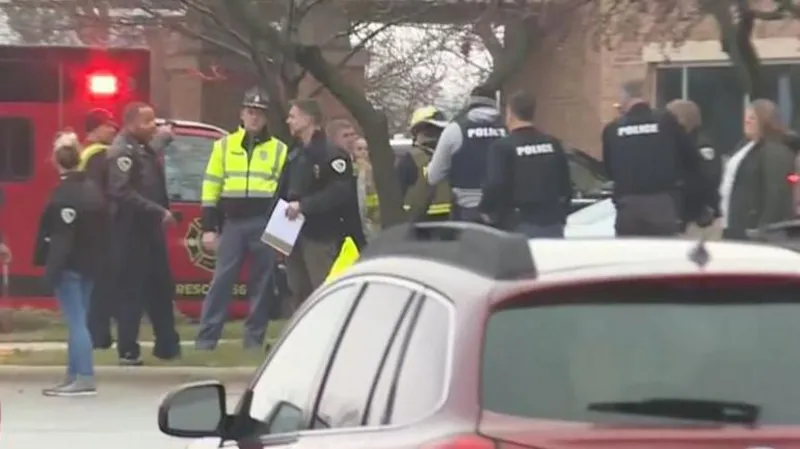
A student opened fire at a private Christian school in the US state of Wisconsin, injuring six people and killing a teacher and teenaged student.
Madison Police Chief Shon Barnes identified the attacker on Monday night as a 15-year-old female student at the school.
Authorities say the attacker was in attendance at Abundant Life Christian School before opening fire and was found dead at the scene. Six students were injured, including two who suffered life-threatening injuries.
A second grade student was the first to call in the active shooter report, according to Chief Barnes
“Today is a sad day not only for Madison, for our entire country,” Chief Barnes said. “We have to do a better job in our community.”
He added the police had not identified a motive in the shooting, and the suspect’s family was co-operating with the investigation. He said it is not yet clear how the attacker got hold of a firearm.
He named the alleged attacker as Natalie Rupnow, who also went by the name Samantha. She is believed to have died from a self-inflicted gunshot wound.
The official cause of death will be released by the Dane County Medical Examiner pending autopsy results.
Chief Barnes said that, to his current knowledge, police had not had any prior interactions with the alleged shooter.
Officers responded to a 911 call of a shooter at the Christian school around 11:00 local time (17:00GMT) on Monday. The attacker attended school before the shooting, Chief Barnes said.
The shooting was confined to a study hall with students in mixed grades.
Barbara Wiers, director of relations at the school, said the school had conducted active shooter training earlier this year and the information was “very fresh” for educators to put into practice on Monday.
She said while the school does not have a dedicated police officer, known as a school resource officer, the doors of all classrooms automatically lock and anyone wanting to gain entry to the campus must be buzzed in through the primary entrance.
Ms Wiers, who said she was teaching at the time of the attack, said students handled themselves “brilliantly”.
“They were clearly scared,” she said. “When they heard ‘lockdown, lockdown’ and nothing else, they knew it was real.”
Police say they found the shooter dead when they arrived at the school, along with a handgun. No officers fired weapons.
Police have not named any of the victims.
Chief Barnes said two students were in critical but stable condition in the hospital facing life-threatening injuries. Four others were taken to hospital with non life-threatening injuries, two of whom have since been released.
Authorities have appealed for witnesses who saw or heard the attack to come speak to police, and that they hope these accounts will shed light on the attacker’s motive.
“But that’s not something we want to rush. We’re not gonna interrogate students,” Chief Barnes said. “We’re gonna give them an opportunity to come in and tell us what they saw when they’re ready.” He added that “eveyr child, every person in that building is a victim and will be a victim forever”.
The chief said officers responded to the school as they were undergoing training at a training centre for law enforcement located three miles away.
“What began as a training day became an actual day,” he said.
The shooting also resulted in a large response from emergency officials. Madison Fire Chief Chris Carbon said 15 ambulances respond.
Officials from the FBI also responded, as well as other federal and local law enforcement officials.
The Abundant Life Christian School has around 400 students ranging from kindergarten through high school.
“Please pray for our Challenger Family,” the school wrote in a post on Facebook. The post quickly received hundreds of comments of support from people across the US.
The school remains closed while police continue their investigation.
“This has been a rough day for our city,” said Chief Barnes. “This is going to be a day that will be etched in the collective minds and memories of all those from Madison.”
Wisconsin Governor Tony Evers said that he was closely monitoring the situation and praying for everyone involved. He also ordered that flags fly at half mast on state buildings.
President Joe Biden said in a statement that the shooting was “shocking and unconscionable”. “Students across our country should be learning how to read and write – not having to learn how to duck and cover,” said Biden, who also called on Congress to act immediately on legislation that could prevent more gun violence.
Shootings are common in the US, and schools are no exception.
The K-12 Violence Project, a non-profit working on reducing violence through accessible and actionable research, has counted more than 300 shootings in 2024. These include events where a gun is brandished or fired, or a bullet hits school property for any reason, regardless of the number of victims.
According to the news organisation EducationWeek, 38 school shootings have resulted in deaths or injuries across the US this year. There were a total of 69 victims – including 16 deaths – before today’s shooting.
Mass shootings by females are far less common, however. School shootings committed by female attackers are even less common.
In a blog post last year, K-12 School Shooting Database founder David Riedman wrote that the vast majority of school shooters are males in their teens or early 20’s. However, at least four planned school shootings were by female attackers dating back to 1979.
[BBC]


North Korea has cancelled the Pyongyang marathon for unspecified reasons, a tour agency linked to the event has said.
British-owned Koryo Tours, which describes itself as the official partner of the marathon, said on Monday that it had received notice of the cancellation from North Korea’s athletics association.
A message it attributed to the association said the marathon was being cancelled “due to some reasons”.
The annual event was established in 1981 to celebrate the birth of North Korea’s founding leader Kim Il Sung. The 2026 race was set to take place on 5 April.
The message, purportedly from the North Korea athletics association’s general secretary, thanked “all the Elite Marathoners and Amateur Runners of the world who are interested in Pyongyang International Marathon”.
The message gave no further explanation on what the reasons for the cancellation were.
Koryo Tours said it understood the decision was final and had been taken “at a level above the organisers of the event itself”.
It said it would be seeking clarification on the circumstances surrounding the decision.
The tour company added that neither organisers nor event partners were involved in making the decision, and said it recognised “this announcement will be disappointing to many runners who had already registered or were planning to participate”.
Koryo Tours, based in Beijing, China, offers several marathon packages to foreigners, departing from Beijing, Shanghai and Shenyang.
Packages start from €2,190 ($2,529; £1,894) for 2.5 nights in the North Korean capital, Pyongyang, including a marathon place and “highlights” of the capital and tickets were sold out this year, according to the agency’s website.
It said all deposits paid will be returned and runners have the option to retain their deposit for a future event or North Korea tour.
A date for the 2027 marathon has not yet been set.
The event had only returned last year after it was suspended for five consecutive years due to the Covid pandemic.
It is open to both amateur and some professional athletes and offers several race distances – 5km (3.1 miles), 10km (6.2 miles), half marathon (21.1km; 13.1 miles) or full marathon (42.2km; 26.2 miles).
[BBC]
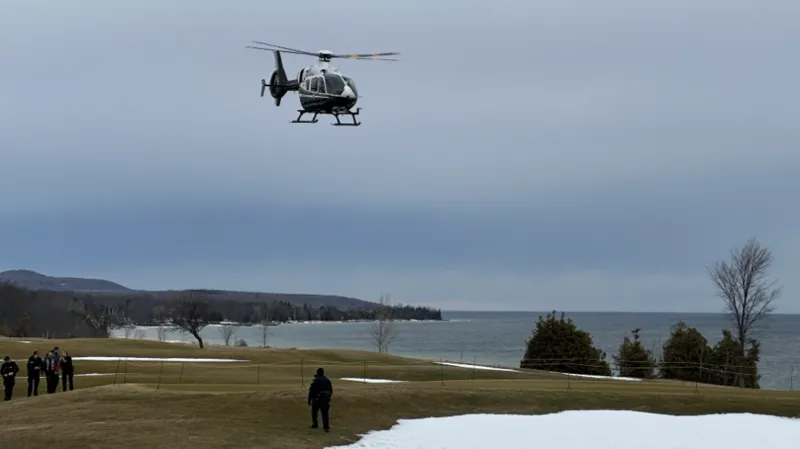
Twenty-three people have been rescued by helicopter crews in Ontario, Canada, after the ice shelf they were standing on broke, sending the group floating into Lake Huron.
Ontario Provincial Police said on social media that the rescue began around noon (16:00 GMT) on Sunday after “winds and current moved the ice shelf away from shore” approximately 2km (1.2 miles).
The rescue involved two helicopters making multiple trips to pluck people off the shelf as it continued to fracture into more pieces in the Owen Sound, about 200km north-west of Toronto.
One member of the group said that he only realised the ice he was fishing on had detached from shore when he noticed that his GPS showed him moving.
Members of the rescued group described harrowing moments, with several of them becoming partially submerged in the cold waters as they sought out the thickest ice on the floe, or sheet.
“I looked at my GPS. We were moving,” fisherman Kevin Fox wrote, identifying himself on Facebook as one of those who were caught up in the incident. “I turned around and saw waves forming behind us.”
He said that he and several others started running towards a route that they hoped still connected to shore.
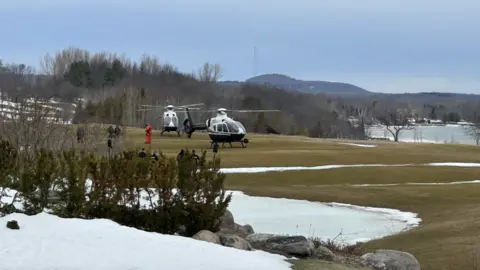
“We decided to run toward one side of the bay, but when we got there the ice had already separated from shore. We turned and ran the other way, but the ice there was breaking apart too,” he wrote.
Some started phoning their families, said Fox, adding: “It’s something I will never forget – seeing grown men crying while saying goodbye to the people they love.”
Fellow fisherman Alfie How told The Owen Sound Sun Times that they eventually “just sat down as a group and said this could be the end”.
Fox told the paper that the rescue occurred during high wind, and the group was concerned that the helicopters would not be able to fly.
“It was being eroded,” Fox said. “It kept getting smaller, and smaller.”
Police say several members of the group suffered hypothermia, but that everyone was expected to make a full recovery.
“Great teamwork and a quick response by all involved,” police added.
Last month in the US state of Vermont, police rescued a group of ice skaters who had also become trapped on floating ice.
Using kayaks and ferry boats, rescuers brought the group back from the icy Lake Champlain.
Officials warn that ice fishing conditions can change rapidly during the relatively warm daylight hours.
[BBC]

At least 23 people have been killed in Nairobi after heavy rain overnight caused severe flooding in Kenya’s capital city.
Police said about 30 people had been rescued but many others drowned after being swept into rivers – some have been electrocuted.
Kenya’s military has been deployed to help people trapped inside their cars as police described widespread damage to properties as well as road closures.
Several flights bound for Nairobi Airport had to be cancelled or diverted to the coastal city of Mombasa.
“The torrential rains have led to significant flooding, unfortunately resulting in 23 fatalities so far, the destruction of property, road closures, and the displacement of residents,” police said in a statement on Saturday afternoon.
[BBC]

Heat Index at ‘Caution level’ at some places in the Western, Sabaragamuwa, Southern and North-western provinces and in Monaragala and Mannar districts

Showers or thundershowers will occur at several places in the Western and Sabaragamuwa provinces and in Galle, Matara, Kandy and Nuwara-Eliya districts after 2.00 pm.

Power sector reforms jolted by 40% pay hike demand

UN scientific research ship here amidst ban on such vessels

Prez assures energy supplies for the time being

Historic address by BASL President at the Supreme Court of India

‘Dates have the highest sugar content to fight Coronavirus’

Sunday Island 27 December – Headlines

#SundayIsland 17th December – Headlines

Sunday Island – 28th March

Sunday Island Headlines – 21 March

Sunday Island – 21st February – Headlines
-

 News6 days ago
University of Wolverhampton confirms Ranil was officially invited
-

 News5 days ago
Peradeniya Uni issues alert over leopards in its premises
-

 News6 days ago
Female lawyer given 12 years RI for preparing forged deeds for Borella land
-

 News3 days ago
Repatriation of Iranian naval personnel Sri Lanka’s call: Washington
-

 News6 days ago
Library crisis hits Pera university
-

 News5 days ago
Wife raises alarm over Sallay’s detention under PTA
-

 News6 days ago
‘IRIS Dena was Indian Navy guest, hit without warning’, Iran warns US of bitter regret
-
 Latest News6 days ago
Sri Lanka evacuates crew of second Iranian vessel after US sunk IRIS Dena