
News
Turbulence ahead: Airline on the block in Sri Lanka reforms

By Amal Jayasinghe
Dozens of state-owned Sri Lankan companies employing tens of thousands of people could be restructured or closed as part of an IMF bailout of the bankrupt country, with the country’s airline top of the list for reform.With nearly 6,000 staff, SriLankan Airlines is the biggest and most expensive of the cash-haemorrhaging, sclerotic companies that have drained the budget and compounded the worst financial crisis in national history.
According to treasury figures, the carrier was losing $4.50 for every dollar it earned at the start of this year. It has not turned a profit since 2008, when its chief executive was sacked for offending the country’s then-leader.
“Even those who have never stepped into a Sri Lankan aircraft are paying to subsidise the airline,” government spokesman Manusha Nanayakkara told reporters this month.
“We can’t continue like this.”
Sri Lanka defaulted on its $51 billion foreign debt in April and is now neck-deep in the arduous process of renegotiating its obligations with creditors.Its 22 million people suffered through months of food and fuel shortages, and at the peak of the crisis, a furious mob stormed government buildings and chased Sri Lanka’s former president into exile.
The International Monetary Fund (IMF) has given preliminary approval to a $2.9 billion bailout, and the government hopes to be able to access the first tranche by the end of the year.Terms of the deal have yet to be released, but IMF cash is usually conditional on painful reforms, such as tax hikes, removing consumer subsidies, and privatising or closing underperforming state firms.
The country has more than 300 state enterprises, ranging from nut farms to fuel retailers, and the top 52 firms lost nearly $2.4 billion between January and April — around $140 million a week.
SriLankan Airline’s future is the most urgent priority, and the government last month instructed the finance ministry to begin its restructuring, ideally by attracting outside investment.
But finding a company willing to pour money into the airline will be immensely challenging, analysts say, given its history of interference, mismanagement and turbulent partnerships.In 1998, Emirates bought a minority stake in the carrier and took over its management.
It stayed in the black for most of the next decade, although one of its most profitable years was — ironically — 2001, when the Tamil Tigers separatist movement attacked the country’s main international airport. Several of the airline’s planes were destroyed in the July attack, but insurance payouts and the removal of excess capacity offset a downturn in ticket sales.
But the partnership was terminated and the chief executive sacked by then-president Mahinda Rajapaksa in 2008 after the carrier refused to bump fare-paying passengers to make room for members of his family returning from a jaunt in London. The leader packed SriLankan’s management with relatives and loyalists, several of whom now face corruption charges, and the airline has bled cash since.Rajapaksa even started a rival state-owned airline named after himself, a colossal failure that was eventually merged into SriLankan — along with its accumulated losses.
Authorities tried to sell a 49 percent stake in SriLankan back in 2017 when the island nation’s tourism market was booming, but even then private equity firm TPG eventually withdrew its bid after deciding it was not a viable operation.Airlines are “generally not that attractive” to investors, Singapore-based aviation analyst Brendan Sobie told AFP, “particularly airlines that are government owned and have a lot of legacy issues, have a lot of debt, like SriLankan does”.
“There’s not many foreign airlines, particularly in this post-Covid environment, that are even looking or considering buying stakes in airlines overseas,” he added, and the track record for strategic investments in the sector was “very bad”.
“It’s very difficult,” he said.SriLankan chairman Ashok Pathirage acknowledges the airline’s current balance sheet is not an attractive proposition.
“If you try to privatise the whole thing, people will come and ask the government to take half of the debt,” Pathirage told AFP.
But he said SriLankan could settle about half of its liabilities by splitting off and selling profitable business arms, including its virtual monopoly on catering and ground handling at Colombo airport.Trade union leaders and employees support a restructuring along those lines, on the condition that no jobs are cut.
“The airline is losing money not because of the staff, but expensive leases and poor financial structures,” a cabin crew member, who requested anonymity, told AFP.But selling off the airline’s profitable divisions would leave the rump operations generating even bigger losses for the government.
Former state finance minister Eran Wickramaratne told AFP that if authorities could not find an investor, the airline should be grounded permanently before it could burden the public further.
“We are a bankrupt country,” he said. “We have not been able to service our debt and that reality has struck home.”





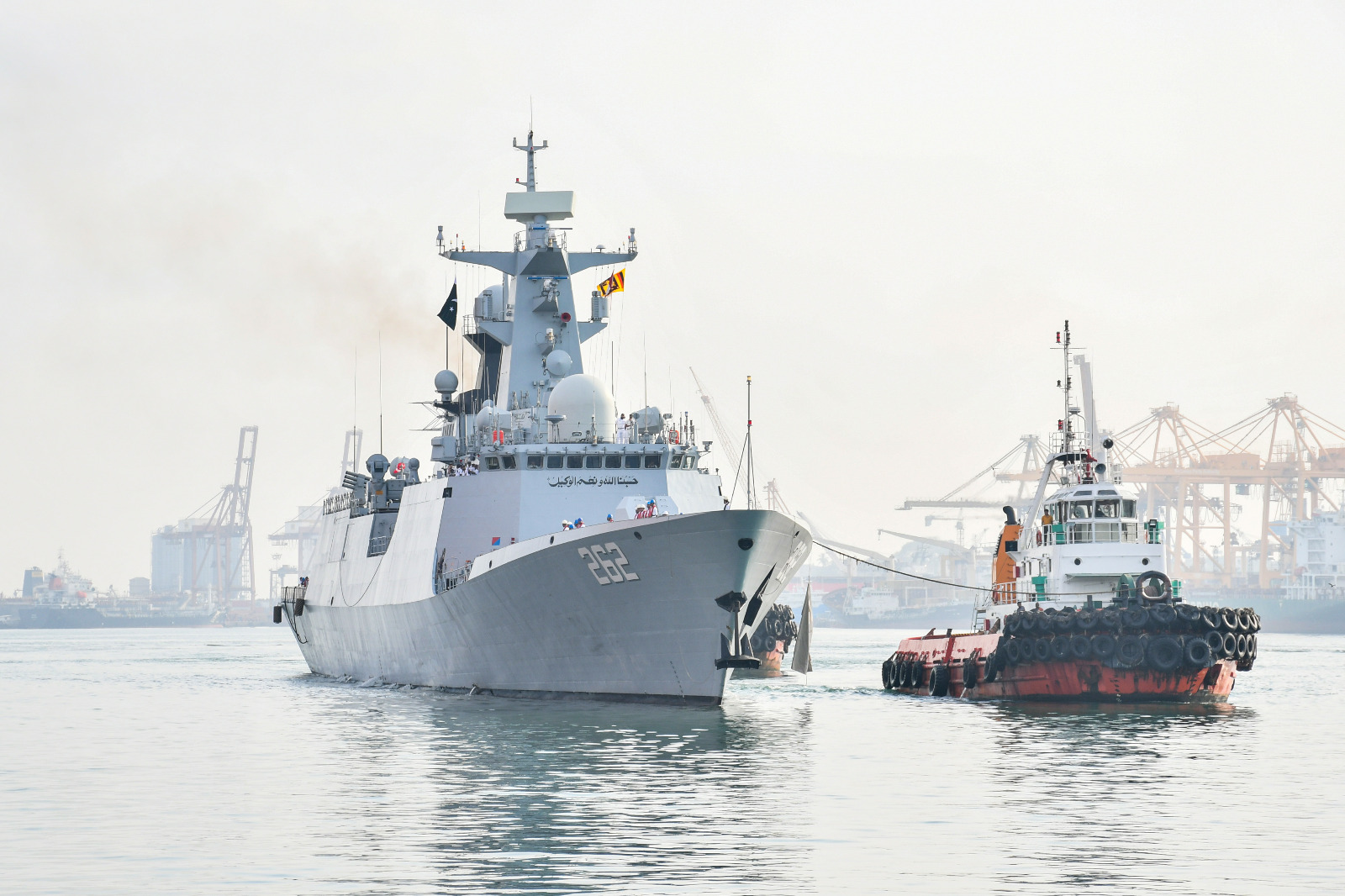
The Pakistan Navy Ship (PNS) TAIMUR and ASLAT arrived at the Port of Colombo on a goodwill visit on 12 Apr 26.
The visiting ships were welcomed by the Sri Lanka Navy in
compliance with naval traditions.
The duo of ships is commanded by Captain NIAMAT SAEED KHAN (PNS TAIMUR) and Captain NADIR MATEEN AFRIDI (PNS ASLAT).
Meanwhile, the ships are expected to conduct a Bilateral Naval Exercise LION STAR V with the Sri Lanka Navy in Colombo seas.
Latest News
Heat index likely to increase up to ‘Caution level’ at some places in the Northern, North-central, North-western, Western, Sabaragamuwa, Southern and Eastern provinces and Monaragala district


Warm Weather Advisory
Issued by the Natural Hazards Early Warning Centre at 3.30 p.m. on 11 April 2026, valid for 12 April 2026
The Heat index, the temperature felt on the human body is likely to increase up to ‘Caution level’ at some places in the Northern, North-central, North-western, Western, Sabaragamuwa, Southern and Eastern provinces and Monaragala district.
The Heat Index Forecast is calculated by using relative humidity and maximum temperature and this is the condition that is felt on your body. This is not the forecast of maximum temperature. It is generated by the Department of Meteorology for the next day period and prepared by using global numerical weather prediction model data.

Effect of the heat index on human body is mentioned in the above table and it is prepared on the advice of the Ministry of Health and Indigenous Medical Services.
ACTION REQUIRED
Job sites: Stay hydrated and takes breaks in the shade as often as possible.
Indoors: Check up on the elderly and the sick.
Vehicles: Never leave children unattended.
Outdoors: Limit strenuous outdoor activities, find shade and stay hydrated.
Dress: Wear lightweight and white or light-colored clothing.
Note: In addition, please refer to advisories issued by the Disaster Preparedness & Response Division, Ministry of Health in this regard as well. For further clarifications please contact 011-7446491.
Latest News
Sun directly overhead Cheddikulam, Kebithigollewa, Gomarankadawala and Nilaveli about 12:11 noon. today [12]

On the apparent northward relative motion of the sun, it is going to be directly over the latitudes of Sri Lanka from 05th to 15th of April in this year.
The nearest areas of Sri Lanka over which the sun is overhead today (12th) are Cheddikulam, Kebithigollewa, Gomarankadawala and Nilaveli about 12:11 noon.

PNS TAIMUR & ASLAT arrive in Colombo

Sanju Samson and Jamie Overton deliver first points for Chennai Super Kings

Arya, Prabhsimran and Shreyas help Punjab Kings ace another 200-plus chase

Beauty of Sri Lanka in focus: Global showcase blends art, diplomacy and conservation

Showers expected in the Western, Sabaragamuwa, Central, Southern, North-western and Uva provinces and in Ampara, Batticaloa and Polonnaruwa districts after 1.00 p.m.

Heat index likely to increase up to ‘Caution level’ at some places in the Northern, North-central, North-western, Western, Sabaragamuwa, Southern and Eastern provinces and Monaragala district

‘Dates have the highest sugar content to fight Coronavirus’

Sunday Island 27 December – Headlines

#SundayIsland 17th December – Headlines

Sunday Island – 28th March

Sunday Island Headlines – 21 March

Sunday Island – 21st February – Headlines
-

 News6 days ago
Lankan-origin actress Subashini found dead in India
-

 News4 days ago
AG: Coal procurement full of irregularities
-

 Business3 days ago
Israeli attack on Lebanon triggers local stock market volatility
-

 News20 hours ago
CEB orders temporary shutdown of large rooftop solar systems
-

 Business4 days ago
Hayleys Mobility introduces Premium OMODA C9 PHEV
-

 Business3 days ago
HNB Assurance marks 25 years with strategic transformation to ‘HNB Life’
-

 Sports4 days ago
DS to face St. Anthony’s in ‘Bridges of Brotherhood’ cricket encounter
-

 News6 days ago
UN Regional Director launches SL’s first Country Gender Equality Profile during official visit