
Features
THE WORLD HERITAGE SITES OF SRI LANKA

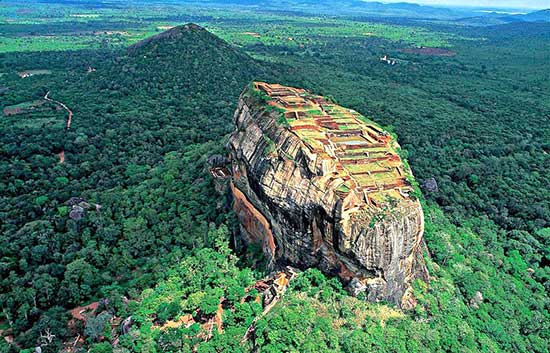
SIGIRIYA – THE CITADEL IN THE SKY
By Everyman
From patricide to a palace. From intrigue to ignominy. From paintings to poems. From pleasure gardens to a playboy king. Sigiriya has it all. Archaeology, history, controversy and folklore are entwined and enmeshed in the unfolding of the story of Sigiriya. Sigiriya or ‘Sinhagiri‘ – ‘Lion Rock’ derives its name from the huge rock carved lion located on a small plateau on the Northern side of the rock. Over the decades the top part of this lion has fallen apart and today only the two mammoth front paws are visible forming an entrance between them. The rock itself is the remains of hardened lava which would have pushed through the ground surface causing a volcanic eruption. According to geologists this could have happened over two billion years ago. Around Sigiriya there still can be seen numerous granite boulders which are also remains of the lava that formed Sigiriya. With the recent passing away of Prince Phillip, Duke of Edinburgh it may interest readers to know that one of the most famous lava created rocks is in Edinburgh , capital of Scotland. On top of this rock lies the magnificent Edinburgh Castle, built in 1103 In 1831 a British Army Major, Jonathan Forbes while riding on horseback through the country stumbled on Sigiriya which was amongst the jungles and scrub land of the Matale District. And for the first time the Western world, in particular Britain, under whom Ceylon (as it was then known ) was a colony, came to know about Sigiriya. In the 1890’s the first extensive archeological excavation on Sigiriya was done by the Archeological Commissioner, H.C.P. Bell who was appointed by the British Governor, Sir Arthur Gordon. Later on in 1982, full scale archeological excavations to restore Sigiriya began through the Sri Lankan Government funded Cultural Triangle Programme. It was in that year that Sigiriya was inscribed on the UNESCO World Heritage Site lists. Also inscribed were The Ancient City of Polonnaruwa and the Sacred City of Anuradhapura. These three sites were the first in Sri Lanka to gain this distinction. However within the pages our own ancient chronical the ‘Culavamsa’, the story of Sigiriya can be traced. Actually the story of Sigiriya commences with the reign of King Dhatusena. Having defeated the Pandyan invaders he was crowned King of Sri Lanka in 549 CE and ruled from Anuradhapura. Despite his fame for developing agriculture and thereby meeting the needs of the people by constructing 18 irrigation tanks, he also performed his kingly duties as a devout Buddhist by erecting the now famous 43 ft tall Avukana statue of Lord Buddha.
Yet, King Dhatusena had a streak of cruelty. Migara the chief of the King’s army was married to King Dhatusena’s favourite daughter. While his mother was King Dhatusena’s sister. In all probability it was due to this family connection that Migara was made the Chief of the Army ( Senapathi ). However for reasons unknown, Migara was extremely cruel to his wife. Being unable to apprehend Migara, King Dhatusena vented his fury on Migara’s mother, his own sister, and ordered her to be burned alive.
From that point onwards, the story of Sigiriya unfolds like a Shakespearian tragedy. Migara’s heart and mind burned within him to take revenge on King Dhatusena. Avenging his mother’s cruel death became a maniacal obsession. And so he planned and plotted and found a ready, willing and able person whom he could inspire and instigate to fulfill this overriding obsession. This person was none other than King Dhatusena’s eldest son, Kasyapa. However Kasyapa though being the eldest son had no right to the throne since his mother was a Non- Royal concubine. Kasyapa knew it. He resented it.
Thus was planned between Migara the Chief of the Army and Kasyapa the King’s son a Royal coup. Fast Forward to 1962- A ‘Royal’ coup also involving a high ranking Army Officer. That was a failed coup. But that as they say is another story! Let’s move on. Migara who had won the fullest confidence of Kasyapa and knew very well how to exploit it arrested King Dhatusena and de-throned him. He then had Kasyapa enthroned as King. This was in 473 CE. The first step in this coup had been completed.
Now for the second. He convinced King Kasyapa that Dhatusena had large amounts of treasure, specially gold hidden in some secret place. Dhatusena was then confronted by the new king Kasyapa, who demanded to know where the hidden treasure was. Dhatusena took his captors to the borders of the Kalawewa which was one of the largest irrigation tanks he had built and taking some water from the tank in his hands, exclaimed that this was the only treasure he had. Infuriated and exasperated King Kasyapa ordered Migara to entomb his father alive into a wall.
According to an alternate story Dhatusena was buried alive on the bund of the Kalawewa. Whichever way the murder took place, Migara had avenged his mother’s murder. Meanwhile Moggallana, the rightful heir to the throne fled to India as he feared that he too would be killed. But the dastardly act of King Kasyapa incurred the ignominy of the people and the venerable monks. Patricide was something that could never have been condoned. It was against the teaching of Lord Buddha. King Kasyapa was a troubled man. The people were against him. The venerable monks were against him. His step-brother brother Mogallana was against him and was collecting an army of invasion. And to add to his misery he was constantly and contemptuously referred to as ” Pithru Ghatathaka Kasyapa.” ( Kasyapa –the paricide ) Abandoning Anuradhapura as his capital he moved to Sigiriya which was once a Buddhist monastery.. Here he built his fortress and his palace which has been called the eighth Wonder of the World. King Kasyapa felt well secured. He had left behind his fears and apprehensions. He now wanted to live in luxury. He lavished his wealth to make into reality his vision of creating a city similar to the mythological ‘Alakamanda’ –the ‘City of the Gods’ which was ruled by Kuvera, the god of plenty and prosperity.
Rising 200 meters from ground level the summit provides a 360 degree panoramic view of the adjacent jungles. Here was a unique harmony between nature and human imagination. It was also of strategic importance because any enemy army moving in, can be detected and defensive measures taken.
As any of today’s visitors enter through the Western gate what greets the eye are the royal gardens, interspersed with pools and fountains. These gardens were meant to be a type of pleasure park for the exclusive use of the royal family to relax. They extend for a few hundred meters from the base of the rock. And now begins the climb to the summit, which is not for the faint hearted as we shall see later. The massive brick stairways leads in a zig- zag to the Mirror Wall. Let us pause here for a while. According to one source the Mirror Wall was made from a special plaster comprising fine lime, egg white and honey. It was then buffed with bee’s wax to give a brilliant luster. In King Kasyapa’s time it was so well polished that the King could clearly see his refection as he walked by. Was it a sign of his vanity ? After all here was his palace which he believed to be similar to ‘The City of Gods’. And as the King was he not like Kuvera? If indeed it was his vanity he felt justified. Passing the Mirror Wall is a platform. No matter how intrepid you are it is better to pause awhile and take some deep breaths. More challenges lie ahead. There is a narrow metal staircase which leads to the frescoes. It is best to stop here and admire these semi-naked doe-eyed beautiful women. They are like heavenly nymphs (apsaras). There is much conjecture as to whom they depicted. Were they the King’s many wives, or members of the play-boy King’s Royal harem ? It is claimed that he had over 500 damsels selected for their sensuous beauty.
Having passed these damsels perhaps with some regret, one comes to the most difficult part of the climb. There is a narrow steel stairway on the exposed side of the rock. It is best not to look down below on the lush green scrubland. You may get a bout of acrophobia! And so we come to the summit and you can breathe a great sigh of relief not only for overcoming the challenge of climbing but also gazing at the magnificent landscape that stretches as far as eye can see.
This terraced summit is approximately 1.6 ha in extent. Here can be seen a number of water tanks, baths and the remains of the Royal Palace. There is also a stone slab like a seat which may have been the remains of a throne. There is also a 27 m x 21 m rock hewn water tank which was a water storage tank. The hydraulic systems, the landscaping, the terraces, all of these indicate unique creative skills and technologies. Sigiriya is said to be one of the finest examples of urban planning of the first millennium.
But we now need to get back to the Mirror Wall for there is a story to relate. On this Mirror Wall there can be seen graffiti in the form of poems written in Sinhala, Sanskrit and Tamil. According to historians and archeologists these graffiti were written long after Sigiriya was abandoned and converted once more into a Buddhist monastery. And then the question arises as to why these monks allowed visitors to enter and write poems on the Mirror Wall , many of which were love poems ? For example –
“Wet, cool dew drops Fragrant with perfume from flowers, Came the gentle breeze, jasmine and water lily Dance in the spring sunshine. Side- long glances of the golden hued ladies stab into my thoughts. Heaven itself cannot take my mind, As it has been captivated by one lass Among the five hundred I have seen.”
It must be noted that these graffiti is of great interest to scholars as it reveals the development of the Sinhala language and script.
But the saga of Sigiriya does not end. Once more the cold steel hand of intrigue and betrayal appears. And this time too it is Migara’s hand. And once more it is anger. And once more it is revenge. This time the victim is King Kasyapa. Annoyed that King Kasyapa did not permit him to conduct a large religious festival Migara secretly switched his loyalty from King Kasyapa to his half brother Moggallana who was in India waiting for an opportunity to return to Sri Lanka and regain the crown that was rightfully his.
Migara’s secret changing of loyalty was Moggallana’s cue to return. On hearing of this new but not unexpected threat King Kasyapa riding his Royal elephant and confident of his army, led by Migara, went into battle. This, despite his soothsayers warning him that it was not the auspicious time for war. At some point, his elephant sensing a swamp close at hand turned to get on to firmer ground. To Migara this was an opportunity sent by the gods. He ordered the army to retreat.
The army fled. King Kasyapa was now alone and abandoned . He knew that his end was near. Rather than being killed in battle he drew out his dagger placed it on his neck and slit his throat. It was in the year 495 CE. He had ruled for 18 years. Moggallana the victorious was not unmindful of his duties. He still respected his half brother and accorded him a Royal cremation. It is believed that the place was at Pidururangala. It is a few km away from Sigiriya and is also like Sigiriya formed by volcanic activity.



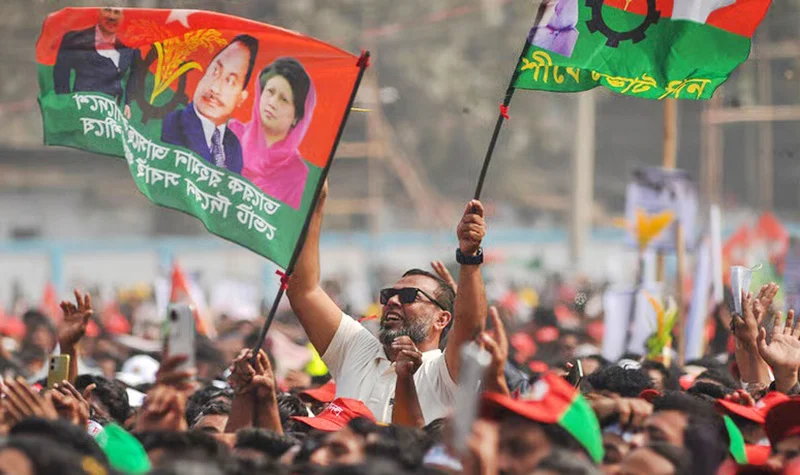
 Will the Bangladesh parliamentary election bring into being a government that will ensure ethnic and religious harmony in the country? This is the poser on the lips of peace-loving sections in Bangladesh and a principal concern of those outside who mean the country well.
The apprehensions are mainly on the part of religious and ethnic minorities. The parliamentary poll of February 12th is expected to bring into existence a government headed by the Bangladesh Nationalist Party (BNP) and the Islamist oriented Jamaat-e-Islami party and this is where the rub is. If these parties win, will it be a case of Bangladesh sliding in the direction of a theocracy or a state where majoritarian chauvinism thrives?
Chief of the Jamaat, Shafiqur Rahman, who was interviewed by sections of the international media recently said that there is no need for minority groups in Bangladesh to have the above fears. He assured, essentially, that the state that will come into being will be equable and inclusive. May it be so, is likely to be the wish of those who cherish a tension-free Bangladesh.
The party that could have posed a challenge to the above parties, the Awami League Party of former Prime Minister Hasina Wased, is out of the running on account of a suspension that was imposed on it by the authorities and the mentioned majoritarian-oriented parties are expected to have it easy at the polls.
A positive that has emerged against the backdrop of the poll is that most ordinary people in Bangladesh, be they Muslim or Hindu, are for communal and religious harmony and it is hoped that this sentiment will strongly prevail, going ahead. Interestingly, most of them were of the view, when interviewed, that it was the politicians who sowed the seeds of discord in the country and this viewpoint is widely shared by publics all over the region in respect of the politicians of their countries.
Some sections of the Jamaat party were of the view that matters with regard to the orientation of governance are best left to the incoming parliament to decide on but such opinions will be cold comfort for minority groups. If the parliamentary majority comes to consist of hard line Islamists, for instance, there is nothing to prevent the country from going in for theocratic governance. Consequently, minority group fears over their safety and protection cannot be prevented from spreading.
Therefore, we come back to the question of just and fair governance and whether Bangladesh’s future rulers could ensure these essential conditions of democratic rule. The latter, it is hoped, will be sufficiently perceptive to ascertain that a Bangladesh rife with religious and ethnic tensions, and therefore unstable, would not be in the interests of Bangladesh and those of the region’s countries.
Unfortunately, politicians region-wide fall for the lure of ethnic, religious and linguistic chauvinism. This happens even in the case of politicians who claim to be democratic in orientation. This fate even befell Bangladesh’s Awami League Party, which claims to be democratic and socialist in general outlook.
We have it on the authority of Taslima Nasrin in her ground-breaking novel, ‘Lajja’, that the Awami Party was not of any substantial help to Bangladesh’s Hindus, for example, when violence was unleashed on them by sections of the majority community. In fact some elements in the Awami Party were found to be siding with the Hindus’ murderous persecutors. Such are the temptations of hard line majoritarianism.
In Sri Lanka’s past numerous have been the occasions when even self-professed Leftists and their parties have conveniently fallen in line with Southern nationalist groups with self-interest in mind. The present NPP government in Sri Lanka has been waxing lyrical about fostering national reconciliation and harmony but it is yet to prove its worthiness on this score in practice. The NPP government remains untested material.
As a first step towards national reconciliation it is hoped that Sri Lanka’s present rulers would learn the Tamil language and address the people of the North and East of the country in Tamil and not Sinhala, which most Tamil-speaking people do not understand. We earnestly await official language reforms which afford to Tamil the dignity it deserves.
An acid test awaits Bangladesh as well on the nation-building front. Not only must all forms of chauvinism be shunned by the incoming rulers but a secular, truly democratic Bangladesh awaits being licked into shape. All identity barriers among people need to be abolished and it is this process that is referred to as nation-building.
On the foreign policy frontier, a task of foremost importance for Bangladesh is the need to build bridges of amity with India. If pragmatism is to rule the roost in foreign policy formulation, Bangladesh would place priority to the overcoming of this challenge. The repatriation to Bangladesh of ex-Prime Minister Hasina could emerge as a steep hurdle to bilateral accord but sagacious diplomacy must be used by Bangladesh to get over the problem.
A reply to N.A. de S. Amaratunga
A response has been penned by N.A. de S. Amaratunga (please see p5 of ‘The Island’ of February 6th) to a previous column by me on ‘ India shaping-up as a Swing State’, published in this newspaper on January 29th , but I remain firmly convinced that India remains a foremost democracy and a Swing State in the making.
If the countries of South Asia are to effectively manage ‘murderous terrorism’, particularly of the separatist kind, then they would do well to adopt to the best of their ability a system of government that provides for power decentralization from the centre to the provinces or periphery, as the case may be. This system has stood India in good stead and ought to prove effective in all other states that have fears of disintegration.
Moreover, power decentralization ensures that all communities within a country enjoy some self-governing rights within an overall unitary governance framework. Such power-sharing is a hallmark of democratic governance.

 Valentine’s Day is all about celebrating love, romance, and affection, and this is how some of our well-known personalities plan to celebrate Valentine’s Day – 14th February:
Merlina Fernando (Singer)
Yes, it’s a special day for lovers all over the world and it’s even more special to me because 14th February is the birthday of my husband Suresh, who’s the lead guitarist of my band Mission.
We have planned to celebrate Valentine’s Day and his Birthday together and it will be a wonderful night as always.
We will be having our fans and close friends, on that night, with their loved ones at Highso – City Max hotel Dubai, from 9.00 pm onwards.
Lorensz Francke (Elvis Tribute Artiste)
On Valentine’s Day I will be performing a live concert at a Wealthy Senior Home for Men and Women, and their families will be attending, as well.
I will be performing live with romantic, iconic love songs and my song list would include ‘Can’t Help falling in Love’, ‘Love Me Tender’, ‘Burning Love’, ‘Are You Lonesome Tonight’, ‘The Wonder of You’ and ‘’It’s Now or Never’ to name a few.
To make Valentine’s Day extra special I will give the Home folks red satin scarfs.
Emma Shanaya (Singer)
I plan on spending the day of love with my girls, especially my best friend. I don’t have a romantic Valentine this year but I am thrilled to spend it with the girl that loves me through and through. I’ll be in Colombo and look forward to go to a cute cafe and spend some quality time with my childhood best friend Zulha.
JAYASRI

Emma-and-Maneeka
This Valentine’s Day the band JAYASRI we will be really busy; in the morning we will be landing in Sri Lanka, after our Oman Tour; then in the afternoon we are invited as Chief Guests at our Maris Stella College Sports Meet, Negombo, and late night we will be with LineOne band live in Karandeniya Open Air Down South. Everywhere we will be sharing LOVE with the mass crowds.
Kay Jay (Singer)
I will stay at home and cook a lovely meal for lunch, watch some movies, together with Sanjaya, and, maybe we go out for dinner and have a lovely time. Come to think of it, every day is Valentine’s Day for me with Sanjaya Alles.
Maneka Liyanage (Beauty Tips)
On this special day, I celebrate love by spending meaningful time with the people I cherish. I prepare food with love and share meals together, because food made with love brings hearts closer. I enjoy my leisure time with them — talking, laughing, sharing stories, understanding each other, and creating beautiful memories. My wish for this Valentine’s Day is a world without fighting — a world where we love one another like our own beloved, where we do not hurt others, even through a single word or action. Let us choose kindness, patience, and understanding in everything we do.
Janaka Palapathwala (Singer)
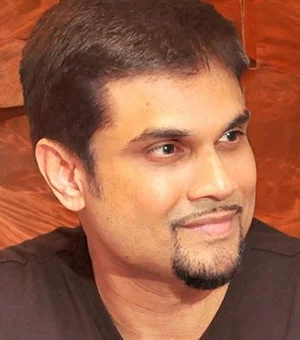
Janaka
Valentine’s Day should not be the only day we speak about love.
From the moment we are born into this world, we seek love, first through the very drop of our mother’s milk, then through the boundless care of our Mother and Father, and the embrace of family.
Love is everywhere. All living beings, even plants, respond in affection when they are loved.
As we grow, we learn to love, and to be loved. One day, that love inspires us to build a new family of our own.
Love has no beginning and no end. It flows through every stage of life, timeless, endless, and eternal.
Natasha Rathnayake (Singer)
We don’t have any special plans for Valentine’s Day. When you’ve been in love with the same person for over 25 years, you realise that love isn’t a performance reserved for one calendar date. My husband and I have never been big on public displays, or grand gestures, on 14th February. Our love is expressed quietly and consistently, in ordinary, uncelebrated moments.
With time, you learn that love isn’t about proving anything to the world or buying into a commercialised idea of romance—flowers that wilt, sweets that spike blood sugar, and gifts that impress briefly but add little real value. In today’s society, marketing often pushes the idea that love is proven by how much money you spend, and that buying things is treated as a sign of commitment.
Real love doesn’t need reminders or price tags. It lives in showing up every day, choosing each other on unromantic days, and nurturing the relationship intentionally and without an audience.
This isn’t a judgment on those who enjoy celebrating Valentine’s Day. It’s simply a personal choice.
Melloney Dassanayake (Miss Universe Sri Lanka 2024)
 I truly believe it’s beautiful to have a day specially dedicated to love. But, for me, Valentine’s Day goes far beyond romantic love alone. It celebrates every form of love we hold close to our hearts: the love for family, friends, and that one special person who makes life brighter. While 14th February gives us a moment to pause and celebrate, I always remind myself that love should never be limited to just one day. Every single day should feel like Valentine’s Day – constant reminder to the people we love that they are never alone, that they are valued, and that they matter.
I’m incredibly blessed because, for me, every day feels like Valentine’s Day. My special person makes sure of that through the smallest gestures, the quiet moments, and the simple reminders that love lives in the details. He shows me that it’s the little things that count, and that love doesn’t need grand stages to feel extraordinary. This Valentine’s Day, perfection would be something intimate and meaningful: a cozy picnic in our home garden, surrounded by nature, laughter, and warmth, followed by an abstract drawing session where we let our creativity flow freely. To me, that’s what love is – simple, soulful, expressive, and deeply personal. When love is real, every ordinary moment becomes magical.
Noshin De Silva (Actress)
Valentine’s Day is one of my favourite holidays! I love the décor, the hearts everywhere, the pinks and reds, heart-shaped chocolates, and roses all around. But honestly, I believe every day can be Valentine’s Day.
It doesn’t have to be just about romantic love. It’s a chance to celebrate love in all its forms with friends, family, or even by taking a little time for yourself.
Whether you’re spending the day with someone special or enjoying your own company, it’s a reminder to appreciate meaningful connections, show kindness, and lead with love every day.
And yes, I’m fully on theme this year with heart nail art and heart mehendi design!
Wishing everyone a very happy Valentine’s Day, but, remember, love yourself first, and don’t forget to treat yourself.
Sending my love to all of you.

 To create a powerful, natural, and hydrating beauty mask that soothes inflammation, fights acne, and boosts skin radiance, mix a mashed banana with fresh aloe vera gel.
This nutrient-rich blend acts as an antioxidant-packed anti-ageing treatment that also doubles as a nourishing, shiny hair mask.
* Face Masks for Glowing Skin:
Mix 01 ripe banana with 01 tablespoon of fresh aloe vera gel and apply this mixture to the face. Massage for a few minutes, leave for 15-20 minutes, and then rinse off for a glowing complexion.
* Acne and Soothing Mask:
Mix 01 tablespoon of fresh aloe vera gel with 1/2 a mashed banana and 01 teaspoon of honey. Apply this mixture to clean skin to calm inflammation, reduce redness, and hydrate dry, sensitive skin. Leave for 15-20 minutes, and rinse with warm water.
* Hair Treatment for Shine:
Mix 01 fresh ripe banana with 03 tablespoons of fresh aloe vera gel and 01 teaspoon of honey. Apply from scalp to ends, massage for 10-15 minutes and then let it dry for maximum absorption. Rinse thoroughly with cool water for soft, shiny, and frizz-free hair.

Prime Minister meets delegation from the European External Action Service

Moscas star as Italy dismantle Nepal for first World Cup win

Kim Jong Un chooses teen daughter as heir, says Seoul

Newly appointed ADB Country Director to Sri Lanka and delegation meet PM

School student transport services are being regulated

Shanaka and Rathnayake blow Oman away with frenetic half-centuries

‘Dates have the highest sugar content to fight Coronavirus’

Sunday Island 27 December – Headlines

#SundayIsland 17th December – Headlines

Sunday Island – 28th March

Sunday Island Headlines – 21 March

Sunday Island – 21st February – Headlines
-
 Features5 days ago
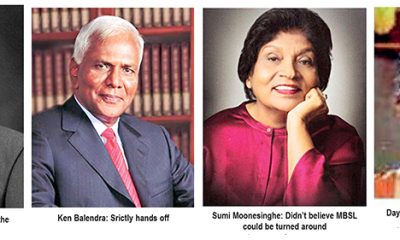
My experience in turning around the Merchant Bank of Sri Lanka (MBSL) – Episode 3
-

 Business6 days ago
Zone24x7 enters 2026 with strong momentum, reinforcing its role as an enterprise AI and automation partner
-

 Business5 days ago
Remotely conducted Business Forum in Paris attracts reputed French companies
-
 Business5 days ago
Four runs, a thousand dreams: How a small-town school bowled its way into the record books
-

 Business5 days ago
ComBank and Hayleys Mobility redefine sustainable mobility with flexible leasing solutions
-

 Business2 days ago
Autodoc 360 relocates to reinforce commitment to premium auto care
-

 Business6 days ago
HNB recognized among Top 10 Best Employers of 2025 at the EFC National Best Employer Awards
-
 Midweek Review2 days ago
A question of national pride