
Sports
Super Rugby 2021 Aotearoa


by Rajitha Ratwatte
We are still in summer in the Southern Hemisphere and international cricket is still being played here in Aotearoa – New Zealand. However, the rugby season has started, and we are into our second week. I guess the media Moghuls have to keep getting richer and certainly we are seeing lots of great running rugby due to the drier conditions.
There are a few new rules being trialled in this largely domestic tournament. Among them the captain’s challenge, a rule that allows 10 seconds to implement and has resulted in the appointment of co-captains, one from the forwards and one from the backs. More on that later.
We saw a game between the Waikato Chiefs and Otago Highlanders played on Friday evening. Chiefs of course being captained by the All-Blacks captain himself, Sam Cane with co-captain, Brad Webber the busy half back or scrum-half as we used to call them. Webber got a run with the All Blacks in preference to the incumbent understudy T.J. Peranara, last year and gave a good account of himself. The Chiefs were also trying out a new no10 Bryn Gatland, pinched from the Highlanders. This probably means that Damian Mackenzie will start at full-back this season, something that he (Damian) may not be too happy about. Liam Squire who was recovering from hip surgery and resulting complications was also starting at no6, a welcome return for a great-hearted player.
The Highlanders were being led by veteran hooker Ash Dickson and the co-captain was Aaron Smith who incidentally didn’t start the game, with new boy Folau Fakatara being picked in the no 9 jersey. Fakatara is a highly talked-up player with a rather fancy hairstyle (reminds me of the tail of a bird of paradise!) who played well but failed to show exceptional skills. The Highlanders were playing in white jerseys and khaki shorts which may be a suggestion for our Police or Army teams back in the Pearl. They looked rather smart. The Highlanders also had Jonah Nareki who had shown so much skill last season at no11, the old number of no doubt, the person whose first name he had been given.
The Waikato Chiefs were tipped by almost everyone to win as they were at home albeit without the loud cowbells of the home team due to Covid 19 restrictions. One factor that should have tipped off any punter was that Sir John Kirwan, the well-known ex All-Black winger tipped the Chiefs to win. JK is also known to get these things horribly wrong and will find it hard to live down his prediction of an Argentine loss to the All Blacks before that historic win by the Pumas!
Things started off on cue with Sam Cane earning a penalty off a ruck within 22 seconds of the start and Damian Mackenzie slotting it with ease. The first 30 minutes or so belonged entirely to the Chiefs and they raced to a 20 – 6 lead. The Highlanders were penalized continually and had two yellow cards dished out, including one to their skipper Ash Dickson. The Chiefs made maximum use of having an extra man on the field and scored twice in quick succession during this period. The only weak link in the Chiefs seemed to be their no10 Gatlin, who consistently made mistakes and made one too many when an attempted chip kick, in the opposition 22, was smothered by the opposition, ended up in the hands of Jonah Nareki who ran the length of the field and scored a try against the run of play. This could be called the turning point of the game and even though the Chiefs still had a healthy lead 20 – 11 at half time, this resurgence of spirit combined no doubt with an expletive-laced “talking to” from their coach (his own admission) at half time saw an amazing turnaround.
The Highlanders didn’t take kickable penalties in the second half and chose to kick for touch and go for the attacking line outs. Shannon Frazelle the All-Blacks blindside flanker who had been steady in the first half was showing more fire and commitment. Five minutes into the second half the hard-tackling Chiefs center and All Black, Lennert- Brown injured his arm and had to go off. “Bird of Paradise” no 9 Fakatava wormed his way through traffic and scored a try for the Highlanders in the 49th minute and was promptly substituted by the one and only Aaron Smith! What a player to be able to bring on at this stage of the game to add weight to a great fightback. The score read 20 -18 with the Chiefs still in the lead.
From this point, it was the Jonah Nareki show! First a scything run, at the end of which he found the inspired Shannon Frazelle, who strolled over the line. They say Nareki has low hips and is hard to tackle, be that as it may, the loss due to injury of hard tackling Lennert- Brown may have also contributed as Nareki kept coming in off his wing and running through the midfield. Nareki completed a hat trick of tries and took the Highlanders to victory with the final score reading 23 – 39.
However, there was one more drama in store. The captain’s challenge or captain’s referral is a new rule that allows the captain to challenge a decision by the referee once during the game. The captain has only 10 seconds to do it in. Hence the need for co-captains in case one of the captains is detained elsewhere in the field. The Chiefs scored a try almost at full time, but the run of play had led to one of the Chiefs players going into a tackle “leading with his arm” a possible red card offense that was missed by the referee. Aaron Smith was quick to point this out to the ref and the resulting video check showed this challenge was valid. The try was disallowed, and a simple penalty awarded to the Highlanders. This was the first time this trial “rule” was invoked. It needs a few more instances to prove its worth.
The overall refereeing was good with the officials even spotting crooked throws into lineouts, which was refreshing. Usually, the referee stands to one side of the line out and misses these offenses. The commentators tried to insinuate that a large number of penalties and yellow cards awarded against the Highlanders were excessive but when the highlanders got their act together in the second half, things returned to normal. In fact, it may have been these penalties that resulted in a better second half of rugby. Jonah Nareki is a name to remember for the future! Even though the national team has a wealth of wingers, this young man can even play center and is certainly a better choice than Ricco Ioane of the Auckland Blues, who seems to be being groomed for the job and is nothing but a no 11 or 14.



Bengaluru’s M Chinnaswamy Stadium has been cleared to host IPL 2026 after a government-appointed Expert Committee approved the venue for use on Monday.
The immediate implication is that Chinnaswamy – scheduled to host the season opener between Royal Challengers Bengaluru (RCB) and Sunrisers Hyderabad on March 28 – will also stage one playoff game and the final, in keeping with the tradition of the defending champions hosting the title clash.
A committee, appointed by Karnataka’s home minister G Parameshwara, conducted a thorough review of the stadium premises on Friday. The day-long audit involved several checks for structural compliance as well as measures taken to enhance crowd control around the venue.
On Monday, the final nod was given following a meeting between the Karnataka State Cricket Association (KSCA) officials, RCB’s top brass as well as members of the expert committee, chaired by G Maheshwar Rao.
The Chinnaswamy will host five RCB home games, while two others will be played at the Shaheed Veer Narayan Stadium in Raipur, as per a pre-arranged agreement between the franchise and the Chhattisgarh government.
RCB has committed to engaging with KSCA to roll out digital QR coded tickets as one of several measures to tackle overcrowding around the venue. They have also partnered with the Bengaluru Metro Rail Corporation (BMRCL) to ensure hassle-free travel.
The metro services will be extended until 1am on match days, while ticketing formalities are being worked out. It’s likely those with match tickets can travel free of cost. BMRCL is also likely to increase frequency of trains on all routes to prevent overcrowding.
As for structural measures, the KSCA have increased the number of entry points by constructing six new gates around the Chinnaswamy, while widening existing entry gates. The old NCA premises had also been equipped with ramps and tarpaulin sheets to become a holding area for fans, as they make their way towards their respective stands.
The Bengaluru police and the KSCA are working to ensure Cubbon Road – which runs alongside the main entrance of the venue – will be cleared for vehicular movement at specific intervals on match days.
The IPL has announced the schedule only for the first two weeks of the competition in 2026. In the first leg, KSCA will host one more game (apart from the opener)on April 5, involving RCB and Chennai Super Kings.
Chinnaswamy last hosted a competitive fixture during IPL 2025. Since then, the venue has been mired in controversy following the death of 11 fans during RCB’s victory celebrations on June 3.
All of KSCA’s structural changes to comply with short-term measures recommended by the expert committee have happened in two months, following the December elections where Venkatesh Prasad, the former India fast bowler, assumed office after winning a tense election.
The stadium will now officially be handed over to the IPL franchise and their event management partners, DNA Entertainment. RCB are yet to announce sale of tickets officially. That process is expected to begin later this week.
[Cricinfo]

This was an old-fashioned classic disguised as 21st century cricket. Probably the best ODI match of the year so far, tucked away as a gilateral decider in Mirpur. Two batters, Salman Agha and Tanzid Hasan, played stellar knocks while everyone else struggled on a pockmarked pitch. Yes, this was old-fashioned: there was the tragic Pakistan collapse, the comical Pakistan running, and the tragicomic Pakistan finish.
At the end of it all, Bangladesh won their second successive bilateral ODI series against Pakistan, the two series being 11 years apart.
Let’s start with just the last over: one wicket left, Shaheen Shah Afridi on strike, Rishad Hossain with the ball. 14 needed off six. Off the second delivery, Rishad ran back to collect a skier and spilled it at mid-on when he could have closed out the match. With 12 needed off two, a wide was given, then a sneaky review was taken by Bangladesh to reverse it. With 12 needed off the last ball, Afridi ventured down the track and missed the ball all ends up, and could have been off for a stroll by the time Litton Das remembered to whip off the stumps.
However, the match was a long way away from being a heart-stopper, and had mostly been a one-way dogfight with Bangladesh calling the shots. Then, Agha made a belated entry to the middle at 67 for 4. They were chasing 291 on a pitch that turned when you slowed it down, and bounced when you speared it in.
Taskin Ahmed was the early wrecker-in-chief for Bangladesh, taking out Sahibzada Farhan and Mohammad Rizwan in the first and third over. Maaz Sadaqat departed to an edge off Nahid Rana in the one over in between. Yet, debutant Ghazi Ghori and two-ODIs-old Abdul Samad got together to stem the bleeding: they poked and prodded, and sometimes middled one, as they laboured to a 50-run partnership in 67 balls. The highlight of their stand was at least four run-out chances, with many yes-and-no calls as nerves gave way.
Bangladesh were poor in the field themselves, with misfields and balls parried away by the close-in fielders – twice against Ghori and Samad – letting Pakistan stay in the contest for as long as they did. Ghori, in particular, rode his luck, smacking three fours and one eye-catching six into the deep-square boundary.
Ghori (29) and Samad (34) departed in quick succession. Having walked in with 224 needed off 36 overs, Agha built a case for Pakistan’s chase from one end, while Saad Masood, the other debutant of the day, kept the other end chugging along. Still, a rush of young blood was inevitable. They had put together a 79-run partnership for the sixth wicket when Masood rushed down the pitch, and Mustafizur Rahman rattled his stumps. Agha took off his gloves and helmet, and sunk to his haunches at the other end.
The pitch might as well have been laid out with Mustafizur in mind, as he kept angling balls away from the batters to finish with figures of 3 for 54. But Agha countered him – and the other pace bowlers – by mostly sticking to shots down the ground. His knock was peppered with nine fours and four sixes. This was as good a riposte as any with the bat, having been run-out in the previous game in rather unusual circumstances.
Here, he only kept the team’s needs in mind as he dug deeper in the middle with Afridi. Even when he bashed Rana down the ground in the 45th over to bring up his century, they still needed 48 off 35 balls with just three wickets left. He did not indulge in much of a celebration.
Agha and Afridi compiled 52 runs in 49 balls, but Agha was the first to depart: skying a cross-batted shot off Taskin to become his fourth and final victim of the night in the 48th over.
Afridi kept the fight going until the end, drilling two fours and two sixes in a knock of 37 off 38 and was only dismissed on the final ball.
Earlier in the day, Bangladesh had put together an old-fashioned innings of their own after being put in to bat. When Tanzid smacked Agha over the ropes in the 33rd over, he was not wearing a helmet like the batters of yesteryears. He bumped his partner’s first at the other end, performed the sajda, and wiped away his sweat on a humid day in Mirpur. He had brought up his maiden ODI ton in the most old-school way possible.
His century was only one of two Bangladesh knocks that managed to go at or over run-a-ball. But even as he hit six fours and seven sixes, most of his run-making shots were along the ground. He stitched a 105-run opening partnership alongside Saif Hassan, who looked less comfortable in his stay of 36 off 55.
Tanzid kept one end stable through the middle overs, right up till when he cut a long-hop by Abrar Ahmed to Afridi at cover in the 37th over. It was a good reward for Abrar, who was Pakistan’s best spinner, bowling with varied pace and cramping up the batters throughout the middle overs.
Haris Rauf – returning after his expensive opening spell – might have learned his lessons from Abrar too, though he had to fulfil a different job at the death overs. He plucked out Litton Das (41) and Rishad (0) in quick succession, pulling his lengths shorter to throttle Bangladesh.
Rauf finished with 3 for 52, and the only reason Bangladesh managed 290 for 5 was because of a late surge from Towhid Hridoy, who scored 48 off 44.
Still, there were two lasting images from the day: one of Tanzid, smiling in celebration after bringing up his century. The other was of Agha after his dismissal – having struck a scintillating ton of his own, but wearing the glum look of a batter walking back with the job half-done.
Brief scores:
Bangladesh 290 for 5 in 50 overs (Saif Hasan 36, Tanzid Hasan 107, Towhid Hridoy 48*; Haris Rauf 3-52) beat Pakistan 279 in 50 overs (Abdul Samad 34, Salman Ali Agha 106, Saad Masood 38, Shaheen Shah Afridi 37; Taskin Ahmed 4-49, Nahid Rana 2-62, Mustafizur Rahman 3-54 ) by 11 runs
[Cricinfo]

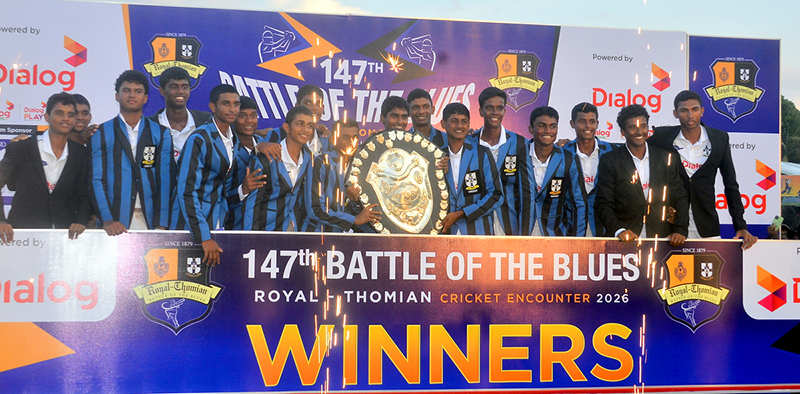
The 147th edition of the historic Battle of the Blues ended in a draw, with Jaden Amaraweera producing the only century of the Big Match to give fans a rare highlight after three days of largely uneventful cricket.
Amaraweera’s unbeaten hundred in the final stages of the match provided an individual milestone for spectators who had otherwise endured a contest dominated by cautious batting and slow scoring.
From the outset it appeared that S. Thomas’ College Mount Lavinia had approached the game with the intention of batting for a draw. Their first innings progressed at a snail’s pace, raising questions among critics about whether the Mount Lavinia side had come prepared to merely occupy the crease rather than push for a result.
The Thomians batted for a massive 124 overs but managed only 302 runs, a modest return for more than 500 minutes of batting. Openers Jaden Amaraweera and Avinash Fernando set the tone with an extremely cautious approach, adding 110 runs for the first wicket in 40 overs. Even their consistent batsman, Reshon Solomon, consumed 147 deliveries for his 66 runs.
In contrast, Royal College Colombo scored at a comparatively brisker rate in their first innings. Skipper Rehan Peiris and Ramiru Perera struck half centuries to guide Royal’s reply. The Reid Avenue school eventually declared their innings in 86 overs with nine wickets down, still trailing by 41 runs.
However, the declaration had little impact on the outcome, as the final day offered limited opportunity for a decisive result.
With the match drifting towards an inevitable draw, the stage was set for individual achievements. Amaraweera seized the moment, crafting the only century of the 2026 encounter. His composed unbeaten 100 came off 162 deliveries and included nine fours and three sixes, ensuring that the match would at least be remembered for a notable batting effort.
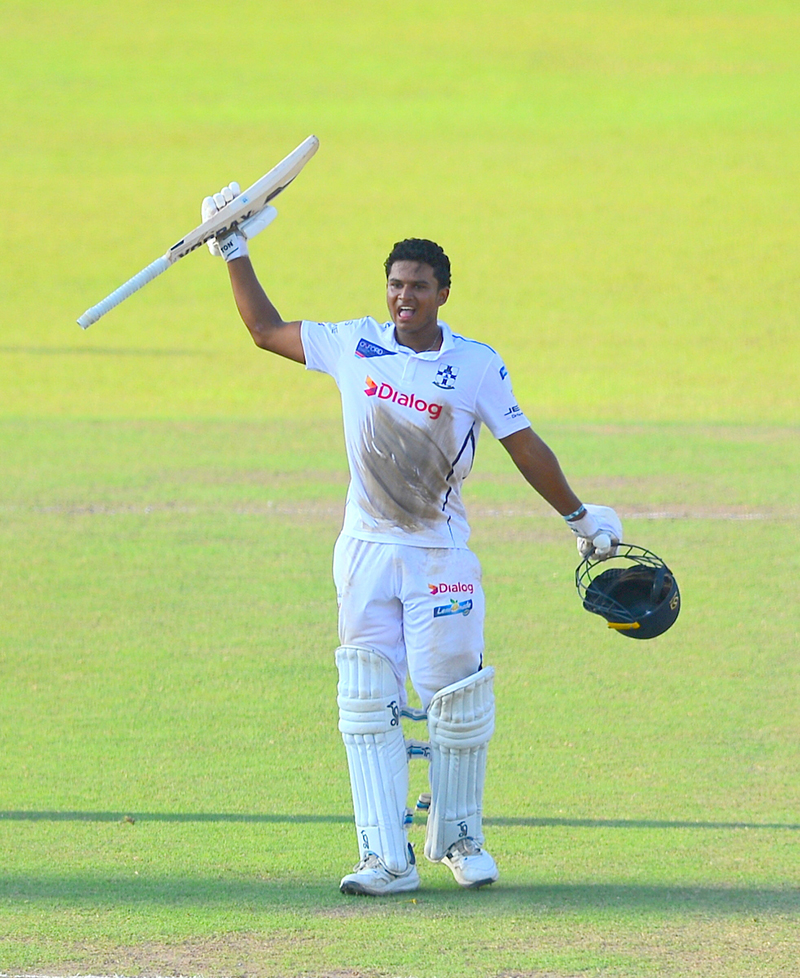
Jaden Amaraweera scored an unbeaten century in the second innings
Royal entered the contest as favourites, yet the Thomians once again managed to deny their arch rivals victory, settling for a draw in another chapter of Sri Lanka’s most celebrated school cricket rivalry

Chinnaswamy stadium receives government clearance to host IPL 2026 final

Tanzid 107, Taskin four-for trump Agha 106 to give Bangladesh series

A new curriculum will be introduced for preschools in 2027, while steps will also be taken to train teachers accordingly – PM

Be mindful of the accuracy of information before sharing it on social media – PM

Heat Index at ‘Caution level’ at some places in the Western, Sabaragamuwa, Southern and North-western provinces and in Monaragala, Mannar, Anuradhapura and Vavuniya districts

Showers expected at several places in the Central, Sabaragamuwa, Southern, North-western, Eastern and Uva provinces after 2.00 pm.

‘Dates have the highest sugar content to fight Coronavirus’

Sunday Island 27 December – Headlines

#SundayIsland 17th December – Headlines

Sunday Island – 28th March

Sunday Island Headlines – 21 March

Sunday Island – 21st February – Headlines
-

 News7 days ago
Prof. Dunusinghe warns Lanka at serious risk due to ME war
-

 News5 days ago
Historic address by BASL President at the Supreme Court of India
-

 Sports6 days ago
Royal start favourites in historic Battle of the Blues
-

 Sports5 days ago
The 147th Royal–Thomian and 175 Years of the School by the Sea
-

 Business6 days ago
BOI launches ‘Invest in Sri Lanka’ forum
-

 News6 days ago
CEBEU warns of operational disruptions amid uncertainty over CEB restructuring
-

 Features6 days ago
Indian Ocean zone of peace torpedoed!
-
 News5 days ago
Power sector reforms jolted by 40% pay hike demand