
News
Summoning all employees back to work places an invitation to fresh spike in epidemic – Expert


Once people start working from home, companies can cut down their expenditure on rent and utilities. The state too will benefit from savings on fuel,”
By Rathindra Kuruwita
Mobility data gathered by Google, Facebook and the World Health Organisation (WHO) show that Sri Lankans have been travelling out of their homes in large numbers since the lifting of the travel restrictions and addressing it should be an immediate concern for the government, Pharmaceutical and Healthcare Management Consultant Dr. Sanjaya Perera told The Island yesterday.
“The data shows that there was a large dip in mobility in late August when travel restrictions were imposed. However, it started rising in September and has now skyrocketed since restrictions were lifted,” he said.
Dr. Perera said that the increase was ominous and showed that the government’s efforts to prevent public and private sector institutions from bringing people to work en masse had failed. The government and the corporate sector should take steps to promote working from home to avoid a fresh spike in the pandemic.
“I am working on a research for Johns Hopkins University covering several Asian countries and we have seen that many countries including Thailand, have adopted work from home practices. It is unfortunate that Sri Lankan public and private institutions have not encouraged this practice although there are many known benefits,” he said.
Research across the world has shown working from home improved productivity of the employees by reducing stress and anxiety, Dr. Perera said. Often the stress of travelling to work, especially in public transport, office politics and diversions at work prevented people from working at peak capacity, he pointed out.
“However, employees who have started working from home have shown dramatic increases in productivity. When one works from home, they are much more relaxed and their overall health improves because of better sleep and food habits,” he said.
Working from home also allowed employees to work from anywhere, even during holidays and even on vacation, Dr. Perera said. If motivated enough, most employees could hit targets set by the management in a few hours a day, he said.
“This also saves a lot of money for the employees as well. At a time when the cost of travelling or meals from a restaurant has increased, people can save a lot of money if they can work from home. This is akin to giving them a salary increase. A lot of companies have reduced salaries and cut benefits, thus, reducing people’s expenses via encouraging work from home that will offset many of the issues caused by these cuts,” he said.
One of the main complaints by managements of public and private institutions is that some people were slacking off when working from home practices were introduced. It had been cited as a main reason why employees had been asked to come to work.
“However, this is a simple problem to address. You just have to set up Key Performance Indicators. You just have to tell an employee that these targets have to be reached. This is not rocket science. We just need to set up protocols and systems in place. Once people start working from home, companies can also cut down their expenditure on rent and utilities. The state too will benefit from savings on fuel,” he said.
Dr. Perera said that Sri Lanka spent close to USD 300 million on fuel imports a month and it could be greatly reduced if people worked from home.

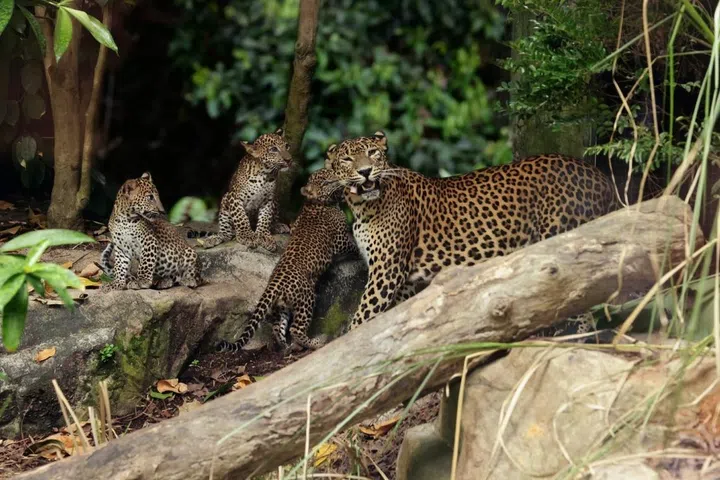
Three Sri Lankan leopard cubs that were born at the Singapore Zoo on Jan 1 have now made their public debut at the facility.
The two males and one female, born to mother Yala and father Asanka, are the first of their species yo be born at the Singapore Zoo. The last successful birth in Singapore was recorded at the Night Safari three decades ago.
The triplets, which are the pair’s first litter, are among around 80 Sri Lankan leopards in zoos worldwide.
The species is listed as vulnerable on the International Union for Conservation of Nature (IUCN) Red List, with fewer than 800 individuals estimated to remain in the wild.
Visitors can now see the triplets at the Wild Africa exhibit, said the Mandai Wildlife Group in a statement on April 16.
The cubs can be found in the exhibit with their mother daily until mid-May and, subsequently, every Wednesday, Saturday and Sunday.
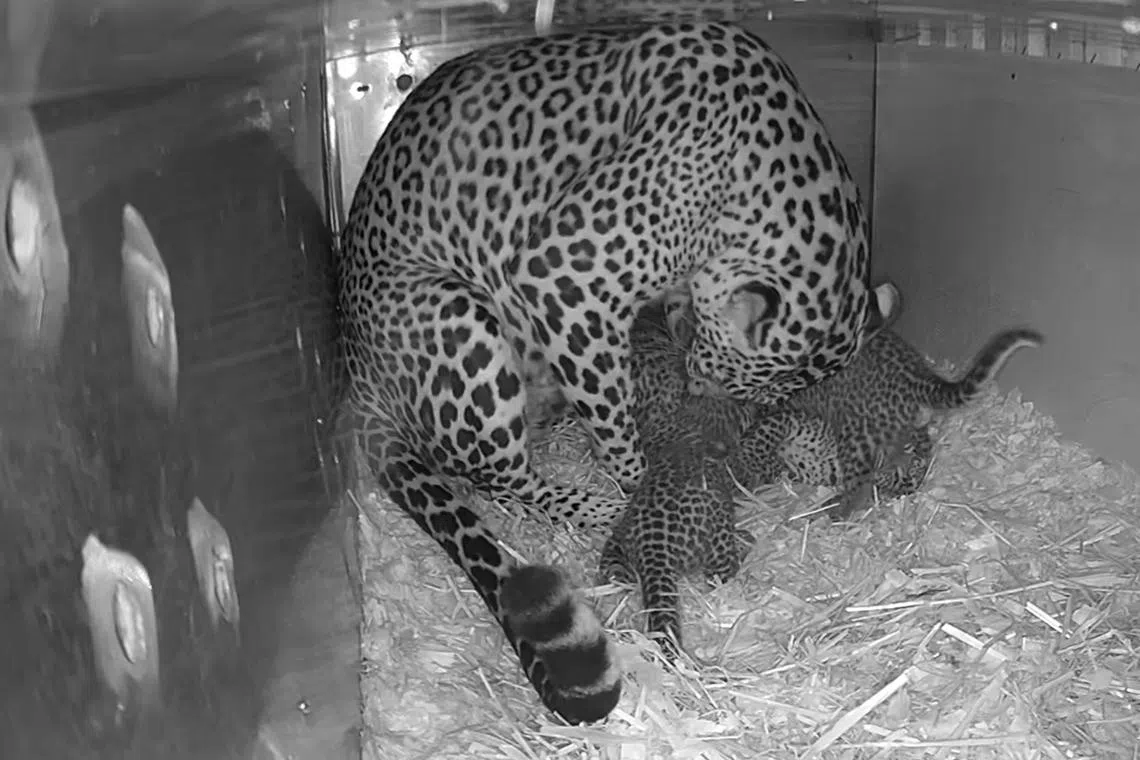
Yala with her cubs in their nest box, a month after their birth on Jan 1. (Straits Times)

A leopard cub investigating a piece of meat suspended from a tree – one of the several enrichment items in the Wild Africa exhibit designed to keep the cats mentally and physically stimulated. (Straits Times)
Mandai Wildlife Group curator Anand Kumar said it took nearly three years and close collaboration across continents to bring together a compatible pair of Sri Lankan leopards.
(Straits Times)
https://www.straitstimes.com/singapore/singapore-zoos-first-sri-lankan-leopard-cubs-make-their-public-debut?ref=top-stories

The Sri Lanka Navy has seized a local multi- day fishing trawler, it’s four man crew together with a consignment suspected to be narcotics off the Southern Coast of the island.
The vessel is presently being escorted to the Dikowita fisheries harbour for further investigations and legal proceedings.
Latest News
Heat Index at Caution Level in the Northern, North-central, North-western, Western, Sabaragamuwa, Eastern and Southern provinces and in Monaragala district


Warm Weather Advisory
Issued by the Natural Hazards Early Warning Centre
Issued at 3.30 p.m. on 15 April 2026, valid for 16 April 2026.
The Heat index, the temperature felt on human body is likely to increase up to ‘Caution level’ at some places in the Northern, North-central, North-western, Western, Sabaragamuwa, Eastern
and Southern provinces and in Monaragala district.
The Heat Index Forecast is calculated by using relative humidity and maximum temperature and this is the condition that is felt on your body. This is not the forecast of maximum temperature. It is generated by the Department of Meteorology for the next day period and prepared by using global numerical weather prediction model data.
Effect of the heat index on human body is mentioned in the above table and it is prepared on the advice of the Ministry of Health and Indigenous Medical Services.
ACTION REQUIRED
Job sites: Stay hydrated and takes breaks in the shade as often as possible.
Indoors: Check up on the elderly and the sick.
Vehicles: Never leave children unattended.
Outdoors: Limit strenuous outdoor activities, find shade and stay hydrated.
Dress: Wear lightweight and white or light-colored clothing.
Note:
In addition, please refer to advisories issued by the Disaster Preparedness & Response Division, Ministry of Health in this regard as well. For further clarifications please contact 011-7446491

Singapore Zoo’s first Sri Lankan leopard cubs make their public debut

Sri Lanka Navy seize multi day fishing craft suspected of smuggling narcotics

‘Sent to be killed’: How Russia forces migrants to fight in Ukraine

Babar Azam 71* helps Peshawar Zalmi extend lead at top

Trump threatens to fire Fed chair Jerome Powell if he doesn’t leave in May

Royal Challengers Bengaluru top the table after bowlers help thump Lucknow Super Giants

‘Dates have the highest sugar content to fight Coronavirus’

Sunday Island 27 December – Headlines

#SundayIsland 17th December – Headlines

Sunday Island – 28th March

Sunday Island Headlines – 21 March

Sunday Island – 21st February – Headlines
-

 News5 days ago
CEB orders temporary shutdown of large rooftop solar systems
-
 Features5 days ago
From Royal College Platoon to National Cadet Corps: 145 years of discipline, leadership, and modern challenges
-

 Business7 days ago
Israeli attack on Lebanon triggers local stock market volatility
-

 Business7 days ago
HNB Assurance marks 25 years with strategic transformation to ‘HNB Life’
-

 Latest News4 days ago
PNS TAIMUR & ASLAT arrive in Colombo
-

 News6 days ago
Anura Solomons passes away
-

 Features5 days ago
CIA’s hidden weapon in Iran
-

 Latest News4 days ago
Prasidh, Buttler set up comfortable win for Gujarat Titans