
News
Sumanthiran tells government not to play politics with economic situation

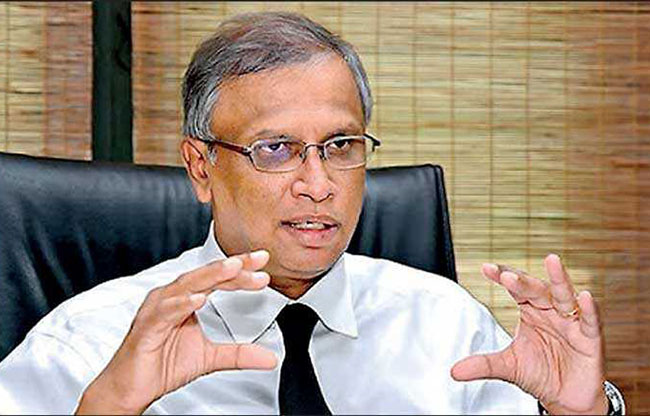
TNA MP M.A.Sumanthiran told Parliament on Thursday that when the previous government attempted to repeal the PTA, MPs that now represent the SLPP MPs too supported it.
“All that they objected to was the Act or the Bill that was supposed to replace the PTA, which was called the counter terrorism bill, had certain other draconian provisions which could have been used against trade unions and other organizations because there was a new provision that was brought in by which organizations can be proscribed. I agreed with them at that point in time, so we were all in agreement that the Prevention of Terrorism Act ought to be repealed. The draconian provisions in the Prevention of Terrorism Act has no place in civilized society,” he said.
Now the same MPs have changed their tune and are accusing others of continuing their attempt to repeal the PTA, the TNA MP said.
State Minister Shehan Semasinghe: “The Act which you are referring to was gazette on 17 September 2018. Am I right? The counter terrorism act. At that time the government which was ruling the country also supported, so why didn’t you go ahead with it? if you say that you had consent from our side also, why didn’t you go ahead with that?”
MP Sumanthiran: “I am thankful to Minister for raising that question. This is the question a lot of people are asking me in the public realm as well, and you have given me an opportunity to answer that. We also found various negative features in that Bill. And in parliamentary committee, particularly, the committee on legal reforms, we corrected those provisions. There were still some more objectionable even for us and the Foreign minister at that time, Tilak Marapana, gave an assurance that at committee stage those also would be corrected. But that was, as you rightly said, in 2018 September. In October your party tried a backflip – tried a constitutional coup in the country. There was instability right through November and December. And after that there was no possibility of going through that Act and then Easter bombing happened.”
The TNA MP said that after the Easter Sunday bombings people called for a strong leader and strong pieces of legislation against terrorism. The TNA MP said that the parliamentary select committee that inquired into the Easter bombing, in September 2019, in its report that asked the question whether this was done to make the country a call for a strong leader with the presidential election coming later in the year.
“Now, that was only a question that was posed by the parliamentary select committee but its being proved more and more to be the actual fact. If not, I ask you the question: there were intelligence reports that were available, not just three weeks before the attack – even one hour before the attack, the previous evening. There were sources that were available who are still alive, because it came from a different country. To date not one muscle has been moved to take action against those who perpetrated the act,” he said.
Sumanthiran said that it is important to go after the ones who planned premeditated acts and caused so much havoc in the country. However, no such persons had been produced before court.
“Now before I sit down, I want to table the letter dated 11 February 2022, which party leaders in this house including members of the government subscribe to, saying certain steps must be taken to arrest the economic situation of the country. Now I am not saying that because we say you should do that. Everyone agrees that this should have been done more than a year ago. There is no coherence in the government: you listen to the Minister of Finance; you can’t even understand what he is saying. There are several interviews…. we are ashamed, that’s the coherence with which the finance minister of the country is speaking. The Governor says something totally opposite. You the Minister of State also holds something connected to finance in this country. There must be a coherent policy. We are willing to support. This is a damage that this caused to the whole country. We are all willing to stand together and approach this situation. So I urge the government: don’t play politics with the economic situation as you have been doing with the Easter bomb attack. This must be faced by the whole country together. And we have demonstrated that we are willing to support the government in addressing this situation.”

Latest News
Heat Index at Caution Level in the Northern, North-central, North-western, Western, Sabaragamuwa, Eastern and Southern provinces and in Monaragala district.


Warm Weather Advisory
Issued by the Natural Hazards Early Warning Centre
at 3.30 p.m. on 20 April 2026, valid for 21 April 2026
The Heat index, the temperature felt on human body is likely to increase up to ‘Caution level’ at some places in the Northern, North-central, North-western, Western, Sabaragamuwa, Eastern and Southern provinces and in Monaragala district.
The Heat Index Forecast is calculated by using relative humidity and maximum temperature and this is the condition that is felt on your body. This is not the forecast of maximum temperature. It is generated by the Department of Meteorology for the next day period and prepared by using global numerical weather prediction model data.

Effect of the heat index on human body is mentioned in the above table and it is prepared on the advice of the Ministry of Health and Indigenous Medical Services.
ACTION REQUIRED
Job sites: Stay hydrated and takes breaks in the shade as often as possible.
Indoors: Check up on the elderly and the sick.
Vehicles: Never leave children unattended.
Outdoors: Limit strenuous outdoor activities, find shade and stay hydrated.
Dress: Wear lightweight and white or light-colored clothing.
Note:
In addition, please refer to advisories issued by the Disaster Preparedness & Response Division, Ministry of Health in this regard as well. For further clarifications please contact 011-7446491.
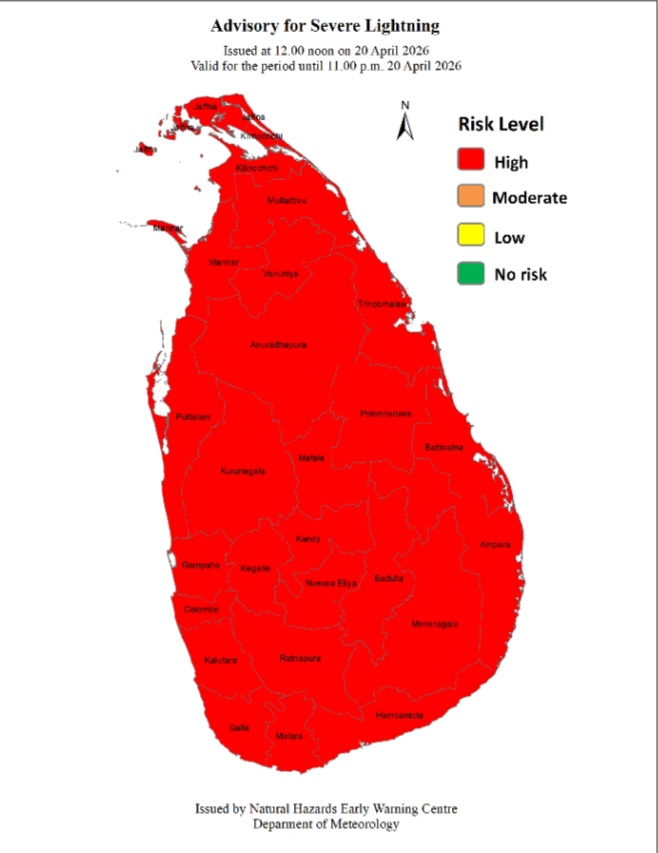
Advisory for Severe Lightning
Issued by the Natural Hazards Early Warning Centre
Issued at 12.00 noon 20 April 2026 valid for the period until 11.00 p.m. 20 April 2026
Thundershowers accompanied with severe lightning are likely to occur most places in the island after 1.00 p.m.
There may be temporary localized strong winds during thundershowers. General public is kindly requested to take adequate precautions to minimize damages caused by lightning activity.
ACTION REQUIRED:
The Department of Meteorology advises that people should:
Seek shelter, preferably indoors and never under trees.
Avoid open areas such as paddy fields, tea plantations and open water bodies during thunderstorms.
Avoid using wired telephones and connected electric appliances during thunderstorms.
Avoid using open vehicles, such as bicycles, tractors and boats etc.
Beware of fallen trees and power lines.
For emergency assistance contact the local disaster management authorities.
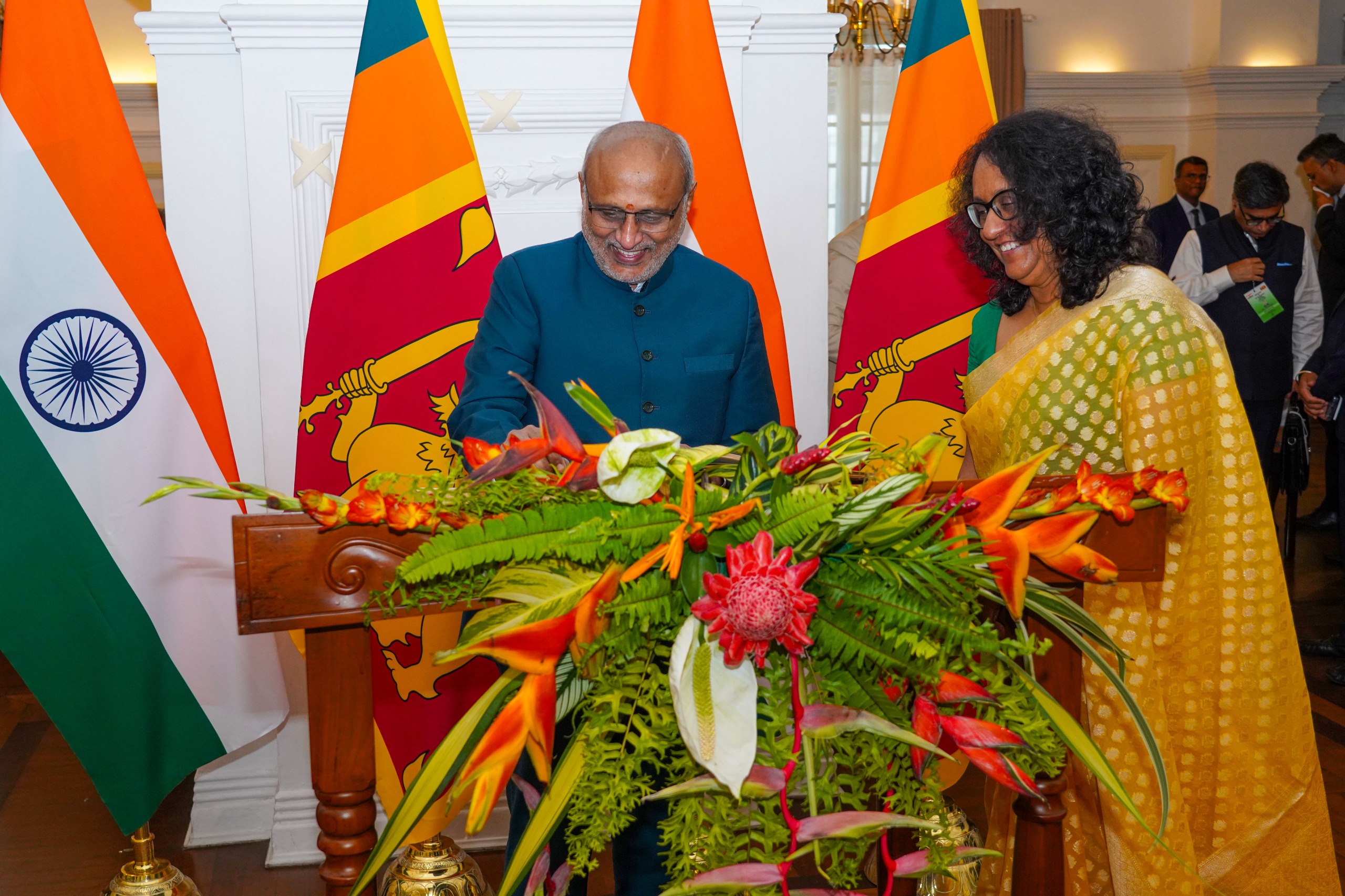
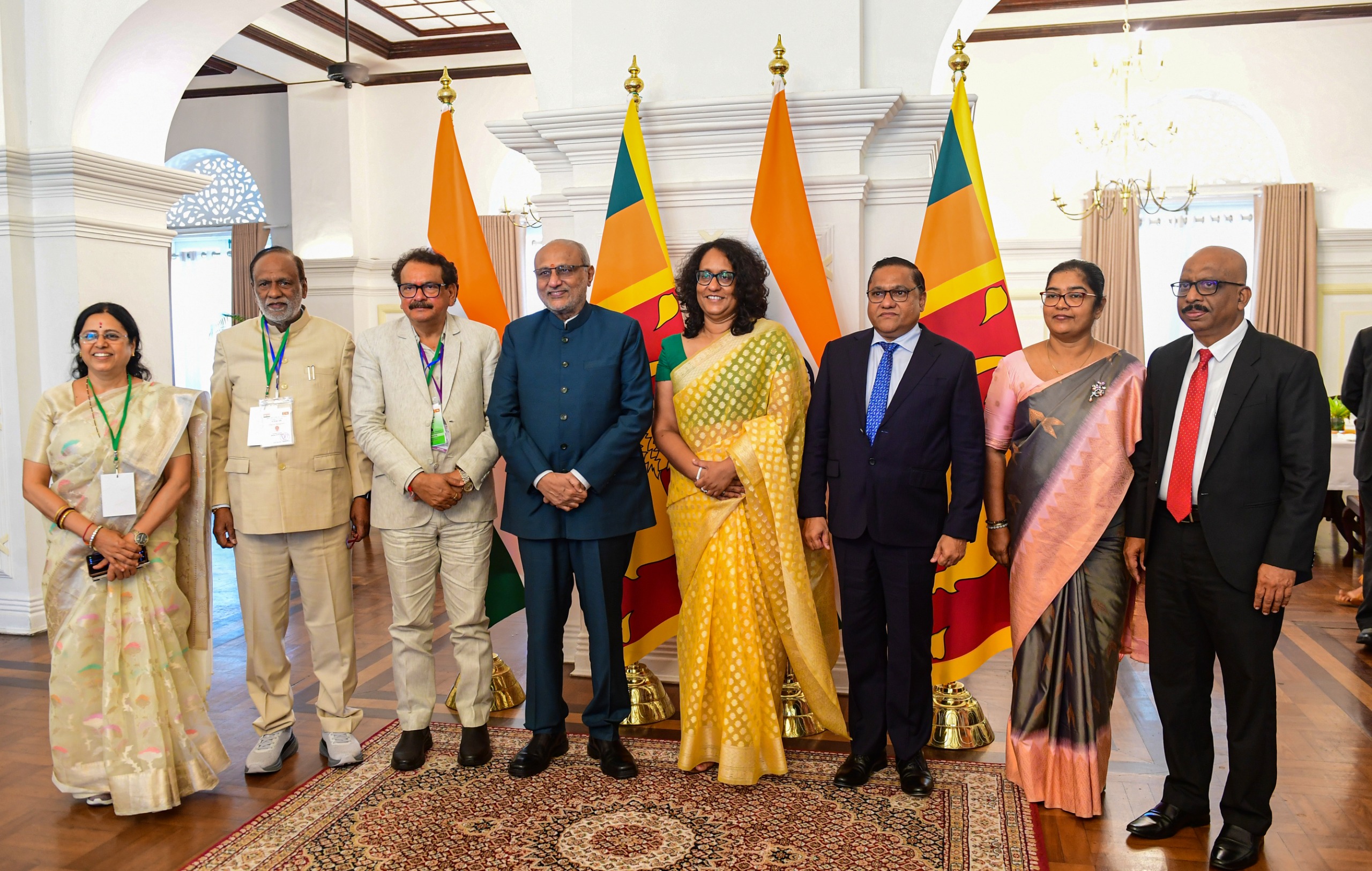
The Vice President of India, C.P. Radhakrishnan, who is currently on a two-day official visit to Sri Lanka, held a bilateral discussion with Prime Minister Dr. Harini Amarasuriya on Sunday (19) morning at Temple Trees.
Upon his arrival at Temple Trees, the Indian Vice President was received by Prime Minister Dr. Harini Amarasuriya. The Prime Minister also extended her congratulations to C.P. Radhakrishnan on his appointment as the Vice President of India.
During the meeting, the Vice President noted that this is his first official visit to Sri Lanka and expressed his appreciation for the warm welcome and hospitality extended to him during his stay.
The occasion was attended by the Minister of State for Fisheries, Animal Husbandry and Dairying, Prof. S.P. Singh Baghel; Members of Parliament Dr. K. Laxman and Dr. Medha Vishram Kulkarni; Foreign Secretary Vikram Misri; and the High Commissioner of India to Sri Lanka, Santosh Jha, and representing the Government of Sri Lanka the Minister of Foreign Affairs, Foreign Employment and Tourism Vijitha Herath; Minister of Sports Sunil Kumara Gamage; Minister of Women and Child Affairs Saroja Savithri Paulraj; Secretary to the Prime Minister Pradeep Saputhanthri; Secretary to the Ministry of Finance Harshana Suriyapperuma; Secretary to the Ministry of Education Nalaka Kaluwewa; and several other officials.
[Prime Minister’s Media Division]

Heat Index at Caution Level in the Northern, North-central, North-western, Western, Sabaragamuwa, Eastern and Southern provinces and in Monaragala district.

Dasun Shanaka handed one-year PSL ban

Nahid, Tanzid help Bangladesh level New Zealand series

Five UAE cricketers given citizenship through naturalisation

Moni, Sharmin help Bangladesh register maiden ODI win against Sri Lanka

Advisory for Severe Lightning issued for all provinces of Sri Lanka

‘Dates have the highest sugar content to fight Coronavirus’

Sunday Island 27 December – Headlines

#SundayIsland 17th December – Headlines

Sunday Island – 28th March

Sunday Island Headlines – 21 March

Sunday Island – 21st February – Headlines
-

 News5 days ago
PNS TAIMUR & ASLAT set sail from Colombo
-

 Business3 days ago
Harnessing nature’s wisdom: Experts highlight “Resist–Align” path to resilience
-

 News3 days ago
Gratiaen Trust announces longlist for the 33rd Annual Gratiaen Prize
-

 Latest News7 days ago
“I extend my heartfelt wishes to all Sri Lankans for a peaceful and joyous Sinhala and Tamil New Year!” – President
-

 News2 days ago
From Nuwara Eliya to Dubai: Isha Holdings markets Agri products abroad
-
 News3 days ago
Heroin haul transported on 50-million-rupee contract
-

 Latest News4 days ago
Singapore Zoo’s first Sri Lankan leopard cubs make their public debut
-
 Latest News7 days ago
US blockade of Iran would worsen global energy crisis, analysts say