
Sports
Stirling-Balbirnie duet powers Ireland to memorable win

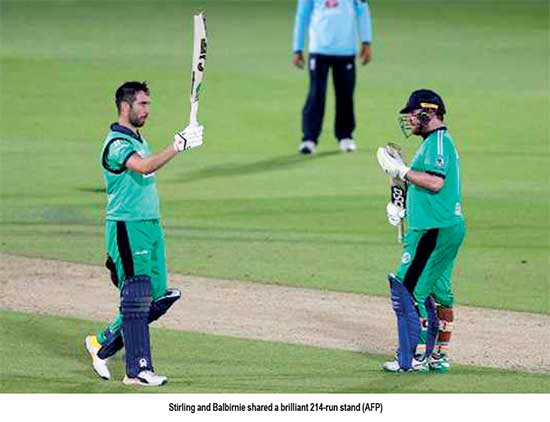
In a match full of sharp twists and turns, Paul Stirling (142) and Andrew Balbirnie (113) composed game-changing hundreds to script a memorable seven-wicket victory for Ireland over the current 50-over World Champions, England. The visitors chased down the target of 329 in the final over to grab 10 crucial points in the Cricket World Cup Super League.
When Balbirnie was dismissed in the 45th over off Adil Rashid, the match was in the balance. However, the duo of Kevin O’Brien and Harry Tector played with a calm head on their shoulders to take the side home.
One of the crucial turning points in the game came in the 46th over when David Willey tried to nail the yorker, but it turned out to be a full toss, with O’Brien depositing it over the midwicket fence. To make matters worse for the hosts, it turned out to be a no-ball, as it was delivered above waist height.
O’Brien also sliced one over the in-field on the off-side in the 48th over, as the equation came down to 17 off two overs. Tector, the junior partner, followed in O’Brien’s footsteps by carving Tom Curran through the point region. O’Brien, who helped Ireland chart a famous victory in the 2011 World Cup game against England, then hit the winning runs off Saqib Mahmood.
The foundation for Ireland’s win was laid down by the duo of Stirling and Balbirnie, with the pair sharing an alliance of 214 for the second wicket. Stirling, who opened the innings with Gareth Delany, showed his aggressive intent when he slammed a couple of sixes off Saqib in the eighth over.
Despite losing his partner, Delany, he continued to play with freedom and got the required support from Balbirnie. The highlight of his innings was the way he kept tonking Rashid over the leg-side boundary for sixes. He even got down on his knee and smashed Willey for a six over midwicket.
Eventually, Stirling was run out on the back of a direct-hit by Curran. Balbirnie, who accumulated his fifth ODI hundred, soon followed him back to the pavilion. At that stage, England seemed to have made a comeback, but O’Brien and Tector had other ideas. Meanwhile, the hosts would rue the fact that they dropped three catches, including two of Stirling.
Earlier, Eoin Morgan’s blazing hundred had powered England to a substantial total. The visitors, who elected to bowl, started on the right note when Craig Young dismissed Jason Roy in the first over of the match. Mark Adair then castled Jonny Bairstow. However, England stuck to their tried and tested mantra of playing with a positive intent.
Morgan led from the front by cracking a flurry of shots including pulls, drives and lofts. Banton, who strode out to the middle at the fall of Vince’s wicket, gave Morgan the support, as the pair shared a timely 146-run stand. Banton and Morgan also crossed their respective milestones – fifty and hundred. Morgan, however, fell to Joshua Little, with Tector taking the catch at backward point.
Morgan’s wicket also opened the gates for Ireland to make further dents, with Banton and Moeen falling in quick succession. Sam Billings, who has been in good form in the series, also fell cheaply. With the score reading 216 for 7, Willey and Curran then propped up the home side with a wide range of shots. For the visitors, Young, Little and the impressive Campher shared seven spoils between them. (cricbuzz)
Brief scores: England 328 in 49.5 overs (Eoin Morgan 106, Tom Banton 58; Craig Young 3-53) lost to Ireland 329/3 in 49.5 overs (Paul Stirling 142, Andrew Balbirnie 113) by seven wickets.



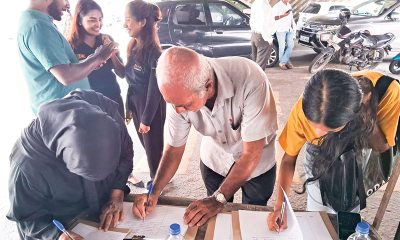


Sri Lankan champion thrower Rumesh Tharanga created history with yet another world-leading effort when he shattered his own national record at the Champions Track and Field event held at Diyagama Mahinda Rajapaksa Stadium on Saturday.
Tharanga produced a massive throw of 89.37 metres in his final attempt, a distance which, once ratified by World Athletics, is expected to stand as the fourth-longest throw ever recorded in Asia. The outstanding performance further cemented his status as one of the region’s leading javelin throwers.
Despite facing little competition from his rivals at the meet, Tharanga displayed the composure and determination of a true champion. Rising above the field, he delivered the record-breaking throw in dramatic fashion with his final effort of the competition.
Coming into the meet, Tharanga already held the world-leading mark of 83.07 metres for the season. Saturday’s performance elevated him to a new level, strengthening his reputation as a strong medal prospect for Sri Lanka on the global stage this year.
Tharanga first attracted widespread international attention when he set a Sri Lankan national record with a throw of 86.50 metres, a performance that earned him the gold medal at an international meet and secured direct qualification for the World Athletics Championships.
The former athlete of St. Peter’s College Colombo has continued to impress since then, producing consistent world-class performances while competing against some of the best javelin throwers in the world. Among his major achievements is reaching the final of the 2025 World Athletics Championships, becoming the first Sri Lankan male javelin thrower to reach the final stage of the event.
With his latest record-breaking performance, Tharanga has once again demonstrated that he is ready to shine and carry Sri Lanka’s hopes at the highest level of international athletics.
By Reemus Fernando
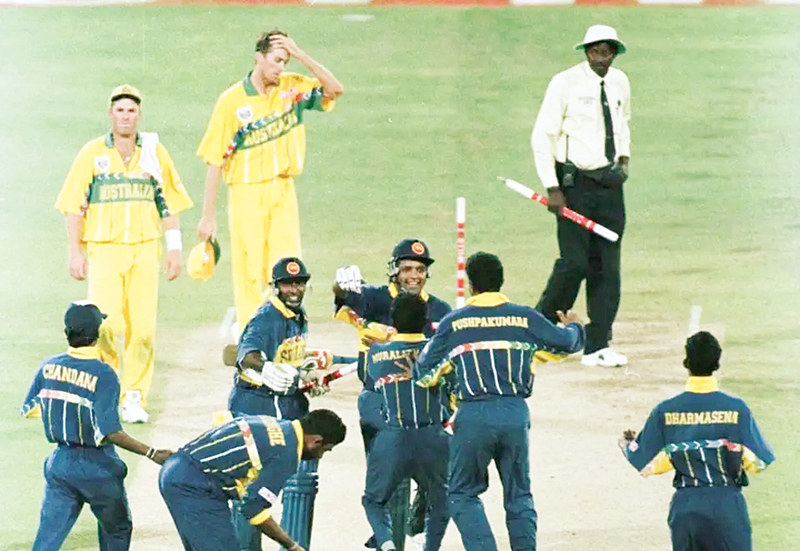
Sri Lanka’s trailblazing 1996 World Cup-winning side will roll back the years when they take on a World XI in Kuala Lumpur, marking three decades since their watershed triumph that changed the game’s field settings for good.
The exhibition match, hosted by the historic Royal Selangor Club, an institution that has been part of Asia’s sporting fabric since 1884, will be preceded by a gala dinner before the old warhorses lace up their boots once more against a Rest of the World XI.
It promises to be more than a nostalgic lap around the park.
“Some of the players took the initiative and I thought it was a splendid idea,” Arjuna Ranatunga, the captain who marshalled his troops like a seasoned general in 1996, told Telecom Asia Sport. “It helps us come together again and more importantly, inspire the next lot coming through.”
Beyond the boundary ropes, the legends will don the coach’s hat, conducting sessions aimed at passing on the baton to aspiring youngsters.
Former Malaysian cricketer Devindran Ramanathan, one of the chief architects behind the event, is keen that this is not just a walk down memory lane but a springboard for the future.
“This isn’t only about celebrating a World Cup win,” Ramanathan said. “It’s about showing young players what’s possible when you dare to dream.”
“When players of that calibre turn up, it shouldn’t end with autographs and photographs. It must open doors and broaden horizons,” he added.
In a heartening initiative, around 20 youngsters from Malaysia’s interior, players who have been making steady strides despite limited facilities, will be brought to the capital on May 15 and 16 to witness the action up close.
For many of them, it will be a once-in-a-lifetime opportunity to rub shoulders with giants of the game, a chance to trade dusty nets for the bright lights and perhaps believe that they, too, can one day play on the big stage.
“The real impact is not the match or the dinner,” Ramanathan noted. “It is whether a young player walks away believing they can go further.”
Malaysia, steadily padding up as a regional cricket hub, has already hosted events like the Under-19 World Cup and continues to expand its footprint in the game. In a sporting landscape dominated by motor racing, racquet sports and football, visits from former world champions in cricket could well help the sport get a firmer grip.
All 14 members of Sri Lanka’s 1996 squad are expected to travel to Malaysia in the second week of May, even as life has taken many of them to different corners of the globe.
Their famous triumph over Australia in Lahore remains one of cricket’s most defining moments, a victory that didn’t just tilt the balance of a final, but shifted the axis of the modern game itself.
(telecomasia.net)


The general secretary of the Confederation of African Football (Caf) has resigned amid a chaotic time for football on the continent
Veron Mosengo-Omba said in a statement he was retiring, but his departure comes during the fallout over decisions to strip Senegal of the 2025 Africa Cup of Nations (Afcon) title and postpone the women’s tournament at the last minute.
These incidents have left Caf, the governing body for African football, battling a crisis of confidence.
Mosengo-Omba alluded to controversies faced during his tenure in his statement on Sunday.
“Now that I have been able to dispel the suspicions that some people have gone to great lengths to cast on me, I can retire with peace of mind and without constraint, leaving the CAF more prosperous than ever,” Mosengo-Omba, deputy to Caf president Patrice Motsepe, wrote.
The 66-year-old has been criticised for staying on as general secretary past the organisation’s mandatory retirement age of 63.
He has also been accused by some employees of creating a toxic atmosphere in the workplace, although an investigation after staff complaints cleared him of any wrongdoing.
Mosengo-Omba, who hails from the Democratic Republic of Congo but also holds Swiss nationality, was appointed general secretary in March 2021.
According to news agency Reuters, Caf’s competitions director, Samson Adamu, will take over as acting general secretary.
The governing body is awaiting a decision by the Court of Arbitration for Sport (Cas) on Senegal’s appeal against being stripped of the Afcon title.
Senegal is challenging Caf’s appeals body for overturning their 1-0 win over hosts Morocco in January’s Afcon final.
During the game, Senegal’s players left the field in protest when, with the score at 0-0, hosts Morocco were awarded a stoppage-time penalty.
When they returned after a delay of about 17 minutes, Morocco subsequently failed to score the spot-kick and Senegal netted an extra-time winner.
Following an appeal by the Moroccan FA (FRMF), Caf later ruled that Senegal had forfeited the match and Morocco were awarded a 3-0 victory.
(BBC)

Oil tops $116 a barrel as Iran accuses US of preparing invasion

Iranian attack damages Kuwait power and desalination plant, kills worker

Warm weather conditions prevailing over the island are expected to continue

Inquiry into female employee’s complaint: Retired HC Judge’s recommendations ignored

Motor Traffic CG remanded

Petition launched seeking resignation of Energy Minister Jayakody

‘Dates have the highest sugar content to fight Coronavirus’

Sunday Island 27 December – Headlines

#SundayIsland 17th December – Headlines

Sunday Island – 28th March

Sunday Island Headlines – 21 March

Sunday Island – 21st February – Headlines
-

 News5 days ago
Senior citizens above 70 years to receive March allowances on Thursday (26)
-

 Features2 days ago
A World Order in Crisis: War, Power, and Resistance
-

 News3 days ago
Energy Minister indicted on corruption charges ahead of no-faith motion against him
-

 News4 days ago
US dodges question on AKD’s claim SL denied permission for military aircraft to land
-

 Business4 days ago
Dialog Unveils Dialog Play Mini with Netflix and Apple TV
-

 Sports3 days ago
SLC to hold EGM in April
-

 News5 days ago
CEB Engineers warn public to be prepared for power cuts after New Year
-

 Business6 days ago
Postponement of Sri Lanka Investment Forum 2026