
News
St. Regis helps reduce Ceylon Tea Carbon Footprint with world’s first carbon-neutral bulk tea packaging


A game-changing world-first in the sphere of packaging for bulk teas by Sri Lanka’s St. Regis Packaging can potentially enhance the environmental credentials of Ceylon Tea on the global stage.
The inventor of the Rigid-T-sack that replaced plywood chests in the bulk packaging of large leaf teas in 1996, St. Regis has received the world’s first ZeroCarbon Product Certification in its category for the Company’s Rigid-T-Sacks as well as for Multiwall paper sacks used for the packaging of Leafy and Grainy Teas.
The certification means that Ceylon Tea packaged in these two types of St. Regis sacks for the Colombo Tea Auction or for export has offset the carbon dioxide equivalents (CO2e) of the packaging, reducing the overall product carbon footprint of the teas.
Significantly, St. Regis Packaging currently supplies sacks for over half the teas sold at the weekly Colombo Tea Auction, and this industry-first achievement could be a catalyst for greater interest in carbon footprint reduction for tea, the Company’s Director Ajith Fernando said.
He said approximately six million packages are auctioned at the Colombo Tea Auction annually and this would be an ideal opportunity for Colombo to become the first tea auction in the world to start offering teas in carbon neutral packages.
“St. Regis Packaging has many firsts to its name, and we are proud to be the first company in the world to offer carbon-neutral bulk tea packaging with two of our flagship products,” Mr Fernando said. “The benefit of having their carbon emissions compensated for can be passed-on to our customers, positively impacting their own carbon footprints. These certifications therefore represent an important value-addition for our customers, at no extra cost to them.”
St. Regis retained the expert services of The Climate and Conservation Consortium (CCC), one of South Asia’s leading Integrated Sustainability Solutions Providers, to assess the Greenhouse Gas (GHG) emissions of the Company’s Multiwall Paper Sacks and Rigid-T-Sacks. This comprehensive Product Carbon Footprint study encompassed all applicable emissions during the ‘Cradle to Gate’ lifecycle stages of the selected types of tea sacks, including Raw Material Extraction, Upstream and Downstream Transportation, and Manufacturing.
Following the assessment, St. Regis retired a matching number of Carbon Credits from a registered project to bring the total Carbon Footprint of a selected volume of sacks down to net zero. The assessment results and offsetting process were then independently verified by The Sustainable Future Group (SFG), the first Validation and Verification Body (VVB) in South Asia to be accredited by the International Accreditation Forum (IAF) to award ISO 14064-1, 14064-2, 14067, and 14065. Post verification, SFG awarded St. Regis their proprietary ZeroCarbon® Certification for the two packaging products.
In 1996, St. Regis changed a 130-year-old tradition by inventing and patenting the Rigid-T- Sack, enabling tea producers to replace the costly and environmentally unfriendly plywood chests used up to that point in the packaging of large leaf teas.
Besides inventing the Rigid-T-Sack, St. Regis has many other firsts to its name, including becoming the world’s first manufacturer of bulk packaging for tea to receive the ISO22000 and HACCP (Hazard Analysis and Critical Control Points) certifications, the first manufacturer to receive the Sri Lanka Standard (SLS) certification for both Rigid-T-Sacks and Multiwall Paper Sacks, the first manufacturer of bulk packaging for tea to be certified compliant with FSSC22000, the highest food packaging certification in the world, and the first manufacturer in the sector to receive a carbon footprint assessment certificate.
St. Regis states the company wants to encourage the Tea Industry to maintain a “Green bottom line” and work towards making pure Ceylon Tea the first carbon neutral tea produced in the world, thereby maintaining and catering to a niche market. This is also in keeping with Sri Lanka’s Green economic policy, the company said.
“We believe that the quality of a corporate bottom line matters and that having a Green Bottom line covered with O2 is better than a bottom line marred by CO2,” Director Ajith Fernando added.


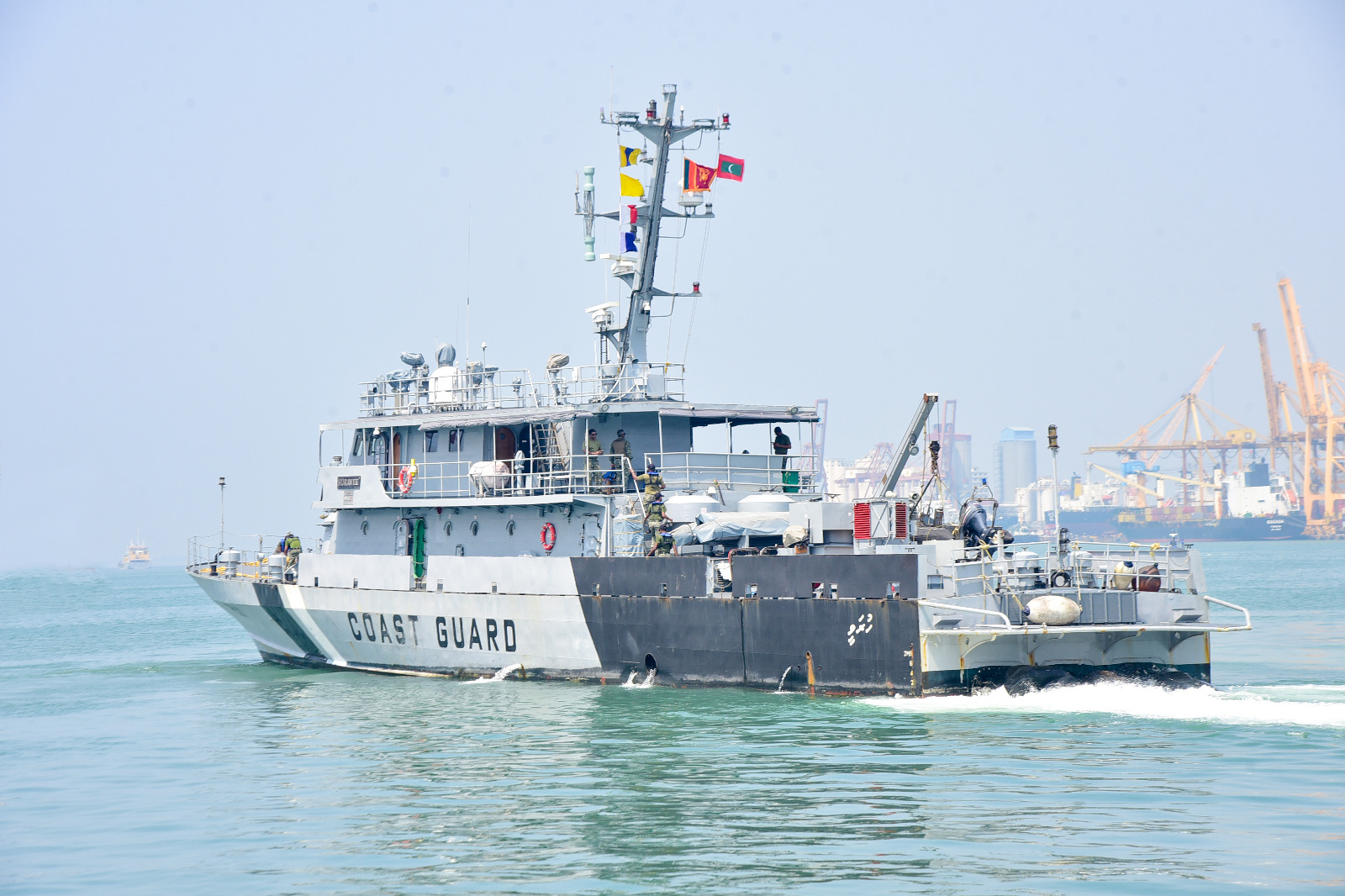
The Maldives Coast Guard Ship Huravee which arrived in Sri Lanka for replenishment purposes, departed the island on 04 Mar 26.
In accordance with naval tradition, the Sri Lanka Navy extended a customary farewell to the departing ship at the Port of Colombo

A day after a US submarine sunk an Iranian Navy warship off the coast of Sri Lanka, the Foreign Minister of Iran, Sayed Abbas Araghchi, has warned that the US would “pay bitterly” for targeting a ship in international waters, The Tribune has reported.
Araghchi posted on social media platform X on Thursday saying, “The US has perpetrated an atrocity at sea, 2,000 miles away from Iran’s shores.”
The frigate IRIS Dena, a guest of India’s Navy carrying almost 130 sailors, was struck in international waters without warning, said the Iran Foreign Minister, adding, “Mark my words: The US will come to bitterly regret the precedent it has set.”
US Secretary of War, Pete Hegseth, on Wednesday confirmed that a US submarine fired a torpedo and sank the Iranian Navy vessel IRIS Dena west of Sri Lanka.
In a way, the Iran and US-Israel conflict has reached close to the Indian coast. The strike today at sea was almost 4,000 kms away from Iran, significantly expanding the radius of war. Already, fearing Iranian missile strikes, several US warships have moved eastward towards India.
These ships are in international waters. India has denied that any US Navy assets were using Indian ports. The Iranian ship, hit on Wednesday, was returning after participating in the international fleet review and exercise Milan hosted by India at Visakhapatnam.
The Iranian ship went down with almost 130 sailors on board missing. The Sri Lankan Navy, acting on a distress call, rescued 32 of the Iranian sailors. Hegseth confirmed the act by the US forces, saying the ship was hit in the Indian Ocean, stating, “an Iranian warship that thought it was safe in international waters. .. Instead, it was sunk by a torpedo”.
Hegseth did not name the Iranian ship that was attacked. But earlier, the Sri Lankan Navy reported the distress call from IRIS Dena when it was some 40 kms west of Galle, located on the south-western part of the island country. On February 16, the Iranian ship had sailed into the port of Visakhapatnam, where seventy-four nations participated.
Warships from Australia, Japan, South Korea, Russia, and dozens of others were anchored alongside the now-sunk Iranian vessel. Iran’s Navy Commander, Rear Admiral Shahram Irani, held talks with India’s Chief of Naval Staff on strengthening maritime security cooperation.
The theme was “United through Oceans.” Notably, the US Navy was supposed to send the guided-missile destroyer USS Pinckney to the exercise Milan; however, the ship was diverted to Singapore on February 15. The US did not field its warship in Milan, which had ships from Russia and Iran.
The exercise ended on February 25. Three days later, on February 28, the United States and Israel launched Operation Epic Fury. The IRIS Dena was transiting home. This morning at 5:08 a.m. local time, the IRIS Dena issued a distress call. Sri Lanka’s Foreign Minister, Vijitha Herath, informed parliament that two navy vessels and an aircraft were deployed. Thirty crew members were rescued and admitted to Karapitiya Hospital in Galle.
The Straits Times reported 32 critically wounded survivors. Reuters reported 101 missing and 78 wounded. The Sri Lankan Navy spokesman said the operation was conducted in line with the International Convention on Maritime Search and Rescue.

The Public Utilities Commission of Sri Lanka (PUCSL) has warned of a possible risk of power cuts due to the use of inferior quality coal affecting generation capacity at the Lakvijaya Power Plant, according to a recent commission report.
The commission said the risk to the continuous electricity supply was assessed based on the peak demand forecast submitted by the Ceylon Electricity Board (CEB) for 2026.
According to the report, the analysis assumed that hydropower plants could contribute up to 1,300 MW to meet the night peak demand, while the Lakvijaya Power Plant (LVPS) would be able to contribute only up to 690 MW due to a capacity shortfall, assuming a 40 MW generation capacity reduction from each unit.
The PUCSL said the assessment was carried out taking into account the planned maintenance schedule submitted by the CEB. Under the schedule, Unit 1 of the Lakvijaya plant is due to undergo maintenance checks and repairs in June for a period of 25 days, while Unit 2 is scheduled for maintenance in July for another 25 days.
The report also noted that the 270 MW West Coast Power Plant is scheduled to undergo maintenance in April for 10 days, while the 150 MW Kelanitissa Combined Cycle Power Plant (KCCP 2) is expected to undergo maintenance during May, June and July.
Under normal conditions, the report said, there is a potential risk of a generation capacity shortage if electricity demand reaches 3,030 MW in April, 3,070 MW in June and 3,000 MW in July.
The highest recorded night peak demand so far in 2026 was 2,949 MW on February 25.
The PUCSL further warned that if one coal unit or any major power plant becomes unavailable from the existing generation mix, there would be a significant risk of a generation capacity shortage to meet the night peak demand, particularly during April, June and July.
Energy sector analysts said the use of substandard coal could further aggravate operational challenges at the Norochcholai plant, potentially affecting generation efficiency and reliability if corrective measures are not taken promptly.
By Ifham Nizam

Tiny possum and glider thought extinct for 6,000 years found in remote West Papua

Maldives Coast Guard Ship Huravee departs island

Cost to US for war on Iran is $3.7bn in first 100 hours, says think tank

More than 120 killed in Israel’s Lebanon attacks as Beirut, south, east hit

Hungary confirms it is holding seven Ukrainian bank workers and $80m

US and Venezuela agree to resume diplomatic ties after Maduro capture

‘Dates have the highest sugar content to fight Coronavirus’

Sunday Island 27 December – Headlines

#SundayIsland 17th December – Headlines

Sunday Island – 28th March

Sunday Island Headlines – 21 March

Sunday Island – 21st February – Headlines
-

 Features5 days ago
Brilliant Navy officer no more
-

 Opinion5 days ago
Sri Lanka – world’s worst facilities for cricket fans
-

 Features5 days ago
A life in colour and song: Rajika Gamage’s new bird guide captures Sri Lanka’s avian soul
-

 Business2 days ago
Cabinet nod for the removal of Cess tax imposed on imported good
-
 Features6 days ago
Overseas visits to drum up foreign assistance for Sri Lanka
-

 News2 days ago
Legal experts decry move to demolish STC dining hall
-
 Features6 days ago
Sri Lanka to Host First-Ever World Congress on Snakes in Landmark Scientific Milestone
-
 Latest News2 days ago
Around 140 people missing after Iranian navy ship sinks off coast of Sri Lanka