
Sports
Sri Lanka women’s teams make clean sweep


Central Asian Beach Volleyball Championship
Sri Lanka women’s teams made a clean sweep bagging the first, second and third places of the Central Asian Beach Volleyball Championship concluded in Negombo on Sunday. The hosts’ number one, two and three teams outperformed Maldives and Uzbekistan teams to reach the final and the third place matches.
 The hosts number one pair Deepika Bandara and Dinesha Prasadini won the women’s championship beating number two team Shehani Asanga and Sulochana Jayawardena 21-15, 21-10 in the final.
In the women’s third place match, Sri Lanka number three team Malsha Priyamali and Chathurika Weerasinghe beat Maldives pair Aminath Rudhaina and Hawwa Nazima 21-4, 21-9.
 Sri Lanka men’s team however had to settle for the runner up position after Iran pair Mojitaba Aro and Shoukati Shekararaei disappointed Anjana Sandeepana and Sandun Madusanka in the final. They beat the hosts 21-12, 21-16. Pakistan, Uzbekistan, Maldives, Iran and Sri Lanka were the teams in the men’s competition.
Sri Lanka Volleyball Federation conducted this beach volleyball championship over three days in Negombo.



If there was one positive from Sri Lanka’s defeat to England in the first T20I, it was how well their bowlers kept England’s batters in check on a batter-friendly surface. Particularly Matheesha Pathirana.
Pathirana, the 23-year-old slinger, returned figures of 1 for 18 across his four overs – and it might have been two had Pathum Nissanka not grassed a chance in the deep – but his impact was immense, as evident in ESPNcricinfo’s MVP index, where he was only behind Adil Rashid, whose 3 for 19 ripped through Sri Lanka’s batting.
The target of 134 off 17 overs (later revised to 115 in 15) proved too low to defend, but the margin of defeat – 11-runs via DLS – was not as wide as it might have been given the nature of the pitch.
On a good batting surface, seamers in particular suffered – Sam Curran and Eshan Malinga went at around 12 an over, while Jofra Archer and Jamie Overton both went at over seven. But Pathirana ticked along at an economy rate of 4.5.
He did so bowling his entire repertoire, from quick yorkers – he was hovering in the mid-140s, with his quickest delivery clocking 148kph – to pace-off length deliveries and spicy short ones. Even more impressive was the fact that he bowled two of his overs inside the powerplay. Pathirana is renowned for his death-overs exploits, but here, with a sub-par total to defend, Sri Lanka called on their strike bowler to take the new ball.
“Even though I’ve practiced to bowl in the powerplay, there was no plan as such for me to bowl there today,” Pathirana said after the game. “It just so happened that our score was lower than we wanted, so it was decided that I would bowl in the powerplay.”
Pathirana’s control was impressive. Wides have been an issue in the past – a common trade-off for a slingy action such as his – but on Friday night, there were just three across his spell.”Honestly I didn’t do anything major, just simple, basic things. The main thing was increasing the number of repetitions in practice. If there is any improvement, that’s the reason”
“Over the last year, year-and-a-half, along with my injuries, it was a challenging period,” he said. “I lost my rhythm. I’ve worked very hard to get back to this level. And then more recently Mali aiya [Lasith Malinga] was here in Sri Lanka helping out, as well all the coaches at SLC – not just one – all of them helped me get here.”
The impact of fellow slinger Malinga cannot be understated. Malinga has long been a proponent of target-based training drills, and hours of repetitive practice. And most recently he has been working as Sri Lanka’s fast-bowling coach in the lead-up to the T20 World Cup.
“Honestly I didn’t do anything major, just simple, basic things,” Pathirana said. “The main thing was increasing the number of repetitions in practice. If there is any improvement, that’s the reason. In terms of practice I increased it greatly.”
It’s a sharp turn in fortunes for Pathirana, who had only played two T20Is for Sri Lanka in 2025 – owing to a combination of poor form and injuries – and had been released by Chennai Super Kings [CSK] following IPl 2025. He had since been picked up by Kolkata Knight Riders (KKR), but that was more of an educated punt than anything based on tangible data.
Among the criticisms levied at Pathirana during this period was that his release point was not as low as it used to be. Stephen Fleming, the CSK coach, in fact pointed out this very fact when talking about the quick bowler’s decline in IPL 2025.
On Friday, Pathirana’s release point was lower than in recent times but still not as low as during his breakout season. He explained that his change in action had largely been involuntary, and down to a fairly serious shoulder injury he had been nursing.
“Yes,” he responded when asked if his release point had changed. “In the recent past, I was playing with a fairly major shoulder injury. So I think my body just automatically changed the release point. Even now I am doing rehab in between matches, and I think that’s why I’m seeing an improvement, and so you can see that the release point is getting to what it used to be.”
A fit and firing Pathirana is crucial for Sri Lanka, and with Dushmantha Chameera waiting in the wings, as well as Eshan Malinga ticking along well – he picked up two wickets on Friday with clever variations – Sri Lanka’s seam contingent at least looks in rude health heading into the World Cup.
[Cricinfo]
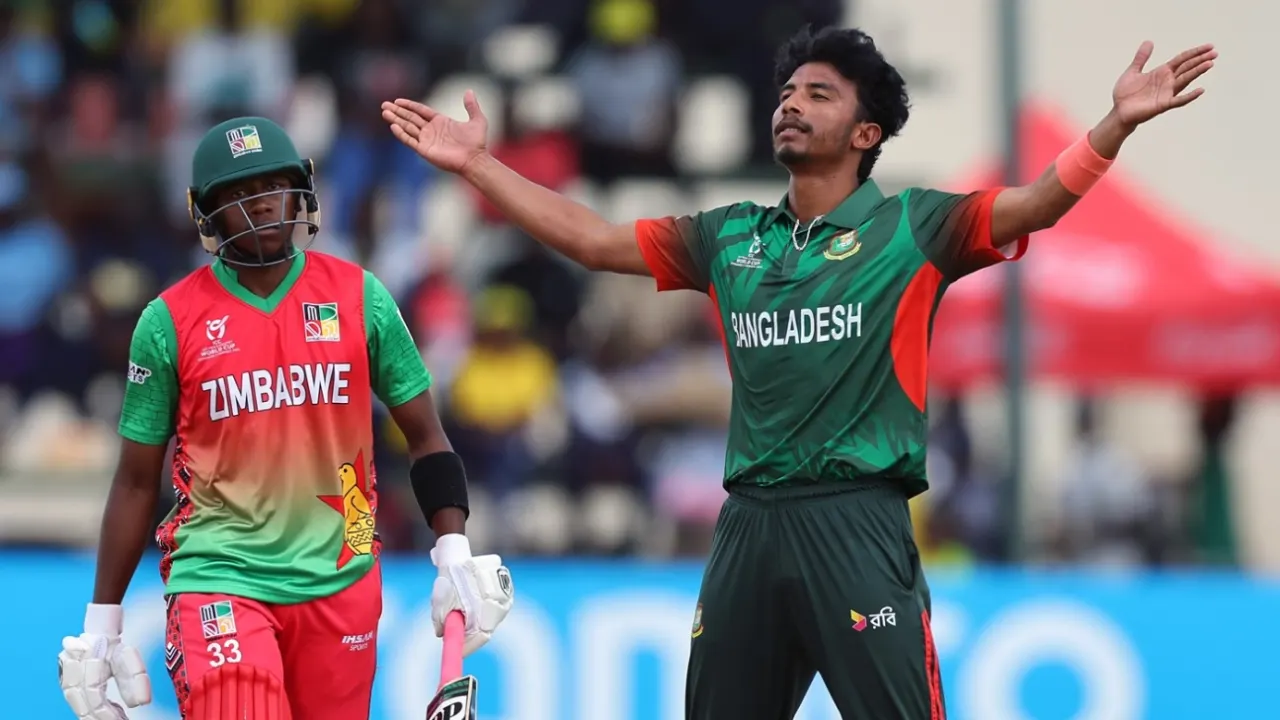
A clinical five-for from Iqbal Hossain Emon set up a consolation win for Bangladesh in their final match of the Super Six and this edition of the Under-19 World Cup. Chasing 254, Simbarashe Mudzengerere’s 70 was the only meaningful contribution in a chase that fizzled out with Zimbabwe reduced to 54 for 5, then 104 for 7.
Emon took out both the openers in his opening spell en route to scalping four of the first five wickets to fall in the Zimbabwe chase. Al Fahad complemented him with the new ball and thereafter, taking three wickets for 39 runs in his own spell – this included the final wicket of the chase as well, when he knocked over Webster Madhidhi.
The most significant resistance in Zimbabwe’s innings was the 64-run partnership between Mudzengerere and Shelton Marzvitorera – the highest for the ninth wicket for them in Youth ODIs. However, by then, the required rate had long climbed out of reach, and Al Fahad’s slow bouncer dismissed Mudzengerere to snuff out any hopes of a miracle.
Earlier, Bangladesh’s innings had been set up by captain Azizul Hakim’s 59 off 87. His steady knock, from No. 3, came to an abrupt end when Tatenda Chimugoro had him nicking behind to the keeper. Rizan Hossan came close to a half-century himself, but was prised out on 47 by Michael Blignaut. Bangladesh were reduced to 153 for 4, then 211 for 8 with less than four overs to go.
The Zimbabwe bowlers, who had kept control of the economy rate throughout a disciplined bowling effort, gave away 22 runs off Webster Madhidhi in the final over of the innings. Emon and Fahad were at the forefront of this attack too: they hit him for 4, 4, 2 wides, 4 and 6 to close out their innings, with the momentum swinging back to Bangladesh in their most productive over of the day.
The duo’s burst with the new ball ensured Bangladesh remained on top for the rest of the contest. Zimbabwe and Bangladesh are both knocked out of contention for the semi-finals at this World Cup, but by the time Fahad took the final wicket of the defense, the latter had something to celebrate.
Brief scores:
Bangladesh Under 19s 253 for 9 in 50 overs (Azizul Hakim 59, Rizan Hossan 47; Tatenda Chimugoro 2-49, Shelton Mazvitoerera 2-44, Michael Blignaut 2-41) beat Zimbabwe Under 19s 179 in 48.4 overs (Simbarashe Mudzengerere 70, Shelton Mazvitorera 42*; Iqbal Hossain Emon 5-24, Al Fahad 3-39) by 74 runs
[Cricinfo]


With another home World Cup less than ten days away, the drums are already rolling across the island and the mood is unmistakably festive. Sri Lanka have been down this road before. In 2011 and 2012, the country staged back-to-back global events that were box-office successes, finals appearances for the home side and the unveiling of three new stadiums with capacities north of 30,000, even if Hambantota later came to be labelled, rather unkindly, a white elephant.
Ticket frenzies during those tournaments prompted Sri Lanka Cricket to float an ambitious 60,000-seat stadium at Diyagama, a plan that was eventually bowled out amid protests from former players. Yet, stripped of sentiment, the logic remains hard to dispute. Demand, especially for marquee clashes like India versus Pakistan, continues to be off the charts.
The hospitality sector is already cashing in. A five-star Colombo hotel room that usually goes for USD 150 at this time of the year is now fetching upwards of USD 500, with some properties touching USD 800. Most are sold out. It underlines just how much appetite there is for cricket between two nuclear-armed neighbours who remain at daggers drawn off the field but irresistible on it.
There is also a larger strategic play for Sri Lanka. Given the geopolitics of the region; India unlikely to tour Pakistan or Bangladesh, and vice versa, the island increasingly shapes up as the neutral venue of choice. Dubai offers an alternative, but the Gulf’s extreme heat and eye-watering costs make Sri Lanka a more practical option. Recent moves to add floodlights at SSC and CCC are steps in the right direction and could pave the way for more Asian Cricket Council and ICC events coming Colombo’s way.
On the field, expectations are cautiously optimistic. Sri Lanka should fancy their chances of getting past the first hurdle. Drawn in Group B alongside Australia, Oman, Ireland and Zimbabwe, Dasun Shanaka’s side ought to cruise through the group stage. The real examination will come in the Super Eight phase, where the margins shrink.
Much will hinge on Pathum Nissanka, Sri Lanka’s most consistent run getter over the past 24 months. He has not been in full flow of late, but if he finds his rhythm, the hosts can be a handful. Kusal Mendis is also firing on all cylinders and this could be the tournament where he truly leaves his mark. After initially signalling that he was not in their plans, selectors have had a rethink and brought back Kusal Janith Perera, a move that adds experience to the top order.
The soft underbelly remains power-hitting. The middle order lacks a batter who can routinely muscle attacks at the death. Captain Dasun Shanaka can plug that gap on his day, but consistency and his struggles against spin remain question marks.
Bowling, however, is Sri Lanka’s trump card. If the batters can put something respectable on the board, the attack has the tools to defend it. Dushmantha Chameera brings pace and accuracy, Matheesha Pathirana is a nightmare to line up with his awkward, slingy action, while Maheesh Theekshana remains notoriously hard to read. And then there is Wanindu Hasaranga, a genuine match-winner whom opponents approach with extreme caution.
All told, Sri Lanka look a well-balanced outfit on home turf. If a few pieces fall into place, don’t be surprised if they end up upsetting a few established orders before this World Cup is done and dusted.
Rex Clementine at Pallekele

Pathirana: ‘My body just automatically changed the release point’ after injury

U 19 World Cup: Emon five-for gives Bangladesh consolation win against Zimbabwe

Showers will occur at times in the Northern, North-Central, North-western, Eastern and Uva provinces and in Matale and Nuwara Eliya districts

Police face 32,000-officer shortage:IGP

Lanka’s Sabina Yousaf wins Mrs. Photogenic, Second Runner-Up at Mrs. World

Korea partners with UNDP to tackle Lanka’s waste management challenges

‘Dates have the highest sugar content to fight Coronavirus’

Sunday Island 27 December – Headlines

#SundayIsland 17th December – Headlines

Sunday Island – 28th March

Sunday Island Headlines – 21 March

Sunday Island – 21st February – Headlines
-
 Business6 days ago
ComBank, UnionPay launch SplendorPlus Card for travelers to China
-
 Business3 days ago
Climate risks, poverty, and recovery financing in focus at CEPA policy panel
-
 Opinion2 days ago
Sri Lanka, the Stars,and statesmen
-

 Business1 day ago
Hayleys Mobility ushering in a new era of premium sustainable mobility
-

 Opinion6 days ago
Luck knocks at your door every day
-

 Business1 day ago
Advice Lab unveils new 13,000+ sqft office, marking major expansion in financial services BPO to Australia
-

 Business1 day ago
Arpico NextGen Mattress gains recognition for innovation
-

 Editorial1 day ago
Govt. provoking TUs