
News
Sri Lanka: UN Rights Council should extend crucial mandate


International monitoring, investigations critical amid ongoing violations, impunity
(Geneva, October 2, 2024) –
The United Nations Human Rights Council should adopt a resolution on Sri Lanka to enable continued UN monitoring, reporting, and evidence collection of rights violations for future prosecutions, Human Rights Watch said today. President Anura Kumara Dissanayake, who was elected on September 21, 2024, should reverse the policies of his predecessors by cooperating with the UN’s investigation mechanism, ending the use of repressive laws to stifle dissent, and preventing security forces from targeting activists, survivors of abuses, and victims’ families with threats and reprisals.
In his latest report, the UN High Commissioner for Human Rights, Volker Türk, found that “ill-treatment by police and security forces remain prevalent.” He stated that, “long overdue reforms have not occurred,” and “there are renewed threats to fundamental freedoms.” He described “entrenched impunity” for past crimes and found that “impunity has also manifested itself in the corruption, abuse of power, and governance failures that were among the root causes of the country’s recent economic crisis.”
“Successive Sri Lankan governments have failed to hold accountable officials implicated in horrific abuses, particularly against Tamils and Muslims, and President Dissanayake, who has pledged to end rights violations, can alter that history by ensuring justice and protecting victims and activists,” said Meenakshi Ganguly, Deputy Asia Director at Human Rights Watch. “The Human Rights Council resolutions are a crucial means of maintaining scrutiny on rights violations in Sri Lanka, offering some hope for justice, and a lifeline for victims who are otherwise at the mercy of abusive authorities.”
Numerous domestic and international investigation commissions, as well as United Nations human rights experts, have made recommendations for reform, which successive Sri Lankan administrations have disregarded. This includes addressing grave violations of international human rights and humanitarian law, including war crimes committed by both government forces and the separatist Liberation Tigers of Tamil Eelam (LTTE) during the 1983-2009 civil war, as well as during a security forces crackdown on an insurrection in 1987-1989 by the Janatha Vimukthi Peramuna (JVP), the party Dissanayake now leads.
The UN High Commissioner noted in his report that the government has “rarely even acknowledged the serious violations that occurred.” Several mass graves have been accidentally discovered, but not properly investigated. Victims face “insurmountable” barriers to justice, “even in the most emblematic of cases,” and government authorities frequently disrupt events at which families attempt to commemorate victims.
The UN found that earlier government commissions of inquiry “failed credibly to establish truth and advance accountability.” When the previous government brought a new proposal for a similar commission, victims’ groups broadly rejected it. The then Foreign Minister, Ali Sabry, told members of Parliament, on September 3, that the purpose of the commission was to “prevent foreign interference.”
Sri Lanka asserted in a statement to the Human Rights Council on September 9 that it has a “constructive engagement” with UN human rights mechanisms, despite rejecting the UN human rights office’s accountability project and having 10 outstanding visit requests from UN special procedures. Despite evidence to the contrary, the previous government claimed, among other things, that it was investigating cases of enforced disappearance and providing compensation to victims’ families.
The Dissanayake government should review the Online Safety Act, adopted in January, which contains broad powers to restrict freedom of expression, and reject proposed legislation curtailing nongovernment organizations that would severely affect groups already suffering “surveillance, intimidation, and harassment,” according to the UN report.
At the Human Rights Council in 2022, Sri Lanka’s then Foreign Minister announced a moratorium on the use of the abusive Prevention of Terrorism Act (PTA). But since then, the previous government used the law dozens of times against perceived critics, especially Tamils. The chilling effect of the law is such that in September 2023 the International Monetary Fund found that “broad application of counter-terrorism rules” in Sri Lanka restricts civil society scrutiny of official corruption. Dissanayake has pledged to repeal the PTA.
Numerous human rights defenders in the Northern and Eastern Provinces have told Human Rights Watch that members of police and intelligence agencies routinely threaten them that they will be accused of terrorism because of their work. “If we talk of Tamil rights, they use the PTA to silence us, saying we are working to reorganize the LTTE,” said an activist in the Northern Province.
Sri Lankan authorities are conducting a campaign to deny Hindus and other religious minorities access to places of worship and other property in the north and east, and to redesignate locations as Buddhist sites, for the country’s majority religion. A pattern has emerged in which agencies, including the Department of Archaeology, the Forest Department, the Department of Wildlife Conservation, the military, and police, along with nationalist Buddhist clergy, have damaged or removed Hindu idols, threatened, attacked, or arrested worshipers, and sought to deny them access to temples and other property.
At the Veddukkunaari temple, in the Vavuniya district, on March 8, police and soldiers obstructed and assaulted Hindu worshippers despite a court order allowing them to celebrate the festival of Shivaratri. Eight were arrested and allegedly beaten in custody before a magistrate released them without charge on March 19. “These types of incidents are causing conflict between the communities,” said a Hindu man who was among those arrested.
Sri Lanka has one of the world’s highest rates of enforced disappearances, including those who disappeared during the JVP insurgency and the civil war between the government and LTTE. The authorities have for decades refused to reveal the fate of the disappeared or to prosecute those responsible.
In his report to the Human Rights Council, the UN High Commissioner described “reprisals against family members of the disappeared engaging with the UN or international actors, including members of the diplomatic community.”
Several relatives of the disappeared recently told Human Rights Watch that the most frightening threats were directed at their other children, including false drug cases. “We can’t raise our voices, we have no freedom to move,” said a woman in the Northern Province, whose husband has not been seen since his arrest in 2008. “They [security agencies] threaten us, and even take action against our family members. We have no freedom to do anything.”
The Human Rights Council should renew for two years the UN mandate for monitoring and reporting, and work on accountability for human rights violations and related crimes in Sri Lanka, Human Rights Watch said.
“Successive Sri Lankan governments have repeatedly broken their human rights commitments, while targeting victims, their families, and human rights defenders with threats and further violations,” Ganguly said. “The UN Human Rights Council resolution is a vital means to maintain international attention on this dire situation and uphold the principle that those responsible for grave international crimes may one day face justice.”

Latest News
Sun directly overhead Pomparippu, Anuradhapura, Mihinthale, Galenbindunuwewa, Agbopura and Serunuwara about 12:11 noon today (11)


On the apparent northward relative motion of the sun, it is going to be directly over the latitudes of Sri Lanka from 05th to 15th of April in this year.
The nearest areas of Sri Lanka over which the sun is overhead today (11th) are Pomparippu, Anuradhapura, Mihinthale, Galenbindunuwewa, Agbopura and Serunuwara about 12:11 noon.

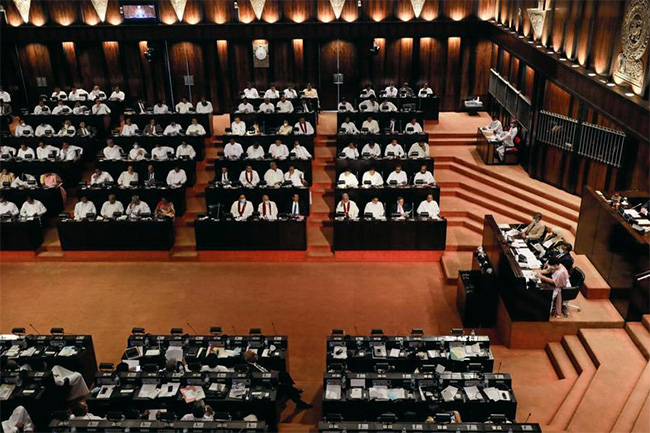
A no-confidence motion brought by the Opposition against Energy Minister Kumara Jayakody was defeated in Parliament yesterday by a majority of 104 votes.At the end of the debate, 49 members voted in favour of the motion, while 153 voted against it.
The motion, submitted to the Speaker on 19 March, was signed by Opposition Leader Sajith Premadasa, SJB MPs, and other Opposition members.
It accused Minister Jayakody of failing to ensure the procurement of adequate and quality coal for the Lakvijaya Coal Power Plant in Norochcholai, alleging that such negligence amounted to a breach of ministerial responsibility over a critical national energy asset.
The motion also cited ongoing legal proceedings against the Minister, noting that he has been indicted by the Commission to Investigate Allegations of Bribery or Corruption and produced before the Colombo High Court under Section 70 of the Bribery Act, in connection with alleged acts of corruption during his tenure as Procurement Manager of the Ceylon Fertiliser Company Limited.
The motion read: Vote of No Confidence against Kumara Jayakody, Minister of Energy,— Whereas the Provision in Section 6 of the Part III of the Code of Conduct for Members of Parliament which states that: “The Members shall on all occasions act in accordance with the public trust entrusted with them and shall always behave with probity and integrity, including the use by them of any public resources.” has been violated; And whereas the following rules of conduct set out in Section 9 of the Part V of the Code of Conduct for Members of Parliament have prima facie been breached, namely:- “(a) to be conscience; (c) to act so as to merit the trust and respect of the people; (e) to hold themselves accountable for the conduct and duties for which they are responsible;” And whereas it is observed that the Minister has failed, in his capacity as a Minister of the Cabinet of Ministers, to discharge the fundamental duties incumbent upon him in accordance with Article 28 of the Constitution;
And whereas it is established that the Minister of Energy has failed to discharge his primary duty of ensuring the procurement of adequate and good quality coal for the Norochcholai Lakvijaya Coal Power Plant;
And whereas such gross negligence in overseeing a critical national energy asset constitutes a fundamental breach of ministerial responsibility;
And whereas the Minister of Energy has failed to carry out the subjects and functions vested in him by the Notification of Gazette Extraordinary No. 2412/08 of 25th November 2024 of the Democratic Socialist Republic of Sri Lanka, including taking necessary steps to reduce the losses at the institutional management level and technical damages that occur to the electricity generation and distribution system and reduction of costs for generating electricity and removal of uncertainties during generation;
And whereas the Commission to Investigate Allegations of Bribery or Corruption has filed formal indictments before the Colombo High Court against the incumbent Minister of Energy under Section 70 of the Bribery Act (Chapter 26) for the offence of “corruption” in connection with acts of corruption allegedly committed while he was serving as the Procurement Manager of the Lanka Fertilizer Company;
And whereas, in light of the foregoing, the Minister of Energy has irretrievably forfeited the confidence of Parliament and the people of Sri Lanka by causing losses to public finances, endangering national energy security, corruptly mishandling the procurement process, being subjected to active judicial proceedings for the offence of “corruption”, and betraying the Government’s own “anti-corruption mandate”, and his continued tenure as the Minister of Energy is contrary to the public interest, the rule of law, and the principles of good governance;
That this Parliament resolves that it has no confidence in the competence of Kumara Jayakody, Minister of Energy to function as a Minister of the Cabinet of Ministers any longer.”
by Saman Indrajith

Chinese Ambassador to Sri Lanka Qi Zhenhong yesterday assured that China would not allow a fuel crisis to arise in Sri Lanka, under any circumstances, reaffirming Beijing’s continued support to the country.
The Ambassador made these remarks addressing the media after attending a dry ration distribution programme for 350 low-income families at Sri Chandananda Buddhist College, at Asgiriya, in Kandy.
Highlighting the longstanding ties between the two countries, Ambassador Qi said China has consistently stood by Sri Lanka and remains ready to extend assistance whenever required.
Amid concerns over global energy disruptions, stemming from the ongoing Middle East conflict, he noted that several countries are already facing difficulties, but stressed that China is prepared to support Sri Lanka at any time.
He said that any potential fuel shortage in Sri Lanka could be managed with the involvement of China’s Sinopec.
Reiterating Beijing’s commitment to Sri Lanka’s economic recovery and development, the Envoy also expressed hope that the current ceasefire in the Middle East would hold, while assuring that China stands ready to respond to any future developments and assist Sri Lanka as needed.
By SK Samaranayake

Sooryavanshi blitz, Jurel 81* help Rajasthan Royals take down Royal Challengers Bengaluru with ease

Sun directly overhead Pomparippu, Anuradhapura, Mihinthale, Galenbindunuwewa, Agbopura and Serunuwara about 12:11 noon today (11)

Showers expected in the Western, Sabaragamuwa, North-western , Southern and Uva provinces and in Anuradhapura, Mannar, Kandy and Nuwara-Eliya districts after 2.00 p.m.

Opposition NCM against Energy Minister defeated

Chinese Ambassador assures Lanka China will not allow a fuel crisis to develop here

Minister Jayatissa blames administrations since 2010 for not following proper procedures when procuring coal

‘Dates have the highest sugar content to fight Coronavirus’

Sunday Island 27 December – Headlines

#SundayIsland 17th December – Headlines

Sunday Island – 28th March

Sunday Island Headlines – 21 March

Sunday Island – 21st February – Headlines
-

 Features7 days ago
Ranjith Siyambalapitiya turns custodian of a rare living collection
-

 News7 days ago
Global ‘Walk for Peace’ to be held in Lanka
-

 News5 days ago
Lankan-origin actress Subashini found dead in India
-

 News3 days ago
AG: Coal procurement full of irregularities
-

 Business2 days ago
Israeli attack on Lebanon triggers local stock market volatility
-

 Features7 days ago
Beyond the Blue Skies: A Tribute to Captain Elmo Jayawardena
-

 Features7 days ago
Aspects of Ceylon/Sri Lanka Foreign Relations – 1948 to 1976
-

 Business3 days ago
Hayleys Mobility introduces Premium OMODA C9 PHEV