
Business
Sri Lanka facing another uphill battle on global front:Climate Finance

• Excessive bureaucracy between developed country parties and Sri Lankan negotiators
• Sri Lankan side studying how to crack the code of complex financial mechanism
• World’s biggest carbon polluters are just a few countries
By Sanath Nanayakkare
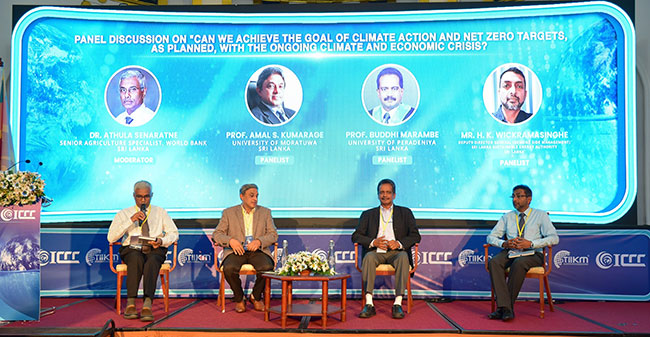
Sri Lanka’s attempts to gain access to Climate Finance from developed country parties is going to require a great deal of effort as there is a whole slew of bureaucracy between the developed country parties and Sri Lankan negotiators, Harsha Wickramasinghe, Deputy Director General (Demand Side Management) Sri Lanka Sustainable Energy Authority told The Island Financial Review last week.
Speaking to The Island at the International Conference on Climate Change 2023 (ICCC 2023) held at Taj Samudra Colombo, the renewable energy expert said,” It is so very difficult to access Climate Finance. It is technically very sophisticated to write a proposal and get it approved by these people. I have gone through the mill with one of the Climate Funds and found it a very frustrating exercise. They are used to these systems, but we are not. So we have to learn the tricks of the trade when it comes to gaining access to Climate Finance. It’s not about being unable to convince these parties, but about the mechanism that they have put in place for such funding to actually materialise. There is a large amount of bureaucracy between us and them. We have not given up though. I’d say that we are learning by doing it. My hope is that things will improve as we go along. We have intelligent people on our side that can crack the code and have access to Climate Finance. When you take institutional lenders such as the Asian Development Bank or the World Bank, they have a good system up and running. In contrast, Climate Finance is in its initial stage and they have a way of doing their own evaluations. Besides, they have a lot of teething issues in the process.”
Climate Finance refers to public, private and alternative sources of financing utilized to support mitigation and adaptation to address climate change. The Kyoto Protocol and the Paris Agreement call for financial assistance from parties with more financial resources to those that are less endowed and more vulnerable.
Developed country parties are to provide financial resources to assist developing country parties in implementing the objectives of the United Nations Framework Convention on Climate Change (UNFCCC).
To facilitate the provision of climate finance, a financial mechanism has been established to provide financial resources to developing country parties. Sri Lanka, however, finds this mechanism a frustrating one to break through.
“Wealthy countries are disproportionately responsible for the climate crisis, and they have the double responsibility to both cut emissions at home and to support developing countries with the costs of moving from dirty energy forms to cleaner, lower-carbon ones,” said Oxfam’s Climate Policy Lead Nafkote Dabi in November 2022.
President Ranil Wickremesinghe, who had participated in the COP 27 United Nations Climate Change Conference in Egypt in November 2022, was critical of the countries that were historically accountable for the greatest damage and are capable of meaningful contributions, but have stymied the furtherance of climate action.


Asian Development Bank (ADB) President Masato Kanda met with Sri Lanka Prime Minister Harini Amarasuriya at ADB’s Manila headquarters recently. The meeting reaffirmed the strong development partnership between ADB and Sri Lanka, with both leaders underscoring their commitment to post-cyclone recovery, inclusive growth, and advancing women’s equality.
“Sri Lanka’s resilience in the face of crises has been remarkable,” said Kanda. “We are committed to helping Sri Lanka rebuild after Cyclone Ditwah, while also investing in the country’s future by empowering women entrepreneurs and strengthening education and essential skills.”
Looking ahead, ADB is ready to provide more than $1 billion annually to Sri Lanka from 2026 to 2029. This financing will target macroeconomic stability, private sector-led growth, education and skills development, and resilient infrastructure. Key initiatives include a major digital transformation program to help unlock Sri Lanka’s digital economy, alongside support for its accession to the Regional Comprehensive Economic Partnership to deepen its integration into regional trade and investment networks.
During their discussion, Kanda emphasized ADB’s response to the devastation caused by Cyclone Ditwah. Building on emergency financing already mobilized, ADB is fast-tracking an emergency assistance loan to restore damaged infrastructure and support affected livelihoods.
With Dr. Amarasuriya serving as the keynote speaker for ADB’s International Women’s Day event, the leaders highlighted women’s equality as a cornerstone of inclusive development. Kanda noted ADB’s long-standing work as an implementing partner of the Women Entrepreneurs Finance Initiative, which expands access to finance, business skills training, and policy reform for women-owned enterprises. This partnership has helped drive lasting change, with Sri Lanka becoming one of the first countries to adopt the Women Entrepreneurs Finance Code at the national level in March 2025.
Dr. Amarasuriya also engaged in dialogue facilitated by ADB to advance Sri Lanka’s skills agenda, including discussions on referencing skills and qualifications with the Association of Southeast Asian Nations and on mutual areas of interest with the Philippines related to technical and vocational education and training.

The Unit Trust Association of Sri Lanka (UTASL) announced its new Board of Directors, appointing Jeevan Sukumaran of SENFIN Asset Management as President. The Board assumes leadership at a time of significant growth and resilience in Sri Lanka’s Unit Trust industry. Over the past five years, the number of unit holders has more than doubled, while assets under management have grown substantially, reflecting a clear shift in investor behaviour amid evolving economic conditions.
The 2026–2027 Board includes Vice President Kavin Karunamoorthy (First Capital Wealth Management), Secretary Asanka Herath (Lynear Wealth Management), Assistant Secretary Gayan De Silva (Capital Alliance), and Treasurer Wishan Perera (Softlogic Invest).
President Jeevan Sukumaran highlighted the importance of expanding the industry’s reach and increasing retail participation nationwide. “Whilst the Unit Trust industry has grown significantly in recent years, the next phase must focus on broadening retail investor participation across Sri Lanka’s different geographic/demographic sectors, with the key priority being strengthening investor education and awareness, particularly outside major urban centres. Improving financial literacy and expanding access to professionally managed investment solutions are essential to building long-term confidence and encouraging more Sri Lankans to invest in unit trusts.”
The new Board intends to build on the industry’s recent momentum by prioritising investor education, digital accessibility, and product innovation. Over the coming years, enhanced digital platforms are expected to make Unit Trust products more accessible, enabling investors across the country to participate in capital markets in a convenient and transparent manner.

Colombo’s vibrant dining landscape has received a fresh infusion of flavour with the renewed culinary direction of Indiya, the signature Indian restaurant perched high above the city at Cinnamon Life at City of Dreams. With celebrated Indian chef Mukesh Joshi now steering the kitchen, the restaurant is presenting a menu that celebrates the depth, diversity and soul of Indian cuisine while subtly weaving in Sri Lankan influences.
Located on the spectacular Level 23 of the sprawling Cinnamon Life complex, Indiya’s setting itself feels like a prelude to the culinary journey that unfolds at the table.
The restaurant’s sweeping views of Colombo’s skyline provide a dramatic backdrop to a menu designed to take diners across India’s many culinary regions — from the fragrant biryani traditions of Awadh to the bold spice profiles of coastal kitchens.
At the heart of this new chapter is Chef Mukesh Joshi, a culinary craftsman whose career spans some of India’s most renowned hospitality institutions as well as prominent dining establishments in the Middle East.
Having honed his skills at luxury hotels such as The Westin and St. Regis Mumbai before leading kitchens in Dubai’s thriving Indian dining scene, Joshi is known for his ability to balance traditional flavours with contemporary finesse.
At Indiya, his philosophy is simple yet compelling: celebrate the authenticity of Indian cooking while creating dishes that encourage sharing and conversation.
The experience begins with a vibrant array of small plates that capture the playful spirit of India’s street food traditions. The crisp Sev Papdi Chaat offers bursts of sweet, tangy and spicy notes, while a generous Pakora Platter brings together an assortment of golden-fried fritters that evoke the comforting flavours of roadside tea stalls across the subcontinent.
From there, the menu moves naturally into the world of the tandoor — the clay oven that lies at the heart of many Indian kitchens. Among the highlights is the Hariyali Tandoori Gobi, where cauliflower is marinated in a fragrant blend of herbs before being charred to smoky perfection. Equally intriguing is the Rajma Galouti, a vegetarian reinterpretation of the famed Lucknowi kebab, delivering a melt-in-the-mouth texture that surprises and delights.
Seafood lovers will find much to savour as well. Jhinga Koliwada, a coastal delicacy of spiced prawns fried to a crisp exterior, offers a lively contrast to the delicately seasoned Rawa Fried Surmai. These dishes reflect Chef Mukesh’s confident handling of spice and texture — two essential pillars of Indian cooking.
No Indian dining experience would be complete without the ritual of sharing freshly baked breads, and Indiya’s basket arrives warm and inviting. Chilli Cheese Naan brings a playful modern twist to a classic favourite, while flaky parathas and stuffed Aloo Kulcha provide comforting companions to the restaurant’s richly spiced curries.
By Ifham Nizam

Heat Index likely to increase up to ‘Caution level’ at some places in the Western, Sabaragamuwa, Southern and North-western provinces and in Monaragala and Mannar districts

Showers above 50 mm can be expected at some places in the Western and Sabaragamuwa provinces and in the Galle and Matara districts

Govt. bends rules, lowers coal standards in favour of errant company: FSP

Lanka requests diesel from India

Gas shortage pushes up electricity demand, night peak rises: CEB

Navy seizes narcotics haul, lethal weapons in two vessels, arrests 10 suspects

‘Dates have the highest sugar content to fight Coronavirus’

Sunday Island 27 December – Headlines

#SundayIsland 17th December – Headlines

Sunday Island – 28th March

Sunday Island Headlines – 21 March

Sunday Island – 21st February – Headlines
-

 News6 days ago
Peradeniya Uni issues alert over leopards in its premises
-

 News4 days ago
Repatriation of Iranian naval personnel Sri Lanka’s call: Washington
-

 News6 days ago
Wife raises alarm over Sallay’s detention under PTA
-
 Features4 days ago
Winds of Change:Geopolitics at the crossroads of South and Southeast Asia
-

 News3 days ago
Prof. Dunusinghe warns Lanka at serious risk due to ME war
-

 Latest News6 days ago
Heat Index at ‘Caution Level’ in the Sabaragamuwa province and, Colombo, Gampaha, Kurunegala, Anuradhapura, Vavuniya, Hambanthota and Monaragala districts
-

 Sports2 days ago
Royal start favourites in historic Battle of the Blues
-

 Features6 days ago
The final voyage of the Iranian warship sunk by the US