
News
SLPP rebel MPs urge GR to break his silence on 13 A

By Shamindra Ferdinando
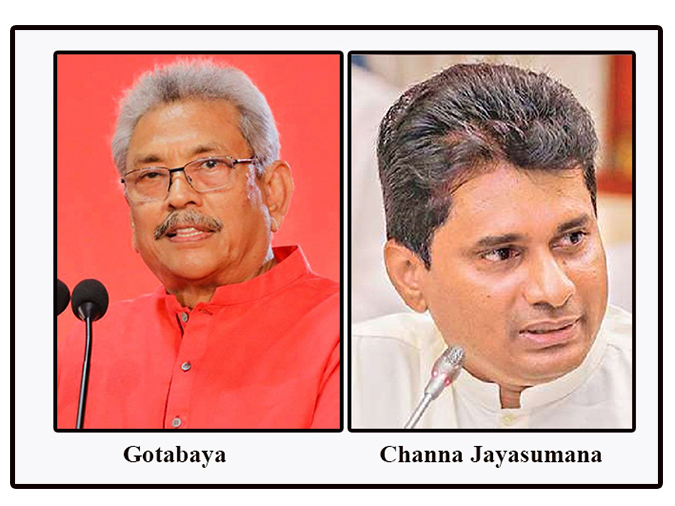
Rebel SLPP MP Prof. Channa Jayasumana yesterday (11) said that former President Gotabaya Rajapaksa should make his position clear on his successor Ranil Wickremesinghe’s move to fully implement the 13th Amendment to the Constitution.
Reiterating his strong opposition to President Wickremesinghe’s controversial plan, the Anuradhapura District MP stressed that Gotabaya Rajapaksa couldn’t keep silent as the Wickremesinghe-Rajapaksa government embarked on a strategy inimical to national interests. Prof. Jayasumana represents a group of about 13 SLPP MPs. The group includes former External Affairs Minister Prof. G. L. Peiris, Dullas Alahapperuma and Prof. Charitha Herath.
Parliament elected the UNP leader as President in late July last year to complete the remainder of Gotabaya Rajapaksa’s five-year term won at the last presidential election in Nov. 2019, Prof. Jayasumana said. Having won a landslide victory, promising a new Constitution that reflected Sri Lanka’s triumph over separatist terrorism, how could the wartime Defence Secretary remain silent when his mandate was being brazenly used to do away with the country’s unitary status.
Referring to President Wickremesinghe’s latest declarations in Parliament, pertaining to the 13th Amendment to the Constitution, enacted in late 1988, the failure on the part of the former President to take a clear stand on this issue could be misconstrued as his tacit support to the current agenda. How the wartime Defence Secretary could allow the abuse of his mandate, the MP asked.
Responding to a query broached by The Island, the academic said that 133 MPs, who voted for Wickremesinghe at the July 20 election in Parliament to elect an MP to complete the ousted leader’s term, wouldn’t have anticipated him taking such far reaching decisions.
Prof. Jayasumana voted for Dullas Alahappeuma who altogether polled 82 votes whereas JVP candidate Anura Kumara Dissanayake managed to secure just three votes. Prof. Jayasumana addressed this issue in the wake of TNA delegation meeting Public Security Minister Tiran Alles to discuss the latest developments.
Acknowledging that the SLPP General Secretary Sagara Kariyawasam, during All-Party Conference (APC), chaired by President Wickremesinghe, on 26 July, declared that they were not on the same page, Prof. Jayasumana urged the SLPP parliamentary group, headed by Prime Minister Dinesh Gunawardena, to issue an official statement in this regard.
Appreciating the significant financial support extended by India during Sri Lanka’s hour of need, MP Jayasumana said but it wouldn’t be fair at all to pressure the incumbent government on the 13th Amendment. “We do not want to revisit the origins of terrorism but India cannot absolve itself of the responsibility for creating an environment here in the ’80s to facilitate its devolution project,” Prof. Jayasumana said.
The MP said that if the former President and the SLPP, still the largest party represented in parliament, didn’t intervene immediately, they would be held accountable for breaking up the country. The outcome could be far worse than the debilitating current crisis blamed on mismanagement of the national economy, Prof. Jayasumana said.
The former President should be answerable to 6.9 mn voters who exercised their franchise for him at the last presidential poll, the MP said. Similarly, the SLPP couldn’t turn its back on those who gave the young party nearly 2/3 majority, Prof. Jayasumana said.
Having recognized the LTTE, way back in 2001, as the sole representative of the Tamil speaking people, thereby justifying Tiger terrorism, the TNA was now demanding federal status, Prof. Jayasumana said, urging the incumbent President to seek fresh mandates at presidential and parliamentary polls if he genuinely wanted to go ahead with the 13th Amendment.
Those pushing for the13th Amendment had conveniently forgotten the way the then President J.R. Jayewardene forcibly enacted it in line with the Indo-Lanka Accord signed the year before, an irate lawmaker said. The MP said that political parties couldn’t be unaware that the implementation of the 13th Amendment was to take place after the disarming of all Indian trained terrorist groups in 1987.
The LTTE retained a conventional fighting capacity till 2009 and was defeated in May 2009, the Minister said, adding that there couldn’t be any justification in granting police powers to a region that challenged the country’s unitary status.








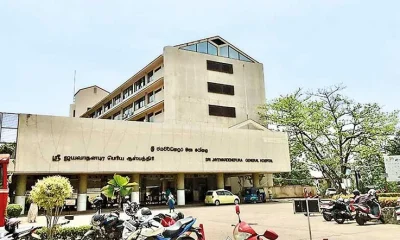
The special ward at Sri Jayewardenepura General Hospital, which had until now been reserved exclusively for the use of the Executive President, was opened for the public for the provision of medical treatment to the general public from Tuesday (24).
This decision was taken jointly by the Ministry of Health and the hospital administration, in accordance with instructions given by President Anura Kumara Dissanayake.
Constructed in 1984 with a grant from the Government of Japan, Sri Jayewardenepura General Hospital was originally established with a capacity of 1,000 beds. However, in line with the initial design, an additional special unit, designated as Room No. 1001, was included exclusively for the personal use of the Executive President.
Over the 42 years since the hospital’s establishment, this facility has been utilised only on a very limited number of occasions. Nevertheless, it has been maintained over the years in anticipation of a possible visit by a sitting President, without being made available for patient use.
With effect from today, this special unit will be utilised for the benefit of general patients receiving treatment at the hospital. This step has been taken in line with the Government’s policy of ensuring the more efficient use of public assets and resources to meet the healthcare needs of the people.

The second meeting of the Cabinet Sub-Committee appointed to ensure the orderly functioning of the public service was held on Tuesday (24) afternoon at the Presidential Secretariat, under the patronage of Prime Minister Dr Harini Amarasuriya.
Extensive discussions were held on the immediate measures required to ensure the uninterrupted delivery of government services to the public and to address the challenges faced by public servants.
Attention was also drawn to maintaining the continuous operation of services under the Ministries of Public Administration, Provincial Councils and Local Government, Health, Education, and Justice. Accordingly, it was decided to ensure that examinations are conducted as scheduled and that essential medicines are supplied to hospitals without disruption.
The challenges in passenger transport services and the railway transport system, as well as future measures, were also discussed at length. Focus was also placed on the steps to be taken regarding the transportation of essential goods.
In addition, attention was given to introducing digital service systems to facilitate working from home and to enhance the efficiency of existing services. It was also noted that these activities would be supervised under the Ministry of Digital Economy.
Instructions were further issued to review the current energy management practices across all ministries and departments and to take steps to implement necessary policy changes.
Minister of Public Administration, Provincial Councils and Local Government A. H. M. M. H. Abeyaratne, Secretary to the Prime Minister Pradeep Saputhanthri, Chief of Staff to the President Prabath Chandrakeerthi, Secretary to the Ministry of Public Administration, Provincial Councils and Local Government S. Aloka Bandara, Secretary to the Ministry of Health and Mass Media Dr Anil Jasinghe, Secretary to the Ministry of Energy Professor T. M. Udayanga Hemapala, Secretary to the Ministry of Digital Economy T. R. W. S. Dhanapala, Secretary to the Ministry of Justice and National Integration Ayesha Jinasena, PC, Senior Additional Secretary to the President Roshan Gamage, and Chairman of the Ceylon Petroleum Corporation D. J. A. S. S. Rajakaruna, along with other committee members, were also present at the occasion.
… first NPPer to face charges under Section 70 of Bribery Act
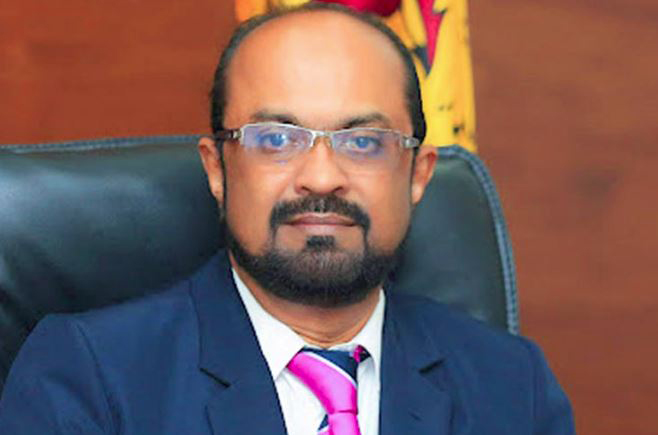
Colombo High Court has issued summons on Energy Minister Kumara Jayakody to appear in court today (27) to serve indictment in a corruption case filed by the Commission to Investigate Allegations of Bribery or Corruption (CIABOC). Action has been taken under Section 70 of the Bribery Act. The losses suffered by the government have been estimated at Rs. 8,859,708.
National List (NL) MP Jayakody is the first NPP minister or politician at any level to be indicted for corruption. The NPP parliamentary group consists of 159 including 18 NL members.
The summons has been issued by High Court judge Rashantha Godawalage.
Although CIABOC previously in many instances arrested those who had been under investigation and produced them before Magistrate courts, Minister Jayakody has been directly summoned by the Colombo High Court.
The investigation into alleged corruption in procurement during the time Jayakody served the Ceylon Fertilizer Corporation (CFC) started after the change of government in 2015.
According to the CIABOC investigation, the alleged instance of corruption took place in early 2014 towards the tail end of Mahinda Rajapaksa’s second term. At that time Jayakody was CFC’s Procurement Manager, and the CIABOC dragged the investigation until its current leadership under overall speeding up of the cases recently completed the inquiry.
Parliament recently announced that the debate on no-faith motion moved against Minister Jayakody over alleged irregularities in the procurement of substandard coal for the country’s only coal-fired power station at Norochcholai.
SJB MP Mujibur Rahman said that the NPP, having campaigned on an anti-corruption platform during presidential and parliamentary polls in 2025 couldn’t under any circumstances shield minister Jayakody. The indictment of Jayakody over a corruption case that had happened in 2014 and the failure on his part to fulfill obligations as Energy Minister under the current dispensation couldn’t be considered separately, the Colombo District MP said.
The issue at hand is whether the NPP would try to protect Jayakody at the expense of the government, MP Rahman said. Once the NPPer is formally charged in a corruption case the government would find it extremely difficult to keep him in the cabinet, the former UNPer said.
SJB lawmaker S.M. Marrikar recently warned Minister Jayakody that he should be prepared to serve a jail term. The warning was issued at a media briefing that primarily dealt with the alleged irregularities in the procurement of coal and their decision to move a no-faith motion against the minister. Marrikar explained how the crisis coupled with the growing diesel shortage could compel the government to increase electricity tariffs by as much as 18 percent next week. MP Marikkar said that they were eagerly waiting to see who backs Jayakody at the expense of the government during the upcoming vote on the no-faith motion.
There had been a previous case of a sitting minister being charged under the Bribery Act in respect of corruption perpetrated as a government servant. MP Rahman said that they intended to intensify the ongoing campaign against the government on the strength of the unprecedented corruption case and the outcome of the no-faith motion. “Of course, they have the numbers to defeat our no-faith motion. But, in doing so, they end up with egg on their face. That is the reality,” Rahman said, adding that those responsible for waste, corruption and irregularities whichever political parties they represented shouldn’t expect special status.
MP Rahman alleged that the CIABOC granted special status to Minister Jayakody. All those who had been indicted previously were first called to the CIABOC, recorded their statements and then arrested, handcuffed and produced in court. The media was afforded the opportunity to cover their humiliation, MP Rahman said, but in this case the powers that be paved the way for the accused to receive indictments directly from the Colombo High Court.
“Let us see whether the Bar Association of Sri Lanka responds to this development,” MP Rahman said.
By Shamindra Ferdinando

Presidential Suite at Sri Jayewardenepura General Hospital opened to the public

Cabinet Sub-Committee appointed to streamline the Public Service meets for the second time

PSL 2026: Teams allowed to submit two XIs and pick one after toss

Japan Premier League [JPL], building cricket from the ground up

Showers may occur at a few places in the Sabaragamuwa province and in Galle, Matara, Kalutara and Nuwara-Eliya districts in the evening

Energy Minister indicted on corruption charges ahead of no-faith motion against him

‘Dates have the highest sugar content to fight Coronavirus’

Sunday Island 27 December – Headlines

#SundayIsland 17th December – Headlines

Sunday Island – 28th March

Sunday Island Headlines – 21 March

Sunday Island – 21st February – Headlines
-

 News3 days ago
Senior citizens above 70 years to receive March allowances on Thursday (26)
-

 Features5 days ago
Trincomalee oil tank farm: An engineering marvel
-
 News23 hours ago
Energy Minister indicted on corruption charges ahead of no-faith motion against him
-

 News2 days ago
US dodges question on AKD’s claim SL denied permission for military aircraft to land
-

 Features5 days ago
The scientist who was finally heard
-

 Business2 days ago
Dialog Unveils Dialog Play Mini with Netflix and Apple TV
-

 News3 days ago
CEB Engineers warn public to be prepared for power cuts after New Year
-
 News3 days ago
Japanese boost to Sri J’pura Hospital, an outright gift from Tokyo during JRJ rule