
News
SL workers to be given military training in Israel – Hakeem

Govt. denies claim as baseless
by Saman Indrajith
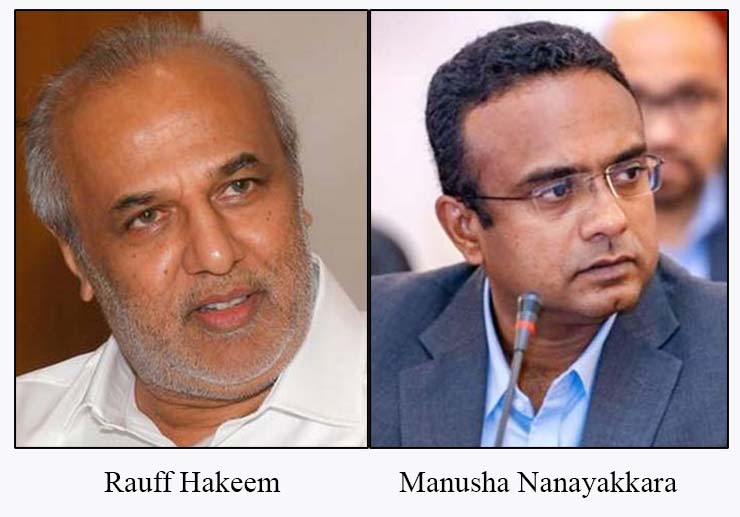
SLMC leader and SJB Kandy District MP Rauff Hakeem told Parliament on Saturday that Sri Lankan expatriate workers planning to go to Israel were to be given military training in that country.
Hakeem said numerous war crimes and crimes against humanity had taken place in and around Gaza. “Israel is surrounded by Arab countries where hundreds of thousands of Sri Lankans are working. We must reject Israel’s offer. This is a very sensitive matter. There is a plan to give military training to expatriate workers in Israel. They are to be given guns even if they work there as caregivers. These expatriate workers are to fill the vacancies created by the workers who have left due to war.
There is a five-day ceasefire, but war will resume. Sri Lankan workers are to be employed as farmers in areas grabbed by Israel from the Palestinians in Gaza. Several envoys from the Arabic countries have raised this question with me. Presidents of South Africa and Brazil have come close to severing diplomatic ties with Israel. It is not wise to send our people to Israel at a time when other countries are planning to suspend ties with that country. We should not be opportunistic. Please, reconsider the decision to send Lankans there and think of the consequences of them getting weapons training. There could be unintended consequences.
“We extend our condolences to the family members of two Lankan expatriate workers who were killed in the war. If such incidents recur then that could lead to disharmony among communities here. Please reconsider this decision at this time,” Hakeem said.
SLPP Polonnaruwa District MP Jagath Samarawickrama said those who were happy when the doctors left this country were now shedding tears for the Sri Lanka Lankans to be sent to Israel. “This is an opportunity that we must grab. I condemn this attempt to prevent us from using that opportunity,” the MP said.
Minister of Labour and Foreign Employment Manusha Nanayakkara said that there was no truth in the allegation by MP Hakeem. He said that Sri Lanka had got an opportunity to send 10,000 workers to Israel.
“No military training is provided for Sri Lankan expatriates. Making false allegations will affect Sri Lanka’s bilateral relationship with Israel. Allow the Sri Lankan government to maintain ties with Israel in line with its non-aligned foreign policy. We have condemned the Hamas attack on Israel on Oct 7 and military strikes carried out by Israel on Palestine since then. One should not make irresponsible statements and disturb diplomatic relations,” the Minister said.
He also denied allegations that Sri Lankans would be sent to war-torn areas and their lives would be in danger. The Minister said no employee would be sent to areas captured by Israel. He said all employees would be sent to areas that are not affected by the war.







Latest News
Heat Index likely to increase up to ‘Caution level’ at some places in the Western, Sabaragamuwa, Southern and North-western provinces and in Monaragala and Mannar districts

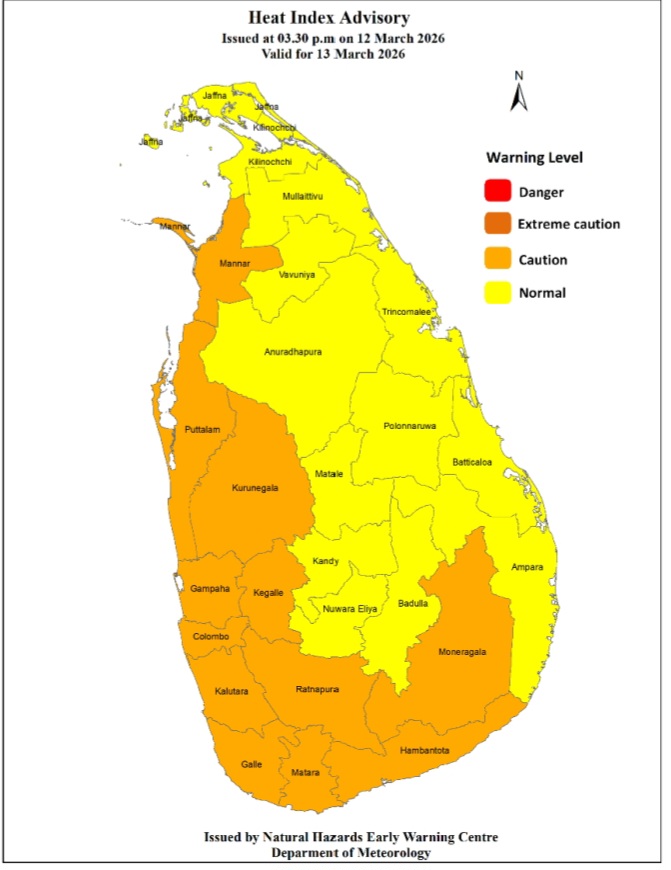
Warm Weather Advisory
Issued by the Natural Hazards Early Warning Centre of the Department of Meteorology at 3.30 p.m. on 12 March 2026, valid for 13 March 2026.
Heat index, the temperature felt on human body is likely to increase up to ‘Caution level’ at some places in Western, Sabaragamuwa, Southern and North-western provinces and in
Monaragala and Mannar districts.
The Heat Index Forecast is calculated by using relative humidity and maximum temperature and this is the condition that is felt on your body. This is not the forecast of maximum temperature. It is generated by the Department of Meteorology for the next day period and prepared by using global numerical weather prediction model data.

Effect of the heat index on human body is mentioned in the above table and it is prepared on
the advice of the Ministry of Health and Indigenous Medical Services.
ACTION REQUIRED
Job sites: Stay hydrated and takes breaks in the shade as often as possible.
Indoors: Check up on the elderly and the sick.
Vehicles: Never leave children unattended.
Outdoors: Limit strenuous outdoor activities, find shade and stay hydrated.
Dress: Wear lightweight and white or light-colored clothing.
Note:
In addition, please refer to advisories issued by the Disaster Preparedness & Response Division, Ministry of Health in this regard as well. For further clarifications please contact 011-7446491.

The Frontline Socialist Party (FSP) yesterday accused the government of trying to award another tender to the Indian company that supplied low-grade coal to the Norochcholai Power Plant and failed to deliver the stipulated amount of coal according to schedule.
The allegation was made by the Education Secretary of the Progressive Socialist Party, Pubudu Jayagoda, during media briefing at the party office in Nugegoda last afternoon.
Jayagoda said that in September 2025, the government had awarded a tender to the Indian company Trident Chemphar to supply 25 coal shipments for electricity generation in 2026.
In August 2025, it was confirmed that the coal delivered by the company was substandard. The company also failed to supply coal on schedule. Although the first shipment was expected in the second week of December 2025, it arrived at the end of the month. By mid-March, only 12 ships had arrived, and biweekly deliveries have been disrupted, putting Sri Lanka at risk of a severe energy shortage.
On 11 March, the government called a sudden spot tender for five coal shipments. Four companies submitted bids, and they include Trident Chemphar. FSP criticiced awarding the tender to the same discredited company, saying it was unethical and could trigger a major national crisis, as the company had failed to supply quality coal reliably in the past.
Previously, coal quality was strictly measured, with a “Reject Value”. But now to help the errant supplier the term of Reject Value has now been omitted altogether and replaced with a new term ‘Minimum Value’ setting it as the minimum calorific threshold—coal producing less than 5,900 kilocalories per kilogram was rejected, and coal with ash content above 16% was also discarded.
However, the government is now reportedly lowering these standards, accepting substandard coal, and changing tender specifications to accommodate the company.
Jayagoda castigated the latest stunt coming especially at a time when the world faces war and oil shortages. Diesel meant for electricity generation is being diverted to school buses, public transport, and emergency vehicles, leaving households at risk of prolonged blackouts. Even if diesel is imported, electricity tariffs could skyrocket.

The Indian Ministry of External Affairs has said it is considering requests for diesel supplies from neighbouring countries, including Sri Lanka, Bangladesh and the Maldives.
Speaking to the Press Trust of India, Ministry Spokesperson Randhir Jaiswal noted that India was a major exporter of refined petroleum products in the region. He confirmed that Bangladesh had formally requested a diesel supply, which is currently under review.
He said that diesel exports to Bangladesh had largely continued since 2017, but any new allocations would take into account India’s refining capacity, domestic demand, and overall fuel availability.
Jaiswal added that similar requests from Sri Lanka and the Maldives were also being considered, with India’s own energy requirements forming a key part of the decision-making process.

Heat Index likely to increase up to ‘Caution level’ at some places in the Western, Sabaragamuwa, Southern and North-western provinces and in Monaragala and Mannar districts

Showers above 50 mm can be expected at some places in the Western and Sabaragamuwa provinces and in the Galle and Matara districts

Govt. bends rules, lowers coal standards in favour of errant company: FSP

Lanka requests diesel from India

Gas shortage pushes up electricity demand, night peak rises: CEB

Navy seizes narcotics haul, lethal weapons in two vessels, arrests 10 suspects

‘Dates have the highest sugar content to fight Coronavirus’

Sunday Island 27 December – Headlines

#SundayIsland 17th December – Headlines

Sunday Island – 28th March

Sunday Island Headlines – 21 March

Sunday Island – 21st February – Headlines
-

 News6 days ago
Peradeniya Uni issues alert over leopards in its premises
-

 News4 days ago
Repatriation of Iranian naval personnel Sri Lanka’s call: Washington
-

 News6 days ago
Wife raises alarm over Sallay’s detention under PTA
-
 Features4 days ago
Winds of Change:Geopolitics at the crossroads of South and Southeast Asia
-

 News3 days ago
Prof. Dunusinghe warns Lanka at serious risk due to ME war
-

 Latest News6 days ago
Heat Index at ‘Caution Level’ in the Sabaragamuwa province and, Colombo, Gampaha, Kurunegala, Anuradhapura, Vavuniya, Hambanthota and Monaragala districts
-

 Sports2 days ago
Royal start favourites in historic Battle of the Blues
-

 Features6 days ago
The final voyage of the Iranian warship sunk by the US