
News
SJU first University in South Asia to report its greenhouse gas emissions


The University of Sri Jayewardenepura has become the first university in South Asia to report its greenhouse gas emissions in accordance with the ISO 14064-1:2018 standard. The official Awarding Ceremony of the ISO 14064-1:2018 certificate took place on Thursday at the Senate Boardroom of the University. The Jayewardenepura University has in a media statement said that it is committed to the environmental well-being of the country and has implemented the “Carbon Neutral Project” led by the Centre for Sustainability (CFS) of the Department of Forestry and Environmental Sciences. The project aims to make USJ the first carbon neutral university in South Asia.
Steps to achieve this goal include calculating the University’s carbon footprint. Calculating and comparing the carbon footprint yearly allows USJ to understand and monitor its individual contribution to global warming and employ strategies to reduce the GHG emissions. Further, to simply calculating the carbon footprint, USJ has now voluntarily disclosed greenhouse gas emissions from 2019 and had them verified in accordance with ISO 14064-3: 2019. The University is now proud to report that the requirements for ISO 14064 -1: 2018 have been successfully met with regards to GHG emissions for the academic year of 2019. A huge achievement on the road to neutrality and combined with multiple other CFS projects brings USJ ever closer to insetting all of its emissions.
The CFS is at the forefront of carbon neutrality study and strategy amongst the academic community of Sri Lanka and has created a systematic plan, based on research findings, to compensate for the University’s GHG emissions, CFS Director, Prof. Priyan Perera, said.Prof. Perera said achieving accurate carbon footprint reporting in an institution of this magnitude is no easy task and requires the contribution and cooperation of all the departments and divisions on campus. He said that the University was to utilise our centralized web-based portal to assist all departments in reporting their individual emissions.
“Spreading awareness about carbon reporting, through training sessions and workshops is, and will remain, a key component of present and future initiatives to reduce our overall climate impact,” he said.
The ISO 14064-1 Certification to the University of Sri Jayewardenepura was awarded by The Sustainable Future Group (SFG), an ISO 14065 accredited body by the International Accreditation Forum (IAF) through the Sri Lanka Accreditation Board (SLAB). SFG is the only sustainability verification and certification body that is accredited to verify and validate Organisational-, Project-, and Product-level GHG emissions inventories under ISO 14064-1 & 2 and ISO 14067.
Under the scrutiny of ‘‘The Sustainable Future Group’ direct and indirect GHG emissions were calculated and verified as 3,838.56 tonnes of CO2e. Direct emissions include sources such as fuel consumption for university-owned vehicles, on-site fuel for generators, and laboratory emissions. Indirect emissions refer to purchased electricity for use in lecture halls, administrative buildings, canteens and other on campus buildings. With this information in hand, the CFS can now start to use its various environmental sustainability projects to attempt to neutralize these emissions.
Reforestation projects represent a vital component of the strategy which proposes to compensate GHG emissions through ‘insetting’. Carbon insetting is the process of balancing one’s carbon emissions via projects that protect existing carbon sinks or create new ones, typically in the form of forests, grasslands or wetlands. The University of Sri Jayewardenepura, through the CFS, now boasts three major carbon sinks including; 145 ha of lowland tropical rainforest at the Yagirala Forest Reserve, 400 ha of dry mixed evergreen forest in Wanniyagamma and 7 ha of mangrove forest and agroforestry land in Ittapana. Reforestation has repeatedly been shown to be one of the most effective ways to combat climate change and the benefits of forest restoration go far beyond carbon sequestration. Forests provide essential ecosystem services to communities around the world in the form of hydrological regulation, biodiversity safe havens and non-timber forest products. Combined with other strategies to reduce GHG emissions on campus such as using alternative energy sources, the expansion of solar power systems and improved waste management and water treatment facilities, the reforestation projects managed by the CFS will make a huge contribution to carbon neutrality.

Latest News
Heat Index likely to increase up to ‘Caution level’ at some places in the Western, Sabaragamuwa, Southern and North-western provinces and in Monaragala and Mannar districts

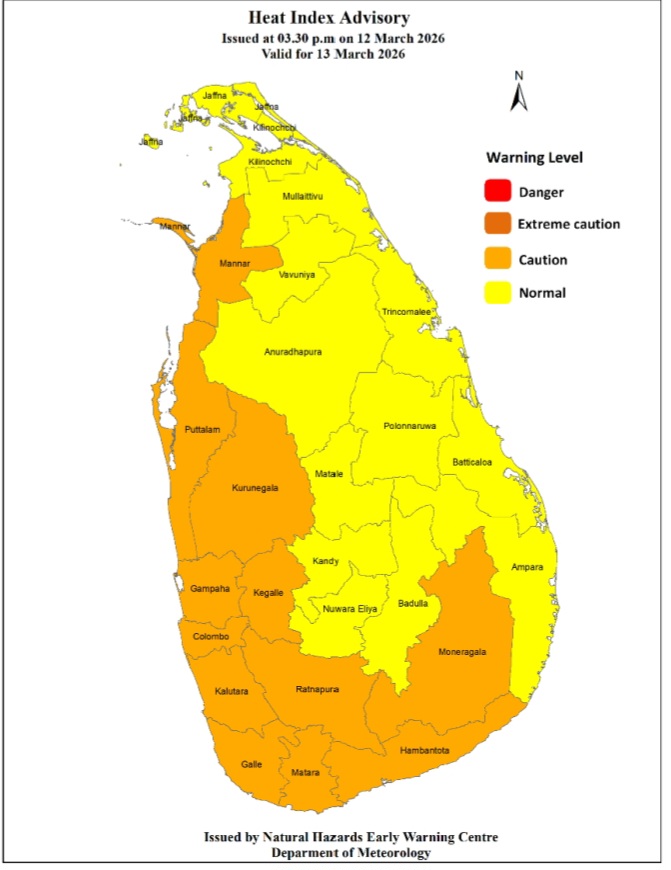
Warm Weather Advisory
Issued by the Natural Hazards Early Warning Centre of the Department of Meteorology at 3.30 p.m. on 12 March 2026, valid for 13 March 2026.
Heat index, the temperature felt on human body is likely to increase up to ‘Caution level’ at some places in Western, Sabaragamuwa, Southern and North-western provinces and in
Monaragala and Mannar districts.
The Heat Index Forecast is calculated by using relative humidity and maximum temperature and this is the condition that is felt on your body. This is not the forecast of maximum temperature. It is generated by the Department of Meteorology for the next day period and prepared by using global numerical weather prediction model data.

Effect of the heat index on human body is mentioned in the above table and it is prepared on
the advice of the Ministry of Health and Indigenous Medical Services.
ACTION REQUIRED
Job sites: Stay hydrated and takes breaks in the shade as often as possible.
Indoors: Check up on the elderly and the sick.
Vehicles: Never leave children unattended.
Outdoors: Limit strenuous outdoor activities, find shade and stay hydrated.
Dress: Wear lightweight and white or light-colored clothing.
Note:
In addition, please refer to advisories issued by the Disaster Preparedness & Response Division, Ministry of Health in this regard as well. For further clarifications please contact 011-7446491.

The Frontline Socialist Party (FSP) yesterday accused the government of trying to award another tender to the Indian company that supplied low-grade coal to the Norochcholai Power Plant and failed to deliver the stipulated amount of coal according to schedule.
The allegation was made by the Education Secretary of the Progressive Socialist Party, Pubudu Jayagoda, during media briefing at the party office in Nugegoda last afternoon.
Jayagoda said that in September 2025, the government had awarded a tender to the Indian company Trident Chemphar to supply 25 coal shipments for electricity generation in 2026.
In August 2025, it was confirmed that the coal delivered by the company was substandard. The company also failed to supply coal on schedule. Although the first shipment was expected in the second week of December 2025, it arrived at the end of the month. By mid-March, only 12 ships had arrived, and biweekly deliveries have been disrupted, putting Sri Lanka at risk of a severe energy shortage.
On 11 March, the government called a sudden spot tender for five coal shipments. Four companies submitted bids, and they include Trident Chemphar. FSP criticiced awarding the tender to the same discredited company, saying it was unethical and could trigger a major national crisis, as the company had failed to supply quality coal reliably in the past.
Previously, coal quality was strictly measured, with a “Reject Value”. But now to help the errant supplier the term of Reject Value has now been omitted altogether and replaced with a new term ‘Minimum Value’ setting it as the minimum calorific threshold—coal producing less than 5,900 kilocalories per kilogram was rejected, and coal with ash content above 16% was also discarded.
However, the government is now reportedly lowering these standards, accepting substandard coal, and changing tender specifications to accommodate the company.
Jayagoda castigated the latest stunt coming especially at a time when the world faces war and oil shortages. Diesel meant for electricity generation is being diverted to school buses, public transport, and emergency vehicles, leaving households at risk of prolonged blackouts. Even if diesel is imported, electricity tariffs could skyrocket.

The Indian Ministry of External Affairs has said it is considering requests for diesel supplies from neighbouring countries, including Sri Lanka, Bangladesh and the Maldives.
Speaking to the Press Trust of India, Ministry Spokesperson Randhir Jaiswal noted that India was a major exporter of refined petroleum products in the region. He confirmed that Bangladesh had formally requested a diesel supply, which is currently under review.
He said that diesel exports to Bangladesh had largely continued since 2017, but any new allocations would take into account India’s refining capacity, domestic demand, and overall fuel availability.
Jaiswal added that similar requests from Sri Lanka and the Maldives were also being considered, with India’s own energy requirements forming a key part of the decision-making process.

Heat Index likely to increase up to ‘Caution level’ at some places in the Western, Sabaragamuwa, Southern and North-western provinces and in Monaragala and Mannar districts

Showers above 50 mm can be expected at some places in the Western and Sabaragamuwa provinces and in the Galle and Matara districts

Govt. bends rules, lowers coal standards in favour of errant company: FSP

Lanka requests diesel from India

Gas shortage pushes up electricity demand, night peak rises: CEB

Navy seizes narcotics haul, lethal weapons in two vessels, arrests 10 suspects

‘Dates have the highest sugar content to fight Coronavirus’

Sunday Island 27 December – Headlines

#SundayIsland 17th December – Headlines

Sunday Island – 28th March

Sunday Island Headlines – 21 March

Sunday Island – 21st February – Headlines
-

 News6 days ago
Peradeniya Uni issues alert over leopards in its premises
-

 News4 days ago
Repatriation of Iranian naval personnel Sri Lanka’s call: Washington
-

 News6 days ago
Wife raises alarm over Sallay’s detention under PTA
-
 Features4 days ago
Winds of Change:Geopolitics at the crossroads of South and Southeast Asia
-

 News3 days ago
Prof. Dunusinghe warns Lanka at serious risk due to ME war
-

 Latest News6 days ago
Heat Index at ‘Caution Level’ in the Sabaragamuwa province and, Colombo, Gampaha, Kurunegala, Anuradhapura, Vavuniya, Hambanthota and Monaragala districts
-

 Sports2 days ago
Royal start favourites in historic Battle of the Blues
-

 Features6 days ago
The final voyage of the Iranian warship sunk by the US