
News
SJB: Situation wouldn’t have deteriorated if govt. had acted six weeks earlier


‘PM ruled out lockdowns in talks with Chinese Defence Minister’
By Shamindra Ferdinando
Samagi Jana Balavegaya (SJB) parliamentarian Mujibur Rahman yesterday (13) alleged that the country was paying a huge price for the government’s refusal to heed medical experts’ advice to impose stringent measures to curb movements.
Had the government acted at least six weeks ago, the ground situation wouldn’t have deteriorated to such an extent, the Colombo District MP told The Island.
Wednesday’s sudden declaration that countrywide travel restrictions would be imposed on Thursday (13), at 11 pm till Monday (17) 4 am pending further measures depending on the requirement revealed the crisis the country was facing, the MP said.
Lawmaker Rahman pointed out that no less a person than Prime Minister Mahinda Rajapaksa as late as April 28 assured the visiting Chinese Defence Minister Wei Fenghe that in spite of the increase in COVID-19 cases in recent weeks, the government wouldn’t declare countrywide lockdowns due to the impact such lockdowns would have on the economy and society.
Rahman said that the Premier Rajapaksa’s assurance to Minister Fenghe couldn’t be taken lightly.
Responding to another query from The Island , lawmaker Rahman alleged that the government pursued a political agenda brazenly at the expense of overall safety and security of the people. The government obviously felt the need to act at last after the country reported over 2000 new cases on a daily basis over the past ten days with alarming increase in the number of deaths.
Referring to a spate of statements issued by the Government Medical Officers’ Association (GMOA) over the past couple of months, the former UNPer said that the crisis the country was experiencing could have been certainly avoided, if the powers that be acted responsibly. Instead, the government undermined Covid-19 health guidelines by encouraging public gatherings, MP Rahman said. The MP said that the April Covid-19 cluster was nothing but a creation of the SLPP government now blaming the public for the crisis.
Rahman said that though the government referred to a countrywide lockdown it was actually a curfew. Asked whether the SJB as the main Opposition party that backed such measures regardless of difficulties caused to the public, the Colombo District MP said that when it came to the country’s interest there couldn’t be a dispute over the required harsher strategy. However, arrogant SLPP leadership should learn, at least now to seek a national consensus on not only a strategy to meet both the daunting Covid-19 challenge as well as post-pandemic scenario.
The national economy that had been in severe difficulty due to waste, corruption, irregularities, mismanagement and shortcomings was now in such a critical situation due to Covid-19 fallout, the country needed a common agenda, MP Rahman said. Unfortunately, the SLPP, had never followed expert advice much to the discomfort of those who believed in a sensible approach, he said. Asked to comment on a shortfall of 600,000 covishield doses for those who needed the second jab, MP Rahman emphasized the government owed an explanation why 927,000 were given the first dose when the country received only 1,264,000 in three separate consignments from India.
Who decided to continue the first covishield round till April 6th, thereby created a wholly unnecessary problem? MP Rahman asked.
The SJB spokesperson said that the government struggled to cover up its failure. Referring to various statements attributed to different government spokespersons and those who serve the interests of the SLPP, in this regard, MP Rahman said the bottom line is that uncertainty gripped over 600,000 people.
MP Rahman appreciated GMOA and GMOF (Government Medical Officers’ Forum) quite rightly pointing out those who received covishield couldn’t receive second jab by way of Sputnik V or the Chinese vaccine in the absence of proper study into such ‘mix-match’. But, that didn’t prevent Co Cabinet spokesman Udaya Gammanpila declaring the possibility of vaccine ‘mix-match.’
Rahman reminded that the second jab would have to be administered between 12-16 weeks after the first. The SJB MP asked the government to issue an official statement in that regard without further delay.
The UNPer said that the SLPP, in spite of winning 2019 presidential and 2020 parliamentary elections with a commanding majority in parliament was struggling to cope up with a spate of issues. The crisis caused due to the mismanagement of the rampaging pandemic was one issue at hand but definitely not the only problem, the MP said.
Asked whether the SJB was trying to exploit the situation regardless of the consequences, Rahman said that the SLPP should accept the responsibility for the situation.
Having won two national elections, the SLPP, instead of seeking a consensus on a national agenda, enacted the 20th Amendment at the expense of the 19th brought in with the backing of over 200 lawmakers, MP Rahman said. Enactment of a new law meant to suppress democratic opposition through vile means and fighting an epidemic two different things, the MP asserted, urging the government to review the overall strategy.
Let the government strategy depend on nothing but sound medical advice backed by political will, Rahman said.
Commenting on accusation directed at Transport Minister and SLPP heavyweight Gamini Lokuge regarding his May Day intervention in lifting of ‘Piliyandala lockdown,’ lawmaker Rahman said that the government explained how a specific directive issued by the Director General of Health Services (DGHS) Dr Asela Gunawardena was countermanded. Who took responsibility for the subsequent deterioration of the situation in Piliyandala area? the MP asked. The situation therein should be examined against the backdrop of the government deploying police to carryaway those who walked about with improperly clad facemasks on the basis they undermined public health. The government conveniently ignored its much touted “One Country, One Law’ slogan, the former UNPer said.

Latest News
Heat Index at ‘Caution Level’ in the Sabaragamuwa province and, Colombo, Gampaha, Kurunegala, Anuradhapura, Vavuniya, Hambanthota and Monaragala districts

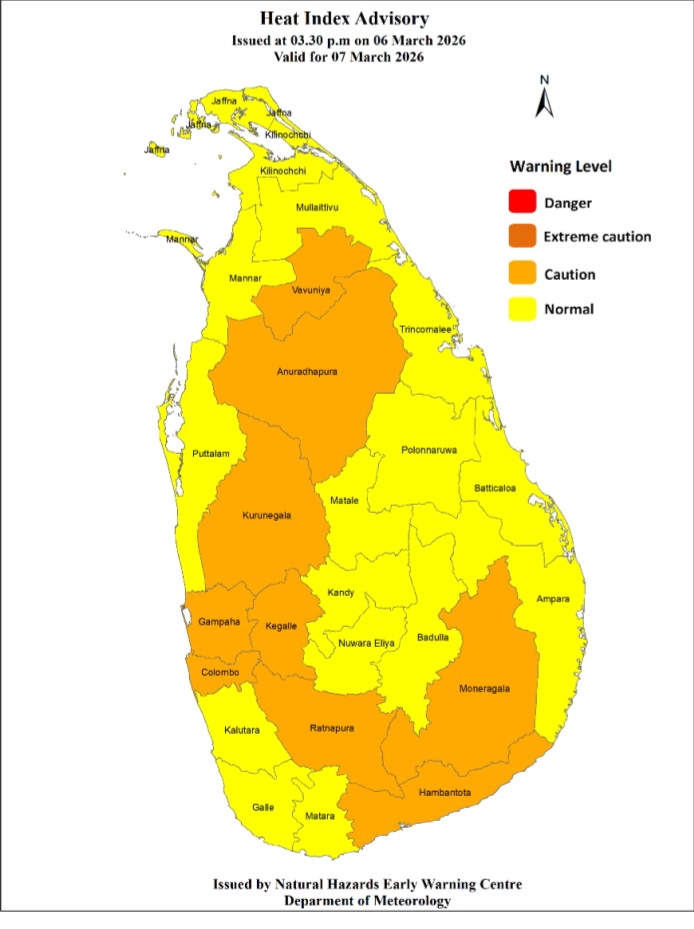
Warm Weather Advisory Issued by the Natural Hazards Early Warning Centre of the Department of Meteorology at 3.30 p.m. on 06 March 2026, valid for 07 March 2026.
The public are warned that the Heat index, the temperature felt on human body is likely to increase up to ‘Caution level’ at some places in the Sabaragamuwa province and in Colombo, Gampaha, Kurunegala, Anuradhapura, Vavuniya, Hambantota and Monaragala districts.
The Heat Index Forecast is calculated by using relative humidity and maximum temperature and is the condition that is felt on your body. This is not the forecast of maximum temperature. It is generated by the Department of Meteorology for the next day period and prepared by using global numerical weather prediction model data.

Effect of the heat index on human body is mentioned in the above table and it is prepared on the advice of the Ministry of Health and Indigenous Medical Services.
ACTION REQUIRED
Job sites: Stay hydrated and takes breaks in the shade as often as possible.
Indoors: Check up on the elderly and the sick.
Vehicles: Never leave children unattended.
Outdoors: Limit strenuous outdoor activities, find shade and stay hydrated.
Dress: Wear lightweight and white or light-colored clothing.
Note: In addition, please refer to advisories issued by the Disaster Preparedness & Response Division, Ministry of Health in this regard as well. For further clarifications please contact 011-7446491
Latest News
Prompt solutions will be provided for the salary anomalies prevailing within the teacher and principal services — PM

Prime Minister Dr. Harini Amarasuriya stated that the government has paid close attention to the salary anomalies prevailing within the teacher and principal services and that prompt solutions will be provided following extensive discussions held with trade unions.
The Prime Minister made these remarks while responding to questions raised in Parliament on Friday (06).
Presenting data on existing vacancies in the education sector, the Prime Minister explained the current situation.
There are 903 vacancies existing in the Sri Lanka Education Administrative Service (SLEAS) and 3,790 vacancies in Sri Lanka Principals’ Service (SLPS).
In order to fill the vacancies which still remain due to various reasons, including selected officers not accepting appointments after the examinations and interviews conducted since 2021, interviews are scheduled to be held in the second week of March 2026.
Further, in order to fill the vacancies for the years 2021 and 2025, competitive examinations will be conducted in the future with the approval of the Public Service Commission.
At present, entry into the Principals’ Service is considered as a new recruitment. As a solution to the salary-related issue arising in this regard, a new Cabinet paper is being prepared seeking approval to consider appointments to the Principals’ Service as a promotion, thereby enabling appropriate salary conversion.
The Prime Minister also emphasized that sustainable solutions are required not only for salary issues in the education sector but also for salary-related concerns in several other sectors. Accordingly, the government plans to appoint a new Salary Commission. Through this commission, the government expects to provide lasting solutions to the issues faced by teachers and principals within this year.
In accordance with the service minute of the Principals’ Service, several training programmes have been made mandatory for the professional development of principals.
These include, Induction training at the beginning of service, capacity development training prior to promotion to Grade II and Grade I, and periodic awareness programmes conducted at provincial and zonal levels.
The Prime Minister further stated that discussions are undertaking with the Department of Management Services regarding the proposals submitted by principals’ associations. Based on the responses received, the government is prepared to take the necessary steps through the Cabinet of Ministers.
[Prime Minister’s Media Division]


The UNP yesterday (06) voiced concern over, what it described as, the continued silence of the Sri Lankan government regarding the sinking of an Iranian vessel by a US submarine within Sri Lanka’s Exclusive Economic Zone (EEZ).
In a statement, the UNP questioned whether the government had been informed, in advance, by the United States of the military action carried out within Sri Lanka’s EEZ, particularly within the framework of the Colombo Security Conclave.
The party warned that such developments had effectively turned Sri Lanka’s EEZ into a war zone, posing potential risks to commercial maritime activity.
Full text of the UNP statement: The United National Party is concerned over the continued silence of the Sri Lankan government regarding the sinking of an Iranian vessel by a US submarine in our Exclusive Economic Zone (EEZ). The government must disclose to the Sri Lankan public whether they were informed by America prior to the military action that was carried out in the country’s EEZ, and within the ambit of the Colombo Security Conclave.
These actions have resulted in our EEZ being turned into a warzone which will have a detrimental impact on our commercial interests. Shipping costs and insurance are expected to increase, impacting the country’s economy, including the cost of living.
The government of Sri Lanka must seek assurance from the United of States of America that further military action will not be conducted in the vicinity of the country. The government must also discuss the potential economic impact with the relevant shipping companies and insurance authorities.

India hit back but Sutherland, Hamilton impress to give Australia the edge

Heat Index at ‘Caution Level’ in the Sabaragamuwa province and, Colombo, Gampaha, Kurunegala, Anuradhapura, Vavuniya, Hambanthota and Monaragala districts

Dry weather will prevail over the island.

Prompt solutions will be provided for the salary anomalies prevailing within the teacher and principal services — PM

Zelenskyy visits front line as Ukraine and Russia swap 500 prisoners each

UNP concerned about govt.’s silence over US sub sinking Iranian warship in Lanka’s EEZ

‘Dates have the highest sugar content to fight Coronavirus’

Sunday Island 27 December – Headlines

#SundayIsland 17th December – Headlines

Sunday Island – 28th March

Sunday Island Headlines – 21 March

Sunday Island – 21st February – Headlines
-

 Features5 days ago
Brilliant Navy officer no more
-

 Opinion5 days ago
Sri Lanka – world’s worst facilities for cricket fans
-

 News2 days ago
Legal experts decry move to demolish STC dining hall
-

 Features5 days ago
A life in colour and song: Rajika Gamage’s new bird guide captures Sri Lanka’s avian soul
-

 Business3 days ago
Cabinet nod for the removal of Cess tax imposed on imported good
-
 Features6 days ago
Overseas visits to drum up foreign assistance for Sri Lanka
-
 Features6 days ago
Sri Lanka to Host First-Ever World Congress on Snakes in Landmark Scientific Milestone
-
 Latest News3 days ago
Around 140 people missing after Iranian navy ship sinks off coast of Sri Lanka