
Business
Sizeable moderation in trade deficit – CBSL

External Sector Performance – February 2023
• Import expenditure declined notably, compared to the reduction in export earnings in February 2023 (y-o-y), resulting into sizeable moderation in the trade deficit.
• Workers’ remittances and earnings from tourism continued to improve in February 2023.
• Gross official reserves strengthened further by end February 2023, compared to recent months.
• The exchange rate appreciated notably in March 2023 following the greater flexibility that was allowed in the determination of the exchange rate.
• The Colombo Stock Exchange (CSE) and foreign investment in the government securities market recorded net inflows during February 2023.
• The Extended Fund Facility (EFF) from the International Monetary Fund (IMF) of US dollars 3 billion was approved and the first tranche was disbursed in March 2023.
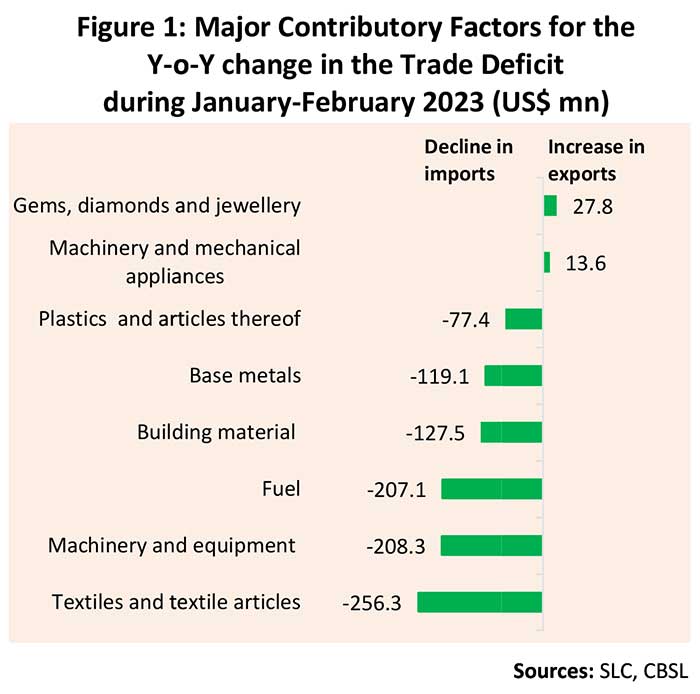
The deficit in the merchandise trade account narrowed significantly to US dollars 39 million in February 2023, from US dollars 780 million in February 2022, mainly reflecting the impact of significant moderation of import expenditure due to subdued aggregate demand conditions. The cumulative deficit in the trade account during January-February 2023 was US dollars 449 million, a sizeable decline from US dollars 1,636 million recorded over the same period in 2022. The major contributory factors for this are shown in Figure 1.
Overall Exports: Despite recording a marginal growth compared to January 2023, earnings from merchandise exports declined by 10.2 per cent in February 2023, year-on-year, to US dollars 982 million. Exports earnings recorded below US dollar 1 billion level for the second consecutive month. While the decline in earnings was observed across all main categories, industrial exports mainly contributed to the overall contraction. Cumulative export earnings during January-February 2023 declined by 10.7 per cent over the same period in the last year.
Industrial Exports: Earnings from the exports of industrial goods declined in February 2023, compared to February 2022, with a substantial share of the decline being contributed by garments. Reduced demand from major markets for garments due to unfavourable economic conditions globally mainly contributed for this outcome. Earnings from rubber products continued to decline due to the lower exports of household rubber gloves. Similarly, earnings from the exports of petroleum products
1 The CBSL classification of exports and the classification of exports based on the Standard International Trade Classification Revision 4, are presented in Annex II and Annex III, respectively. also declined due to the drop in volumes of bunker and aviation fuel exports despite the higher aviation fuel prices. In contrast, earnings from machinery and mechanical appliances (mainly, electronic equipment); and gems, diamonds, and jewellery increased in February 2023.
Agricultural Exports: Earnings from the export of agricultural goods marginally declined in February 2023, compared to a year ago, since the increase in earnings from spices and tea was offset by the decline in earnings from coconut related products (primarily, fibres and desiccated coconut). Export earnings from spices improved due to higher export volumes of cloves; cinnamon; and nutmeg and mace. Increased earnings from tea exports were mainly due to price increases as the volumes registered a decline.
Mineral Exports: Earnings from mineral exports declined in February 2023, compared to February 2022, mainly due to the decline in exports of titanium ores.
Overall Imports: Expenditure on merchandise imports was almost halved in February 2023 at US dollars 1,021 million, compared to February 2022, recording the lowest imports since May 2020. All major import sectors declined while the decline in expenditure on intermediate goods was significant. Meanwhile, cumulative import expenditure during January-February 2023 also declined by 37.1 per cent over the corresponding period in 2022.
Consumer Goods: Expenditure on the importation of consumer goods declined in February 2023, compared to February 2022, driven by lower expenditure on both food and non-food consumer goods. Decline in expenditure on non-food consumer goods was broad-based but the drop in imports
2 The CBSL classification of imports and the classification of imports based on the Standard International Trade Classification Revision 4, are presented in Annex IV and Annex V, respectively.


Sri Lanka has reached a staff-level agreement with the International Monetary Fund to secure the next tranche of funding under its ongoing bailout programme, marking a key step in the country’s fragile economic recovery.
The agreement, announced this week, will enable Sri Lanka to access approximately USD 700 million, subject to approval by the IMF Executive Board. The funds form part of the USD 2.9 billion Extended Fund Facility (EFF) programme agreed following the 2022 economic crisis.
The latest development covers the combined fifth and sixth reviews of Sri Lanka’s reform programme, indicating that the country has made sufficient progress to move forward, while highlighting the need to sustain reform efforts.
Sri Lanka’s economy has shown signs of stabilisation in recent months, supported by improved revenue collection, easing inflation, and a gradual buildup of foreign reserves. However, the recovery remains vulnerable to both domestic and external pressures.
By Ifham Nizam

Initially CSE trading was somewhat volatile despite the ceasefire in West Asia but it experienced further volatility after Israel attacked Lebanon yesterday.
However, the IMF delegation which is now in Sri Lanka to release two tranches of its relief package created some positive sentiments for the market, analysts said.
The All Share Price Index went down by 73.06 points, while the S and P SL20 rose by 10.57 points.
Turnover stood at Rs 2.96 billion with six crossings. Those crossings were: JKH 5.5 million shares crossed to the tune of Rs 807.6 million and its shares traded at Rs 19.70, CIC Holdings two million shares crossed for Rs 54 million; its shares traded at Rs 32, Access Engineering 600,000 shares crossed for Rs 44.4 million; its shares traded at Rs 74, Central Finance 116,000 shares crossed to the tune of Rs 27.5 million ; its shares sold at Rs 237, LMF 250,000 shares crossed for Rs 22.8 million; its shares fetched Rs 91.10 and Kelani Cables 200,000 shares crossed for Rs 21 million and its shares traded at Rs 105.
In the retail market seven companies that mainly contributed to the turnover were; Dialog Rs237 million (7.5 million shares traded), LMF Rs 203 million (22 million shares traded), Colombo Dockyard Rs 199.7 million (1.1 million shares traded), HBA Foods Rs 163 million (18.5 million shares traded), JKH Rs 156 million (7.8 million shares traded), JKH Rs 156 million (7.8 million shares traded), Softlogic Holdings Rs 117 million (9.6 million shares traded) and Acme Printers Rs 107 million (15.6 million shares traded). During the day 133.3 million share volumes changed hands in 23666 transactions.
It is said that manufacturing sector counters, like JKH, performed well, while food sector counters, especially LMF and HBA Foods, performed well. Other sectors too performed somewhat well during the day.
Yesterday the rupee was quoted a Rs 315.42/48 to the US dollar in the spot market from 315.30/40 the previous day, dealers said, while bond yields were quoted higher.
By Hiran H. Senewiratne

Marking 25 years of trust, growth, and service excellence, HNB Assurance PLC has unveiled its new corporate identity, transitioning to HNB Life PLC a strategic evolution that reflects the company’s forward-looking vision and commitment to empowering lives with protection and the freedom to thrive, no matter where life takes them.
This milestone signifies more than a change in name or visual identity. It represents a deliberate transformation shaped by strong performance over the past few years, during which the company has achieved remarkable growth, strengthened its market position and enhanced its customer-centric capabilities.
The newly introduced logo, inspired by the form of a wing, symbolises HNB Life’s role as a proactive enabler. It reflects the organisation’s commitment to supporting individuals in navigating life’s journey with confidence, empowering them to pursue their aspirations and live life on their own terms.
The official unveiling took place at a launch event attended by key stakeholders, strategic business partners, well-wishers and employees.
Addressing the gathering, Chairman, Stuart Chapman highlighted the significance of this transformation, stating, “As we mark 25 years of progress, the transition to HNB Life reflects our strategic intent to evolve with the changing needs of our customers and the broader market. This new identity embodies our purpose, to enable and empower individuals to achieve what they truly aspire to in life, with confidence and security. As a company we are extremely excited on what the future holds for as, as we build on an incredible foundation laid over the past two and a half decades.”
The new Vision of the Company is “To be the leader in empowering lives with protection and freedom to thrive, no matter where life takes them”.

Brazil bowler Laura Cardoso takes 9 Lesotho wickets in record-breaking T20 win

Zimbabwe Women set for maiden tour of Pakistan

Bangladesh advance match timings to save energy

PM on inspection tour of newly renovated Colombo Central Bus Stand

Israel to hold direct talks with Lebanon but no ceasefire, Netanyahu says

Sun directly overhead Nagawilluwa, Galgamuwa, Sigiriya, Palugasdamana and Mankerni about 12:11 noon today (10)

‘Dates have the highest sugar content to fight Coronavirus’

Sunday Island 27 December – Headlines

#SundayIsland 17th December – Headlines

Sunday Island – 28th March

Sunday Island Headlines – 21 March

Sunday Island – 21st February – Headlines
-

 Features6 days ago
Ranjith Siyambalapitiya turns custodian of a rare living collection
-

 News6 days ago
Global ‘Walk for Peace’ to be held in Lanka
-

 News4 days ago
Lankan-origin actress Subashini found dead in India
-

 Features6 days ago
Beyond the Blue Skies: A Tribute to Captain Elmo Jayawardena
-

 News2 days ago
AG: Coal procurement full of irregularities
-

 Features6 days ago
Aspects of Ceylon/Sri Lanka Foreign Relations – 1948 to 1976
-

 Business2 days ago
Hayleys Mobility introduces Premium OMODA C9 PHEV
-

 Sports2 days ago
DS to face St. Anthony’s in ‘Bridges of Brotherhood’ cricket encounter