
Opinion
Sinhala wordsmith extraordinaire remembered on his 40th death anniversary

By Dr Upul Wijayawardhana
“I write my songs not for critical acclaim but for the sole purpose of the enjoyment of listeners, without them having to turn the pages of a dictionary!” Thus retorted Karunaratne Abeysekera, during an interview, when reference was made to the disapproval of some critics of his lyrical style. Paradoxically now, 40 years after his death, critics are falling over each other to praise his lyrical style; simple though beautiful and musical words, arranged rhythmically to subtly convey, meanings often very deep, which brought about a sea change in Sinhala music for the masses! More importantly, his philosophy has proved correct as the songs he penned still dominate the airwaves, despite the vast changes in the broadcast media since his death. The young, who have no idea whose compositions they are, join the old in singing his songs, made immortal by the vast number of talented Sinhala singers, most of whom he nurtured. To them, to me and my generation, he was our dearly beloved Karuayya whose life was cut short at the height of his career, prematurely at the age of 52, on 20th April 1983. Even the vast expanse of four decades has not dulled the pain in our hearts.
Because of his enduring legacy as a lyricist, many forget that Karunaratna Abeysekara was a pioneer and excelled in many other fields too. He was a true wordsmith excelling in the written word as well as the spoken. He was born in Ratmale, a little village south of Matara on 3 June 1930, the eldest of ten children of Podiappuhami Abeysekara and Premawathi Abeysekara. The family moved to Colombo where his father started a small business but they moved back temporarily to their village during World War II which gave him the opportunity to study Sinhala, Pali, and Sanskrit under Venerable Ananda of Galkanda Vihara, which laid the foundation for the mastery with words. On return, he entered Nalanda College where his teacher was the poet U A S Perera, better known as Siriayya who conducted Lama Pitiya in Radio Ceylon, which was a life-changing event. This drew him to broadcasting, taking part in “Lama Pitiya” from the age of 12. He continued to study oriental languages under Venerable Dehigaspe Pannasara of Vidyodaya Pirivena whilst continuing his studies in English at Nalanda.
Even before gaining reputation as a lyricist, Karunaratna Abeysekara won recognition as a leading poet of the ‘Colombo Era.’ He started writing Sinhala poetry at a very young age, winning the competition for ‘The Best Young Poet’ conducted by Nava Kala Mandalaya in 1942, and continued to write regularly to Sinhala newspapers till death, in addition to publishing several collections. Thanks to Karuayya’s youngest brother Kirthie, who lives in the USA, I have been able to read three sets of poems written close to his unexpected death, which gives a hint of premonition. In a poem titled Ayachanayak (Request), printed in Kalpana in October 1982, he makes an appeal to the ‘Life-giver’ for an extension of ten years. It is a moving poem wherein he gives reasons why he is requesting the extension; that he wishes to see his son grow up, that he can contribute to Sinhala literature in many ways and write for the unity of the nation. It is not without humour, as he states that all he wants is the extension even if it makes him look aged! In a poem addressed to his sister Suji, who has just got married, titled Thawath Neyek (Another Relative) printed in Silumina of 27 February 1983, two months before death, whilst welcoming the brother-in-law, he ends up with a request: ‘Me neth piyawunoth hema heta midee pinin – mage piyambai putui dingak balaganin’ which translates as ‘If by any chance these eyes close due to exhaustion of merit, please look after a bit, my dear wife and son.’ His last poem ‘Duka biya nethi Nivana pathami’ (Wishing for Nibbana sans sorrow and fear) appeared in Silumina a month after his death!
Karunaratna Abeysekara faced the most crucial decision of his life in 1950, when he had to choose between admission to Peradeniya University for a degree or join Radio Ceylon as a relief announcer, earning seven Rupees a day. He opted for the latter as he felt that was the only way he could support his younger siblings, his father’s business being not lucrative. This move not only allowed him to support his siblings admirably but also build a very successful broadcasting career. He was a brilliant newsreader but outshone all others as a commentator. In the era of before television, we were at the mercy of commentators to visualise any important event. Whereas others described what was happening, Karuayya painted the picture in our minds with his unmatched eloquence. I still remember listening to his commentary when Queen Elizabeth visited us in 1954 and painting the picture of the procession in my mind. The way he moved the entire nation to tears at S W R D’s funeral has become part of broadcasting legend.
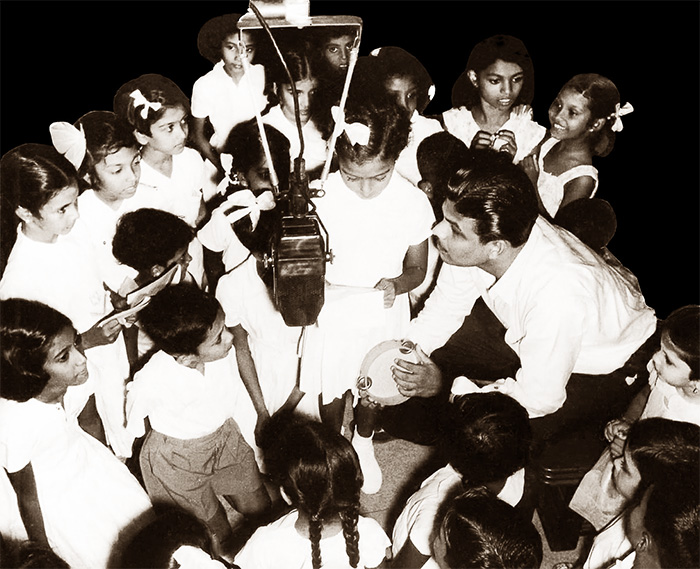
Invariably, he was drawn to children’s programmes and Saraswathi Madapaya he hosted on Sunday evenings, became the star of children’s programmes. I had the fortune of participating regularly and helping Karuayya from 1957 to 1964, being introduced to it by Karuayya’s brother Daya and my good friend Buddhadasa Bodhinayaka. We would help by sorting out letters, writing features and reading scripts live ,etc.. which gave us the grounding in broadcasting. Karuayya arrived about half an hour before the programme goes live on-air and penned a couple of songs, which were set to music by Master D D Denny to be sung by the children who became the leading musicians later. Saraswathi Mandapaya was the incubator not only for budding singers but also for lyricists and script writers, far too many to mention by name.
Karuayya was the creator of the genre of Sinhala Children’s Songs and his compositions like Sarungale, Lenage pitameda Iri tuna ende kauda mage amme, Dan nivadukale hinda ne iskole, Mamai Raja kale vihilu keru Andare, Surathal ape denila vana mal kele pipeela are still sung by children and adults alike.
He pioneered cricket commentary in Sinhala, the very first being a report on the Ananda-Nalanda Big-match he gave on Saraswathi Mandapaya. He quickly switched to live commentary and is credited with coining many Sinhala cricket terms. No doubt the enthusiasm for and the popularity of cricket, the ‘coloniser’s game,’ in the villages is in no mean measure due to the commentaries in Sinhala which Karuayya pioneered in his inimitable style which enabled the listeners to visualise the game long before the advent of television.
On retiring from the National Service, he joined the Commercial Service of Radio Ceylon where he revolutionised advertising by coining catchy slogans and introducing memorable jingles which are played even today. He was ethical to the core, ensuring that products he advertised stood to scrutiny, often visiting the establishments to ensure. This, unfortunately, is a practice unknown today when celebrities sell their souls endorsing any product for cash!
He was in great demand to present concerts and, in fact, many attended to see Karuayya as much for the concert. When he commenced the proceedings, immaculately dressed with hair combed with Brylcream and a wide smile below the thin moustache, crowds roared with applause as he raised his hands and said Ayubowan His introductions were crisp and concise, describing a lot in a few words. Another less well-known activity was writing the dialogue for films.
Without any doubt, Karunaratna Abeysekara was one of the best lyricists, if not the best, Sri Lanka has ever had; the most versatile without a doubt. His lyrics could be anything from children to classical, funny to provocative but he was at his best when it came to romance, probably because of his own turbulent love affair with Raniakka before marriage. She, like many millions in the country, had fallen in love with his voice initially which later developed into a romance, much objected to by her elders who kept her a virtual prisoner in her home. One day, Tilakasiri Fernado has been waiting in studio 10 of Radio Ceylon for Karuayya as he was one song short for his programme the same evening. When the plight was explained, Karuayya vented the pent-up feelings by writing immediately ‘Enna mada nale, gos pawasanna duka mage’ which was sung with great emotion the same evening and remains a classic in Sinhala music. He requests the wind to take his message of love to her, as it is only the wind that can reach her prison and tells the wind that he is helpless, his only treasure being her, adding that he will be ever grateful if the wind conveys his sadness to her. Quoting a passage from a note Raniakka was able to smuggle through to him, he wrote “Mawa hanga wane, aiyo Sakdevidune, Pandupul asane, aido unu nune” for the film Dingiri Menike.
In turn, Karuayya extended a helping hand to others in romantic difficulties. When there were problems with Sanath Nadasiri’s romance with Malkanthi Pieris, he is supposed to have mediated, in addition to writing the beautiful song “Ma hada asapuwa, kusumin sarasuwa, e Malbara dethai” sung in the melodious voice of Sanath, with the word Malbara hinting at Malkanthi! When Milton Perera had difficulty in expressing his love to Kalyani, he appealed to Karuayya who obliged with “Kalyaniye oba nesu kathawak kiyannam” with Milton declaring his love over the airwaves and thousands of lovers using it since to overcome their difficulties of romantic expression! In fact, Kalyani is mentioned in another song he wrote for Milton: “Sihina dev duwe, obata thun love, ekama nami ma danne e nama adare” wherein Milton sings “Kalyani namata ama pem, divi banduna puda karannam” No doubt, they were happily married!
When Dileepa was born, after a gap of ten years, Karuayya was overjoyed and had been lying down on a mat between the two beds occupied by his wife and mother, when he got the sudden urge to pen a song. He got up and wrote “Dileepa podi puthu, saneepayata nidi, Mawage ukul yahane” which was printed in Silumina. Seeing this Clarence Wijewardene has approached Karuayya and had said he will pay anything for the song! In an interview Karuayya mentioned that this and “Enna mada nale” are his favourite songs. Shortly before his death, Karuayya had been listening to a radio programme where they had discussed “Enna mada nale” Raniakka mentioned in an interview that Karuayya was very pleased and had commented “It is a haunting song.” It is a small mercy that he could listen to his favourite as the last.
No one knows how many songs he wrote in his short but fruitful lifetime as he penned songs for many including my wife, Primrose and the figure of 2,000 often quoted is a gross underestimate. He must have written thousands for the Saraswathi Mandapaya, which went unrecorded. Before the introduction of television, more than half the songs in the SLBC library had been written by him. He had written songs for over 300 films. Though the first song he composed for a film was “Kataragame Devige bime, Ruhunu janapade” screening of Sirisena Wimalaweera’s film Asoka was delayed, Varada Kageda being released before, two songs of which remain popular to this day: “Dalula prema gase” and “Piyalee kedila wetuna nebul Saman male” both sung by Mohideen Baig.
Some critics consider Karuayya’s best lyrics for a film are in Kurulu Bedda, with music by R Muthusamy and sterling performances by Punya Heendeniya and D R Nanayakkara, which include “Aruna Udaye” by Milton Perera, “Oya belma, oya kelma, nilupul nete” by Lata and Dharmadasa Walpola. However, my personal choice is Daskama, the only film Edwin Samaradiwakara provided music for. “Ipida mere” sung by Amaradewa is a synopsis of Buddhism and is a classic but there are many other beautiful songs too, masterfully crafted, and beautifully sung: “Honda Kala ada” by Mohideen Baig, “Mada diye pipunata” and “Turu wadulu tule” by GSB Rani Perera, “Goyam paseela kumbure” by Indrani Wijebandara as well as “Devlova devsepa” by Indrani Wijebandara and Mallika Kahavita.
Karuayya had the versatility to suit the lyric to the singer’s style and even to suit the actor, for film songs. It is said that seven other lyricists failed to satisfy Nimal Mendis for his composition for the film Kalu Diya Dahara but Karuayya succeeded with “Master Sir” He excelled in writing about inanimate objects; perhaps, the only lyricist to do so. “Awile semada” is about a candle, “Basicale” is about the bicycle, “Sarungale” is about a kite and “Naga lovin gena apu Bulathatha” is about sheaf of Betel, a song that runs through all the associated rituals, reminding us about our old traditions. Often, he made use of life-events to pen a song. Whilst having dinner in a Chinese restaurant, the waiter has dropped a tray earning a public reprimand from the manager which prompted, the moment he got home, to write “Wedakarala ewara nometha deviyane – Mokotada ma duppathwe ipadune”
A week or two before his death, we visited Karuayya’s place as Primrose wanted a song for her SLBC concert and she requested any song. It took him less than fifteen minutes to write the song “Minimewuldama nethath banda bendune, Visakavak wanna Diyaniyane – Amila kahavanu nethath ata randune, Anepindusitu wanna Puthanuwane” It was his message to our two children telling them to be generous even if they do not posses the riches of Anathapindika or Visaka. In the lyrics, he urged them to love the nation, serve and treasure Buddhism and shine like the moon by eradicating ignorance through wisdom. Perhaps, he knew this was our last meeting as when he died, I was in Vienna attending the World Congress of Pacing. Forever I regret, for not being with him in his hour of need.
May Karuayya attain the Supreme Bliss of Nibbana!


Broader Strategic Consequences
One of the most significant strategic consequences of the war is the accelerated erosion of U.S. political and moral hegemony. This is not a sudden phenomenon precipitated solely by the present conflict; rather, the war has served to illuminate an already evolving global reality—that the era of uncontested U.S. dominance is in decline. The resurgence of Donald Trump and the reassertion of his “America First” doctrine reflect deep-seated domestic economic and political challenges within the United States. These internal pressures have, in turn, shaped a more unilateral and inward-looking foreign policy posture, further constraining Washington’s capacity to exercise global leadership.
Moreover, the conduct of the war has significantly undermined the political and moral authority of the United States. Perceived violations of international humanitarian law, coupled with the selective application of international norms, have weakened the credibility of U.S. advocacy for a “rules-based international order.” Such inconsistencies have reinforced perceptions of double standards, particularly among states in the Global South. Skepticism toward Western normative leadership is expected to deepen, contributing to the gradual fragmentation of the international system. In this broader context, the ongoing crisis can be seen as symptomatic of a more fundamental transformation: the progressive waning of a global order historically anchored in U.S. hegemony and the emergence of a more contested and pluralistic international landscape.
The regional implications of the crisis are likely to be profound, particularly given the centrality of the Persian Gulf to the global political economy. As a critical hub of energy production and maritime trade, instability in this region carries systemic consequences that extend far beyond its immediate geography. Whatever may be the outcome, whether through the decisive weakening of Iran or the inability of external powers to dismantle its leadership and strategic capabilities, the post-conflict regional order will differ markedly from its pre-war configuration. In this evolving context, traditional power hierarchies, alliance structures, and deterrence dynamics are likely to undergo significant recalibration.
A key lesson underscored by the war is the deep interconnectivity of the contemporary global economic order. In an era of highly integrated production networks and supply chains, disruptions in a single strategic node can generate cascading effects across the global system. As such, regional conflicts increasingly assume global significance. The structural realities of globalisation make it difficult to contain economic and strategic shocks within regional boundaries, as impacts rapidly transmit through trade, energy, and financial networks. In this context, peace and stability are no longer purely regional concerns but global public goods, essential to the functioning and resilience of the international system
The conflict highlights the emergence of a new paradigm of warfare shaped by the integration of artificial intelligence, cyber capabilities, and unmanned systems. The extensive use of unmanned combat aerial vehicles (UCAVs)—a trend previously demonstrated in the Russia–Ukraine War—has been further validated in this theatre. However, unlike the Ukraine conflict, where Western powers have provided sustained military, technological, and financial backing, the present confrontation reflects a more direct asymmetry between a dominant global hegemon and a Global South state. Iran’s deployment of drone swarms and AI-enabled targeting systems illustrates that key elements of Fourth Industrial Revolution (4IR) warfare are no longer confined to technologically advanced Western states. These capabilities are increasingly accessible to Global South actors, lowering barriers to entry and significantly enhancing their capacity to wage effective asymmetric warfare. In this evolving context, technological diffusion is reshaping the strategic landscape, challenging traditional military hierarchies and altering the balance between conventional superiority and innovative, cost-effective combat strategies.
The war further exposed and deepened the weakening of global governance institutions, particularly the United Nations. Many of these institutions were established in 1945, reflecting the balance of power and geopolitical realities of the immediate post-Second World War era. However, the profound transformations in the international system since then have rendered aspects of this institutional architecture increasingly outdated and less effective.
The war has underscored the urgent need for comprehensive international governance reforms to ensure that international institutions remain credible, representative, and capable of addressing contemporary security challenges. The perceived ineffectiveness of UN human rights mechanisms in responding to violations of international humanitarian law—particularly in contexts such as the West Bank and the Gaza Strip, and more recently in Iran—has amplified calls for institutional renewal or the development of alternative frameworks for maintaining international peace and security. Moreover, the selective enforcement of international law and the persistent paralysis in conflict resolution mechanisms risk accelerating the fragmentation of global norms. If sustained, this trajectory would signal not merely the weakening but the possible demise of the so-called liberal international order, accelerating the erosion of both the legitimacy and the effective authority of existing multilateral institutions, and deepening the crisis of global governance.
Historically, major wars have often served as harbingers of new eras in international politics, marking painful yet decisive transitions from one order to another. Periods of systemic decline are typically accompanied by instability, uncertainty, and profound disruption; yet, it is through such crises that the contours of an emerging order begin to take shape. The present conflict appears to reflect such a moment of transition, where the strains within the existing global system are becoming increasingly visible.
Notably, key European powers are exhibiting a gradual shift away from exclusive reliance on the U.S. security umbrella, seeking instead a more autonomous and assertive role in global affairs. At the same time, the war is likely to create strategic space for China to expand its influence. As the United States becomes more deeply entangled militarily and politically, China may consolidate its position as a stabilising economic actor and an alternative strategic partner. This could be reflected in intensified energy diplomacy, expanded infrastructure investments, and a more proactive role in regional conflict management, advancing Beijing’s long-term objective of reshaping global governance structures.
However, this transition does not imply a simple replacement of Pax Americana with Pax Sinica. Rather, the emerging global order is likely to be more diffuse, pluralistic, and multilateral in character. In this sense, the ongoing transformation aligns with broader narratives of an “Asian Century,” in which power is redistributed across multiple centers rather than concentrated in a single hegemon. The war, therefore, may ultimately be understood not merely as a geopolitical crisis, but as a defining inflection point in the reconfiguration of the global order.
Conclusion: A New Era on the Horizon
History shows that major wars often signal the birth of new eras—painful, disruptive, yet transformative. The present conflict is no exception. It has exposed the vulnerabilities of the existing world order, challenged U.S. dominance, and revealed the limits of established global governance.
European powers are beginning to chart a more independent course, reducing reliance on the U.S. security umbrella, while China is poised to expand its influence as an economic stabiliser and strategic partner. Through energy diplomacy, infrastructure investments, and active engagement in regional conflicts, Beijing is quietly shaping the contours of a more multipolar world. Yet this is not the rise of Pax Sinica replacing Pax Americana. The emerging order is likely to be multilateral, fluid, and competitive—a world in which multiple powers, old and new, share the stage. The war, in all its turbulence, may therefore mark the dawn of a genuinely new global era, one where uncertainty coexists with opportunity, and where the next chapter of international politics is being written before our eyes.
by Gamini Keerawella
(First part of this article appeared yesterday (08 April)
130,000 students are left out each year—academics hold the key
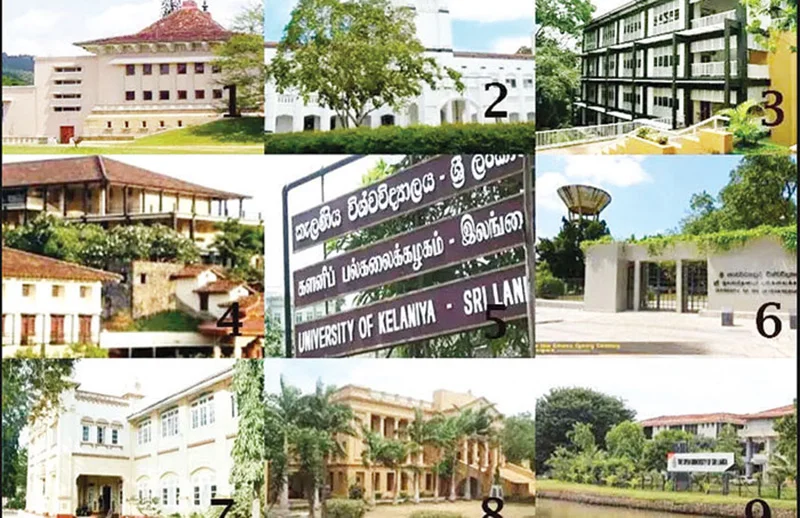
Each year, Sri Lanka’s G.C.E. Advanced Level examination produces a wave of hope—this year, nearly 175,000 students qualified for university entrance. Yet only 45,000 will be admitted to state universities. That leaves more than 130,000 young people stranded—qualified, ambitious, but excluded. This is not just a statistic; it is a national crisis. And while policymakers debate infrastructure and funding, the country’s academics must step forward as catalysts of change.
Beyond the Numbers: A National Responsibility
Education is the backbone of Sri Lanka’s development. Denying access to tens of thousands of qualified students risks wasting talent, fueling inequality, and undermining national progress. The gap is not simply about seats in lecture halls—it is about the future of a generation. Academics, as custodians of knowledge, cannot remain passive observers. They must reimagine the delivery of higher education to ensure opportunity is not a privilege for the few.
Expanding Pathways, Not Just Campuses
The traditional model of four-year degrees in brick-and-mortar universities cannot absorb the demand. Academics can design short-term diplomas and certificate programmes that provide immediate access to learning. These programmes, focused on employable skills, would allow thousands to continue their education while easing pressure on degree programmes. Equally important is the digital transformation of education. Online and blended learning modules can extend access to rural students, breaking the monopoly of physical campuses. With academic leadership, Sri Lanka can build a reliable system of credit transfers, enabling students to begin their studies at affiliated institutions and later transfer to state universities.
Partnerships That Protect Quality
Private universities and vocational institutes already absorb many students who miss out on state admissions. But concerns about quality and recognition persist. Academics can bridge this divide by providing quality assurance and standardised curricula, supervising joint degree programmes, and expanding the Open University system. These partnerships would ensure that students outside the state system receive affordable, credible, and internationally recognised education.
Research and Advocacy: Shaping Policy
Academics are not only teachers—they are researchers and thought leaders. By conducting labour market studies, they can align higher education expansion with employability. Evidence-based recommendations to the University Grants Commission (UGC) can guide strategic intake increases, regional university expansion, and government investment in digital infrastructure. In this way, academics can ensure reforms are not reactive, but visionary.
Industry Engagement: Learning Beyond the Classroom
Sri Lanka’s universities must become entrepreneurship hubs and innovation labs. Academics can design programmes that connect students directly with industries, offering internship-based learning and applied research opportunities. This approach reduces reliance on classroom capacity while equipping students with practical skills. It also reframes education as a partnership between universities and the economy, rather than a closed system.
Making the Most of What We Have
Even within existing constraints, academics can expand capacity. Training junior lecturers and adjunct faculty, sharing facilities across universities, and building international collaborations for joint programmes and scholarships are practical steps. These measures maximise resources while opening new avenues for students.
A Call to Action
Sri Lanka’s university admission crisis is not just about numbers—it is about fairness, opportunity, and national development. Academics must lead the way in transforming exclusion into empowerment. By expanding pathways, strengthening partnerships, advocating for policy reform, engaging with industry, and optimizing resources, they can ensure that qualified students are not left behind.
“Education for all, not just the fortunate few.”
Dr. Arosh Bandula (Ph.D. Nottingham), Senior Lecturer, Department of Agricultural Economics & Agribusiness, Faculty of Agriculture, University of Ruhuna
by Dr. Arosh Bandula
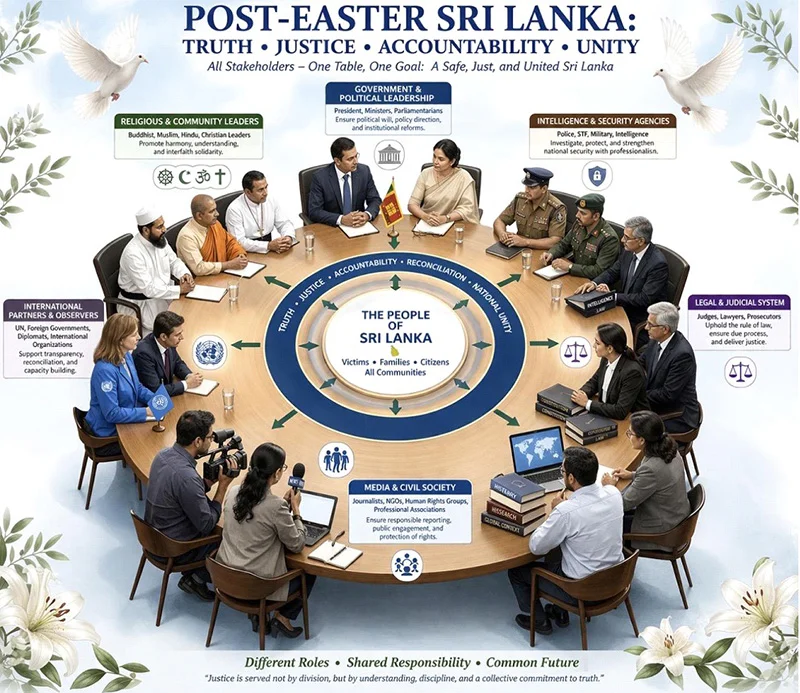
As Sri Lanka approaches the seventh commemoration of the Easter Sunday attacks, the national mood is once again marked by grief, reflection, and an enduring sense of incompleteness. Nearly seven years later, the tragedy continues to cast a long shadow not only over the victims and their families, but over the institutions and narratives that have since emerged.
Commemoration, however, must go beyond ritual. It must be anchored in clarity, accountability, and restraint. What is increasingly evident in the post-Easter landscape is not merely a search for truth, but a contest over how that truth is framed, interpreted, and presented to the public.
In recent times, public discourse has been shaped by book launches, panel discussions, and media interventions that claim to offer new insights into the attacks. While such contributions are not inherently problematic, the manner in which certain narratives are advanced raises legitimate concerns. The selective disclosure of information particularly when it touches on intelligence operations demands careful scrutiny.
Sri Lanka’s legal and institutional framework is clear on the sensitivity of such matters. The Official Secrets Act (No. 32 of 1955) places strict obligations on the handling of information related to national security. Similarly, the Police Ordinance and internal administrative regulations governing intelligence units emphasize confidentiality, chain of command, and the responsible use of information. These are not mere formalities; they exist to safeguard both operational integrity and national interest.
When individual particularly those with prior access to intelligence structures enter the public domain with claims that are not subject to verification, it raises critical questions. Are these disclosures contributing to justice and accountability, or are they inadvertently compromising institutional credibility and future operational capacity?
The challenge lies in distinguishing between constructive transparency and selective exposure.
The Presidential Commission of Inquiry into the Easter Sunday Attacks provided one of the most comprehensive official examinations of the attacks. Its findings highlighted a complex web of failures: lapses in intelligence sharing, breakdowns in inter-agency coordination, and serious deficiencies in political oversight. Importantly, it underscored that the attacks were not the result of a single point of failure, but a systemic collapse across multiple levels of governance.
Yet, despite the existence of such detailed institutional findings, public discourse often gravitates toward simplified narratives. There is a tendency to identify singular “masterminds” or to attribute responsibility in ways that align with prevailing political or ideological positions. While such narratives may be compelling, they risk obscuring the deeper structural issues that enabled the attacks to occur.
Equally significant is the broader socio-political context in which these narratives are unfolding. Sri Lanka today remains a society marked by fragile intercommunal relations. The aftermath of the Easter attacks saw heightened suspicion, polarisation, and, in some instances, collective blame directed at entire communities. Although there have been efforts toward reconciliation, these fault lines have not entirely disappeared.
In this environment, the language and tone of public discourse carry immense weight. The framing of terrorism whether as a localized phenomenon or as part of a broader ideological construct must be handled with precision and responsibility. Overgeneralization or the uncritical use of labels can have far-reaching consequences, including the marginalization of communities and the erosion of social cohesion.
At the same time, it is essential to acknowledge that the global discourse on terrorism is itself contested. Competing narratives, geopolitical interests, and selective historiography often shape how events are interpreted. For Sri Lanka, the challenge is to avoid becoming a passive recipient of external frameworks that may not fully reflect its own realities.
A professional and unbiased approach requires a commitment to evidence-based analysis. This includes:
· Engaging with primary sources, including official reports and judicial findings
·
· Cross-referencing claims with verifiable data
·
· Recognizing the limits of publicly available information, particularly in intelligence matters

It also requires intellectual discipline the willingness to question assumptions, to resist convenient conclusions, and to remain open to complexity.
The role of former officials and subject-matter experts in this discourse is particularly important. Their experience can provide valuable insights, but it also carries a responsibility. Public interventions must be guided by professional ethics, respect for institutional boundaries, and an awareness of the potential impact on national security.
There is a fine balance to be maintained. On one hand, democratic societies require transparency and accountability. On the other, the premature or uncontextualized release of sensitive information can undermine the very systems that are meant to protect the public.
As Sri Lanka reflects on the events of April 2019, it must resist the temptation to reduce a national tragedy into competing narratives or political instruments. The pursuit of truth must be methodical, inclusive, and grounded in law.
Easter is not only a moment of remembrance. It is a test of institutional maturity and societal resilience.
The real question is not whether new narratives will emerge they inevitably will. The question is whether Sri Lanka has the capacity to engage with them critically, responsibly, and in a manner that strengthens, rather than weakens, the foundations of its national security and social harmony.
In the end, justice is not served by noise or conjecture. It is served by patience, rigor, and an unwavering commitment to truth.
Mahil Dole is a former senior law enforcement officer and national security analyst, with over four decades of experience in policing and intelligence, including serving as Head of Counter-Intelligence at the State Intelligence Service of Sri Lanka and a graduate of the Asia Pacific Center for Security Studies in Hawai, USA.
by Mahil Dole
Former Senior Law Enforcement Officer National Security Analyst; Former Head of Counter-Intelligence, State Intelligence Service)

Salt and Patidar power RCB past Mumbai Indians

Prasidh, Buttler set up comfortable win for Gujarat Titans

Heat Index at Caution level’ in the Northern, North-central, North-western, Western and Southern provinces and in Trincomalee district.

Showers above 75 mm are likely at some places in the Western, Sabaragamuwa, Central, Southern and North-western provinces.

Sun directly overhead Pesalai, Mankulam and Nedunkerny about 12:11 noon

PNS TAIMUR & ASLAT arrive in Colombo

‘Dates have the highest sugar content to fight Coronavirus’

Sunday Island 27 December – Headlines

#SundayIsland 17th December – Headlines

Sunday Island – 28th March

Sunday Island Headlines – 21 March

Sunday Island – 21st February – Headlines
-

 News2 days ago
CEB orders temporary shutdown of large rooftop solar systems
-

 News7 days ago
Lankan-origin actress Subashini found dead in India
-

 News5 days ago
AG: Coal procurement full of irregularities
-

 Business4 days ago
Israeli attack on Lebanon triggers local stock market volatility
-

 Business5 days ago
Hayleys Mobility introduces Premium OMODA C9 PHEV
-

 News7 days ago
UN Regional Director launches SL’s first Country Gender Equality Profile during official visit
-

 News7 days ago
Dialog Launches ‘GanuDenu QR’, Making Cashless Transfers Free for All with eZ Cash and Dialog Finance
-

 Business4 days ago
HNB Assurance marks 25 years with strategic transformation to ‘HNB Life’