
Latest News
Shafali and Jonassen power Delhi Capitals into playoffs

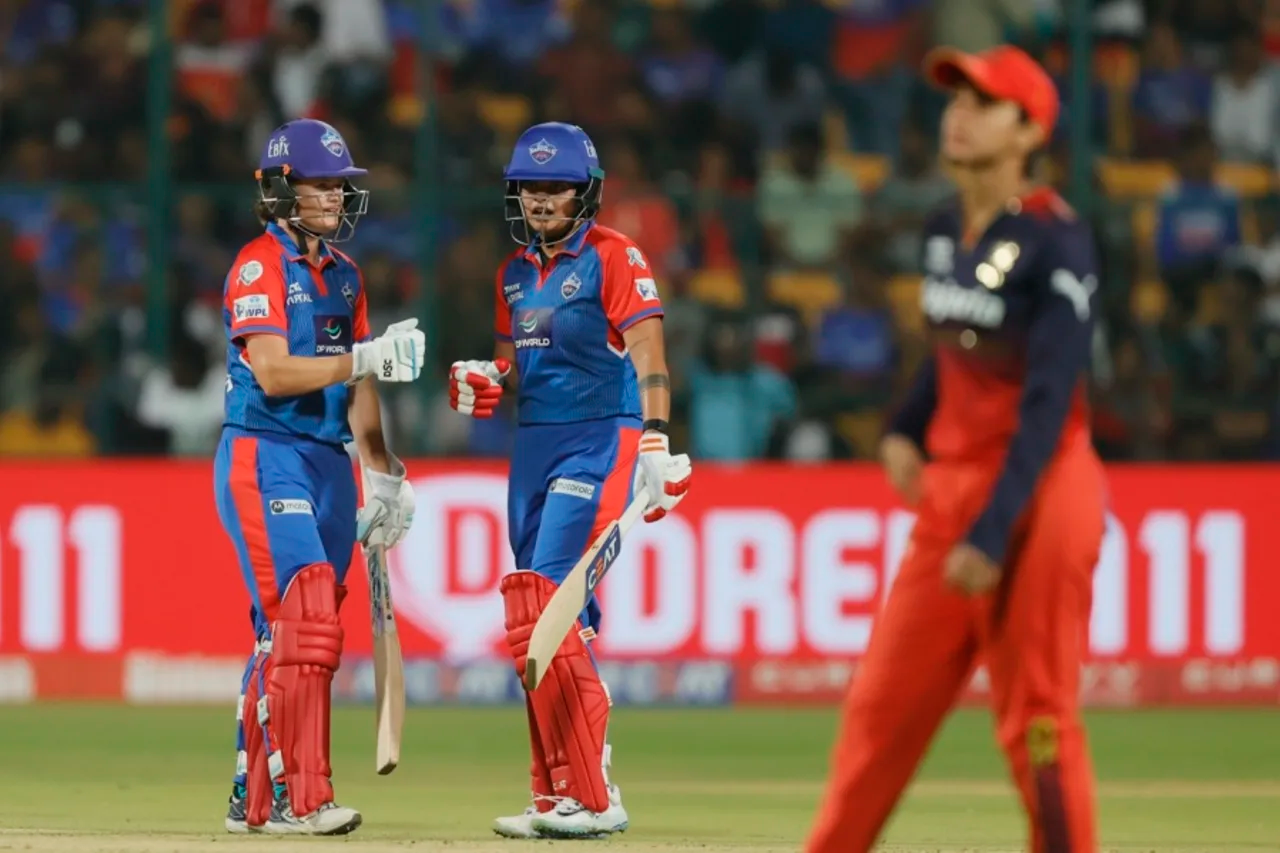
Shafali Verma and Jess Jonassen smashed merciless unbeaten fifties to steer Delhi Capitals (DC) into the WPL 2025 playoffs with a nine-wicket win over Royal Challengers Bengaluru (RCB) on Saturday. It was RCB’s fourth defeat in a row, and they ended up without a single win in the Bengaluru leg of the tournament.
Ellyse Perry once again led RCB’s fight after they were sent in, and scored an unbeaten 60 to help the side post 147 for 5, but it wasn’t enough against the table-toppers. DC rode on the efforts of Shikha Pandy and debutant left-arm spinner Shree Charani, who picked up two wickets apiece.
The chase though got off on a tricky note for DC, who lost Meg Lanning in the third over, but Shafali and Jonassen put on an unbroken 146 for the second wicket, off just 77 balls – the highest partnership for any wicket in a WPL run chase. The Chinnaswamy was left silenced as DC romped home with 27 balls remaining.
Perry came into this game with three fifties in RCB’s first five games, and she was once again central to her team’s fortunes on a slow surface. While there were starts from Danni Wyatt-Hodge (21 off 18) and Raghvi Bist (33 off 32), neither went on to a big score. It was left to Perry to anchor the innings and keep the scorecard ticking at a healthy rate.
Coming in after Pandey dismissed Smriti Mandhana in the second over, Perry was up and running in Pandey’s next over by crashing a wide half-volley over the covers for four. She then hit a six each off spinners Jonassen, Charani and Minnu Mani.
Perry put on a brisk 44 with Wyatt-Hodge for the second wicket, and 66 with Bist for the third. With Bist struggling to middle the ball, however, that partnership consumed 54 balls.
Perry reached her fourth fifty of the season, off 37 balls, in the 14th over. At the end of the 16th over, RCB were 119 for 2 and eyeing a strong finish. But they fell apart around Perry, scoring just 28 in the last four overs for the loss of three wickets. Perry only faced seven balls in the last five overs, scoring eight runs off them.
With 25 runs in six innings, Perry has overtaken Nat Sciver-Brunt to become the tournament’s leading run-scorer.
DC preferred Charani over fast bowler Titas Sadhu and she looked in her element. Unfazed by the huge turnout at the Chinnaswamy, Charani used the turn that was on offer in the first innings, kept the stumps in play, constantly angling the ball into middle and leg over the course of a tight spell. She removed Bist and Richa Ghosh in a momentum-changing 17th over to deflate RCB at the death, and ended with figures of 2 for 28 from four overs.
Mandhana owned the Chinnaswamy during WPL 2024, scoring 219 runs in five innings, including two half-centuries, at the astonishing strike rate of 154.22. This season, however, she has perished to ill-judged shots, accumulating just 50 runs in four innings at her home ground at a strike rate of 102.04. On Saturday, she chased a Pandey delivery shaping away from off stump and edged to Lanning at wide slip.
RCB had an excellent start to the powerplay, conceding just five runs in the first three overs. Renuka Singh displayed excellent control with her swing bowling, with almost all of her deliveries finishing within the stumps. She removed Lanning for a 12-ball 2, with Perry taking a sharp chance at mid-on. But once Jonassen joined Shafali, runs started flowing for DC, and it became hard for RCB to keep them quiet.
Today was the second time Jonassen walked in at No. 3. She had scored another unbeaten 61 from that position at the same ground against Gujarat Giants. With DC’s top order predominantly batting right-handed, they promoted the left-handed Jonassen and it began to unsettle RCB. Jonassen looked fluent in her 38-ball stay, hitting nine fours and a straight six off left-arm spinner Ekta Bisht.
Shafali, who had been out in the 40s three times before today, played a composed knock, showing a desire to not throw her wicket away after a bright start. She ended up with her top score of the season, smashing eight fours and four sixes (two each on the off and leg sides) and hammered the bowling to all parts.
As DC neared their target, RCB’s bowling began to wither, and Shafali and Jonassen duly punished them. From 68 for 1 after nine overs, DC sprinted to their target, hitting eight fours and five sixes while ransacking 83 runs off what turned out to be the last 39 balls of their innings.
Brief scores:
Delhi Capitals Women 151 for 1 in 15.3 overs (Shafali Verma 80*, Jess Jonassen 61*; Renuka Singh 1-12) beat Royal Challengers Bengaluru Women 147 for 5 in 20 overs (Danni Wyatt Hodge 21, Ellyse Perry 60*, Raghvi Bist 33, Georgia Wareham 12*; Marizanne Kapp 1-18, Shikha Pandey 2-24, Shree Charani 2-28) by nine wickets
[Cricinfo]

Latest News
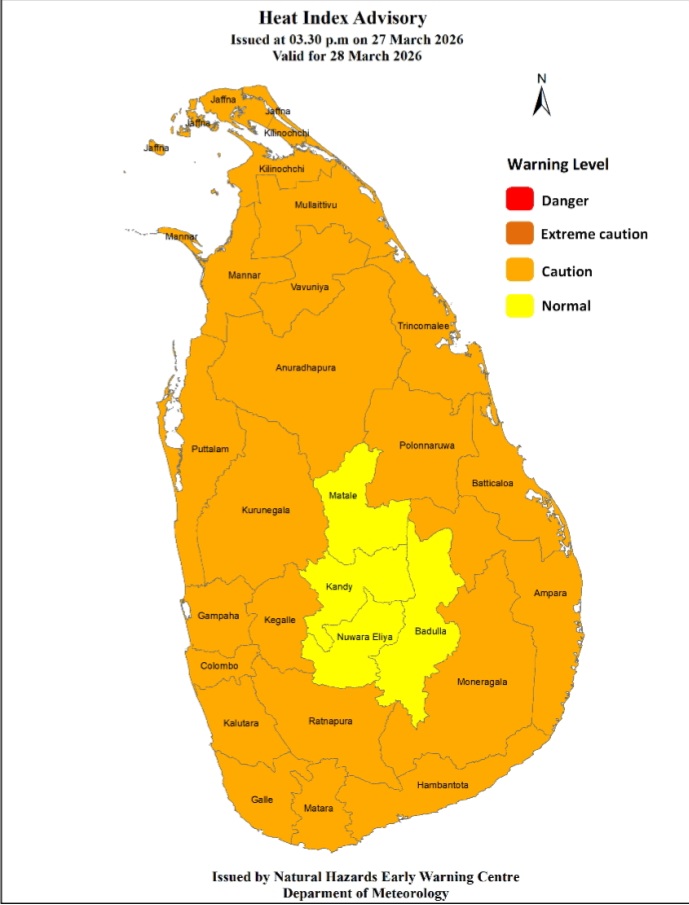
Heat Index at Caution Level in the Western, Sabaragamuwa, Southern, Eastern, North-western, Northern and North-central provinces and in Monaragala district
Warm Weather Advisory
Issued by the Natural Hazards Early Warning Centre of the Department of Meteorology
Issued at 3.30 p.m. on 27 March 2026, valid for 28 March 2026.
The ‘Heat index‘, the temperature felt on human body is likely to increase up to ‘Caution level’ at some places in the Western, Sabaragamuwa, Southern, Eastern, North-western, Northern and North-central provinces and in Monaragala district
The Heat Index Forecast is calculated by using relative humidity and maximum temperature and this is the condition that is felt on your body. This is not the forecast of maximum temperature. It is generated by the Department of Meteorology for the next day period and prepared by using global numerical weather prediction model data.

Effect of the heat index on human body is mentioned in the above table and it is prepared on the advice of the Ministry of Health and Indigenous Medical Services.
ACTION REQUIRED
Job sites: Stay hydrated and takes breaks in the shade as often as possible.
Indoors: Check up on the elderly and the sick.
Vehicles: Never leave children unattended.
Outdoors: Limit strenuous outdoor activities, find shade and stay hydrated.
Dress: Wear lightweight and white or light-colored clothing.
Note:
In addition, please refer to advisories issued by the Disaster Preparedness & Response Division, Ministry of Health in this regard as well. For further clarifications please contact 011-7446491.

Shaheen Shah Afridi and Marnus Labuschagne, captains of Lahore Qalandars and Hyderabad Kingsmen, walked out with two team sheets each for the toss ahead of the opening matchof PSL 2026 and selected their final XIs based on which way the coin fell.
This was in accordance with a new regulation in the PSL playing conditions, which permits the captains to submit two team sheets to the match referee before the toss and finalise one of the submitted line-ups after the toss.
The clause 1.2.1 in the “Nomination and Replacement of Players” section reads: “Before the toss, each captain may submit two (2) different XI lineups in writing to the PSL Match Referee. Each lineup must include 11 players and a maximum of 4 substitute fielders (subject to Clause 1.2.5). After the toss, each captain must finalise one of the two submitted lineups by signing the selected team sheet. Once the final lineup has been nominated, no player listed in the selected playing eleven may be changed before the start of the match without the consent of the opposing captain.”
Tosses can play a significant role in this part of the world in night matches as a result of dew. The ball often gets wet and difficult to grip for the spinners, making them ineffective in the second innings. This change in the playing conditions is expected to provide a level playing field – a team batting first can add a fast bowler instead of a spinner while a team batting second can look to add depth to their batting.
There were no signs of dew in the first match of the season however because of the wind throughout the day and cloud cover.
[Cricinfo]

The Japan Premier League (JPL) T20 competition is cricket’s unlikely outpost – a self-sustaining though struggling-to-survive tournament far away from cricket’s traditional centres. It’s on a growth path just over a decade into its existence, starting to connect local players to those outside, and looking to create a cricketing community in the country.
It was founded in 2015 with four regions – North, South, East and West Kanto (Tokyo region) – in the fray, with games held at the home venues of each of the teams. That model was scrapped owing to low turnouts, and the tournament has since been played at one or the other venue, while Kansai (Osaka region) has come in as the fifth team.
In 2026, the JPL will be a three-day competition – May 2 to 4 – with 12 games at the Sano International Cricket Ground. All the buzz in the lead-up is about the participation of former Sri Lanka captain Dimuth Karunaratne, BBL winner Josh Brown, and Nepal allrounder Karan KC.
“A major goal,” Alan Curr, the Japan Cricket Association (JCA) chief operations officer, says, “is to showcase a good standard of cricket for Japanese fans so that they can really see and understand what the sport looks like.”
The challenge there is that despite being played in Japan since 1863, cricket hasn’t found a niche. There has been some systemic progress, with the formation of the JCA in the 1980s, five-year plans running up to 2032, and the presence of men and women’s leagues for juniors and seniors – including the JPL, which struggled to find traction early on.
One of the reasons for excitement recently was that a significant majority of the 15 players in Japan’s squad at the 2020 Under-19 World Cup came through the Cricket Blast, the junior participation programme. However, that’s not translated to mass acceptance or participation.

“Often, for us, cricket in itself isn’t enough to attract people to the ground,” Curr says. “We have to be creative and come up with other things – dance, music, food, drinks and Japanese commentary. But the hope is that if they see the game, it’s of a high standard because when fans see players doing special things, it’s easier to be impressed.”
When it comes to the players, not everyone is too ambitious. Those that are have rewards to aim for as the JPL can have a significant effect on selection for the national side. Having said that, those in the national side are not professionals – they are students or are employed – and use their annual leaves for international assignments. Making time can be a challenge.
“A lot of the players here play recreationally,” Curr says. “Cricket is a recreational hobby to them rather than a high-performance pursuit. For us, concentrating the talent, getting players together at once to give local players the opportunity to play at a higher standard, and going overseas and playing cricket isn’t a feasible option. [So] to be able to bring high-level cricket here is really important.”
The last bit is why Brown, especially, coming to JPL in 2024 was critical. Brown is a “pro player” – each team gets one – and will be returning for his third year in a row.
“He signed up quite a long time in advance – that year he had a breakthrough year in the Big Bash,” Curr says. “He scored 140 off 57 balls against Adelaide Strikers. We had him locked in when he did that, but we hadn’t announced it. Then his profile went up, and he started playing leagues around the world. Fair play to him, he still came.
“That year, people were pretty excited when we made that announcement, and people did come and the live-streaming certainly got up. It was the first time we had someone of genuine stature coming over and being involved.”
Other than pro players, the 14-player squads have four retained from the previous year’s teams. All of them find their teams in a draft – this year’s draft took place on March 24.

Where do these players come from, and how do they make their way? “Inside Japan is through domestic performances and trials at the start of the year for any new players,” Curr says. “The overseas talent right now comes from our own contacts as we want to make sure we get players who really understand what the tournament is about. It’s a development league; there’s no salary for these players. We just cover their costs.”
As for the future, there are different avenues for expansion. One is getting more pro players into teams, which, according to Curr, could squeeze out local players, making it a less-than-ideal option. Having more teams is more appealing, as is the prospect of having a nine-day tournament than one only over a long weekend.
“All of those things require funding. At the moment, we are relying heavily on the goodwill of people, who are happy to come out and play for no payment and out of the kindness of their heart,” Curr says. “We know that’s not sustainable. If we can get financial backing, getting a sponsor on board will really make a big difference.”
So far, cricket in Japan made news when the national team did anything of note, like qualifying for the 2020 and 2026 men’s Under 19 World Cups. If the JPL can take the next steps towards becoming bigger and better, maybe it will start attracting interest from other parts of the world in a more significant way. And that in turn could mean the next step for cricket in Japan as a whole.
[Cricinfo]

SC finds Keheliya, others, guilty of violating FRs of public through corrupt drug procurement deal

Sajith nudges govt. to follow India’s example in giving relief to consumers by slashing taxes on fuel

Expect hot weather until end of May

SLRCS steps in to help Lankans to reconnect with loved ones in West Asia

Minister Jayakody indicted in Colombo High Court over alleged corruption

Court of Appeal orders fresh trial into the murder of TNA MP Raviraj

‘Dates have the highest sugar content to fight Coronavirus’

Sunday Island 27 December – Headlines

#SundayIsland 17th December – Headlines

Sunday Island – 28th March

Sunday Island Headlines – 21 March

Sunday Island – 21st February – Headlines
-

 News3 days ago
Senior citizens above 70 years to receive March allowances on Thursday (26)
-

 Features5 days ago
Trincomalee oil tank farm: An engineering marvel
-

 News1 day ago
Energy Minister indicted on corruption charges ahead of no-faith motion against him
-

 News2 days ago
US dodges question on AKD’s claim SL denied permission for military aircraft to land
-

 Features5 days ago
The scientist who was finally heard
-

 Business2 days ago
Dialog Unveils Dialog Play Mini with Netflix and Apple TV
-

 News3 days ago
CEB Engineers warn public to be prepared for power cuts after New Year
-

 Sports1 day ago
SLC to hold EGM in April