
Latest News
Settled Sri Lanka meet a Bangladesh in transition for ODI series opener


After a hard-fought Test series, the action now switches to the white-ball format, with the first of three ODIs starting today [Wednesday]. For Bangladesh it’s the dawn of a new era in many ways. They have a new ODI captain for starters, with Mehidy Hasan Miraz taking over from Najmul Hossain Shanto, but more pressingly are the recent retirements of stalwarts Mushfiqur Rahim and Mahmudullah.
To say it signals a changing of the guard would be an almost textbook definition of the idiom, in fact, as Mushfiqur and Mahmudullah were the last remaining vestiges of Bangladesh’s fab five, which also included Mashrafe Mortaza, Tamim Iqbal and Shakib Al Hasan. You would have to go all the way back to September 2005 to find the last ODI that neither of these players took part in – coincidentally, also against Sri Lanka in Colombo.
So what does this new look Bangladesh entail? Well, they’ll be hoping recent form isn’t an accurate indicator. They’ve lost their last six completed ODIs, and 8 of their last 11 ODIs since the start of 2024. Though more promisingly, two of those wins were part of a series victory against Sri Lanka.
Since that series defeat though, Sri Lanka have been on a bit of a tear, particularly at home. They’ve beaten India, West Indies, New Zealand and Australia on home turf in the past year, with their only ODI series loss coming away to New Zealand.
And while Bangladesh are seeking to fill some big holes, Sri Lanka very well might be settling into a favoured setup. Their batting is now replete with ever more dependable performers, while their bench strength is becoming quite formidable.
Nowhere is this more exemplified than in the pace contingent with Eshan Malinga, Asitha Fernando and Dilshan Madushanka included ahead of the likes of Dushmantha Chameera, Lahiru Kumara, Nuwan Thushara and Matheesha Pathirana. Meanwhile a spin department headed by Wanidu Hasaranga and Maheesh Theekshana is comfortably in world-class territory, and even deadlier in home conditions.
But Bangladesh have exciting talents of their own, even if overall depth is still lacking. Rishad Hossain was a key part of Bangladesh’s most recent win against Sri Lanka, while in Mehidy they have one of the premier allrounders in world cricket. Shanto, meanwhile, unburdened by captaincy will be eyeing to turn over a new leaf of his own.
So it very well could be a fresh start for this young Bangladesh outfit, and where better to start than by targeting a first-ever series win in Sri Lanka.
Maheesh Theekshana played just one out of a possible three ODIs against India last year, and then two out of three against West Indies. But since then he’s played in every home ODI he’s been available for, while even picking up seven wickets across two games in New Zealand. While Theekshana has for the most part been considered a T20 specialist, it seems the think tank is increasingly more attuned to the utility of his skill-set in ODIs as well. And even when he’s not picking up wickets, he’s creating the pressure for the bevy of spinners around him to profit.
Unlike Sri Lanka’s, Bangladesh’s spinners haven’t had all that great a time as of late, but in Rishad Hossain they have the kind of talent every team in world cricket is looking for – namely, a leg spinning all-rounder that can hit the ball far. But sadly for Bangladesh and Rishad, neither facet of his skillset has been coming off as of late. His last 10 games, internationally and in franchise cricket, has seen a high score of 13 and 11 wickets. But when Bangladesh last played Sri Lanka in the format, Rishad struck a devastating 48 off 18, with a wicket to go with it. If Bangladesh are to challenge a strong Sri Lankan outfit, Hossain will have to be on top of his game.
Sri Lanka’s XI is largely settled but there are a few areas wherein things might not be as nailed down. An opening partner for Pathum Nissanka is one of them, with Nishan Madushka preferred over Avishka Fernando in Sri Lanka’s last ODI. Eshan had a storming IPL and domestic season, which means it’ll likely be between Asitha and Madushanka for that final seamer spot.
Sri Lanka (probable): Nishan Madushka/Avishka Fernando, Pathum Nissanka, Kusal Mendis, Charith Asalanka, Kamindu Mendis Janith Liyanage, Dunith Wellalage, Wanindu Hasaranga, Maheesh Theekshana Eshan Malinga Asitha Fernando/Dilshan Madushanka
The visitors have to make at least two major changes to their middle-order with Mushfiqur and Mahmudullah gone from ODIs since their last match in this format. Shanto will likely move into the middle-order with Mohammad Naim and Litton Das set to get into the top-order.
Bangladesh (probable): Tanzid Hasan, Litton Das (wk), Mohammad Naim, Najmul Hossain Shanto, Towhid Hridoy, Mehidy Hasan Miraz (capt), Jaker Ali, Rishad Hossain, Taskin Ahmed, Mustafizur Rahman, Nahid Rana
[Cricnfo]


A tiny possum with one extra-long finger on each hand is one of two species thought to have been extinct that have been discovered in West Papua, in what’s been called an “exceptional” scientific discovery.
The other is a a ring-tailed glider with a tail that can grasp branches. Both have been found living in remote rainforests after they were thought to have disappeared 6,000 years ago.
Finding living examples of a lost species is rare, but discovering two is “remarkable,” say scientists who published their findings in the Records of the Australian Museum journal on Friday.
Such discoveries are known as “lazarus taxon”, a term inspired by a biblical figure who was raised from the dead.
“The discovery of one lazarus taxon… is an exceptional discovery,” said Prof Tim Flannery, a prominent Australian scientist best known for his 2005 The Weather Makers book about climate change.
“But the discovery of two species, thought to have been extinct for thousands of years, is remarkable.”
The first rediscovered species was the pygmy long-fingered possum, a striped marsupial weighing about 200g, which is understood to have vanished from Australia during the Ice Age.
A distinguishing feature is that on each hand, the possum’s fourth finger is twice the length of other digits, which scientists say help it dig out wood-boring insect larvae, it’s main source of food.
The second species is the ring-tailed glider, and just like its Australian cousin the greater glider, it lives in the hollows of tall trees.
The discoveries were made by piecing together parts of a puzzle with scientists combing through decades-old fossils, rare photos and old specimens to gather clues before making visits to remote New Guinea locations.

Flannery, along with another of the paper’s co-authors Prof Kris Helgen and researchers from the University of Papau, spoke to local elders from the Tambrauw and Maybrat clans – some of whom have only had contact with the modern world since the 1960s.
Identification of the species would not have been possible without their help, according to Rika Korain, a Maybrat woman and another co-author.
“They’re very traditional people,” Flannery added, and regard the glider as so sacred that “not only won’t they hunt it, they won’t mention its name”.
But the gliders habitat was increasingly coming under threat from logging in the area, Flannery said.
This, in part, has prompted efforts by scientists and wildlife groups to try secure native title for the forests to ensure logging cannot be carried out without consent from locals, he said.

(BBC)
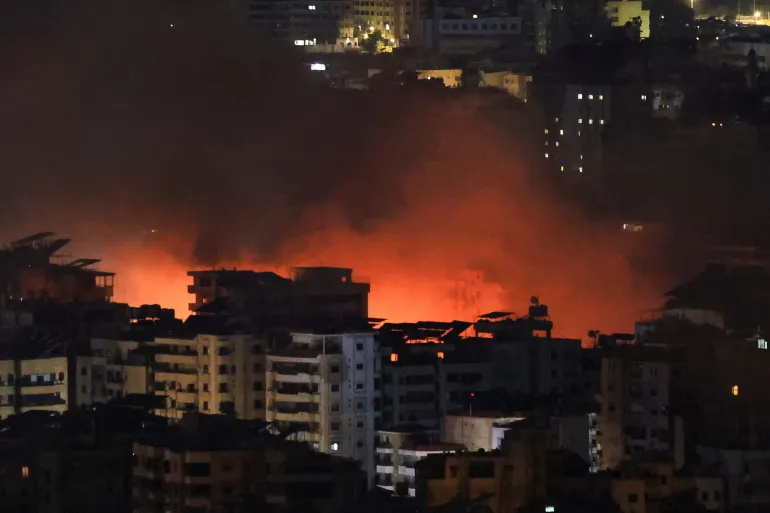
The death toll from Israeli attacks on Lebanon this week has risen to at least 123 people, the Lebanese Ministry of Public Health says, as a new wave of strikes pounded the country and Hezbollah warned Israeli residents to evacuate towns within 5km (3 miles) of their northern border, in one of the fiercest fronts in the wider United States – Israel war on Iran.
“The toll from the Israeli aggression on Monday, increased to 123 martyrs and 683 wounded,” a ministry statement said on Thursday.
Lebanese state media said early on Friday that Israel had launched air strikes on several towns in southern Lebanon.
“Enemy warplanes launched nighttime strikes on the towns of Srifa, Aita al-Shaab, Touline, as-Sawana and Majdal Selem,” the official National News Agency (NNA) reported.
Another strike hit the eastern Lebanese town of Douris at dawn, the NNA said.
The Israeli army also reported a new attack on the suburb of Dahiyeh in Beirut.
It has also continued attacks in southern Lebanon with raids on the area’s biggest city Sidon, according to sources on the ground.
NNA also reported Israeli warplanes over the southern towns of Tyre and Bint Jbeil.
(Aljazeera)

Hungary’s tax authority has said it has arrested seven Ukrainians and two cash-transport vehicles on suspicion of money-laundering after Ukraine’s foreign minister accused Budapest of taking them hostage.
“The reasons are still unknown, as well as their current well-being,” Andrii Sybiha wrote on X. “We have already sent an official note demanding an immediate release of our citizens.”
According to Ukraine’s state savings bank, Oschadbank, the seven workers were in two vans carrying $80m (£60m) worth of cash and 9kg of gold in a regular transport between Austria and Ukraine. They were “unjustifiably detained” and GPS data showed their vehicles in Budapest, it said.
Hungary’s tax authority said on Friday that it was conducting criminal proceedings and added that one of the group was a former general of Ukraine’s intelligence service.
(BBC)

Tiny possum and glider thought extinct for 6,000 years found in remote West Papua

Maldives Coast Guard Ship Huravee departs island

Cost to US for war on Iran is $3.7bn in first 100 hours, says think tank

More than 120 killed in Israel’s Lebanon attacks as Beirut, south, east hit

Hungary confirms it is holding seven Ukrainian bank workers and $80m

US and Venezuela agree to resume diplomatic ties after Maduro capture

‘Dates have the highest sugar content to fight Coronavirus’

Sunday Island 27 December – Headlines

#SundayIsland 17th December – Headlines

Sunday Island – 28th March

Sunday Island Headlines – 21 March

Sunday Island – 21st February – Headlines
-

 Features5 days ago
Brilliant Navy officer no more
-

 Opinion5 days ago
Sri Lanka – world’s worst facilities for cricket fans
-

 Features5 days ago
A life in colour and song: Rajika Gamage’s new bird guide captures Sri Lanka’s avian soul
-

 Business2 days ago
Cabinet nod for the removal of Cess tax imposed on imported good
-

 Features6 days ago
Overseas visits to drum up foreign assistance for Sri Lanka
-
 Features6 days ago
Sri Lanka to Host First-Ever World Congress on Snakes in Landmark Scientific Milestone
-

 News2 days ago
Legal experts decry move to demolish STC dining hall
-

 Latest News2 days ago
Around 140 people missing after Iranian navy ship sinks off coast of Sri Lanka