
Sports
Scotland thrash Oman to boost Super 8s hopes

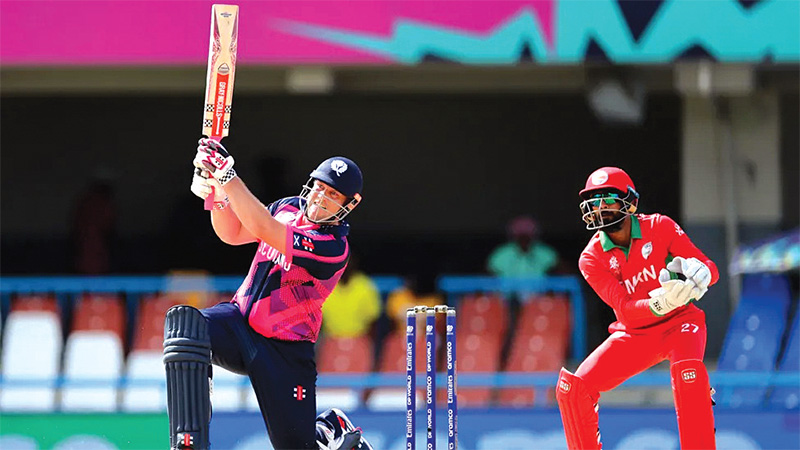
Scotland raced to a comprehensive seven-wicket victory over Oman at the T20 World Cup to go top of Group B.
A wonderful unbeaten 61 from Brandon McMullen guided Scotland to their target of 151 in just 13.1 overs as Richie Berrington’s side delivered a real statement.
Safyaan Sharif marked his 200th Scotland cap with two wickets before the batting line-up took over.
George Munsey and Michael Jones set the tone before McMullen took charge with a series of eye-catching shots all around the Sir Vivian Richards Stadium.
The nature of the result leaves Scotland in a strong position to make the Super 8s and leaves England’s qualification hopes hanging by a thread.
A win over Australia next Sunday would guarantee the Scots’ place in the next stage, while even a loss could see them through.
In that scenario, England would need to win both their games against Oman and Namibia and also overhaul Scotland’s healthy net run-rate.
Scotland’s batters deliver again
In all three of their games at this World Cup, Scotland’s batting arsenal has come up with the goods when required.
Against England, Munsey and Jones whacked the likes of Mark Wood and Adil Rashid around the Kensington Oval – and it was only the rain that denied the Scots a shot at an historic win.
Chasing 156 against Namibia, it was left to the middle order to stand up. Scotland needed 40 from the last four overs; and Berrington and Michael Leask delivered a late barrage as they cruised home with nine balls to spare.
In Antigua, on a true pitch, Scotland utilised a strong wind and a short boundary to full advantage.
Munsey was at his brutal best, clubbing into the leg side off the seamers and reverse sweeping the slower bowlers into the stands. He is one of the more unorthodox players in world cricket and, when he plays well, Scotland tend to follow.
McMullen is Scotland’s bright young thing, all elegance and timing. The South African-born bat has played several eye-catching innings since his international debut in December 2022 and this was up there with the best of them.
If Scotland carry their batting form into their meeting with Australia then you wouldn’t bet against them making the next stage of the competition.
What they said
Scotland captain Richie Berrington: “Really pleased with that performance. It was important to get a win in what we knew would be a tough game. We’ve put ourselves in a really good position.
“It’s the first game on this wicket and we had to work it out quickly.
“We didn’t have a score in mind. It was more about trying to work out the right lengths to bowl and what was going to be effective.
“It was hard to defend the short side with the breeze, but we did that well for most of the innings.
“Although we were happy with what we’re chasing, it was really important to get a good start. If you lose a few early wickets, it can be a different chase.
“That partnership between George and Brandon got us in a strong position. We know what a classy player McMullen is, so I was really pleased for him to get a score.
“[Net run-rate] might come into play, but we can only control what we can. We’ll enjoy this moment, but we know there’s another big game to come.”

Latest News
Sooryavanshi blitz, Jurel 81* help Rajasthan Royals take down Royal Challengers Bengaluru with ease


Vaibhav Sooriyavanshi equalled his own record for the fastest half-century, off 15 balls, in a six-fest on a flat Guwahati deck as Rajasthan Royals walloped Royal Challengers Bengaluru for their fourth straight win.
RCB hit seven sixes through their 20 overs in an innings where they went all out, seemingly mindful of the challenge Sooryavanshi would pose. And pose he did, hitting seven sixes off his own blade, in a scarcely believable exhibition of brutal hitting.
Reputation counted for little. If it was Jasprit Bumrah the other night, it was Josh Hazlewood’s turn to come under Sooryavanshi’s wheel on Friday. By the time he was dismissed for a 26-ball 78, toe-ending a flat-batted hit to long-on off Krunal Pandya, RR’s asking rate in a 202 chase was just over six with 11.5 overs remaining.
Sooryavanshi’s uninhibited hitting was matched by Dhruv Jurel’s scintillating stroke play, the pair effectively snuffed out RCB’s hopes in the powerplay itself as they plundered 97 – the highest of the season. Although RR lost a couple of wickets in a rush thereafter, the result was never really in doubt.
RCB’s defence was given an early lift when the returning Hazlewood struck in the second over to remove Yashasvi Jaiswal. After conceding a couple of sixes off the short ball, Hazlewood responded smartly by going cross-seam and into the pitch to induce the edge. But the delight at having struck early dissipated quickly as Sooryavanshi seized control by rattling off three boundaries and a six in succession in his next over.
Each of the four boundaries pierced a different arc. The short ball was carved behind point, the hard length into the pitch was muscled over mid-on, the fuller one driven crisply between cover and mid-off, and when tested with the bumper, Sooryavanshi fetched it from outside off and nailed the pull over deep square for six.
And remarkably, it wasn’t just Hazlewood under the pump. Bhuvneshwar Kumar – who had nearly dismissed him first ball with a late-curving inswinging yorker, only for the teenager to dig it out and shovel it straight back for four – was also taken apart. In the fifth over, Sooryavanshi swatted him for back-to-back sixes to bring up his half-century.
Keeping pace with Sooryavanshi stroke for stroke can’t be easy, but Jurel managed it seamlessly, without ever looking like he was trying to. He capped off the powerplay by hitting rookie Abhinandan Singh for a sequence of 4, 6, 4, 0, 6, 4 to end an extraordinary passage.
Jurel’s fast hands were the defining feature of that over – whether it was picking length early to pull or using his wrists to whip the ball into the top tier over deep square. He would later take charge of the innings, tightening his approach after a flurry of wickets, and finishing unbeaten on 76 off 36 balls.
Jurel’s 68-run fifth-wicket stand with Ravindra Jadeja then guided RR home comfortably, steadying things after Krunal briefly stirred RCB’s hopes with back-to-back strikes of Sooryavanshi and Shimron Hetmyer in the ninth over.
RR went through a quiet passage of four overs without a boundary, but the early onslaught from Sooryavanshi and Jurel meant they could afford to play out a few quiet overs fully knowing RCB were a spinner short, as they activated Venkatesh Iyer as an impact player for batting firepower in place of Suyash Sharma.
The match had a blockbuster opening act, with Jofra Archer’s vicious, rip-roaring bouncer sending back Phil Salt for a golden duck. But Virat Kohli fought fire with fire, hitting him for three boundaries in his next over, before Archer struck back to remove the in-form Devdutt Padikkal.
This didn’t affect Kohli, though, as he shredded a much-talked-about matchup with Sandeep Sharma (who had dismissed him seven times in 18 innings) by thumping him over the infield for two fours. But trouble soon came RCB’s way as Ravi Bishnoi struck two quick blows to leave them 73 for 4.
In his first two outings, Rajat Patidar went crash-bang-wallop from the get-go. But a top-order wobble forced him to dig deep. He played himself in, getting to 20 off 22 balls at one stage. And then, three overs later, he brought up a half-century off 35 balls. One of the reasons for this surge was his surety in stroke-making.
The two sixes he hit off Nandre Burger in the 15th had that stamp of authority. A gentle extension of his arms to loft one cleanly over long-off laid down the marker, but the hop back to whip a short ball aimed at his ribs over deep square leg was the blockbuster.
With none of Romario Shepherd or Tim David coming off with the bat, RCB brought in Venkatesh Iyer as their Impact Player, leaving Suyash on the bench. And Venkatesh gave an excellent account of himself on RCB debut, finishing the innings off with a cameo 29 that pushed them past 200.
As it turned out, it was nowhere near enough.
Brief scores:
Rajasthan Royals 202 for 4 (Yashasvi Jiswal 13, Dhruv Jurel 81*, Vaibhav Sooryavanshi 78, Ravindra Jadeja 24*; Josh Hazelwood 2-44, Krunal Pandya 2-30) beat Royal Challengers Bengaluru 201 for 8 in 20 overs (Virat Kohli32, Devudutt Padikkal 14, Rajat Patidar 63, Tim David 13, Romario Shepherd 22, Venkatesh Iyer 29*; Jofra Archer 2-33, Sandeep Sharma 1-47, Ravi Bishnoi 2-32, Ravindra Jadeja 1-14, Brijesh Sharma 2-37) by six wickets
[Cricinfo]
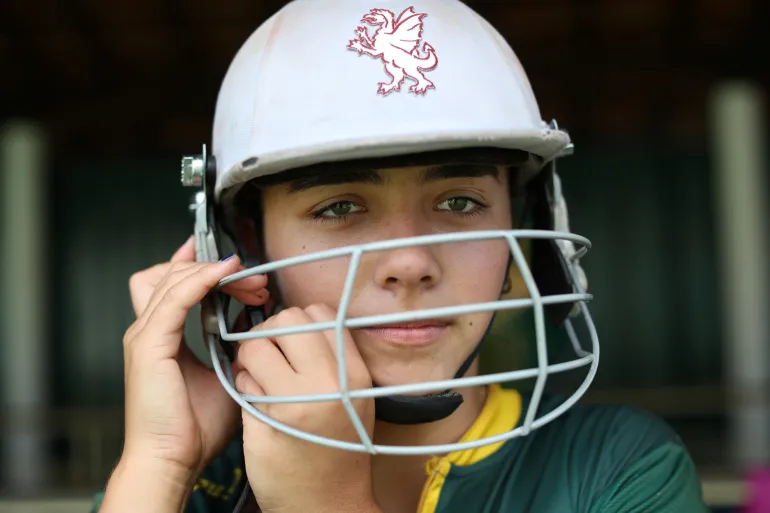
Brazil are the unlikely candidates to have claimed two cricket records as one of their bowlers took a record nine wickets – including five in a row – in their 189-run T20 Women’s International victory against Lesotho in Botswana.
Having won the toss on Thursday, at the BCA Kalahari Women’s T20 International Tournament, Brazil posted a daunting 202-8 with wicketkeeper Monnike Machado hitting 69 off 41.
The fun, for the Brazilians, was only just beginning, though, as Laura Cardoso claimed a hat-trick with the last three deliveries of her first over – the second of the Lesotho innings – to set in motion the incredible feat that eventually saw the Africans bowled out for 13.
The 21-year-old then continued her wicket-taking achievement with a Women’s T20 International first of five dismissals in a row as she struck with the first two balls of her second over. This was all part of claiming the first nine Lesotho wickets to fall, but being denied the chance to take all 10 after a change of bowling following her third over. Her final wicket was Ret’sepile Limema, who fell to the fifth ball of the fifth over, with Cardoso replaced for the following over at that end. Her nine wickets, nevertheless, is the best return in either men’s or women’s T20 internationals.
The right-arm seamer did, indeed, come close to another hat-trick, when she claimed wickets with the last two balls of her second over, which itself totalled four victims.
Cardoso, who has has taken 55 wickets in 48 T20 matches for Brazil, replaces Indonesia’s Rohmalia Rohmalia at the top of the Women’s T20 best bowling rankings, as she finished with figures of 3-2-4-9.
Rohmalia had claimed seven wickets in 2024 in a match against Mongolia in Bali. Only three other women have claimed seven in a T20 international.
The men’s record, and the overall in the format, had been held by Bhutan’s Sonam Yeshey after he took eight wickets for seven runs against Myanmar last year.
The previous record for the number of wickets in consecutive deliveries was four, and was jointly held with the most prominent occasion in women’s cricket being when Shakera Selman pulled off the feat for the West Indies against Pakistan in 2018. Afghanistan’s Rashid Khan and Sri Lanka’s Lasith Malinga are among the most notable bowlers from the men’s game to have claimed four consecutively in the format.
Although a huge winning margin, Brazil’s overall win does not compare with Argentina’s record after they beat Chile by 364 runs in 2023. The Argentinians had struck 427-1 to set up their victory.
Lesotho’s part in the record extends to no further than Cardoso’s haul, with the record-lowest total belonging to Mali, who were bowled out for 6 in 2019 by Rwanda.
Brazil, who lead the six-team tournament with five straight wins, play Mozambique on Friday.
[Aljazeera]
| Date | Match |
|---|---|
| May 3 | 1st ODI |
| May 6 | 2nd ODI |
| May 9 | 3rd ODI |
| May 12 | 1st T20I |
| May 14 | 2nd T20I |
| May 15 | 3rd T20I |
[Cricbuzz]

Sooryavanshi blitz, Jurel 81* help Rajasthan Royals take down Royal Challengers Bengaluru with ease

Sun directly overhead Pomparippu, Anuradhapura, Mihinthale, Galenbindunuwewa, Agbopura and Serunuwara about 12:11 noon today (11)

Showers expected in the Western, Sabaragamuwa, North-western , Southern and Uva provinces and in Anuradhapura, Mannar, Kandy and Nuwara-Eliya districts after 2.00 p.m.

Opposition NCM against Energy Minister defeated

Chinese Ambassador assures Lanka China will not allow a fuel crisis to develop here

Minister Jayatissa blames administrations since 2010 for not following proper procedures when procuring coal

‘Dates have the highest sugar content to fight Coronavirus’

Sunday Island 27 December – Headlines

#SundayIsland 17th December – Headlines

Sunday Island – 28th March

Sunday Island Headlines – 21 March

Sunday Island – 21st February – Headlines
-

 Features7 days ago
Ranjith Siyambalapitiya turns custodian of a rare living collection
-

 News7 days ago
Global ‘Walk for Peace’ to be held in Lanka
-

 News5 days ago
Lankan-origin actress Subashini found dead in India
-

 News3 days ago
AG: Coal procurement full of irregularities
-

 Business2 days ago
Israeli attack on Lebanon triggers local stock market volatility
-

 Features7 days ago
Beyond the Blue Skies: A Tribute to Captain Elmo Jayawardena
-

 Features7 days ago
Aspects of Ceylon/Sri Lanka Foreign Relations – 1948 to 1976
-

 Business3 days ago
Hayleys Mobility introduces Premium OMODA C9 PHEV