
Opinion
Science vs religion – II

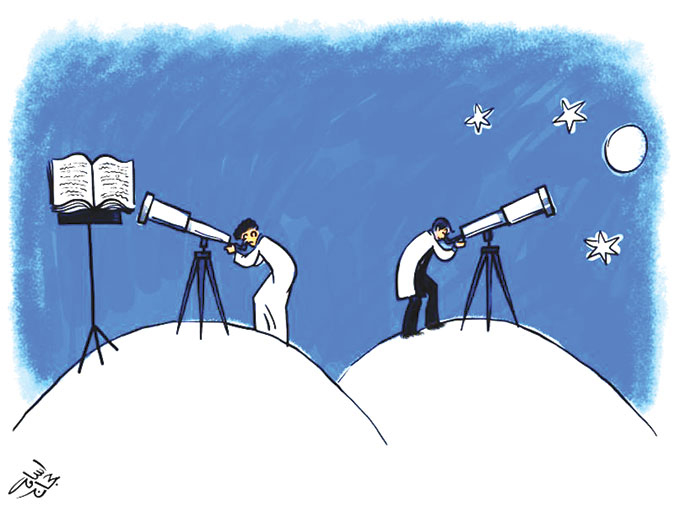
Of course, there are many shortcomings and limitations of the scientific method. Scientific knowledge alone is certainly not enough to make humans attain their full potential. The human values we live by, and questions of meaning and purpose, morality or ethics. are not amenable to hypotheses, modelling, and mathematical equations. They rely on methods that are interpretive, speculative, and philosophical.
By GOVIND BHATTACHARJEE
(The first part of this article reproduced from our Asia News Network partner in India, The Statesman, appeared on 25 Nov.)
“The known is finite, the unknown infinite”, the British biologist Thomas Huxley wrote in 1887, “Intellectually we stand on an islet in the midst of an illimitable ocean of inexplicability. Our business in every generation is to reclaim a little more land.”
Before the last century, the vast unknown territory of inexplicability was ruled by religion.But the last century has seen a tremendous explosion of scientific knowledge, and ever since, science has been reclaiming more and more territory from religion so that scholars started predicting a diminishing relevance and eventual disappearance of religion from human society.
While it is true that religion’s stranglehold has been remarkably weakened in most countries during the last half-century, except in the diehard Islamic states which stubbornly refuse to reform Islam, the resurgence of religion in our contemporary socio-political life negates the prediction of religion’s demise.
There is too much religion on the streets now that is increasingly intruding unto our lives. It is not the spirituality that Sagan had talked about, it is religion in its crudest original form – bloodthirsty, demanding total and unquestioning allegiance from its followers who would not shy away from spilling the blood of non-believers. While science continues to conquer ever newer frontiers and invents technologies that are revolutionising our society, a full transition to a scientific society is not possible without the complete displacement of religion.
From medicine to biotech, from electronics to telecommunication, from AI to nanoscience, the progress of science during the last 50 years has completely transformed the way we organize society, conduct business, and connect with people for ideation.
The paradox is that while we are exploring the frontiers of science and technology driven by limitless human yearning and thirst for knowledge, we are also reinforcing the prejudices, bigotry, and intolerance of contrary ideas and beliefs in our social and public life with renewed vigour and pride. Of course, there are many shortcomings and limitations of the scientific method.Scientific knowledge alone is certainly not enough to make humans attain their full potential. The German philosopher Edmund Husserl argued against recurrent tendencies of applying the methods of natural science in the research of human affairs, which are essentially outside empirical scientific approaches.
The human values we live by, and questions of meaning and purpose, morality or ethics, etc. are not amenable to hypotheses, modelling, and mathematical equations. They rely on methods that are interpretive, speculative, and philosophical. This is always an epistemological problem in social sciences, and this is where religion is supposed to supplement the techno-scientific worldview of science to understand how Nature works her laws in the universe and in human society.
But Nature also includes her children and us humans, and her well-being depends on their activities. No one knows that better than us, especially at this juncture of time when the world is precariously poised between sustainability and irreversible devastation from uncontrolled human greed.
Religion was supposed to impart and promote morality, ethics, love, and compassion among humans to make them understand their symbiotic relationships with nature, with fellow beings, and with animals. Religion was supposed to teach humans to limit their greed, increase empathy towards others, and strike a harmonious balance with nature to make the world a better place for all to live. What it has done and the moral blindness it has promoted instead is for all to see and judge.
Religion today is relentlessly marching to colonize every aspect of our socio-economic and political life with increasing aggressiveness. Suffering has been trivialised by it, the pain has been glorified by it, killing has been sanctified by it and the tattered social fabric that has resulted is being flaunted with egotistical pleasure and pride.
Though it will be unfair to blame religion alone, it has to take a large share of the blame for this sorry state of affairs. It is propelling us energetically to forget our humanity and respect for those who do not share our faith and driving us towards an Orwellian world where intercultural understanding, the richness of culture and diversity, and the ideal of an inclusive and pluralistic society are strongly denounced in favour of a blind pursuance of faith as dictated by its self-proclaimed guardians and their bigoted followers.
The ideal of peace and harmony are receding at the speed of light as religion strives to regain the territory it has lost to science and is countering science with what can best be described as a pseudoscience that is carving out a niche for itself – and a wide one at that.To quote Huxley again, “The question of all questions for humanity is that of the determination of man’s place in nature and his relation to the Cosmos.”
Religion derived sustenance from the concept that humanity was positioned proudly at the centre of God’s magnificent creation, the Earth, around which revolved everything, and humanity – the crowning achievement of God’s creation in his own image, the pinnacle of his divine handiwork, occupied the centre-stage on this earth.Science would shatter the concept, but not before thousands of Giordano Brunos were burned at the stake for holding a contrary view.
In The Structure of Scientific Revolutions (1962), Thomas Kuhn convincingly explained how paradigm shifts take place in the history of science when one dominant worldview is replaced by another. He showed that scientific progress is like Darwinian evolution – a process of selection of one amongst all the competing theories that have the most predictive power puzzle-solving ability, a concept that was later supported by Bas van Fraassen in The Scientific Image (1980).
But each such major paradigm shift has shaken the edifice of religion from which it could never recover. Thus, when the geocentric Ptolemaic worldview was replaced by the Copernican worldview, man lost his centrality in the scheme of things. Till then, heaven was in the sky, hell was underground and God in heaven ruled all three while religion regulated the entry to heaven or hell.
Copernicus banished the earth from the centre of the Universe, and later Hubble displaced the entire Milky way from the centre of the universe, giving us instead an expanding universe of billions of galaxies in which neither is humanity at the centre of creation nor is the earth at the centre of the universe; in fact, the universe itself is one tiny dot in a multiverse of many universes.
Thus, God’s magnificent creation has been relegated to the position of a second-rate planet attached to a third-rate star, discarding religion’s medieval fancies. Today we are humbled by the immensity of the universe and mesmerized by the eternal silence of infinite space.
But for religion, the determination of man’s place in nature and his relation to the cosmos was not a question, it was an irrefutable truth questioning which meant inviting risk. Copernicus wrote De Revolutionibus Orbium Coelesticum on his deathbed in 1543, beyond the morbid reach of the Inquisition.
Galileo and Bruno were not that fortunate. Science established that neither does life enjoy any special privilege – countless worlds exist in deep space devoid of life, and countless species have become extinct in the course of evolution. We may be one someday, and going by our misdeeds on this planet, that day even may not be too far.
Darwin would finally dislodge humanity from the centre of the biological universe, giving it a lowly ancestor that was too humble compared to an almighty God to be a creator of such intelligence as possessed by man. Thankfully, the inquisition was dead, but prejudiced minds that shun logic were not. They are again back at the centre stage in force, flaunting scriptures, dictating how we should conduct ourselves, threatening to push us into a hell of ignominy and violence if we disobey.
Creationism is still being taught in many US public schools, despite the Supreme Court ruling to the contrary. Half the people in the USA still don’t believe in evolution, their share in India is unknown. But here, vigorous attempts are now on somehow bringing God inside the classroom in any guise, be it a hijab, or anything else.
Worship only makes you a slave. A slave forgets his reason, and his purpose for existence, and ultimately becomes an automaton to serve the master – Religion – and obey its commands without thinking.Religion is not the source of spirituality, peace, morality, virtue, and ethics any longer. Its principles may be eternal, but its methods are gross. It has now become the source of violence, hatred, unconcealed greed, corruption, and a road to power.
Instead of breaking barriers, it is building them afresh, destroying the very roots upon which mankind has built civilizations through the millennia. Don’t expect the State to control religion and the street will always celebrate it with ever-ostentatious pomp and splendour. It is therefore for us citizens to shield our children from the corrupting influences of religion. It has no place in the fabric of the mind of civilized men and women, just as God has no place in the fabric of the space-time that science tries to untangle. We don’t need the ancient wisdom of the spirit to guide us, because religion which was supposed to imbibe it has lost its divinity. It is now for science to redeem religion.
(Concluded)



Here is what you can do!
Comedy and the ability to have a good laugh are what keep us sane. The good news to announce is that there are many British and American comedy shows posted up and available on the internet.
They will bring a few hours of welcome relief from our present doldrums.
Firstly, and in a class of its own, are the many Benny Hill shows. Benny is a British comedian who comes from a circus family, and was brought up in an atmosphere of circus clowning. Each show is carefully polished and rehearsed to get the comedy across and understood successfully. These clips have the most beautiful stage props and settings with suitable, amusing costumes. This is really good comedy for the mature, older viewer.
Benny Hill has produced shows that are “Master-Class” in quality adult entertainment. All his shows are good.
Then comes the “Not the Nine o’clock news” with Rowan Atkinson and his comedy team producing good entertainment suitable for all.
And then comes the “Two Ronnies” – Ronnie Barker and Ronnie Corbett, with their dry sense of humour and wit. Search and you will find other uplifting shows such as Dave Allen, with his monologues and humour.
All these shows have been broadcast in Britain over the last 50 years and are well worth viewing on the Internet.
Similarly, in The USA of America. There are some really great entertainment shows. And never forget Fats Waller in the film “Stormy Weather,” where he was the pianist in the unforgettable, epic, comedy song “Ain’t Misbehavin”. And then there is “Bewitched” with young and glamorous Samantha Stevens and her mother, Endora who can perform magic. It is amazing entertainment! This show, although from the 1970s was a milestone in US light entertainment, along with many more.
And do not overlook Charlie Chaplin and Laurel and Hardy, and all the Disney films. Donald Duck gives us a great wealth of simple comedy.
The US offers you a mountain of comedy and good humour on Youtube. All these shows await you, just by accessing the Internet! The internet channel, ‘You tube’ itself, comes from America! The Americans reach out to you with good, happy things right into your own living room!
Those few people with the ability to understand English have the key to a great- great storehouse of uplifting humour and entertainment. They are rich indeed!
Priyantha Hettige

After the recent disaster, a great deal of information has been circulating on WhatsApp and YouTube regarding our reservoirs, highways, etc.
In many of these discussions, people have analysed what went wrong and how the damage could have been prevented. My question is this: why do all these knowledgeable voices emerge only after disaster strikes? One simple reason may be that our self-proclaimed, all-knowing governing messiahs refuse to listen to anyone outside their circles. It is never too late to learn, but has any government decision-maker read or listened to these suggestions?
When the whole world is offering help to overcome this tragedy, has the government even considered seeking modern forecasting equipment and the essential resources currently not available to our armed forces, police, and disaster-management centres?
B Perera
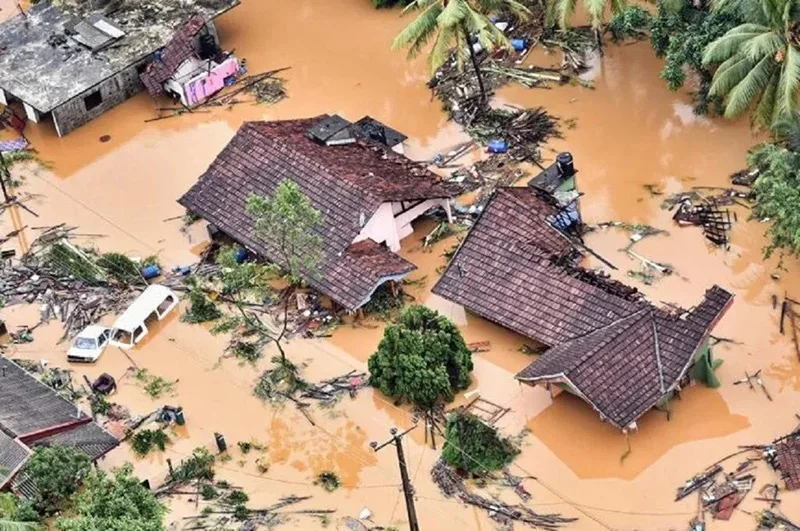
A great deal has been said about Cyclone Ditwah and its impact. To my mind one important aspect of it has not been addressed.
During the 1,400 odd landslides, it washed off a vast volume of soil which entered the various water bodies like tanks, lakes, rivers and streams etc. This process has raised their water levels reducing the water holding capacities (water holding capacity has a different meaning in soil science). What it means is that they cannot hold the same amount of water as before without spilling. Therefore, a precipitation which would not have been significant then can cause spilling of tanks leading to floods now. Hence there is a possibility of experiencing more floods in the future. Due to silting the tanks will carry less water than before, thus reducing the irrigable areas under their command. They will not be able to irrigate the same extents of paddy, thus affecting production.
How do we rectify this situation? It is desilting which can be very expensive.
It is good if these are considered in future planning.
Gamini Peiris
Panadura
Experienced agriculturist

Trump files $5bn defamation lawsuit against BBC over Panorama speech edit

UK and South Korea strike trade deal

Rob Reiner’s son Nick arrested for murder after director and wife found dead

70,297 persons still in safety centers

Showers will occur at times in the Northern, North-Central, Eastern, Uva and Central provinces

MEPA to crack down on marine polluters

‘Dates have the highest sugar content to fight Coronavirus’

Sunday Island 27 December – Headlines

#SundayIsland 17th December – Headlines

Sunday Island – 28th March

Sunday Island Headlines – 21 March

Sunday Island – 21st February – Headlines
-

 Features6 days ago
Finally, Mahinda Yapa sets the record straight
-

 Features6 days ago
Handunnetti and Colonial Shackles of English in Sri Lanka
-
 Business5 days ago
Cabinet approves establishment of two 50 MW wind power stations in Mullikulum, Mannar region
-

 News5 days ago
Gota ordered to give court evidence of life threats
-

 Features5 days ago
Cliff and Hank recreate golden era of ‘The Young Ones’
-

 Opinion6 days ago
A national post-cyclone reflection period?
-
 Features5 days ago
Sri Lanka and Global Climate Emergency: Lessons of Cyclone Ditwah
-

 Latest News6 days ago
Sri Lanka squad named for ACC Men’s U19 Asia Cup