
Business
Sarvodaya-Fusion and HSBC collaborate to educate Sri Lankan women on Personal Financial Literacy


In a concerted attempt to empower Sri Lankan women Sarvodaya-Fusion in partnership with HSBC has launched Personal Financial Literacy Education Programme for women starting June 2021.
“In its essence, financial literacy can be defined as the understanding of how money works and this includes generating, investing, spending, and saving money in ways that ensure a person’s financial stability – an essential life-skill that becomes even more significant in challenging times. This knowledge is the basic building block that enables women to become more independent, and lead more fulfilling, secure lives,” said Stuart Rogers, Interim CEO and Head of Wholesale Banking HSBC Sri Lanka and Maldives.
The ongoing crisis in the country, due to the pandemic has affected both working and non-working women. They are currently forced to manage in an extremely challenging environment with wage gaps and gender inequality. Through this programme, non-working women will be educated and made aware of how to manage their household expenses and look for more avenues to earn an extra income apart from the main income received by their spouse. Similarly, working women will learn how to make their way up the financial ladder, with smart investments and savings. Individuals can visit the Sarvodaya-Fusion Facebook Page for more information on registrations.
“We are excited to partner with a leading global financial entity such as HSBC to educate and enable women of Sri Lanka to take stronger control of their finances. We are convinced that these two key segments of the population should have access to not only financial services, but to recognize themselves as economic agents that can make a change in their families and society through their everyday choices,” said Rohan Pandithakorralage, Chairman, Board of Advisors, Sarvodaya-Fusion.

The engaging Zoom based webinars of one and half hours each cover the main aspects of wise spending, managing debts, earning an extra income, saving as a habit, and making smart investments. The sessions are delivered by utilizing appealing elements such as webinar polls, icebreakers, chats, Q & A sessions and online feedback gathering surveys to ensure maximum engagement and interaction.
“We have seen how financial health has significant ramifications in society, particularly during the pandemic. It’s important for us that we provide women across Sri Lanka with access to the right skills, attitude and tools required to manage their finances and make the most of their money. These carefully crafted webinars dispense the practical knowledge needed by women to manage their money with confidence and, grow their economies,” Rogers continued to state.
Sri Lanka’s adult literacy was 92% in 2018, but the country’s financial literacy rate measures at just 35%. Although this is still the highest out of South Asia, the high print literacy rates do not necessarily correlate to financial savviness. Still, the ability to read and write does provide the basis on which one can build, access and use financial services.
Therefore, it is critical to encourage both working women and non-working women to have a stronger grasp of their finances to benefit themselves, their families and society at large, as well as contribute towards reviving the country’s economy, even at an individual level. Additionally, basic financial literacy among households can also lead to healthier family welfare. Consequently, improving financial literacy and financial capability among all community segments irrespective of age, sectors, and gender would lead to higher levels of economic wellbeing of the individual, their family and the country at large.
With this ethos, the Personal Financial Literacy initiative was launched by Sarvodaya-Fusion as a corporate social responsibility (CSR) project under HSBC’s Future Skills charity program. Over the past few years, the programme has targeted low-wage workers, undergraduates and entrepreneurs. The initiative aims to provide different sectors in the community with the necessary awareness on handling their finances, ranging from personal financial management to managing business finance.

Business
Earth Day warning: Environmental neglect risks undermining Sri Lanka’s economic stability — CEJ

By Ifham Nizam
Today, April 22, as the world marks Earth Day, the Centre for Environmental Justice (CEJ) warned that Sri Lanka’s fragile economic recovery could face serious setbacks if environmental degradation and climate vulnerabilities are not urgently addressed—framing sustainability as a core economic priority rather than a peripheral concern.
CEJ stressed that the country’s exposure to climate shocks—ranging from floods and droughts to coastal erosion—poses direct and escalating risks to key economic sectors including agriculture, water resources, fisheries, and infrastructure.
CEJ chairperson Hemantha Withanage stressed that Sri Lanka’s development trajectory remains dangerously disconnected from environmental realities.
He told The Island Financial Review:”Sri Lanka is highly vulnerable to climate change. Increasingly erratic weather patterns are already disrupting livelihoods, damaging crops, and straining water systems. If these risks are not integrated into economic planning, the cost to the national economy will be severe.”
The warning comes at a time when Sri Lanka is attempting to rebuild fiscal stability, attract investment, and strengthen export sectors. However, CEJ argues that environmental mismanagement—from unchecked pollution to poor land-use planning—continues to erode long-term economic resilience.
The organisation pointed out that climate-induced disasters not only incur immediate financial losses but also create cascading impacts across industries. Agricultural output declines, supply chains are disrupted, and public expenditure rises due to disaster response and infrastructure repairs—placing further pressure on an already constrained national budget.
CEJ also highlighted that unsustainable practices, including excessive plastic use and chemical pollution, carry hidden economic costs—ranging from healthcare burdens to ecosystem damage and loss of tourism appeal.
However, the group noted that policy interventions can yield measurable gains. It cited the government’s move to ban the distribution of polythene bags in supermarkets from November 2025, following a court ruling, as a step that has already contributed to a significant reduction in plastic usage.
“Policy consistency and enforcement are key. When strong environmental regulations are implemented, the benefits are not only ecological but also economic,” Withanage said.
Framing this year’s Earth Day theme, “Our Power, Our Planet,” CEJ called for a shift towards sustainable consumption patterns, green investment, and climate-resilient infrastructure.
“Environmental protection is no longer optional—it is central to economic survival and growth,” CEJ emphasised.

Sampath Bank PLC reported a solid financial performance for 2025, with earnings surpassing market expectations and reinforcing investor confidence in its medium-term growth trajectory, according to a recent equity research update by First Capital Holdings PLC.
The bank recorded a net profit of LKR 32.6 billion for the full year 2025, marking a 13.5% year-on-year increase. Fourth-quarter profit came in at LKR 9.4 billion, marginally down 2% from a year earlier, largely due to base effects stemming from a one-off impairment reversal in the corresponding period of 2024.
Core banking operations remained robust. Net interest income rose 8.1% year-on-year in the final quarter, supported by strong credit expansion, while fee and commission income grew 23.2%. Total other income surged 130%, aided by improved treasury performance, including a turnaround to a trading gain compared to a loss a year earlier.
A key highlight for investors was the sharp expansion in the loan book, which grew 32.6% year-on-year to reach LKR 1.2 trillion by end-2025. Growth was driven by import financing, leasing, and long-term lending. Deposit growth, while more moderate at 11.8%, was led by gains in savings accounts.
Asset quality also improved during the year, with the Stage 3 loan ratio declining to 3.31% from 4.69% a year earlier, reflecting stronger recoveries and improved repayment capacity among borrowers. The reinstatement of parate execution laws further supported recoveries.
Capital and liquidity positions remained well above regulatory thresholds, with total capital adequacy at 17.65% and liquidity coverage at nearly 240%, providing ample buffers to sustain lending growth.
Looking ahead, First Capital forecasts earnings to grow at a more moderate pace, projecting net profits of LKR 34.7 billion in 2026 and LKR 39.9 billion in 2027, as macroeconomic momentum is expected to ease.
Reflecting broader market re-rating trends, the bank’s estimated fair value for 2026 has been revised down to LKR 165 per share, though the stock still offers an expected total return of around 18%. A 2027 fair value of LKR 180 implies a potential return of 30%.
Despite near-term headwinds, the First Capital report maintains a “buy” recommendation on Sampath Bank, citing strong fundamentals, improving asset quality, and sustained credit growth as key drivers of long-term value.
By Sanath Nanayakkare
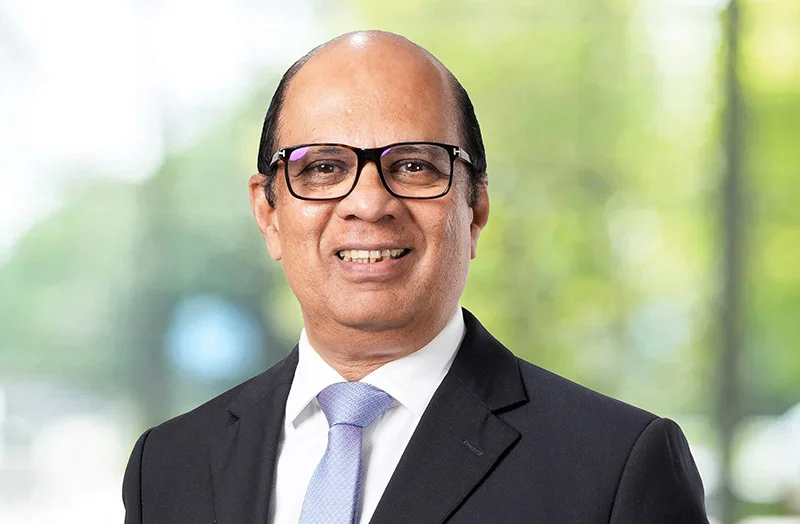
Dialog Axiata PLC, Sri Lanka’s #1 connectivity provider, announced the appointment of Mr. Arjuna Herath as an Independent Non-Executive Director, effective 1 May 2026. Herath brings extensive experience across consulting, corporate finance, investments, and regulatory governance.
“Arjuna brings a unique blend of private sector experience and public sector leadership, with deep exposure to regulatory and institutional environments. His insights will add meaningful value to the Board as we continue to strengthen governance and navigate an increasingly dynamic digital landscape,” said David Lau, Chairman of Dialog Axiata PLC.
Herath most recently served as Chairman of the Board of Investment of Sri Lanka, contributing to national investment promotion strategy. He was also the inaugural Chair of the Sri Lanka Data Protection Authority, where he led early regulatory efforts in digital privacy. Earlier, he served as Senior Partner and Head of Consulting at Ernst & Young (EY) Sri Lanka and Maldives, and held roles in corporate development at Ceylon Tobacco Company and Merchant Bank of Sri Lanka.
He has held several key regulatory roles, including as Commissioner of the Securities and Exchange Commission of Sri Lanka, Board Member of the Sri Lanka Accounting and Auditing Standards Monitoring Board, and Member of the Company Law Advisory Commission. He currently serves as a Director of the Colombo Stock Exchange.
Herath is a Fellow Member and a Past President of The Institute of Chartered Accountants of Sri Lanka and has contributed extensively to the global accountancy profession. He is the first Sri Lankan to chair a committee of the International Federation of Accountants (IFAC), where he led the Professional Accountancy Organisation Development Committee.

Cabinet approves establishment of Activity-Based Learning Centers at Regional Level for Commerce Education
M/s. Resources Development Consultants (Pvt) Ltd appointed to prepare Feasibility Study and detailed plans for the extension of the Kelani Valley Railway Line from Avissawella to Ratnapura
Import and Export (Control) Regulations No. 01 of 2026, issued under the Imports and Exports (Control) Act, No. 1 of 1969, to be submitted for concurrence of the Parliament

Cabinet nod to establish ‘Sri Lanka Industrial Transformation and Innovation Authority ‘
Iraj Chaminda Pathiraja appointed Controller General of Immigration and Emigration
Implementation of the recommendations of the Report submitted by the Presidential Commission appointed to Inquiry on the Easter Sunday attacks and the Then Sectoral Oversight Committee on National Security.

‘Dates have the highest sugar content to fight Coronavirus’

Sunday Island 27 December – Headlines

#SundayIsland 17th December – Headlines

Sunday Island – 28th March

Sunday Island Headlines – 21 March

Sunday Island – 21st February – Headlines
-
 News2 days ago
Rs 13 bn NDB fraud: Int’l forensic audit ordered
-

 Business5 days ago
Harnessing nature’s wisdom: Experts highlight “Resist–Align” path to resilience
-

 News7 days ago
PNS TAIMUR & ASLAT set sail from Colombo
-

 News5 days ago
Gratiaen Trust announces longlist for the 33rd Annual Gratiaen Prize
-

 News4 days ago
From Nuwara Eliya to Dubai: Isha Holdings markets Agri products abroad
-

 Opinion3 days ago
Shutting roof top solar panels – a crime
-
 News5 days ago
Heroin haul transported on 50-million-rupee contract
-

 Latest News6 days ago
Singapore Zoo’s first Sri Lankan leopard cubs make their public debut