
News
Ranil rejects Batalanda report wholesale


Former President Ranil Wickremesinghe yesterday rejected the Batalanda Commission report in its entirety.
“I wholly reject the report. No one can say the report was kept hidden. It was published as a sessional paper in 2000, but no one, including the JVP, asked for a debate,” Wickremeisnmghe said in a special statement.
He also said that there was no precedent in this country, or anywhere else in the world, of debating a sessional paper 25 years after it was published.
Making a special statement Wickremeisnghe said: “The Commission has only questioned my action to heed the request by then State Minister of Defence Ranjan Wijeratne to provide accommodation to the security forces which provided security to important state owned institutions in Biyagama during the height of the JVP insurrection of 1987/89.”
He pointed out that the Commission report mentions the heinous terrorist acts committed by the JVP during the 1988-90 period.
“I was only summoned as a witness. According to the Commission’s findings, I was implicated only in the matter of providing housing for police officers, which, as per regulations, should have been done through the Inspector General of Police. The report indicates that both Nalin Delgoda and I were indirectly responsibile for this process.
Apart from this, I was not implicated in any other allegations in the Commission’s report,” Wickremesinghe said.
The former President pointed out that the report was made available to Parliament in 2000, yet no party, including the JVP, requested a debate on it.
The full statement by former President Ranil Wickremesinghe:
In 1987, following the signing of the Indo-Lanka Accord, the JVP launched a wave of terror across the country.
During this period, President J.R. Jayewardene assigned the responsibility of securing key locations in the country to Cabinet Ministers. Several economically significant sites were located in the Biyagama area, including the oil refinery, diesel power plant, the substation supplying electricity from Mahaweli to Colombo, and the free trade zone. The military was deployed to safeguard these locations.
To accommodate security personnel, it was decided to provide them with abandoned buildings and houses owned by the Lanka Fertiliser Manufacturing Corporation. At the time, several employees of the Ceylon Electricity Board were residing in some of these houses.
During this period of terror, the Sapugaskanda Police Station was attacked, and its Officer-in-Charge was killed. In response, Deputy Minister of Defence Ranjan Wijeratne contacted me, requesting that the vacant houses in the complex be allocated to military and police personnel for their security. Consequently, the administrator at the time took steps to hand over the houses to Kelani Police Chief Nalin Delgoda.
Several individuals, including a Provincial Councillor, a cooperative society chairman, and a police sergeant, were assassinated during this period. Additionally, an attack was carried out on the residence of another Provincial Council member.
The government in power took steps to restore the country’s stability, rebuilding the economy and ensuring national security.
After 1994, President Chandrika Bandaranaike Kumaratunga appointed a Commission to investigate allegations of a torture centre in the Batalanda area. Several individuals were summoned before the Commission, and I was called as a witness. At that time, I was serving as the Leader of the Opposition. The establishment of the Batalanda Commission was politically motivated, but the attempt to use it for political gain was unsuccessful.
According to the Commission’s findings, I was implicated only in the matter of providing housing for police officers, which, as per regulations, should have been done through the Inspector General of Police. The report indicates that both Nalin Delgoda and I were indirectly responsibile for this process.
Apart from this, I was not implicated in any other allegations in the Commission’s report. The report also extensively documented the JVP’s terrorist activities between 1988 and 1990, detailing the background and listing numerous violent acts committed by the JVP in Chapter Three. The entire history of those events is included in the report.
Beyond these findings, no other accusations in the report are relevant to me, and I completely reject the report.
No one can claim that the Batalanda Commission report was hidden. It was made available as a parliamentary session record in 2000, yet no one, including the JVP, requested a debate on it. Many did not accept the report, which may explain why no steps were taken to debate it in Parliament.
It is also noteworthy that no political party that came to power has attempted to use the report for political advantage. Furthermore, there is no precedent in Sri Lanka or other parliaments for debating a session record 25 years after its publication.




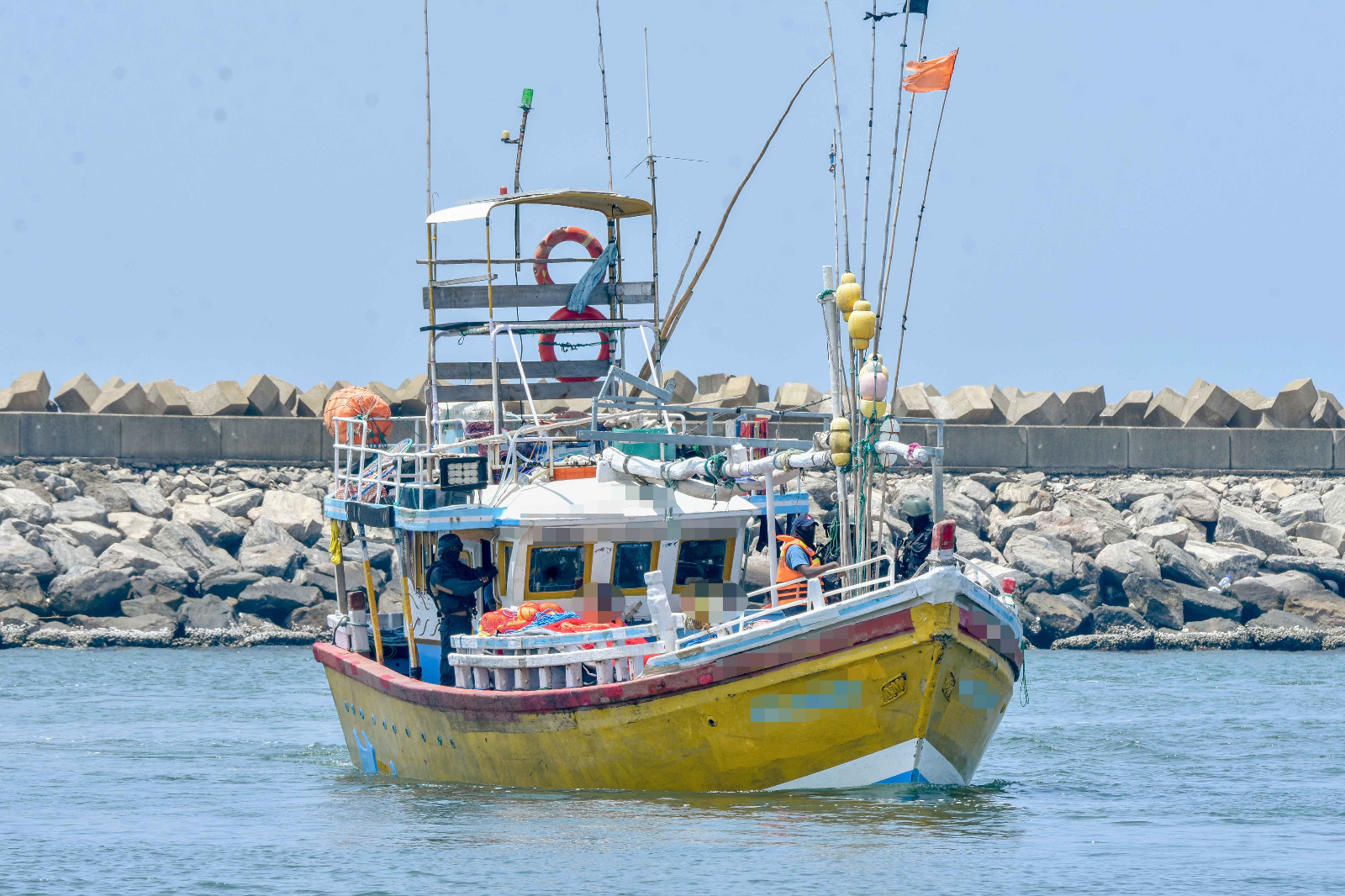
The Sri Lanka Navy during yet another successful operation on the high seas south of Sri Lanka, intercepted two (02) local multi-day fishing trawlers.
One trawler, along with 05 individuals, was suspected of attempting to smuggle a consignment of narcotics and weapons. The second trawler and the remaining 05 suspects are believed to be linked to the same illicit operation.
On 12 Mar 26, the multiday fishing trawlers and crew were brought to the Dickowita Fishery Harbour.
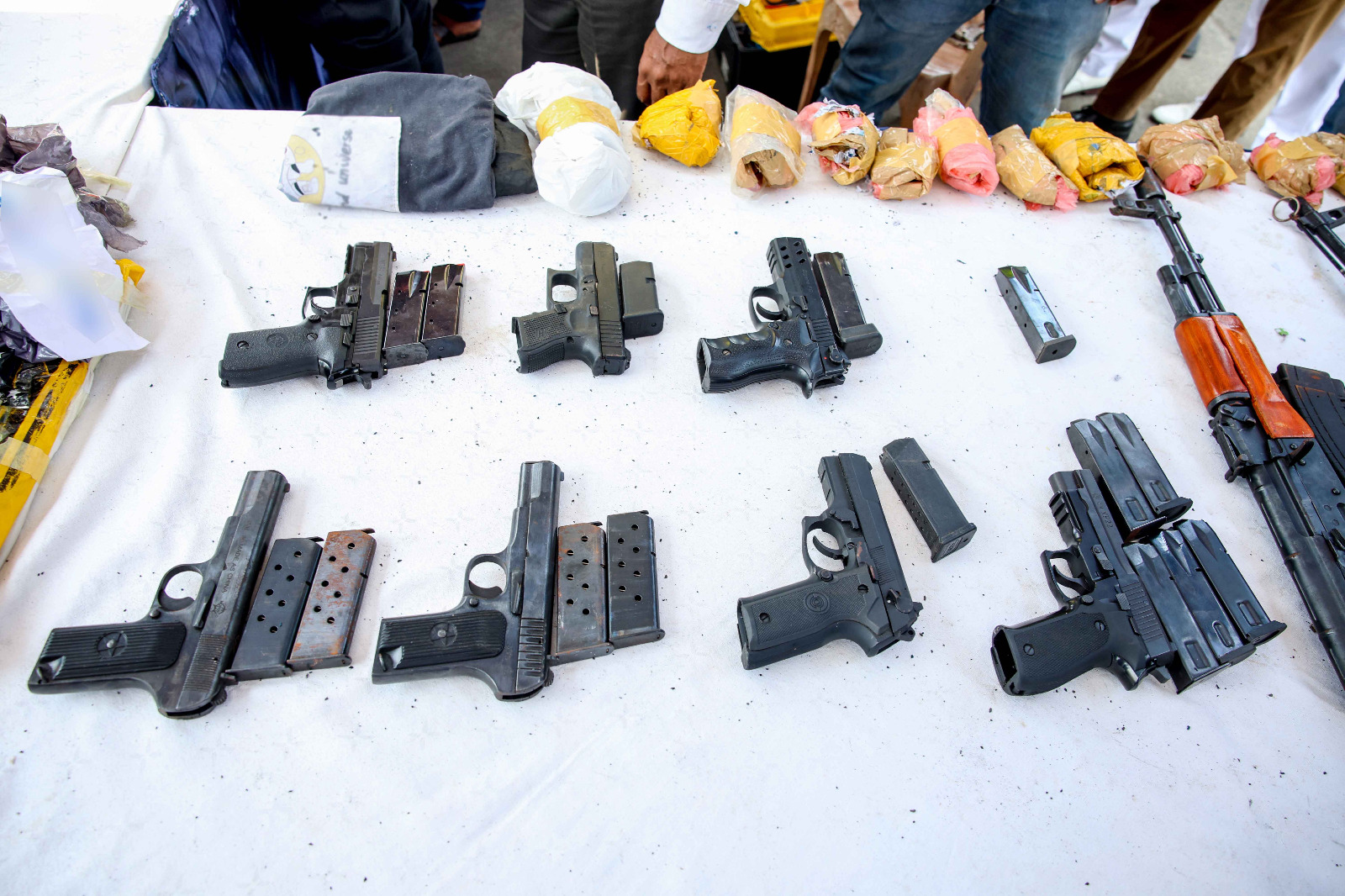
After a meticulous examination the Police Narcotic Bureau (PNB) detected 478kg of crystal methamphetamine, 176kg of heroin as well as 03 mechanical weapons, 08 sidearms and
communication equipment.
The Honourable Deputy Minister of Defence, Major General Aruna Jayasekara (Retd), along with the Commander of the Navy, Vice Admiral Kanchana Banagoda and the Inspector General of Police, Priyantha Weerasooriya, were present to inspect the seized narcotics and weapons.



Latest News
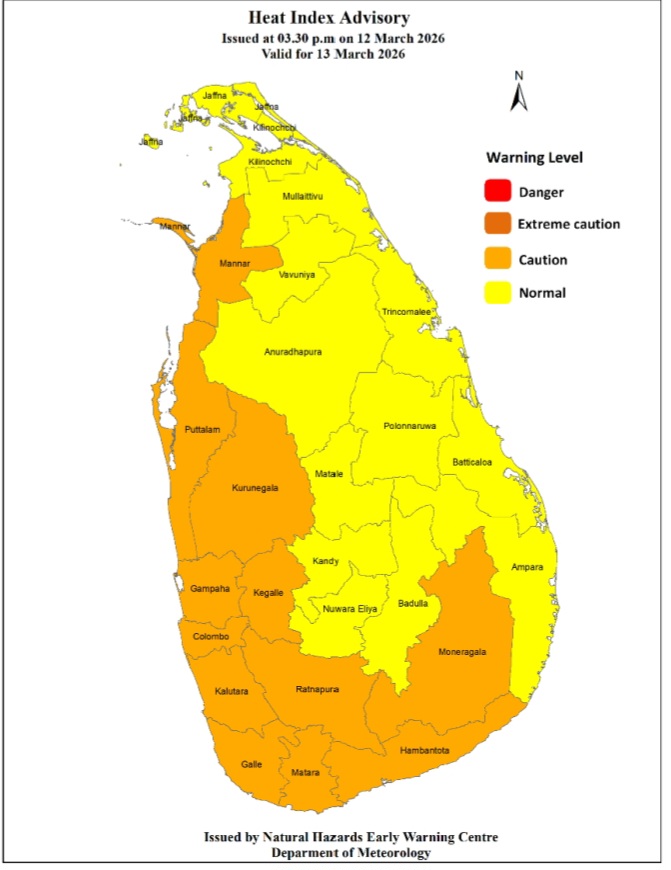
Heat Index likely to increase up to ‘Caution level’ at some places in the Western, Sabaragamuwa, Southern and North-western provinces and in Monaragala and Mannar districts

Warm Weather Advisory
Issued by the Natural Hazards Early Warning Centre of the Department of Meteorology at 3.30 p.m. on 12 March 2026, valid for 13 March 2026.
Heat index, the temperature felt on human body is likely to increase up to ‘Caution level’ at some places in Western, Sabaragamuwa, Southern and North-western provinces and in
Monaragala and Mannar districts.
The Heat Index Forecast is calculated by using relative humidity and maximum temperature and this is the condition that is felt on your body. This is not the forecast of maximum temperature. It is generated by the Department of Meteorology for the next day period and prepared by using global numerical weather prediction model data.

Effect of the heat index on human body is mentioned in the above table and it is prepared on
the advice of the Ministry of Health and Indigenous Medical Services.
ACTION REQUIRED
Job sites: Stay hydrated and takes breaks in the shade as often as possible.
Indoors: Check up on the elderly and the sick.
Vehicles: Never leave children unattended.
Outdoors: Limit strenuous outdoor activities, find shade and stay hydrated.
Dress: Wear lightweight and white or light-colored clothing.
Note:
In addition, please refer to advisories issued by the Disaster Preparedness & Response Division, Ministry of Health in this regard as well. For further clarifications please contact 011-7446491.

The Frontline Socialist Party (FSP) yesterday accused the government of trying to award another tender to the Indian company that supplied low-grade coal to the Norochcholai Power Plant and failed to deliver the stipulated amount of coal according to schedule.
The allegation was made by the Education Secretary of the Progressive Socialist Party, Pubudu Jayagoda, during media briefing at the party office in Nugegoda last afternoon.
Jayagoda said that in September 2025, the government had awarded a tender to the Indian company Trident Chemphar to supply 25 coal shipments for electricity generation in 2026.
In August 2025, it was confirmed that the coal delivered by the company was substandard. The company also failed to supply coal on schedule. Although the first shipment was expected in the second week of December 2025, it arrived at the end of the month. By mid-March, only 12 ships had arrived, and biweekly deliveries have been disrupted, putting Sri Lanka at risk of a severe energy shortage.
On 11 March, the government called a sudden spot tender for five coal shipments. Four companies submitted bids, and they include Trident Chemphar. FSP criticiced awarding the tender to the same discredited company, saying it was unethical and could trigger a major national crisis, as the company had failed to supply quality coal reliably in the past.
Previously, coal quality was strictly measured, with a “Reject Value”. But now to help the errant supplier the term of Reject Value has now been omitted altogether and replaced with a new term ‘Minimum Value’ setting it as the minimum calorific threshold—coal producing less than 5,900 kilocalories per kilogram was rejected, and coal with ash content above 16% was also discarded.
However, the government is now reportedly lowering these standards, accepting substandard coal, and changing tender specifications to accommodate the company.
Jayagoda castigated the latest stunt coming especially at a time when the world faces war and oil shortages. Diesel meant for electricity generation is being diverted to school buses, public transport, and emergency vehicles, leaving households at risk of prolonged blackouts. Even if diesel is imported, electricity tariffs could skyrocket.

Qantas agrees to pay $74m over Covid-19 travel voucher refunds

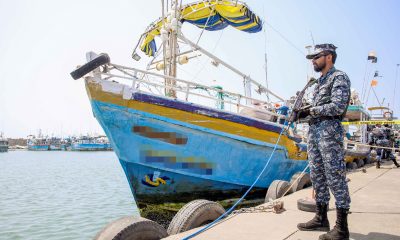
Navy seize 654kg of narcotics and haul of arms off South Coast

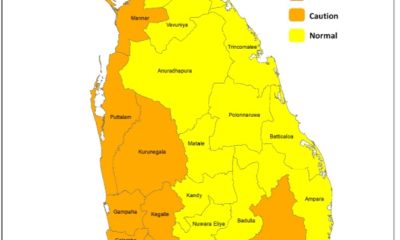
Heat Index likely to increase up to ‘Caution level’ at some places in the Western, Sabaragamuwa, Southern and North-western provinces and in Monaragala and Mannar districts

Showers above 50 mm can be expected at some places in the Western and Sabaragamuwa provinces and in the Galle and Matara districts

Govt. bends rules, lowers coal standards in favour of errant company: FSP

Lanka requests diesel from India

‘Dates have the highest sugar content to fight Coronavirus’

Sunday Island 27 December – Headlines

#SundayIsland 17th December – Headlines

Sunday Island – 28th March

Sunday Island Headlines – 21 March

Sunday Island – 21st February – Headlines
-

 News6 days ago
Peradeniya Uni issues alert over leopards in its premises
-
 News4 days ago
Repatriation of Iranian naval personnel Sri Lanka’s call: Washington
-

 News6 days ago
Wife raises alarm over Sallay’s detention under PTA
-
 Features4 days ago
Winds of Change:Geopolitics at the crossroads of South and Southeast Asia
-

 News3 days ago
Prof. Dunusinghe warns Lanka at serious risk due to ME war
-

 Latest News6 days ago
Heat Index at ‘Caution Level’ in the Sabaragamuwa province and, Colombo, Gampaha, Kurunegala, Anuradhapura, Vavuniya, Hambanthota and Monaragala districts
-

 Sports2 days ago
Royal start favourites in historic Battle of the Blues
-

 Features6 days ago
The final voyage of the Iranian warship sunk by the US