
Latest News
Quake of 4.0-magntiude hits Delhi, strong tremors rock NCR


The Press Trust of India has reported that the National Center for Seismology has announced that an earthquake of 4.0 magnitude rocked parts of Delhi-NCR early on Monday,
There were no immediate reports of any damage or injuries. The earthquake, with its epicentre in New Delhi, struck at a depth of five kilometres at 5:36 am, it said in a post on X.
The epicentre was near Durgabai Deshmukh College of Special Education in Dhaula Kuan, an official told PTI.
That region, which has a lake nearby, has been experiencing smaller, low-magnitude quakes once every two to three years. It recorded an earthquake of 3.3 magnitude in 2015, he said. A loud sound was also heard when the earthquake hit, the official added.
In a post on X, The Delhi Police said, “We hope you all are safe, Delhi!” It also urged citizens to call on the emergency 112 helpline for emergencies.
The strong tremors triggered by the earthquake prompted residents of several high-rise buildings in Delhi, Noida, Greater Noida and Ghaziabad to rush out of their homes.
A woman in her 50s who was out on a morning walk in E Block of Noida Sector 20 said, “‘Hum log bahar park me walk kar rahe the toh pata nahin chala. Lekin kafi tej tha. Log bahar aa gaye. (We were walking in the park, so we didn’t feel it strongly. But it was quite strong. People came rushing out)’.”
Visuals from PTI Videos showed people waiting outside their homes across Delhi-NCR, fearful of any aftershock.
Naresh Kumar, a resident of West Delhi, said this was the first time that he had experienced such a strong tremor.
Ratanlal Sharma, who was waiting at New Delhi railway station for a train to Prayagraj, said he was at the platform when he felt a sudden jolt.
“It felt like a train suddenly came to a screeching halt,” he said.
A resident of a high-rise in Ghaziabad said the tremors were so strong that everyone rushed downstairs in panic.
AAP leader Atishi said on X, “A strong earthquake just hit Delhi. I pray to God that everyone is safe.”
Resharing Atishi’s post, AAP supremo Arvind Kejriwal said he prayed for everyone’s safety.
“Massive tremors were felt 10 minutes back in Delhi, woke us up from sleep. I hope and pray everyone is safe and sound,” AICC national spokesperson Ragini Nayak said in a post on X.
The National Capital Territory (NCT) of Delhi is located about 250 kilometres from the seismically-active Himalayan collision zone and frequently experiences far- and near-field shaking due to Himalayan and local sources, respectively.
A 3.5-magnitude quake on April 12, 2020 and a 3.4-magnitude one on May 10, 2020, in northeast Delhi and a 4.4-magnitude earthquake on May 29, 2020, near Rohtak (about 50 kilometres west of Delhi), followed by more than a dozen aftershocks, sparked panic in the densely populated habitat.
Delhi is placed in Seismic Zone IV in the seismic zoning map of India. This intraplate region is exposed to moderate to high risk due to Himalayan earthquakes.
[PTI]


The Commissioner General of Essential Services, Prabath Chandrakeerthi has announced that, after taking into consideration the current fuel situation in Sri Lanka, the Government has decided to declare Wednesdays of every week as a holiday for government sector employees, all government schools, universities, and courts with effect from March 18, 2026, until further notice
The holiday will not apply to essential service sectors including Healthcare, Ports, Water Supply and Customs.
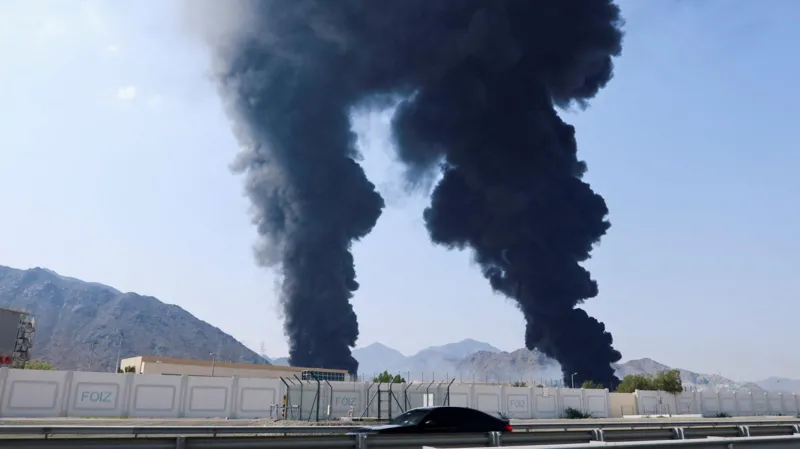
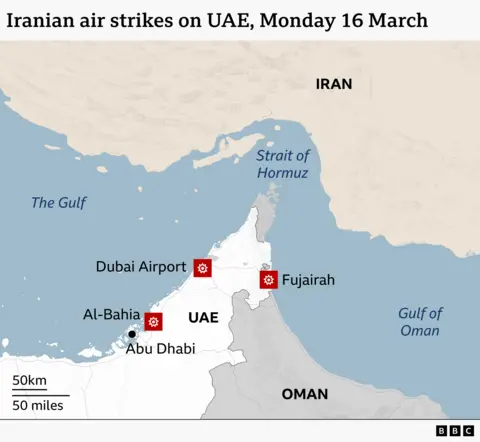
The United Arab Emirates’ (UAE) biggest port and oil storage facility, Fujairah, and Dubai’s international airport have come under further drone attacks as Iran continues to target Gulf transport and oil infrastructure.
Flights were temporarily suspended on Monday after a fire broke out near the airport after a “drone-related incident”.
A fire also raged after a drone attack on the strategically important port and industrial zone at Fujairah, one of the largest oil storage facilities in the region.
And a rocket attack on a car killed a Palestinian national on the outskirts of the UAE capital, Abu Dhabi, the city’s Media Office reported.
The attack occurred in the Al Bahia area, it said.
UAE air defence systems intercepted six ballistic missiles and 21 drones on Monday, the Defence Ministry said. Iran has launched over 1,900 missiles and drones at the UAE since the war between the US and Israel, and Iran, began.
Monday’s drone strike was the third incident since the start of the war near Dubai’s airport, which is the world’s busiest for international passengers.
Some flights were delayed, while others were cancelled altogether, in another hit to the UAE’s image of safety and stability.
The country’s energy sector came under attack as a drone hit an oil storage tanker on Saturday, and another drone hit the oil facilities on Monday, causing a fire.
Oil loading activities at the port were halted for a time while damage assessments were carried out.
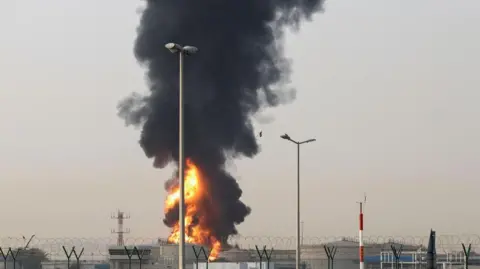
Fujairah sits on the UAE’s eastern coast, on the Gulf of Oman – rather than the Persian Gulf – and so vessels do not need to navigate the Strait of Hormuz to reach it.
The location means the port plays a “crucial” role in “helping keep global supplies moving” when the Strait of Hormuz is blocked by Iran, Dubai-based Justin Harper, editor of CEO Middle East – who regularly speaks to Dubai’s oil industry executives – told the BBC.
“If tensions with Iran disrupt the chokepoint, the UAE can still export oil through Fujairah via pipelines from the oilfields in Abu Dhabi,” he said.
The port city is “ideally placed to bypass the Strait of Hormuz”, said Dubai-based oil analyst Matt Stanley, who works for commodities data provider Kpler.
“The UAE’s state oil company Adnoc have their oil tankers there, it is crude grade oil which is what the Asian buyers want.”
Iran hitting a storage tanker and oil facilities at Fujairah “shows the vulnerability of Gulf infrastructure”, Stanley told the BBC.
“Iran wants to disrupt the flow of energy”.
The port city is close to India and the “first stop out of the Middle East on the way to Singapore and China”, Stanley said.
“Fujairah is on the old Silk Road, the maritime route, and it picked up a lot of business bunkering – that is providing fuel, food, water – for container ships that have been at sea for 25 or 30 days.”
Fujairah is like a “huge vending machine” for ships, Stanley added.
Despite the attacks on Dubai, Harper says the business community there is “resilient”. Restaurants have been offering deals to get people back into restaurants and “the malls still seem to be busy”. People “underestimate Dubai and its ability to survive a downturn”, he added.
Last week the UAE’s Minister of State Lana Nusseibeh vowed in a BBC interview that her country would bounce back from the conflict, insisting that its economy was “resilient”.
(BBC)

As a key frontline stakeholder in the national mission, ‘A Nation United,’ the Navy continues to conduct maritime operations in the waters surrounding the island, in coordination with other law enforcement agencies.
During a recent successful operation on the high seas south of Sri Lanka, the Navy intercepted a local multi-day fishing trawler and apprehended five suspects (05) in connection with the smuggling of a stock of suspected drugs.
During a special inspection at the Dickowita fisheries harbour today (16 Mar26), the Police Narcotic Bureau (PNB) confirmed the presence of over one hundred and thirty-three (133)
kilograms of heroin.
The Deputy Minister of Defence, Major General Aruna Jayasekara (Retd), accompanied by the Commander of the Navy, Vice Admiral Kanchana Banagoda, was present in Dickowita to inspect the seized items.
Addressing the media, the Deputy Minister stated that the tri-forces, particularly the Navy, along with the Coast Guard, Police, and other law enforcement agencies, are executing the
government’s vision for national security. He noted that the recent naval operation in the southern seas, which seized a large consignment of narcotics and weapons, demonstrates the government’s success in combating criminal networks involved in narcotics, arms and human trafficking.
He added that such successful outcomes result from the Navy’s meticulous planning, surveillance, intelligence analysis, and inter-agency coordination. He affirmed that no leniency will be shown to drug trafficking networks, and conveyed admiration, on behalf of the President, for the distinctive contribution made by the Sri Lanka Navy, in collaboration with other stakeholders,
towards ensuring public safety and protecting the younger generation from the menace of drugs.
Highlighting the scale of the Navy’s impact, he revealed that naval operations in 2025 seized narcotics valued over Rs. 75 billion, and operations so far in 2026 have seized over Rs. 20 billion worth of drugs.
The Deputy Minister warned that traffickers are increasingly using the guise of legitimate fishing activities to smuggle narcotics. Besides, he emphasized that the responsibility lies not only with law enforcement agencies but with all sectors of society to eradicate the networks associated with drug trafficking. He issued a firm directive to traffickers, dealers, and distributors to “quit,” asserting that there is no loophole, whether by sea or air, that the security forces cannot close. He
further urged drug users to abandon this destructive habit.
He announced plans for legal amendments to impose stricter penalties for drug offenses. Noting that law enforcement agencies have operational autonomy, he appealed to the public to report information on drug trafficking to hotlines 1818 and 1997.
He also commended the media for their responsible reporting in educating the public on the drug menace.
The trawler, the suspects, the communication equipment and the stock of narcotics held in this operation were handed over to the PNB for onward investigation and legal proceedings.

Wednesdays declared a government holiday with effect from 18th March

Iran hits key UAE oil port and Dubai airport

PM declares open Angunukolapelessa Leisure Island

Navy’s successful high-seas bust nets over 133kg haul of heroin

Chinnaswamy stadium receives government clearance to host IPL 2026 final

Tanzid 107, Taskin four-for trump Agha 106 to give Bangladesh series

‘Dates have the highest sugar content to fight Coronavirus’

Sunday Island 27 December – Headlines

#SundayIsland 17th December – Headlines

Sunday Island – 28th March

Sunday Island Headlines – 21 March

Sunday Island – 21st February – Headlines
-

 News7 days ago
Prof. Dunusinghe warns Lanka at serious risk due to ME war
-

 News5 days ago
Historic address by BASL President at the Supreme Court of India
-

 Business6 days ago
BOI launches ‘Invest in Sri Lanka’ forum
-

 Sports6 days ago
Royal start favourites in historic Battle of the Blues
-

 Sports5 days ago
The 147th Royal–Thomian and 175 Years of the School by the Sea
-

 News6 days ago
CEBEU warns of operational disruptions amid uncertainty over CEB restructuring
-
 Features6 days ago
Indian Ocean zone of peace torpedoed!
-

 News5 days ago
Power sector reforms jolted by 40% pay hike demand