
Features
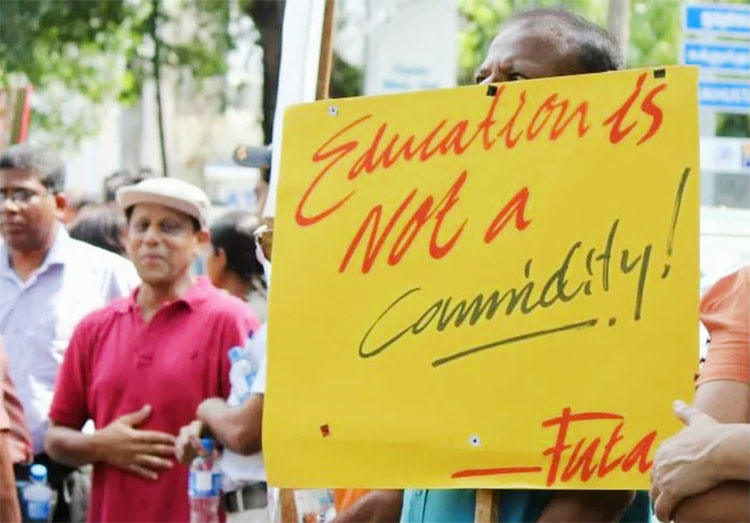
Pursuing accountability through privatisation of higher education

By Hasini Lecamwasam
 Massive changes are sweeping through the higher education sector in the midst of political and economic chaos. As Naomi Klein’s ‘Disaster Capitalism’ thesis cautions us, hasty changes pushed through during times of great uncertainty and desperation tend to have devious intentions. These times do not afford the leisure of circumstance to carefully deliberate the implications of the proposed changes. We need to grasp the urgency of the situation and respond collectively before irreversible harm is inflicted upon our system of free public education.
The most recent of these reforms came in the form of a report issued by a Parliamentary Select Committee recently appointed to “make suitable recommendations for the expansion of higher education opportunities in Sri Lanka”. While the purported intent of the report is not objectionable, the proposed reforms are framed by a narrative of accountability of the state university system towards the public that funds it. Of course, this is not entirely nonsensical, and one could argue that more accountability is what we need. However, before rushing to implement new policies and programmes to this end, one has to critically examine how the term ‘accountability’ is understood and deployed in the report, in ways that undermine Free Education, primarily through the promotion of privatisation.
Privatisation of higher education
The key thrust of the report is to expand access to higher education inside the country, both as a means of stemming the outflow of foreign exchange and purportedly in the name of fairness. As a solution, the reforms propose to “improve access to financing and to manage the higher education system with the participation of both public and private providers”. One key way in which ‘fairness’ is to be achieved seems to be by way of making credit facilities accessible to students, irrespective of the income bracket.
Many academics at state universities are now seen taking a ‘tolerance approach’ to private universities, believing they are harmless and, in fact, expand opportunities for higher education. I do not believe it escapes their attention that once private interests are introduced, public interests automatically take a backseat. As decades of transformation within state universities should already tell us, the performance-based remuneration system in fee levying postgraduate courses, diplomas, and certificates we currently offer, pushes lecturers to prioritise their commitment to those courses over free ones. Given this reality, it is likely that private universities will draw much of the current human resource of state universities, probably on contract basis given profit imperatives.
Privatisation of education (particularly higher education to which access is currently mediated by a restrictive merit criterion due to resource constraints) is problematic on several other counts as well: first and most obviously, it requires people to pay for something they ought to have by right, in the process crystalising and intensifying wealth-based inequalities; second, it transforms our mind set from citizen to consumer, the latter of whom has to make do with the quality of service that comes with their paying capacity, rendering any conversation of equality (and dignity) irrelevant; third and more specific to education, it transforms its purpose from understanding the world and working to changing it for better in the service of humanity, to a mere tool of securing employment. Once its ethos has been transformed thus, education becomes a business, jettisoning its socio-political commitments. In the current sense of urgency engendered by the economic crisis, the government is hastening these reforms in the name of economic prudence, particularly with the worries associated with forex outflows. It is this context of financial deprivation that frames the report’s discussion on accountability.
Accountability in higher education
The proposals outlined in the report do not address the problems it highlights. For instance, it then makes a leap (mid-paragraph, while talking about the forex leakage due to educational reasons) to the research output of state universities. Here, it makes hazy reference to the number of working hours of senior professors at Sri Lankan state universities, as opposed to those in the UK, without adequate explanation as to how those figures were arrived at, nor their sources. The report’s attempt is to justify its key recommendation of introducing private higher education institutions (HEI) on grounds that state universities are not doing anything particularly useful for the public who pays their bills, even by way of their research output, with no analysis of the reasons for this, in particular, the lack of public investment in research.
The dominant understanding of accountability in this thinking is an administrative, contractual notion that seeks to ensure that university staff abide by their job contract and efficiently deliver services that they were hired to deliver. To this end, they are to demonstrate among other things that they teach the required number of courses over the required number of hours, conduct research that aligns with national development goals, and align their degree programmes with market demands to ensure employability for their graduates. This entire process is known by the term ‘Quality Assurance’, whose quantitative establishment (despite the name) of ‘work being done’ is then taken as an indication of public money being spent in a way that is useful to society.
One should not have any issue with such administrative accountability as it is a useful instrument of ensuring the functionality of institutes of higher education. The question, however, is whether establishing these processes alone is adequate to ensure an accountable education system. This is where the question of ‘accountability to whom?’ becomes relevant. Is it to the public tax payers as the report says, or is it to a market that would take access to education further away from those who cannot afford to pay for it? As we well know, private entities are about profit, which explains their ‘accountability’ to market demands. The hands-off approach hinted at in the report is an indication of just what kind of free reign the state envisions allowing for the proposed private HEI’s pursuing of profit. Clearly, this entails neither social nor political accountability particularly to the younger generation who will have to negotiate their lives in an unforgivingly privatised system.
The proposed reforms (as well as some of the measures presently taken as part of Quality Assurance), then, ensure accountability to the free market rather than the true objectives of free education which I see as “coming into a knowing of the world around us [as] social mobility and as an awareness of one’s place in the country, society and the world”, borrowing from Sumathy Sivamohan in the inaugural article of this column. Free education’s emancipatory vision is altogether jettisoned, and replaced with a progressive-sounding narrative of ‘expanding access to education’ by offering alternative ways of accessing (both state and private) universities through fee levying courses. The possibility of offering greater access through better resourcing the free education system is rarely discussed because there is no money. Where the money has gone is discussed even less. Any conversation around accountability, particularly its social and political variants, will only be meaningful if the question of resources is addressed.
(Hasini Lecamwasam is attached to the Department of Political Science, University of Peradeniya)
Kuppi is a politics and a pedagogy happening on the margins of the lecture hall that parodies, subverts and simultaneously reaffirms social hierarchies.





It has become fashionable to criticise the US for its recent conduct toward Iran. This is not an attempt to defend or rationalise the US’s actions. Rather, it seeks to inject perspective into an increasingly a historical debate. What is often missing is institutional memory: An understanding of how the present international order was constructed and the conditions under which it emerged.
The “rules-based order” was forged in the aftermath of two catastrophic wars. Earlier efforts had faltered. Woodrow Wilson’s proposal for a League of Nations after World War I was rejected by the US Senate. Yet, it introduced a lasting premise: International order could be consciously designed, not left solely to shifting power balances. That premise returned after World War II. The Dumbarton Oaks process laid the groundwork for the UN, while Bretton Woods established the global financial architecture.
These frameworks shaped modern norms of security, finance, trade, and governance. The US played the central role in this design, providing leadership even as it engaged selectively- remaining outside certain frameworks while shaping others. This underscored a central reality: Power and principle have always coexisted uneasily within it.
This order most be understood against the destruction that preceded it. Industrial warfare, aerial bombardment, and weapons capable of unprecedented devastation reshaped both the ethics and limits of conflict. The post-war system emerged from this trauma, anchored in a fragile consensus of “never again”, even as authority remained concentrated among five powers.
The rise of China, the re-emergence of India, and the growing assertiveness of Russia and regional powers are reshaping the global balance. Technological disruption and renewed competition over energy and resources are transforming the nature of power. In this environment, some American strategists argue that the US risks strategic drift Iran, in this view, becomes more than a regional issue; it serves as a platform for signalling resolve – not only to Tehran, but to Beijing and beyond. Actions taken in one theatre are intended to shape perceptions of credibility across multiple fronts.
Recent actions suggest that while the US retains unmatched military reach, it has exercised a level of restraint. The avoidance of escalation into the most extreme forms of warfare indicates that certain thresholds in great-power conflict remain intact. If current trends persist-where power increasingly substitutes for principle — this won’t remain a uniquely American dilemma.
Other major powers may face similar choices. As capabilities expand, the temptation to act outside established norms may grow. What begins as a context-specific deviation can harden into accepted practice. This is the paradox of great power transition: What begins as an exception risk becoming a precedent The question now is whether existing systems are capable of renewal. Ad hoc frameworks may stabilise the present, but risk orphaning the future. Without a broader framework, they risk managing disorder rather than designing order. The Dumbarton Oaks process was a structured diplomatic effort shaped by competing visions and compromise. A contemporary equivalent would be more complex, reflecting a more diffuse distribution of power and lower levels of trust Such an effort must include the US, China, India, the EU, Russia, and other key powers.
India could serve as a credible convenor capable of bridging divides. Its position -engaged with multiple powers yet not formally aligned – gives it a degree of convening legitimacy. Nalanda-the world’s first university – offers an appropriate symbolic setting for such dialogue, evoking knowledge exchange across civilisations rather than competition among them.
Milinda Moragoda is a former cabinet minister and diplomat from Sri Lanka and founder of the Pathfinder Foundation, a strategic affairs think tank could be contacted atemail@milinda.org. This article was published in Hindustan Times on 2026.04.19)
By Milinda Moragoda

The combination of father and daughter, Shafi and Jana, as a duo, turned out to be a very rewarding experience, indeed, and now they have advanced to Section 8 – a high-energy, funk-driven, jazz-oriented live band, blending pop, rock, funk, country, and jazz.
Guitar wizard Shafi is a highly accomplished lead guitarist with extensive international experience, having performed across Germany, Australia, the Maldives, Canada, and multiple global destinations.

Shafi: Guitar wizard, at the helm of Section 8

Jana: Dynamic and captivating lead vocalist
He is best known as a lead guitarist of Wildfire, one of Sri Lanka’s most recognised bands, while Jana is a dynamic and captivating lead vocalist with over a decade of professional performing experience.
Jana’s musical journey started early, through choir, laying the foundation for her strong vocal control and confident stage presence.
Having also performed with various local bands, and collaborated with seasoned musicians, Jana has developed a versatile style that blends energy, emotion, and audience connection.
The father and daughter combination performed in the Maldives for two years and then returned home and formed Section 8, combining international stage experience with a sharp understanding of what it takes to move a crowd.
In fact, Shafi and Jana performed together, as a duo, for over seven years, including long-term overseas contracts, building a strong musical partnership and a deep understanding of international audiences and live entertainment standards.
Section 8 is relatively new to the scene – just two years old – but the outfit has already built a strong reputation, performing at private events, weddings, bars, and concerts.
The band is known for its adaptability, professionalism, and engaging stage presence, and consistently delivers a premium live entertainment experience, focused on energy, groove, and audience connection.
Section 8 is also a popular name across Sri Lanka’s live music circuit, regularly performing at venues such as Gatz, Jazzabel, Honey Beach, and The Main Sports Bar, as well as across the southern coast, including Hikkaduwa, Ahangama, Mirissa, and Galle.
What’s more, they performed two consecutive years at Petti Mirissa for their New Year’s gala, captivating international audiences present with high-energy performance, specially designed for large-scale celebrations.
With a strong following among international visitors, the band has become a standout act within the tourist entertainment scene, as well.
Their performances are tailored to diverse audiences, blending international hits with dance-driven sets, while also incorporating strong jazz influences that add depth, musicianship, and versatility to their sound.
The rest of the members of Section 8 are also extremely talented and experienced musicians:
Suresh – Drummer, with over 20 years of international experience.
Dimantha – Keyboardist, with global exposure across multiple countries.
Dilhara – Bassist and multi-instrumentalist, also a composer and producer, with technical expertise.

Rajiv Sebastian could be classified as an innovative performer.
Yes, he certainly has plenty of surprises up his sleeves and that’s what makes him extremely popular with his fans.
Rajiv & The Clan are now 35 years in the showbiz scene and Rajiv says he has plans to celebrate this special occasion … in a unique way!
According to Rajiv, the memories of Clarence, Neville, Baig, Rukmani, Wally and many more, in its original flavour, will be relived on 14th July.
“We will be celebrating our anniversary at the Grand Maitland (in front of the SSC playground) on 14th July, at 7.00pm, and you will feel the inspiration of an amazing night you’ve never seen before,” says Rajiv, adding that all the performers will be dressed up in the beautiful sixties attire, and use musical instruments never seen before.
In fact, Rajiv left for London, last week, and is scheduled to perform at four different venues, and at each venue his outfit is going to be different, he says, with the sarong being very much a part of the scene.

Showers or thundershowers will occur at most places of the island after 1.00 pm

Rs 13 bn NDB fraud: Int’l forensic audit ordered

Easter Sunday commemorations

Former Minister Gamage under CIABOC probe over recruiting 134 persons from Galle district

Coal scam: SJB says NAO report obstacle to NPP bid to suppress the truth

Of masterminds

‘Dates have the highest sugar content to fight Coronavirus’

Sunday Island 27 December – Headlines

#SundayIsland 17th December – Headlines

Sunday Island – 28th March

Sunday Island Headlines – 21 March

Sunday Island – 21st February – Headlines
-

 News6 days ago
PNS TAIMUR & ASLAT set sail from Colombo
-

 Business3 days ago
Harnessing nature’s wisdom: Experts highlight “Resist–Align” path to resilience
-

 News3 days ago
Gratiaen Trust announces longlist for the 33rd Annual Gratiaen Prize
-

 Latest News7 days ago
“I extend my heartfelt wishes to all Sri Lankans for a peaceful and joyous Sinhala and Tamil New Year!” – President
-

 News2 days ago
From Nuwara Eliya to Dubai: Isha Holdings markets Agri products abroad
-
 News3 days ago
Heroin haul transported on 50-million-rupee contract
-

 Latest News5 days ago
Singapore Zoo’s first Sri Lankan leopard cubs make their public debut
-

 Latest News7 days ago
US blockade of Iran would worsen global energy crisis, analysts say