
News
Previous regime ignored 97 early warnings on Easter carnage – Defence Secy

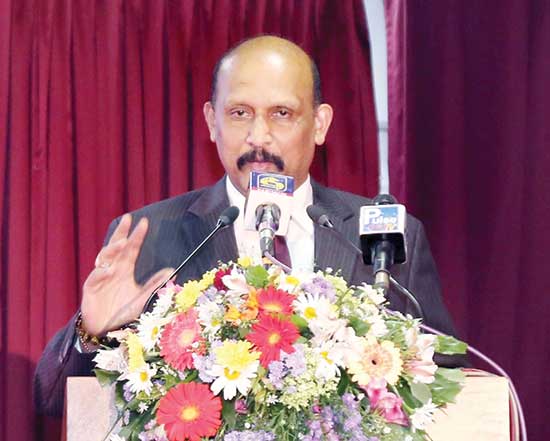
The previous government had ignored 97 early warnings about the impending Easter Sunday attacks, Defence Secretary Maj. Gen. (Retd) Kamal Gunaratne said, addressing a gathering of professionals at the Sri Lanka Foundation Institute recently.
The event organised by the “Harimaga organization” was themed “Post COVID-19 Renaissance – Present and future development of Sri Lanka.”
Gunaratne said national security and defence were essential for the country’s development.
“These two are also crucial in attracting much-needed direct foreign investment to the country,” he said, alluding to the President Gotabaya Rajapaksa’s election manifesto – Vistas of Prosperity and Splendour.
“Although separatism was militarily defeated in May 2009, we need to eliminate the separatist ideology. Some individuals of the Tamil diaspora are constantly promoting this ideology,.”.
Following the war 12,242 ex-LTTE cadres had been rehabilitated and reintegrated into the society. However, some remnants of front organisations of the LTTE were still attempting to indoctrinate and recruit the rehabilitated cadres, he said.
Referring to the Easter Sunday suicide attacks in 2019, the Defence Secretary said that if those responsible had listened to the intelligence agencies the attacks could have been prevented. “Our military intelligence operatives were imprisoned and harassed. This caused gaps in our intelligence information. This allowed extremists to operate scot-free and under the radar” he said.
In contrast the current administration took intelligence information seriously and because of that a number of detections had already been made, Gunaratne said. The security forces had found over 1.5 kilos of high explosives and over 90 detonators from Mannar.
“In addition, the military has also taken a few remote control devices into custody. If we also overlooked these incidents, none of these would have been recovered. We will never leave room for separatism from the North to rise or extremism from the East to spread fear and destruction in this country ever.”
The Defence Secretary also mentioned the steps taken to eliminate drug syndicates that had been operating from prison cells. “To deal with this, we appointed capable officers in charge of the Prisons Department and the Police Special Task Force,” he said.
Speaking about the initiatives taken to change the existing system in prisons, Gunaratne said a maximum security prison was already under construction to detain serious criminals and drug smugglers. Meanwhile mobile phone jammers had already been installed at the Boossa and the Angunakolapelessa prisons.
He also revealed plans to enhance the welfare of prisoners and to reduce overcrowding in prisons.
“We have taken steps to increase facilities to rehabilitate drug addicts. A special Centre, with state-of- the-art facilities, to accommodate over 1,000 inmates is now under construction at Nittambuwa. Another facility will be constructed at Weerawila to accommodate 2,000 inmates”, he added.
The Defence Secretary highlighted the plans to curb illegal sand mining and prevent illegal encroachments especially in the Western Province. A special unit had been established at the Criminal Investigation Department (CID) to investigate public complaints, he said.
Commandant of the Police Special Task Force (STF) DIG Waruna Jayasundara, Commissioner General of Prisons Thushara Upuldeniya and Chairperson Harimaga organization Kanishka de Silva were also present.


The International Monetary Fund (IMF) has declared that the Extended Fund Facility (EFF) wouldn’t be amended in view of the impact of Cyclone Ditwah.
The IMF delegation, at the end of its visit to Sri Lanka, informed President Anura Kumara Dissanayake of its decision during a meeting at the Presidential Secretariat yesterday (28). The IMF delegation included Director of the Asia and Pacific Department Krishna Srinivasan, Deputy Director for Asia and the Pacific Sanjaya Panth, Mission Chief Evan Papageorgiou, and Resident Representative Martha Woldemichael.
The 48-month arrangement, approved on 20 March, 2023, during Ranil Wickremesinghe’s tenure as the President, is for SDR 2.286 billion (approximately US$3 billion). In terms of the agreement, repayment of debt has to be resumed in 2028. Sri Lanka unilaterally suspended debt repayment in April 2022.
Close on the heels of Cyclone Ditwah, the main Opposition party, the Samagi Jana Balawegaya (SJB), repeatedly pressed the government to request the IMF to amend the agreement.
The Presidential Media Division ( PMD) quoted the IMF delegation as having said that the strong fiscal discipline maintained by the government over the past year had been a key factor in addressing the challenges caused by Cyclone Ditwah. They said that the government’s ability to present a supplementary estimate of Rs. 500 billion was made possible by a surplus in the Treasury.
The Government of Sri Lanka was represented by Minister of Labour and Deputy Minister of Economic Development Dr. Anil Jayantha Fernando, Secretary to the Ministry of Finance Dr. Harshana Suriyapperuma, Governor of the Central Bank Dr. Nandalal Weerasinghe, Senior Economic Adviser to the President Duminda Hulangamuwa, along with several others.
Sri Lanka’s economy has “stabilised decisively” under its International Monetary Fund (IMF)-supported programme, with growth rebounding, tax revenues doubling, and inflation sharply declining, a senior IMF official said in Colombo yesterday.
Dr. Krishna Srinivasan, Director of the IMF’s Asia and Pacific Department, delivered the assessment during a public lecture on the IMF Regional Economic Outlook: Asia and Pacific, held at the Central Bank of Sri Lanka. He was joined by Dr. Thomas Helbling, the Department’s Country Director.
Both officials commended the Asia-Pacific (APAC) region’s overall economic resilience in the face of global challenges and advocated for deeper trade and supply chain integration to mitigate vulnerabilities in international trade.
Presenting a country-focused analysis, Dr. Srinivasan outlined how Sri Lanka has performed against the five key pillars of the IMF programme:
Revenue-based fiscal consolidation, supported by tax reforms and strengthened social safety nets.
Restoring debt sustainability through fiscal adjustment and debt restructuring.
Maintaining price stability and rebuilding foreign exchange reserves.
Safeguarding external stability.
Combating corruption via a comprehensive anti-corruption reform agenda.
“Sri Lanka has come out of the crisis stabilising its economy across three dimensions,” Dr. Srinivasan stated referring to Sri Lanka’s Growth, Revenue, and Inflation. He highlighted that growth “bounced back decisively,” turning positive within six months of the programme and recently averaging about 5 percent annually.
On fiscal performance, he noted a “significant turnaround.” Tax revenue has doubled from a critically low 7.3 percent of GDP to 14.8 percent in 2025.
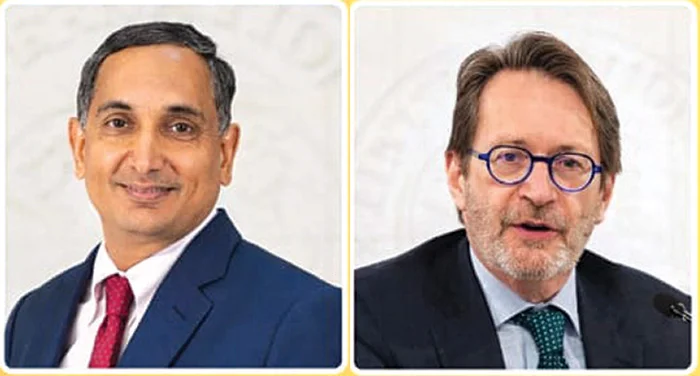
Dr. Krishna Srinivasan / Dr. Thomas Helbling
Furthermore, inflation has dropped “in a very convincing manner” from approximately 70 percent to the current 2-3 percent range. “One would hope that in the next few quarters, it will reach the Central Bank’s target of 5 percent,” he added.
“Overall, the IMF programme for Sri Lanka has delivered on many of its objectives,” Dr. Srinivasan concluded. “There is still a long way to go in terms of securing strong, sustained, balanced growth, but the program is off to a very good start. All of you, the authorities, and the people of Sri Lanka need to be congratulated for the progress made so far,” he said.
In his regional remarks, Dr. Srinivasan projected that Artificial Intelligence (AI) will be a key driver of the Asian economy. He suggested that technology companies in the region would be “better served by the capital markets than from conventional banks,” pointing to a need for evolved financial ecosystems to support innovation.
The lecture underscored the IMF’s constructive outlook for Asia’s continued resilience, while emphasising structural reforms and regional cooperation as vital for future stability and growth.
By Sanath Nanayakkare
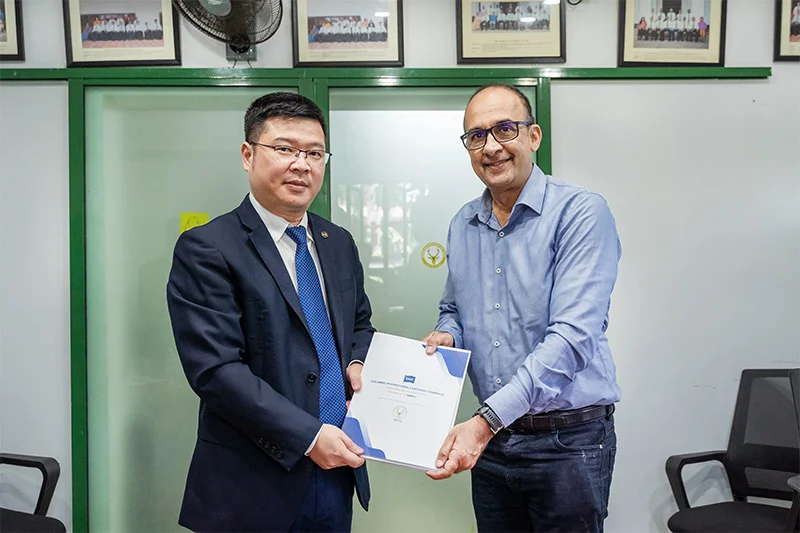
Colombo International Container Terminals (CICT) has entered into a three-year partnership (2025–2028) with the Wildlife and Nature Protection Society (WNPS) under the Turtle and Coastal Health United Programme (TACHUP) to protect sea turtles and restore coastal ecosystems along the Colombo Port City–Mount Lavinia coastline.
Sri Lanka is home to five of the world’s seven sea turtle species, all of which nest along this highly urbanised stretch of coastline. The initiative will focus on safeguarding turtle nesting and hatchling success, restoring coastal vegetation, strengthening citizen science and data collection, and engaging local communities, schools, and volunteers in long-term conservation efforts.
The project builds on ongoing conservation work that has already recorded more than 680 turtle visits in a single nesting season and protected over 15,900 eggs with hatching success rates exceeding 80 per cent.
Commenting on the partnership, CICT CEO Jan Zhang said, “As a gateway to global trade, CICT recognises its responsibility to protect the environment that surrounds us. This partnership with WNPS is an investment in long-term ecological resilience, biodiversity conservation, and responsible stewardship of Sri Lanka’s coastal heritage.”
The collaboration enhances Colombo’s global standing as an accredited Ramsar Wetland City and reflects CICT’s continued commitment to sustainability, environmental protection, and responsible port operations.

Dry weather will prevail in the most parts of the island.

No changes to IMF agreement despite Cyclone Ditwah impact

IMF lauds Sri Lanka’s economic turnaround, highlights regional resilience

ICT, WNPS unite to protect sea turtles along Colombo coast

Solheim on carbon-neutrality in sustainable tourism

CBSL keeps overnight policy rates unchanged; latest review of IMF program awaited

‘Dates have the highest sugar content to fight Coronavirus’

Sunday Island 27 December – Headlines

#SundayIsland 17th December – Headlines

Sunday Island – 28th March

Sunday Island Headlines – 21 March

Sunday Island – 21st February – Headlines
-
 Business3 days ago
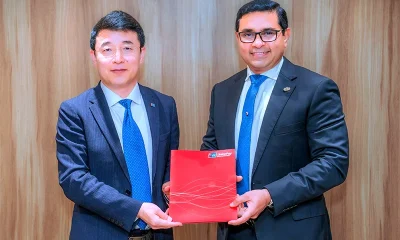
ComBank, UnionPay launch SplendorPlus Card for travelers to China
-

 Business4 days ago
ComBank advances ForwardTogether agenda with event on sustainable business transformation
-
 Opinion4 days ago
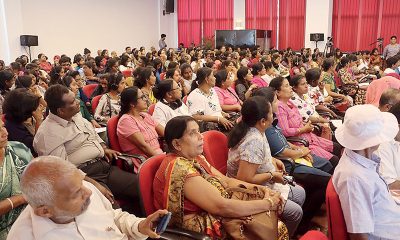
Conference “Microfinance and Credit Regulatory Authority Bill: Neither Here, Nor There”
-

 Opinion6 days ago
A puppet show?
-

 Opinion3 days ago
Luck knocks at your door every day
-
 Features6 days ago
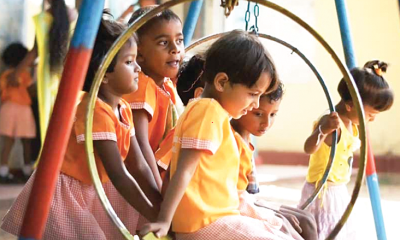
‘Building Blocks’ of early childhood education: Some reflections
-

 Business5 days ago
Dialog Brings the ICC Men’s T20 Cricket World Cup 2026 Closer to Sri Lankans
-
 News4 days ago
Rising climate risks and poverty in focus at CEPA policy panel tomorrow at Open University