
News
Power policy consultation ‘sham’, say consumers

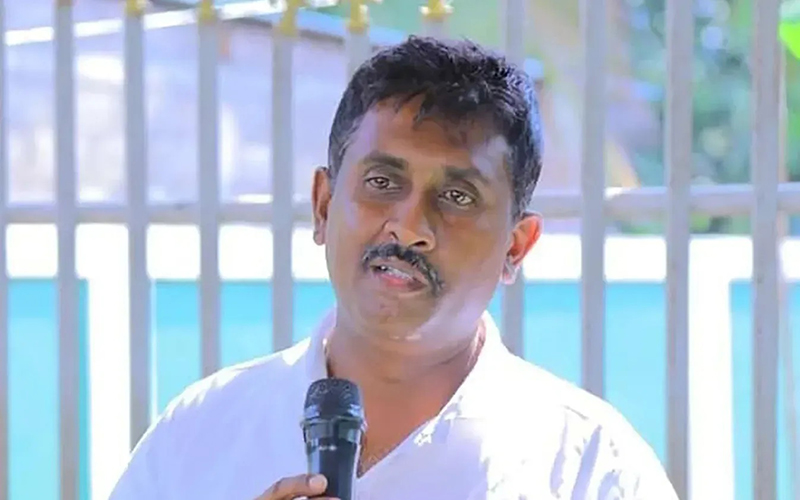
The Electricity Consumers’ Association has raised serious concerns over the consultation process for the proposed National Electricity Policy, describing it as inadequate and legally questionable.National Secretary of the Association, Sanjeewa Dhammika, said he had been given only 30 minutes to present his views on the policy at a meeting held on Wednesday (21) at the Ministry of Power and Energy.
He said that although six members had been appointed to the National Policy Committee, only three were present at the meeting, casting doubt on the credibility and seriousness of the process.
Dhammika also criticised the absence of Dr. Tilak Siyambalapitiya, who is widely reported to have drafted the policy, from the committee meeting.
“He wrote the policy and then walked away. We didn’t even get a chance to question him,” Dhammika said.
He alleged that the consultation lacked proper notice and planning, noting that he had been informed only by a phone call the previous evening and asked to attend the meeting the following morning.
“This is not how public views should be obtained on a national policy. It should have been done well in advance, in a systematic and transparent manner. It wasn’t even communicated to the media,” he said.
Comparing the process to the public consultation mechanisms used by the Public Utilities Commission of Sri Lanka (PUCSL), Dhammika described the exercise as a “makeshift, token process.”
He also raised concerns over the composition of the committee, stating that the inclusion of a retired senior official of the Ceylon Electricity Board—whom he said bears responsibility for the current state of the power sector and continues to favour coal power while opposing renewable energy—was a serious issue.
According to Dhammika, the proposed National Electricity Policy has been drafted in violation of existing laws.
“Under the current law, the authority to determine electricity tariffs lies with the Public Utilities Commission of Sri Lanka. Through this new policy, there is an attempt to remove those powers from the Commission,” he alleged.
He warned that the policy centralises key decision-making powers—including licensing, power plant acquisitions, power infrastructure development, and renewable energy decisions—into the hands of a few individuals, calling it a high-risk approach.
“This is similar to how the Education Act was distorted under the guise of education reforms. It is shocking to see whether this is what the government calls a progressive new law,” he said.
The Electricity Consumers’ Association strongly opposes the formulation of the policy, with Dhammika describing it as “one of the most failed initiatives seen in recent times.”
He said that if implemented in such a haphazard way, the policy would result in higher electricity bills for low-consumption users, while high-consumption users would benefit from reductions of approximately 38% to 45%.
Dhammika also alleged that the policy discourages the solar power industry and promotes a diesel- and coal-dependent energy model driven by vested interests aligned with oil-based power generation.
By Anuradha Hiripitiyage ✍️





The Indian Ministry of External Affairs has said it is considering requests for diesel supplies from neighbouring countries, including Sri Lanka, Bangladesh and the Maldives.
Speaking to the Press Trust of India, Ministry Spokesperson Randhir Jaiswal noted that India was a major exporter of refined petroleum products in the region. He confirmed that Bangladesh had formally requested a diesel supply, which is currently under review.
He said that diesel exports to Bangladesh had largely continued since 2017, but any new allocations would take into account India’s refining capacity, domestic demand, and overall fuel availability.
Jaiswal added that similar requests from Sri Lanka and the Maldives were also being considered, with India’s own energy requirements forming a key part of the decision-making process.

A noticeable rise in electricity consumption, particularly during the night peak hours, has been observed in recent weeks, with power sector officials attributing the trend partly to households increasingly turning to electricity for cooking amid shortages of liquefied petroleum gas (LPG).
Data from the Ceylon Electricity Board (CEB) shows that both the total units generated and the evening peak demand have been gradually increasing, signalling a possible shift in household energy use.
Energy sector sources said the rising night peak load suggests that more consumers may be relying on electric appliances such as hot plates, electric cookers and induction stoves as alternatives to LPG.
“The night peak is increasing steadily. One of the likely reasons could be the growing use of electricity for cooking due to the shortage of LPG,” a senior power sector official said.
Electricity demand traditionally rises during the evening hours between 6.30 p.m. and 9.30 p.m., when domestic consumption surges as households switch on lighting and appliances while preparing meals.
Power engineers point out that electric cooking appliances consume comparatively high amounts of electricity, and a widespread shift towards their use can significantly raise the evening peak load.
“If many households begin cooking with electricity at the same time, the night peak can rise sharply even if the total daily consumption increases only moderately,” an engineer familiar with grid operations said.
The increase in demand comes at a time when the power sector is undergoing a major restructuring programme aimed at unbundling the CEB into separate entities responsible for generation, transmission and distribution.
Energy analysts note that higher electricity consumption could boost revenues for the sector if tariffs remain stable.
However, they caution that a sustained rise in peak demand may place additional pressure on generation capacity.
During the night peak period, the system relies heavily on thermal and hydropower plants to meet demand, as solar power is unavailable after sunset.
If the trend towards electric cooking continues, planners may need to adjust generation schedules and grid management strategies to cope with higher evening demand.
Energy experts say the development illustrates the close link between different energy sources.
“When shortages occur in one energy source, consumers quickly shift to alternatives. In this case, LPG shortages appear to be pushing more households towards electricity for cooking,” an analyst said.
Power sector officials say demand patterns are being closely monitored to determine whether the rising night peak represents a temporary fluctuation or a longer-term shift in consumer behaviour.For now, engineers say the power system remains stable, though sustained growth in evening demand could require careful management to ensure uninterrupted electricity supply.
By Ifham Nizam

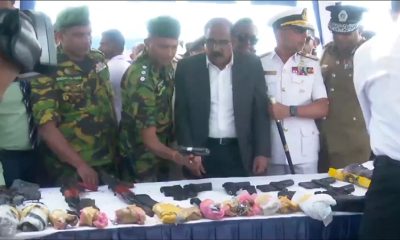
A massive consignment of narcotics with a street value of about Rs. 10 billion, along with a cache of firearms suspected to be linked to international organised crime, was seized by the Navy during a special operation in international waters south of the country.
Two multi-day fishing trawlers intercepted during the operation were brought to Dikkowita Fisheries Harbour yesterday morning with 10 suspects on board. Deputy Minister of Defence Aruna Jayasekara told reporters that the narcotics haul weighed over 600 kilos and includes eight pistols, two T-56 assault rifles, and one M16 rifle.
Investigators have identified Pallewatte Gamage Chaminda Dilruk, widely known as Parevi Suda, as the orchestrator of the smuggling operation. Security sources revealed that two underworld figures and alleged shooters, Dippitigoda Lahiru and Konda Ranji were believed to be involved in recent shooting incidents in and around Colombo.
The seizure has raised serious questions at both the Public Security Ministry and the Defence Ministry regarding why local authorities have so far failed to obtain an Interpol Red Notice against Parevi Suda, who is reportedly operating from Dubai.
Preliminary investigations suggest the second trawler was providing logistical support and surveillance during the smuggling operation. Intelligence sources also indicate that the firearms may have been intended for organised crimes, including contract killings, with alleged plots to target informants and previous seizure leads.
By Norman Palihawadane and Hemantha Randunu

Lanka requests diesel from India

Gas shortage pushes up electricity demand, night peak rises: CEB

Navy seizes narcotics haul, lethal weapons in two vessels, arrests 10 suspects

Heed ominous signs – II

ADB pledges over $1 billion annually to Sri Lanka in post-cyclone recovery push

Ranking public services with AI — A roadmap to reviving institutions like SriLankan Airlines

‘Dates have the highest sugar content to fight Coronavirus’

Sunday Island 27 December – Headlines

#SundayIsland 17th December – Headlines

Sunday Island – 28th March

Sunday Island Headlines – 21 March

Sunday Island – 21st February – Headlines
-

 News6 days ago
Peradeniya Uni issues alert over leopards in its premises
-
 News4 days ago
Repatriation of Iranian naval personnel Sri Lanka’s call: Washington
-

 News6 days ago
Wife raises alarm over Sallay’s detention under PTA
-

 News3 days ago
Prof. Dunusinghe warns Lanka at serious risk due to ME war
-
 Features4 days ago
Winds of Change:Geopolitics at the crossroads of South and Southeast Asia
-

 Latest News6 days ago
Heat Index at ‘Caution Level’ in the Sabaragamuwa province and, Colombo, Gampaha, Kurunegala, Anuradhapura, Vavuniya, Hambanthota and Monaragala districts
-

 Features6 days ago
The final voyage of the Iranian warship sunk by the US
-

 Sports2 days ago
Royal start favourites in historic Battle of the Blues