
News
Poultry farmers cry out for help, oppose govt. move to import eggs


By Rathindra Kuruwita
All-Island Poultry Farmers’ Association chairman Ajith Gunasekara yesterday urged retailers to adhere to maintain the retail price of eggs at Rs. 55 each and to work together to resist the government’s plan to import eggs.
Gunasekera said that the government should help the local poultry farmers boost their production.
“We tell the Trade Minister Nalin Fernando that importing eggs is not the answer. We must help the small and medium scale farmers who have stopped operating. We should boost production here. If eggs are imported from India the entire sector will collapse and many people will lose their jobs,” Gunasekara said, urging retailers to keep selling eggs at Rs 55 each and assuring that they would supply the wholesale traders the necessary stocks.
Gunasekara said the production of eggs and chicken had dropped drastically because of high costs. He said that the daily production of eggs, which was around 800,000 per day, had dropped to about 400,000.
He added that by December the industry had shrunk by 40 percent due to a severe shortage of animal feed.
On Saturday (07) the Sri Lanka State Trading (General) Corporation announced that international tenders to import eggs would be called from 09 January.


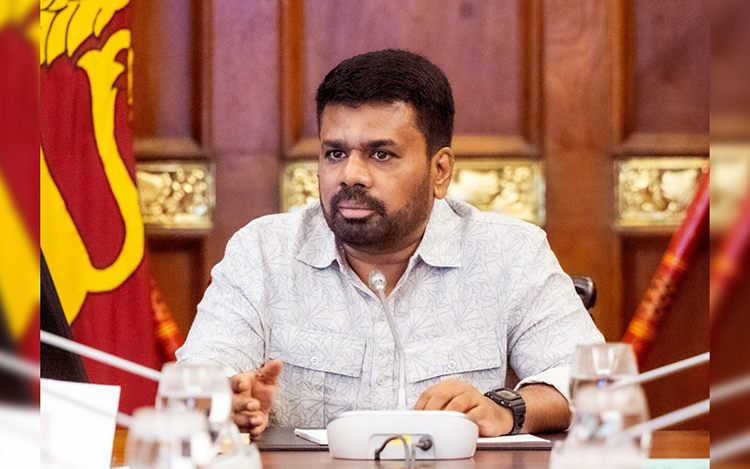
Sri Lanka refused the request by three Iranian ships to come to Sri Lanka on a goodwill visit and the request by the United States to land two of its fighter jets in Mattala, President Anura Kumara Dissanayake told Parliament yesterday.
“Sri Lanka maintained neutrality by refusing the two requests by both the US and Iran,” he said.
President Dissanayake provided a clarification on domestic fuel prices in light of rising crude oil prices in the global market and subsequent fuel price increases in other countries, triggered by the ongoing crisis in the Middle East.
The President highlighted that the Ceylon Petroleum Corporation (CPC) currently supplies 57% of the country’s fuel requirements, while the remaining 43% is supplied by the private sector.
He further noted that private sector suppliers have requested pricing that reflects current global market rates for the fuel they import.
Accordingly, the President emphasised that a decisive decision on fuel price adjustments must be reached as expeditiously as possible to ensure the continuity of the national fuel supply.
Addressing the Parliament, the President stated that the current pricing formula dictates that for every one-dollar increase in global oil prices, domestic fuel prices must rise by Rs. 2.
He noted that the primary impact being faced is driven by the surge in global fuel prices rather than the depreciation of the rupee against the US dollar.
The President said that, globally, countries have been compelled to make difficult decisions regarding fuel costs, with price increases ranging from approximately 6% to 50%.
He added that while global prices have risen by as much as 49%, the domestic increase has been limited to 8%.
He further stated that Sri Lanka is currently facing a significant challenge in maintaining fuel supply.
The Ceylon Petroleum Corporation (CPC) accounts for 57% of the country’s fuel supply. He noted that had the CPC been the sole supplier, fluctuations could have been managed by offsetting current losses with future profits.
However, he said the private sector now controls 43% of the market, and their position is that if retail prices do not reflect the current landed cost of fuel, they will cease imports.
He added that, from a business perspective, this is a valid concern, as private companies reportedly incur a loss of approximately USD 55 million per shipment, which he said is unsustainable.
The President emphasised that the contribution of the private sector is essential to maintaining the national fuel supply, but noted that they will only participate if they are able to sell at cost-reflective prices.
He stressed that the issue of fuel pricing must, therefore, be addressed urgently.
He also pointed out that under the existing Act, companies are permitted to increase prices; however, the maximum retail price is determined by the Ceylon Petroleum Corporation.
“Although we have entered into agreements with these private companies, the necessary legislative amendments to the Act have not yet been finalised,” he noted.
Regarding government revenue, the President stated that tax income from fuel currently stands at Rs. 20 billion, compared to Rs. 240 billion generated last year from taxes on diesel.
Latest News
Heat Index likely to increase up to ‘Caution level’ at some places in the Western, Sabaragamuwa, North-central, Southern and North-western provinces and in Monaragala, Mannar, Vavuniya and Mullaitivu districts

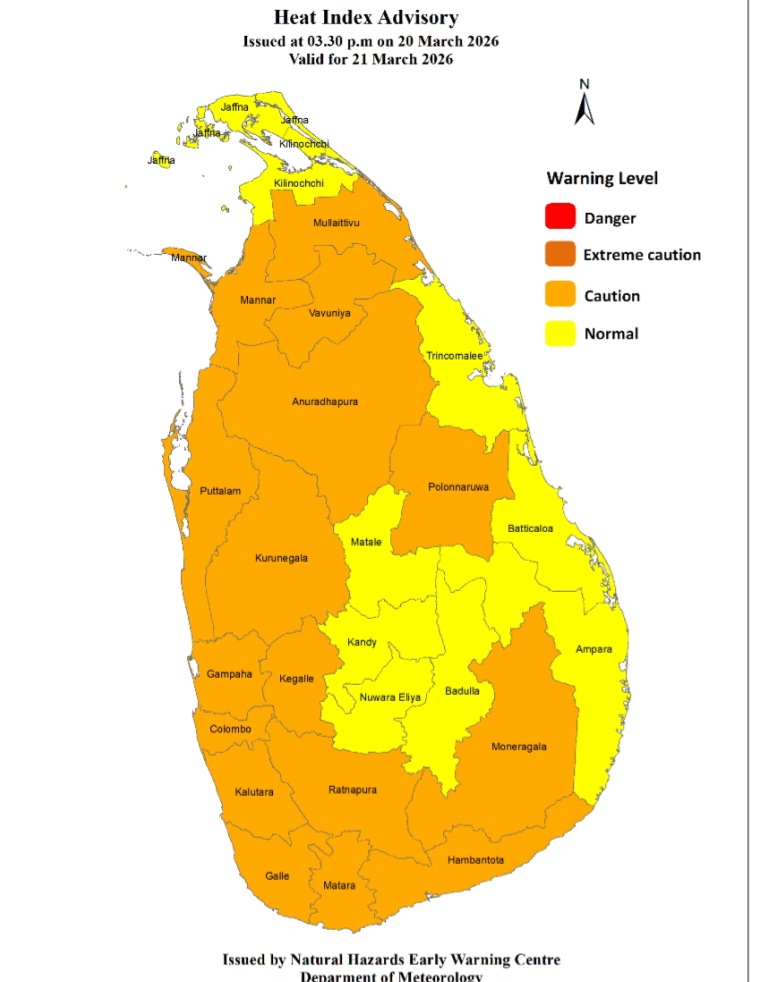
Warm Weather Advisory Issued by the Natural Hazards Early Warning Centre of the Department of Meteorology at 3.30 p.m. on 20 March 2026, valid for 21 March 2026
The public are warned that the Heat index, the temperature felt on human body is likely to increase up to ‘Caution level’ at some places in the Western, Sabaragamuwa, North-central, Southern and North-western provinces and in Monaragala, Mannar, Vavuniya and Mullaitivu districts.
The Heat Index Forecast is calculated by using relative humidity and maximum temperature and this is the condition that is felt on your body. This is not the forecast of maximum temperature. It is generated by the Department of Meteorology for the next day period and prepared by using global numerical weather prediction model data.
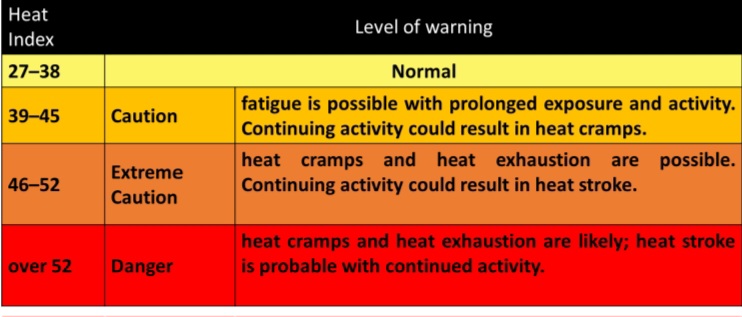
Effect of the heat index on human body is mentioned in the above table and it is prepared on the advice of the Ministry of Health and Indigenous Medical Services.
ACTION REQUIRED
Job sites: Stay hydrated and takes breaks in the shade as often as possible.
Indoors: Check up on the elderly and the sick.
Vehicles: Never leave children unattended.
Outdoors: Limit strenuous outdoor activities, find shade and stay hydrated.
Dress: Wear lightweight and white or light-colored clothing.
Note:
In addition, please refer to advisories issued by the Disaster Preparedness & Response Division, Ministry of Health in this regard as well. For further clarifications please contact 011-7446491
A staff team of the International Monetary Fund (IMF) will visit Sri Lanka from 26 March to 09 April, IMF Communications Director Julie Kozack announced.
Addressing the IMF press briefing, Kozack said the visit will focus on discussing economic policies.
“The aim will be to complete a combined fifth and sixth review of the IMF-supported programme, while assessing the potential impact of the Middle East conflict on the economy,” she said.
Kozack added that as part of the discussion, the team will be engaging with the authorities to better understand what the potential impact of the Middle East conflict could be on Sri Lanka’s economy.
“When the team returns, it will have an updated assessment of Sri Lanka’s economy and how the IMF can continue to support Sri Lanka.
The IMF Communications Director noted that the Fund is actively engaging with countries affected by the Middle East conflict, assessing global economic risks and standing ready to provide support.
“We are engaging very actively with our membership. We are talking to them about how we see, as I explained here, how we see some of the impacts, on the global economy. But also asking them, how can we best support them at this time, using the full range of tools available to us, including through our policy advice, capacity development and also financial support as needed.
We have engaged with finance ministers and central bank governors in many countries and regions. We’ve also engaged with regional institutions to discuss and share perspectives on the implications of the conflict and again, how the Fund can best provide support. The overall impact, of course, is going to depend very much on the duration and intensity of the conflict.We will provide an updated assessment in our World Economic Outlook in April, which will be comprehensive for the individual country level and also for global and regional economies,” Kozack added.

Showers may occur at several places in the Western, Sabaragamuwa, Northwestern and Uva provinces and in Galle, Matara, Kandy and Nuwara-Eliya districts after 1.00 pm.

Iranian strikes on bases used by US caused $800m in damage, new analysis shows

President maintains Lanka has been even-handed in dealing with Iran and US

Heat Index likely to increase up to ‘Caution level’ at some places in the Western, Sabaragamuwa, North-central, Southern and North-western provinces and in Monaragala, Mannar, Vavuniya and Mullaitivu districts

IMF team here from 26 March to 09 April

Colombo, Oslo steps up efforts to strengthen bilateral cooperation in key environmental priority areas

‘Dates have the highest sugar content to fight Coronavirus’

Sunday Island 27 December – Headlines

#SundayIsland 17th December – Headlines

Sunday Island – 28th March

Sunday Island Headlines – 21 March

Sunday Island – 21st February – Headlines
-

 Business5 days ago
Browns EV launches fast-charging BAW E7 Pro at Rs. 5.8 million
-

 Life style6 days ago
From culture to empowerment: Indonesia’s vision for Sri Lanka
-

 News3 days ago
CIABOC questions Ex-President GR on house for CJ’s maid
-

 Life style6 days ago
Ranjith Fernando celebrates cricketing journey with Hob Nails to Spikes
-

 News4 days ago
Sri Lankan marine scientist Asha de Vos honoured at UNGA opening
-

 Features5 days ago
Achievements of the Hunduwa!
-

 Latest News6 days ago
QR code system will be implemented for fuel with effect from 06.00 a.m. today (15th)
-

 News4 days ago
Australian HC debunks misleading travel risk claims for Sri Lanka