
News
‘Political leaders and corporate titans put profit and power ahead of people, betraying promises for fair recovery from pandemic’


From a human rights perspective, 2021 was largely a story of betrayal in the corridors of power, says Amnesty International.
Amnesty International’s annual report on the state of the world’s human rights in 2021, published in March 2022, shows that promises to “build back better” after the Covid-19 pandemic were little more than lip service. Hopes of global cooperation withered in the face of vaccine hoarding and corporate greed.
Governments suppressed independent and critical voices, with some even using the pandemic as a pretext to shrink further the civic space. New and unresolved conflicts erupted or persisted. Those forced to flee were subjected to a litany of abuses, including pushbacks by countries in the Global North.
But hopes for a better post-pandemic world were kept alive by courageous individuals, social movements and civil society organizations.
Wealthy states colluded with corporate giants in 2021 to dupe people with empty slogans and false promises of a fair recovery from the Covid-19 pandemic, in what amounts to one of the greatest betrayals of our times, said Amnesty International today, as it launched its annual assessment of human rights around the world.
The report finds that these states, alongside corporate titans, have in fact driven deeper global inequality. It details root causes including noxious corporate greed and brutal national selfishness, as well as neglect of health and public infrastructure by governments around the world.
“2021 should have been a year of healing and recuperation.?Instead, it became an incubator for deeper inequality and greater instability, a legacy caustic for years to come,”?said Agnès Callamard, Secretary General of Amnesty International.
“Leader after leader dangled promises to ‘build back better’ to address deep-seated inequalities that exacerbated the impact of the pandemic. Instead, they have performed a tragic fable of betrayal and greed in cahoots with corporate titans. Whilst this has played out around the world, the effects have been most damaging to the most marginalized communities, including those on the front lines of endemic poverty.”
The rapid roll-out of Covid-19 vaccines appeared to be a scientific silver bullet, offering hope of an end to the pandemic for all.
However, despite enough production to fully vaccinate the world in 2021, by year’s end less than 4% of those living in low-income countries had been fully vaccinated.
“At the G7, G20 and COP26 summits, grandstanding on a global stage, political and economic leaders paid lip service to policies that could generate a sea change in vaccine access, reverse under-investment in social protection, and tackle the impact of climate change. Heads of Big Pharma and Big Tech spun us lines about corporate responsibility. At this watershed movement, the stage was set for recovery, and genuine meaningful change for a more equal world,” said Agnès Callamard.
“However, they squandered the opportunity, reverting to type with policies and practice that drove further inequality. Members of the Rich Boys Club offered promises publicly that they reneged on privately.”
Wealthy states such as EU member states, the UK and the USA stockpiled more doses than needed, whilst turning a blind eye as Big Pharma put profits ahead of people, refusing to share their technology to enable wider distribution of vaccines. In 2021, Pfizer, BioNTech and Moderna projected eye-watering profits of up to US$54 billion yet supplied less than 2% of their vaccines to low-income countries.
Big Pharma were not the only corporate giants to undermine pandemic recovery for profit. Social media companies such as Facebook, Instagram and Twitter provided fertile ground for Covid-19 misinformation, allowing vaccine hesitancy to flourish. Some political leaders also acted as super-spreaders of misinformation, breeding distrust and fear for their own political gain.
“Social media companies’ allowed their lucrative algorithms to spread harmful misinformation about the pandemic, prioritizing the sensationalist and the discriminatory over truth,” said Agnès Callamard.
“The extent of their profiteering from that misinformation and the impact of that on the lives of millions mean those companies have a serious case to answer.”



The computer system at the Department of Registration of Persons has been rectified and the services are back to normal.
… questions why the price of a by-product like kerosene was jacked up
China Petrochemical Corporation (Sinopec Group) and Indian Oil Corporation Lanka (IOC PLC) have increased the prices of certain products significantly more than the Ceylon Petroleum Corporation (CPC). However, the fourth player in the market R.M. Parks, a US company in collaboration with Shell that launched operations here in late February last year, has increased its prices in line with Ceypetco.
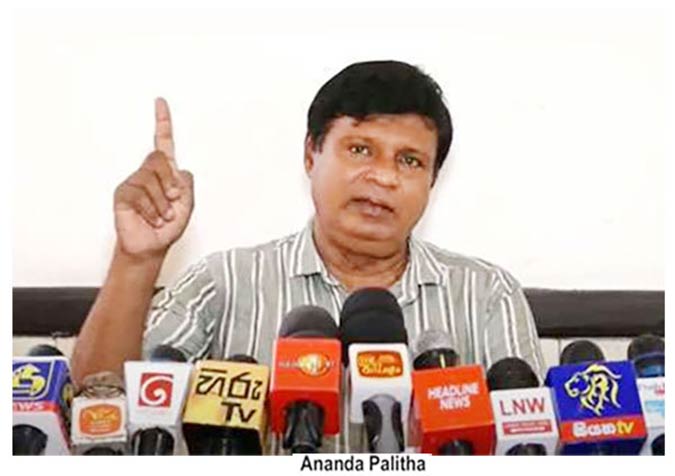
Convener of the Samagi Joint Trade Union Alliance, Ananda Palitha, yesterday (23) told The Island that foreign players had immensely benefited from the latest price revision at the expense of Sri Lankan consumers.
Alleging that Sinopec and Lanka IOC PLC had become a law unto themselves, Palitha pointed out that the failure on the part of successive governments to establish an Independent Commission and Regulatory Authority for the petroleum sector had allowed Ceypetco and all foreign players to do as they please. Palitha said that in the absence of proper regulatory mechanism, CPC/Energy Ministry should ensure genuine competitiveness in the market.
Palitha said that the NPP government had exploited the ongoing Middle East war to earn unconscionable profits at a time the economy was reeling under the impact of the Hormuz Strait blockade. According to him, all four players increased Auto Diesel by Rs. 79 to Rs. 382 per litre, and Octane 92 Petrol by Rs. 81 to Rs. 398 per litre, while Sinopec and Lanka IOC PLC price list differed in respect of other products. At most filling stations Octane 92 was not available and only higher priced Octane 95 petrol was available.
Pointing out that since the eruption of the Middle East conflict, on 28 February, the NPP had twice increased fuel prices on 09 and 22 March, Palitha said that the government could have cushioned the impact by lowering taxes imposed on crude oil and refined petroleum products. Instead, the latest price revisions resulted in further increase of customs duties, VAT and Port and Airport Development Levy. Additional duties often apply, such as a surcharge tax, on diesel and petrol.
Since the entry of Lanka IOC into the market in 2003, Sinopec in 2023 and R.M. Parks in 2025 eroded the CPC share and, at the moment, it was down to about 57%, and the private players accounted for the rest. Palitha placed the number of filling stations players authorised to operate at Ceypetco (836), Lanka IOC (274) and Sinopec and R.M. Parks 150 each.
Palitha said Lanka IOC has increased Petrol Octane 95 to Rs. 487 a litre whereas the CPC priced the same at Rs. 455) a litre. Lanka IOC and Ceypetco have priced a litre of Super diesel at Rs. 572 and Rs. 443, respectively.
LIOC has also revised its premium fuel categories, with Xtra Premium Petrol priced at Rs. 465, Xtra Mile at Rs. 551, and Xtra Green Diesel at Rs. 588.
Claiming that the government had twice increased the prices of old petroleum stocks, procured at a maximum USD 70 a barrel, weeks, if not months, before the new war, Palitha found fault with the Opposition for not launching a sustained campaign against the exploitation of the public. Palitha said that the increase of a litre of kerosene by Rs. 13 on 09 March and Rs. 60 on 22 March was unjustifiable. “The people do not know that kerosene is a by-product in the process of refining crude oil. Sapugaskanda produces LPG, naphtha, petrol, diesel, kerosene and furnace oil.”
The price of a litre of kerosene to had been increased to Rs 255, Palitha said, adding that it could have been provided to the needy at a much lower rate. If those who represent Parliament bothered to study the issues at hand, they would be able to challenge the government on this disgraceful manipulation of the entire country, he said.
Palitha said that the Parliament owed an explanation as to why the Commission to regulate the oil trade hadn’t been appointed and whether some interested parties financially benefited at the expense of the country.
Palitha said that the introduction of the QR code to control fuel sales and the increase of the fuel quota last Sunday night had been used to deceive the public when those in power and their friends in the industry made money at the expense of the public.
By Shamindra Ferdinando
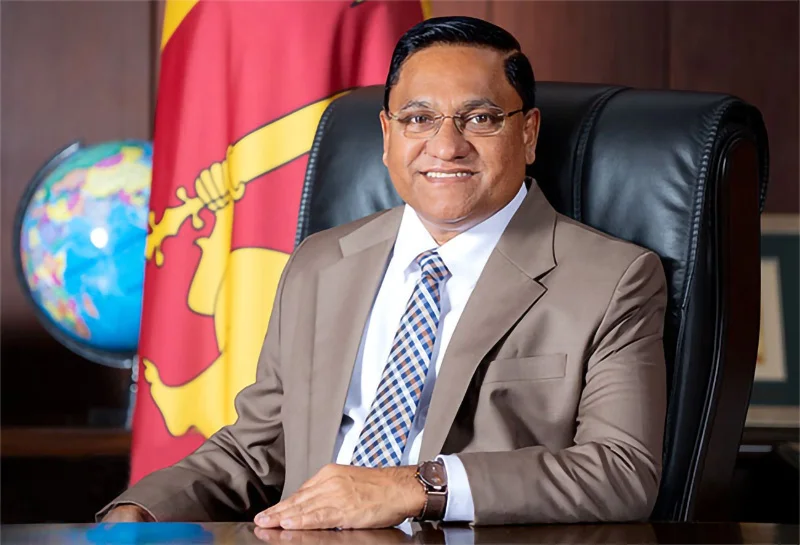
Sri Lanka is planning to fast-track the redevelopment of the Trincomalee oil tank farm as a long-term solution to its ongoing energy crisis, with backing from India and the United Arab Emirates, The Hindu has reported.
Foreign Minister Vijitha Herath said the project, which involves restoring World War II-era oil storage facilities in the eastern district, is seen as a “permanent solution” to managing fuel supply challenges.
“Temporary solutions are not sustainable. We need a long-term strategy to deal with oil storage and distribution, given the global energy situation,” he told The Hindu.
The initiative follows a Memorandum of Understanding signed in April 2025 between Sri Lanka, India, and the UAE to develop Trincomalee as a regional energy hub.
Despite previous delays spanning decades, the project has gained renewed urgency amid the current global energy crisis, which has disrupted supply chains and driven up fuel costs.
Sri Lanka has already submitted a concept proposal to its partners, while technical aspects are being reviewed by the Energy Ministry before moving to the tender stage, according to the report.
The renewed push also marks a notable policy shift, as the ruling administration, led by the National People’s Power, had previously opposed Indian involvement in the project.

‘Dates have the highest sugar content to fight Coronavirus’

Sunday Island 27 December – Headlines

#SundayIsland 17th December – Headlines

Sunday Island – 28th March

Sunday Island Headlines – 21 March

Sunday Island – 21st February – Headlines
-

 News6 days ago
CIABOC questions Ex-President GR on house for CJ’s maid
-

 News5 days ago
Bailey Bridge inaugurated at Chilaw
-

 Features1 day ago
Trincomalee oil tank farm: An engineering marvel
-

 News4 days ago
CIABOC tells court Kapila gave Rs 60 mn to MR and Rs. 20 mn to Priyankara
-

 News5 days ago
Pay hike demand: CEB workers climb down from 40 % to 15–20%
-

 Editorial6 days ago
Couple QR-based quota with odd-even rationing
-
 Features4 days ago
Science and diplomacy in a changing world
-

 News3 days ago
Colombo, Oslo steps up efforts to strengthen bilateral cooperation in key environmental priority areas