
News
Police chasing some vital leads into Dutch monk’s death to ‘clear some doubts’

by Suresh Perera
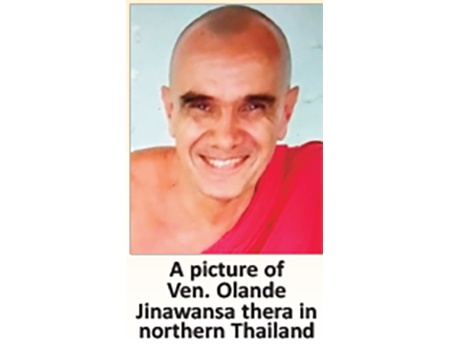
Police investigators are pursuing some important leads to figure out the circumstances which led to the death of the Dutch monk at the Dodanduwa Polgasduwa forest monastery, a high-ranking police official in the region said on Friday.
“Though preliminary investigations suggest the possibility of suicide, we are working on some vital clues to clear some doubts that have emerged”, says Senior DIG Rohan Silva in charge of the Southern province.
“We are probing the case with an open mind”, he noted, while declining to divulge more information on the leads police sleuths are chasing as it will hamper ongoing investigations.
The body of Ven. Olande Jinawansa thera was found floating in the Ratgama lagoon on December 8. At the time the body was fished out, two stones were found tied to the 59-year-old monk’s legs.
The police and the STF searched the island, where the monastery is situated, plus an adjoining island, but nothing suspicious was found, the senior police official said.
Asked about social media reports that the monk had opposed the construction of a hotel in a near-by island as it disturbed the serenity of the monastery, and this may have led to his untimely death, he explained that there was no such hotel being built in the locality.
The Dutch monk was, however, not in favor of a Dharma Salawa that was being built within the precincts of the monastery as he believed there was no need for such a facility as devotees in large numbers did not visit the Aramaya, the senior DIG Silva said.
“He had protested that the din caused by the construction disturbed the meditating monks. Apart from that, there was no hotel being built in the vicinity for the bhikku to have opposed it”, he added.
Earlier, there was a move to build a bridge to link the island but the idea was dropped as it didn’t find favor with the monks at the monastery, he further said.
“We also inspected the monk’s kutiya (small hut), where he meditated, but there was nothing amiss”, he continued.
The Government Analyst visited the scene and also examined the knots on the rope with which the stones were found tied to the monk’s legs.
The autopsy revealed that there was no water or sand in the prelate’s lungs, which indicated that he had been alive at the time he was in the lagoon. This raised the possibility of the monk taking his own life, he said.
An open verdict was returned at the magisterial inquiry into his death.
Senior DIG Silva said that body parts have been sent to the Government Analyst for examination to ascertain, amongst other factors, whether the monk was poisoned.
He said the Dutch monk, who settled in Sri Lanka 12 years ago, was basically a loner. He kept to himself and went on pindapatha alone. As a lover of animals, he set aside a part of the alms he received to feed them. He even reared a young injured animal in his Kutiya.
Asked whether any arrests have been made or are imminent, the senior police official replied, “it depends on the outcome of the continuing investigations. We need to clear some existing doubts surrounding the prelate’s death”.
Meanwhile, a close associate, who now lives in New Zealand, said the Dutch monk was residing in northern Thailand and left for Sri Lanka in 2008.
“I was very close to Ven. Tone Jinawamso thera, as he was known there”, he said.
Requesting anonymity, he told The Sunday Island from Auckland that as a well established monk, who had even translated a Thai Buddhist publication into English, he didn’t see any reason why the prelate should commit suicide.
“As a bhikku very close to me, I can assure you that he was content with the simple, uncomplicated life he led and would have never contemplated suicide”, he asserted.
The Dutch monk’s death is suspicious, he claimed. “The police should get to the bottom of it”.



The Landslide Early Warning Center of the National Building Research Organisation [NBRO] has issued landslide early warnings to the districts of Kandy and Nuwara Eliya valid from 06:00 hrs on 13.02.2026 to 06:00 hrs on 14.02.2026
Accordingly,
Level II [AMBER] landslide early warnings have been issued to the Divisional Secretaries Divisions and surrounding areas of Walapane and Nildandahinna in the Nuwara Eliya district.
Level I [YELLOW] landslide early warnings have been issued to the Divisional Secretaries Divisions and surrounding areas of Pathahewheta in the Kandy district.
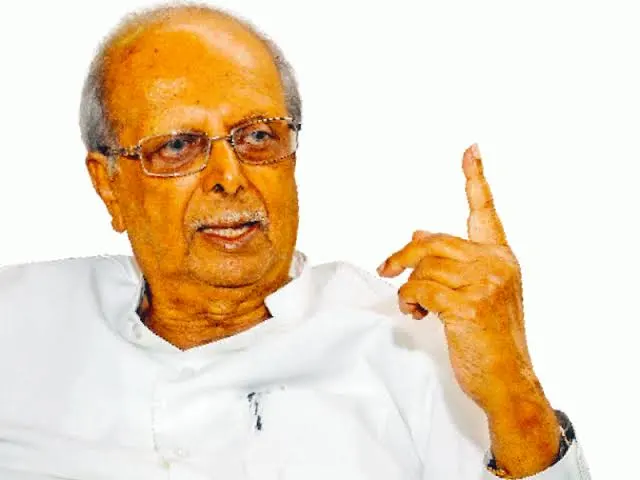
Former Minister Professor Tissa Vitharana has passed away at the age of 91, according to family sources

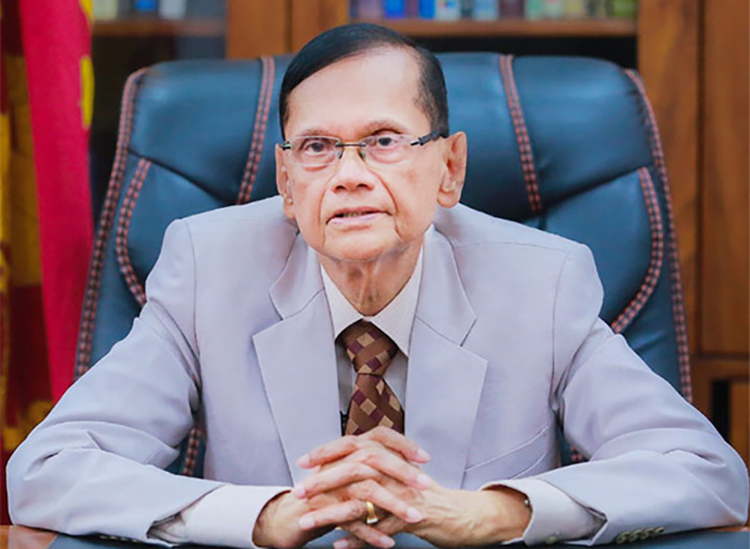
‘Media freedom will be in jeopardy’
Former Minister of Justice, Constitutional Affairs, National Integration and Foreign Affairs Prof. G. L. Peiris has warned that the proposed Protection of the State from Terrorism Act (PSTA) will deal a severe blow to civil liberties and democratic rights, particularly media freedom and the overall freedom of expression.
Addressing a press conference organised by the joint opposition alliance “Maha Jana Handa” (Voice of the People) in Colombo, Prof. Peiris said the proposed legislation at issue had been designed “not to protect people from terrorism but to protect the State.”
Prof. Peiris said that the proposed law would sound the death knell for the rights long enjoyed by citizens, with journalists and media institutions likely to be among those worst affected.
Prof. Peiris took exception to what he described as the generous use of the concept of “recklessness” in the draft, particularly in relation to the publication of statements and dissemination of material. He argued that recklessness was recognised in criminal jurisprudence as a state of mind distinct from intention and its scope was traditionally limited.
“In this draft, it becomes yet another lever for the expansion of liability well beyond the properly designated category of terrorist offences,” Prof. Peiris said, warning that the elasticity of the term could expose individuals to prosecution on tenuous grounds.
Prof. Peiris was particularly critical of a provision enabling a suspect already in judicial custody to be transferred to police custody on the basis of a detention order issued by the Defence Secretary.
According to the proposed laws such a transfer could be justified on the claim that the suspect had committed an offence prior to arrest of which police were previously unaware, he said.
“The desirable direction of movement is from police to judicial custody. Here, the movement is in the opposite direction,” Prof. Peiris said, cautioning that although the authority of a High Court Judge was envisaged, the pressures of an asserted security situation could render judicial oversight ineffective in practice.
Describing the draft as “a travesty rather than a palliative,” Prof. Peiris said the government had reneged on assurances that reform would address longstanding concerns about existing counter-terrorism legislation. Instead of removing objectionable features, he argued, the new bill introduced additional provisions not found in the current Prevention of Terrorism Act (PTA).
Among them is a clause empowering the Defence Secretary to designate “prohibited places”. That was a power not contained in the PTA but previously exercised, if at all, under separate legislation such as the Official Secrets Act of 1955. Entry into such designated places, as well as photographing, video recording, sketching or drawing them, would constitute an offence punishable by up to three years’ imprisonment or a fine of up to Rs. 3 million. Prof. Peiris said. Such provision would have a “particularly chilling effect” on journalists and media personnel, he noted.
The former minister and law professor also criticised the breadth of offences defined under the draft, noting that it sought to create 13 categories of acts carrying the label of terrorism. This, he said, blurred the critical distinction between ordinary criminal offences and acts of terrorism, which require “clear and unambiguous definition with no scope for elasticity of interpretation.”
He cited as examples offences such as serious damage to public property, robbery, extortion, theft, and interference with electronic or computerised systems—acts which, he argued, were already adequately covered under existing penal laws and did not necessarily amount to terrorism.
Ancillary offences, too, had been framed in sweeping terms, Prof. Peiris said. The draft legislation, dealing with acts ‘associated with terrorism,’ imposed liability on persons “concerned in” the commission of a terrorist offence. “This is a vague phrase and catch-all in nature.” he noted.
Similarly, under the subheading ‘Encouragement of Terrorism,’ with its reference to “indirect encouragement,” could potentially encompass a broad spectrum of protest activity, Prof. Peiris maintained, warning that the provision on “Dissemination of Terrorist Publications” could render liable any person who provides a service enabling others to access such material. “The whole range of mainstream and social media is indisputably in jeopardy,” Prof. Peiris said.
Former Minister Anura Priyadarshana Yapa and SLFP Chairman Nimal Siripala de Silva also addressed the media at the briefing.
by Saman Indrajith ✍️

Landslide Early Warnings issued to the Districts of Kandy and Nuwara Eliya

Former Minister Professor Tissa Vitharana has passed away at the age of 91

Buoyant Zimbabwe plot massive upset against depleted Australia

Mexican ships arrive in Cuba with humanitarian cargo amid US oil blockade

Tarique Rahman’s BNP claims majority in Bangladesh election

Kishan, Hardik, spinners hand India record win

‘Dates have the highest sugar content to fight Coronavirus’

Sunday Island 27 December – Headlines

#SundayIsland 17th December – Headlines

Sunday Island – 28th March

Sunday Island Headlines – 21 March

Sunday Island – 21st February – Headlines
-

 Features5 days ago
My experience in turning around the Merchant Bank of Sri Lanka (MBSL) – Episode 3
-

 Business6 days ago
Zone24x7 enters 2026 with strong momentum, reinforcing its role as an enterprise AI and automation partner
-

 Business5 days ago
Remotely conducted Business Forum in Paris attracts reputed French companies
-

 Business5 days ago
Four runs, a thousand dreams: How a small-town school bowled its way into the record books
-

 Business5 days ago
ComBank and Hayleys Mobility redefine sustainable mobility with flexible leasing solutions
-

 Business2 days ago
Autodoc 360 relocates to reinforce commitment to premium auto care
-

 Business6 days ago
HNB recognized among Top 10 Best Employers of 2025 at the EFC National Best Employer Awards
-

 Midweek Review2 days ago
A question of national pride