
Midweek Review
Playing politics with disappearances

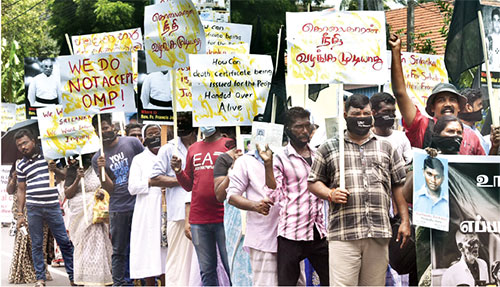
A recent protest in Jaffna demanding justice for those who had been reported missing during the conflict and after the successful conclusion of the war, in May 2009(pic posted by PEARL)
By Shamindra Ferdinando
Washington-based People for Equality and Relief in Lanka (PEARL) says it campaigns for justice and self-determination for the Tamil people, living in the Northern and Eastern Provinces. Identifying itself as a non-profit organization, PEARL says formation of the group took place in 2005 in the wake of volunteers visiting Sri Lanka – the year before the Liberation Tigers of Tamil Eelam (LTTE) launched the fourth phase of the war.
Having reignited the war, in August 2006, with devastating initial success, the LTTE, however, lost the entire Eastern Province, by mid-2007. The armed forces brought the war to a successful conclusion in May 2009. Since then, various Tamil politicians, Diaspora organizations and suspicious bleeding hearts, in the West, have been alleging enforced disappearances on a mass scale.
“For too long, the plight of the families of the disappeared has been used as a talking point and a prop for politicians and the international community, but no concrete measures have been taken,” said PEARL’s Executive Director Tasha Manoranjan. “The international community contributed to the destruction of Tamil lives and Tamil aspirations in 2009 — it is now time for the same international community to meet the demands of the families of the disappeared,” she said, in a statement issued in solidarity with the Tamil families of victims of enforced disappearances in Sri Lanka, from the 1980s and during the entirety of the country’s armed conflict. PEARL estimated the number of disappearances at 60,000-100,000, during this period.
PEARL, too, alleges genocide and demands accountability on the part of Sri Lanka. The group admits that it twice revised its five-year strategic plan after wartime Defence Secretary Gotabaya Rajapaksa won the 2019 presidential election. The original plan, put out in 2018, has been revised in Dec 2019 and April-July 2020. Perhaps, PEARL will have to revise its strategic plan further in the wake of President Gotabaya Rajapaksa’s party securing an unprecedented near two-thirds majority at the Aug 5, 2020 general election. PEARL anticipates rapid deterioration of the situation in the Northern and Eastern Provinces as a result of Gotabaya Rajapaksa’s victory. PEARL has conveniently forgotten Tamils living there overwhelmingly voted for General Sarath Fonseka at the 2005 presidential election. The group’s concerns over Gotabaya Rajapaksa’s victory obviously seemed baseless against the backdrop of Tamils’ backing for war-winning Army commander Fonseka’s candidature at the 2005 presidential election.
PEARL will also have to take into consideration the major setback suffered by one-time LTTE mouthpiece, the Tamil National Alliance (TNA), at the recent general election. Having championed hybrid war crimes court in terms of Geneva Resolution 30/1 ‘Promoting reconciliation, accountability and human rights in Sri Lanka’, co-sponsored by the yahapalana government, the TNA felt comfortable though the general election results proved otherwise. The TNA ended up with just 10 seats, its worst performance since winning 22 seats at the April 2004 general election with overt and covert help from the LTTE.
In addition to the TNA, two other political outfits, namely the Ahila Illankai Tamil Congress (AITC) and Tamil Makkal Theshiya Kutani (TMTK), led by Gajendrakumar Ponnambalam and C.V. Wigneswaran, respectively, have emerged at the expense of the TNA grouping, led by veteran Sampanthan. It was more a war of attrition, fought by the two, against the established TNA that resulted in the major electoral reversal by the latter.
It would be pertinent to remind how lawmaker Ponnambalam, on Aug 21, 2020 reiterated genocide allegations during the debate on President Gotabaya Rajapaksa’s policy statement, delivered on the previous day. While declaring their resolve for self-determination, Ponnambalam challenged President Gotabaya Rajapaksa’s mandate, and that of the SLPP, received in Nov 2019 and August 2020. Many an eyebrow was raised when Speaker Mahinda Yapa Abeywardena, in respect of C.V. Wigneswaran’s provocative speech, at the inauguration of the parliament, declared that lawmakers were free to say whatever they wanted to.
The writer felt the need to examine the contentious issue of missing persons, against the backdrop of PEARL’s latest statement, headlined “PEARL stands with Victims’ Families in Sri Lanka on the International Day of the Victims of Enforced Disappearances”, with the strapline ‘Since the end of the war in 2009, thousands of Tamils have not been heard from, after surrendering to the government’
PEARL has estimated the number of disappearances at 60,000-100,000 during the conflict and after. If the number of disappearances has been estimated as much as 100,000, wouldn’t it be necessary to examine the number of killed? Did some of those, who had been listed among the disappeared were actually killed in the fighting, or perished after being caught in the crossfire. Before examining the missing persons issue, let me remind the reader what yahapalana Prime Minister Ranil Wickremesinghe said of those categorized as disappeared.
Ranil sets the record straight
The 2015 presidential election brought an end to war-winning President Mahinda Rajapaksa’s rule. The Rajapaksa administration was repeatedly accused of running secret detention facilities, both in the Northern and Eastern provinces. A section of the Western powers, too, subscribed to these unsubstantiated allegations. In spite of the change of the government, in 2015, accusations persisted. In the run-up to the 2015 Geneva sessions, Sri Lanka was accused of still operating secret detention facilities.
In 2015, Sri Lanka agreed to set up (1) a judicial mechanism with a Special Counsel to investigate allegations of violations and abuses of human rights and violations of international human rights law (11) Commission truth, justice, reconciliation and non-recurrence (111) An Office on missing and (1V) An office for reparations.
In the run-up to the Geneva sessions, Premier Wickremesinghe chose to set the record straight, at a ceremony at Rukmale Sri Dharmaloka Vijayaloka Maha Viharaya, on March 01, 2015, to felicitate the newly appointed Maha Nayaka Thera Ven. Ittapane Dharmalankara. Among those present was Malcolm Cardinal Ranjith, Archbishop of Colombo. Premier Wickremesinghe declared that as all those who had been taken into custody, during the war and the post-conflict period, were being held in legally run facilities, all detainees/prisoners could be accounted for. The UNP leader didn’t mince his words when he emphasized that those missing, but not listed among those in government custody, had either perished during the conflict or were living overseas ‘(Prime Minister denies existence of secret detention camps’. with strap line ‘Those not among prison population either perished during the war or living overseas, The Island March 04, 2015.’)
A couple of days later, Premier Wickremesinghe challenged the much-touted UN claim of over 40,000 civilians killed on the Vanni east front, in 2009. Wickremesinghe also stressed the urgent need to verify the UN claims, as well as various other accusations. Unfortunately, Wickremesinghe’s did nothing. Wickremesinghe handling of the post-war accountability issue, too, contributed to the humiliating defeat his party suffered at the recently concluded general election. Over seven decades old, the UNP ended up without an elected MP. Nearly a month after the general election, the UNP is yet to reach consensus on its solitary National List slot.
The UNP leader Wickremesinghe set the record straight in an exclusive interview with Indian Thanthi TV in which he insisted that figures, quoted by the UN or other organizations, couldn’t be accepted without being verified. The March 6, 2015, interview couldn’t have been conducted at a better time, though Wickremesinghe did nothing subsequently to examine the Vanni death toll. Instead, Wickremesinghe gave the then Foreign Minister Mangala Samaraweera the go ahead to co-sponsor the accountability resolution, in Geneva, on Oct 01, 2015. The rest is history.
When the interviewer, S.A. Hariharan, pointed out that the Tamil Diaspora had estimated the number of civilian deaths closer to 100,000, Wickremesinghe asserted that it wouldn’t even come up to 40,000. Wickremesinghe pointed out that, in addition to the PoE (Panel of Experts) report, there had been other official reports that dealt with accountability issues. The Premier emphasized the pivotal importance of verifying such accusations to establish the number of civilian deaths. The Premier said that some official reports placed the number of civilian deaths at 5,000. The UNP leader never called for the verification of the UN report until he was kicked out of parliament.
In spite of underlining the importance of verifying accusations, Wickremesinghe didn’t take any follow-up action. The Sirisena-Wickremesinghe government conveniently refrained from using heavy ammunition in our rightful defence, provided by Lord Naseby, in Oct 2017, to counter the PoE report. The incumbent government, too, is yet to formulate a cohesive strategy to use Lord Naseby’s disclosure.
PEARL owes an explanation
During the conflict, thousands of Sri Lankan Tamils fled the country. The war here gave them an opportunity to secure political asylum in Europe, the US, Australia and the Scandinavian region. The Tamil Diaspora provided a substantial amount of funding, required by the LTTE to continue its conventional military campaign. The LTTE, in turn, controlled the Diaspora groups. The LTTE maintained strict surveillance over them. The Diaspora groups lacked courage at least to request the LTTE not to use their own helpless people as human shields in 2009. Wouldn’t it be interesting to know what PEARL did during the last phase of the war in Sri Lanka? Did PEARL intervene on behalf of the Vanni Tamils after the LTTE abandoned Kilinochchi, in January 2009? Did PEARL request the LTTE, at least privately, to let go of those who were being held as human shields on the Vanni east front at the behest of a megalomaniac?
PEARL’s Executive Director, Tasha Manoranjan, and a member of its board of directors, having alleged in their latest media release that the international community contributed to the destruction of Tamil lives and Tamil aspirations in 2009, demanded the same international community should meet the demands of the disappeared. As a Diaspora group seeking to influence Western policy, through legal and political advocacy and direct research and reporting, PEARL should know how Western powers prolonged the conflict. In fact, the LTTE wouldn’t have survived nearly three decades without Western support, if not overt, but definitely covert. Western powers allowed the funding required to procure arms, ammunition and equipment needed to wage war though some countries proscribed the group. Neither did they unmask the international Tiger terrorist network, which was also resorting to drug running, extortion, etc., to fund the war here. However, the US facilitated the destruction of the floating arsenals in secret naval operations undertaken by the SLN. This was at the onset of the Vanni offensive.
If PEARL is genuinely interested in knowing what really happened to those who had been reported missing, it would seek the assistance of Western powers, as well as India. A substantial number of those who had been categorized as missing is today living in various countries, in many cases under assumed names. If not for them, there wouldn’t have been so many Diaspora organizations still raising funds on behalf of their people living in the Northern and Eastern Province.
PEARL tweeted on August 14, 2020: “Today marks 14 years since the #SLAF dropped 16 bombs over the #Sencholai children’s home, killing at least 51 #Tamil schoolgirls and 4 teachers. We remember them, acknowledge the gendered dimension of genocide, and continue to call for justice and accountability.”
Tasha Manoranjan, who had been in the Vanni at the onset of the Eelam War IV, tweeted on the following day; “I visited Sencholai hours after the bombing. The wailing of the mothers and families of these slaughtered schoolgirls haunt me to this day.”
Now that Tasha Manoranjan had claimed that she was hours away from Sencholai at the time of the SLAF attack on August 14, 2006, how could she become the founder of PEARL, established in 2005.
Manoranjan certainly owed an explanation.
Let me produce the description of the PEARL official on its official website: “Tasha Manoranjan is the founder and director of People for Equality and Relief in Lanka (PEARL). She spent over a year documenting human rights violations committed against Tamil civilians in northern Sri Lanka, and remains committed to pursuing accountability for violations of international law. Tasha was previously an associate in Sidley Austin LLP’s Litigation Practice. Tasha received her B.A., magna-cum-laude, in Justice and Peace Studies from Georgetown University’s School of Foreign Service. Tasha earned her law degree at Yale Law School, where she served as the Features Editor and Book Reviewer for the Yale Journal of International Law, Chair of the South Asian Law Students Association and Community Enrichment Chair of the Women of Color Collective. While at Yale, Tasha wrote a paper entitled “Beaten but not Broken: Tamil Women in Sri Lanka”, which was subsequently published in the Georgetown Journal of International Affairs.”
According to the website, Manoranjan works as a Senior Policy Advisor at the Ontario Human Rights Commission. Is she a Canadian passport holder?
From Vanni to the US
How could Manoranjan, who had been in LTTE held Vanni, on August 14, 2006, ended up in the US? Or had she been a member of the PEARL at the time she entered the Vanni? In other words, what was her status at the time she entered Vanni? Did she ever serve the LTTE? When did she leave the Vanni? And, most importantly, how did she leave the country? Depending on the duration of Manoranjan’s stay in the Vanni, she can surely shed light on the circumstances leading to the entire Vanni population being herded into accompanying the retreating LTTE fighting units. What was Manoranjan’s status in the Vanni? Had she been a displaced person? Did anyone of her family serve the LTTE or any other terrorist group? In Manoranjan’s brief description there is no reference to her being in the Vanni during the conflict.
PEARL board of directors includes Dr. Vino Kanapathipillai, Gajan Raj and Sadena Thevarajah. In addition to the PEARL board of directors, its team comprised Tasha Manoranjan (Executive Director), Mario Arulthas (Strategic Advisor / Sr. Advocacy Officer, US), Anji Manivannan (Legal Director), Vivetha Thambinathan (Research Director), Avi Selvarajah (Sr. Legal Officer), Sivakami Rajamanoharan (Sr. Advocacy Officer, UK), Sagi Thilipkumar (Sr. Advocacy Officer, CH), Archana Ravichandradeva (Sr. Advocacy Officer, CA), Abarna Selvarajah (Advocacy Officer, CA), Thevya Balendran (Advocacy Officer, CA), Ernest Rajakone (Advocacy Officer, US), Luxsiga Ambigaibagan (Research Associate / Education Coordinator), Brannavy Jeyasundaram (Operations Officer) and Athavarn Srikantharajah (Interim Project Manager).
In addition to Manoranjan, did other members of the PEARL board of directors, as well as the PEARL team, live in the Northern and Eastern Provinces, during the conflict? Had their parents been refugees during the conflict? Had their parents served the LTTE, or any other terrorist organization? As PEARL had secured the services of a capable team, it can probe how 60,000-100,000 people disappeared during the conflict. Let me remind multiple causes for disappearances/ cases where bodies were not found.
* Disappearances resulted from fighting among /between Indian trained terrorist groups.
* Abductions of civilians carried out by Tamil terrorist groups
* Disappearances during Eelam War 1 (1983-July 1987) blamed on Sri Lankan military and police.
* Disappearances blamed on the Indian military during its deployment here (July 1987-March 1990).
PEARL should take into consideration the level of fighting between the Indian military and the LTTE as the former lost well over 1,300 officers and men and over 2,000 wounded.
* Those who disappeared /killed during weapons training in India
* Disappearances/deaths due to capsizing of boats taking youth to training facilities in India or while returning from India
* Those LTTE cadres killed by Indian security forces and police after the assassination of Congress leader Rajiv Gandhi on May 21, 1991 at Sriperumbudur, India.
* PLOTE cadres killed/disappeared during an abortive sea borne raid on the Maldives in early Nov 1988 and as a result of Indian military operations.
* Disappearances blamed on the Sri Lankan military during Eelam War II (June 1990 to 1994), Eelam War III ((April 1995 to Dec 2001) and Eelam War IV (Aug 2006 to May 2009)
* Those who perished while trying to reach Australia in boats.
* Clandestine movement of Sri Lankans facilitated by foreign missions in Colombo during the conflict and after.
* Issuance of new foreign passports to Sri Lankans under different names. One of the most glaring examples is Australia issuing a new passport to leader of the breakaway JVP faction Frontline Socialist Party (FSP) Kumar Gunaratnam bearing Noel Mudalige, a Sinhala Buddhist. Many countries continue to issue passports under different names, even to former members of terrorist groups.
*Those taken refuge in India and other countries to avoid forced conscription by the LTTE.
* Bodies disposed of by Sri Lankan and Indian militaries due to their failure to establish identities of the dead. Those killed during clandestine operations in the South. And finally,
* Political asylum in industrial countries for bogus refugees on the false grounds of persecution in Sri Lanka?
Let me end this piece with a story of an ex-LTTE cadre who ended up being an internationally renowned actor. Anthonythasan Jesuthasan, the lead actor of French film ‘Dheepan’ which won the top Palme d’Or prize for director Jacques Audiard at the 68th Cannes International Film Festival in 2015 had been an ex-LTTE cadre who fled the country in early 90s. Jesuthasan is on record as having said that he wanted to reach the UK but had to settle for France. Perhaps, members of the PEARL board of directors/team should watch ‘Dheepan’ if they hadn’t already done so.
Those who had been killed in combat though their bodies were not recovered and those who fled Sri Lanka for various reasons and are leading comfortable lives overseas while Sri Lanka is under pressure to account for the dead and the missing. The vast majority are those who had secured political asylum, on bogus grounds, taking advantage of hostility of some countries towards Sri Lanka.


The failure on the part of the Janatha Vimukthi Peramuna (JVP)-led National People’s Power (NPP) government to fulfil a plethora of promises given in the run up to the last presidential election, in September, 2024, and a series of incidents, including cases of corruption, and embarrassing failure to act on a specific weather alert, ahead of Cyclone Ditwah, had undermined the administration beyond measure.
Ditwah dealt a knockout blow to the arrogant and cocky NPP. If the ruling party consented to the Opposition proposal for a Parliamentary Select Committee (PSC) to probe the events leading to the November 27 cyclone, the disclosure would be catastrophic, even for the all-powerful Executive President Anura Kumara Dissanayake, as responsible government bodies, like the Disaster Management Centre that horribly failed in its duty, and the Met Department that alerted about the developing storm, but the government did not heed its timely warnings, directly come under his purview.
The NPP is on the back foot and struggling to cope up with the rapidly developing situation. In spite of having both executive presidency and an overwhelming 2/3 majority in Parliament, the government seems to be weak and in total disarray.
The regular appearance of President Dissanayake in Parliament, who usually respond deftly to criticism, thereby defending his parliamentary group, obviously failed to make an impression. Overall, the top NPP leadership appeared to have caused irreparable damage to the NPP and taken the shine out of two glorious electoral victories at the last presidential and parliamentary polls held in September and November 2024 respectively.
The NPP has deteriorated, both in and out of Parliament. The performance of the 159-member NPP parliamentary group, led by Prime Minister Dr. Harini Amarasuriya, doesn’t reflect the actual situation on the ground or the developing political environment.
Having repeatedly boasted of its commitment to bring about good governance and accountability, the current dispensation proved in style that it is definitely not different from the previous lots or even worse. (The recent arrest of a policeman who claimed of being assaulted by a gang, led by an NPP MP, emphasised that so-called system change is nothing but a farce) In the run-up to the November, 2024, parliamentary polls, President Dissanayake, who is the leader of both the JVP and NPP, declared that the House should be filled with only NPPers as other political parties were corrupt. Dissanayake cited the Parliament defeating the no-confidence motions filed against Ravi Karunanayake (2016/over Treasury Bond scams) and Keheliya Rambukwella (2023/against health sector corruption) to promote his argument. However, recently the ongoing controversy over patient deaths, allegedly blamed on the administration of Ondansetron injections, exposed the government.
Mounting concerns over drug safety and regulatory oversight triggered strong calls from medical professionals, and trade unions, for the resignation of senior officials at the National Medicines Regulatory Authority (NMRA) and the State Pharmaceutical Corporation (SPC).
Medical and civil rights groups declared that the incident exposed deep systemic failures in Sri Lanka’s drug regulatory framework, with critics warning that the collapse of quality assurance mechanisms is placing patients’ lives at grave risk.
The Medical and Civil Rights Professional Association of Doctors (MCRPA), and allied trade unions, accused health authorities of gross negligence and demanded the immediate resignation of senior NMRA and SPC officials.
MCRPA President Dr. Chamal Sanjeewa is on record as having said that the Health Ministry, NMRA and SPC had collectively failed to ensure patient safety, citing, what he described as, a failed drug regulatory system.
The controversy has taken an unexpected turn with some alleging that the NPP government, on behalf of Sri Lanka and India, in April this year, entered into an agreement whereby the former agreed to lower quality/standards of medicine imports.
Trouble begins with Ranwala’s resignation
The NPP suffered a humiliating setback when its National List MP Asoka Ranwala had to resign from the post of Speaker on 13 December, 2024, following intense controversy over his educational qualification. The petroleum sector trade union leader served as the Speaker for a period of three weeks and his resignation shook the party. Ranwala, first time entrant to Parliament was one of the 18 NPP National List appointees out of a total of 29. The Parliament consists of 196 elected and 29 appointed members. Since the introduction of the National List, in 1989, there had never been an occasion where one party secured 18 slots.
The JVP/NPP made an initial bid to defend Ranwala but quickly gave it up and got him to resign amidst media furor. Ranwala dominated the social media as political rivals exploited the controversy over his claimed doctorate from the Waseda University of Japan, which he has failed to prove to this day. But, the JVP/NPP had to suffer a second time as a result of Ranwala’s antics when he caused injuries to three persons, including a child, on 11 December, in the Sapugaskanda police area.
The NPP made a pathetic, UNP and SLFP style effort to save the parliamentarian by blaming the Sapugaskanda police for not promptly subjecting him for a drunk driving test. The declaration made by the Government Analyst Department that the parliamentarian hadn’t been drunk at the time of the accident, several days after the accident, does not make any difference. Having experienced the wrongdoing of successive previous governments, the public, regardless of what various interested parties propagated on social media, realise that the government is making a disgraceful bid to cover-up.
No less a person than President Dissanayake is on record as having said that their members do not consume liquor. Let us wait for the outcome of the internal investigation into the lapses on the part of the Sapugaskanda police with regard to the accident that happened near Denimulla Junction, in Sapugaskanda.
JVP/NPP bigwigs obviously hadn’t learnt from the Weligama W 15 hotel attack in December, 2023, that ruined President Ranil Wickremeinghe’s administration. That incident exposed the direct nexus between the government and the police in carrying out Mafia-style operations. Although the two incidents cannot be compared as the circumstances differ, there is a similarity. Initially, police headquarters represented the interests of the wrongdoers, while President Wickremesinghe bent over backwards to retain the man who dispatched the CCD (Colombo Crime Division) team to Weligama, as the IGP. The UNP leader went to the extent of speaking to Chief Justice Jayantha Jayasuriya, PC, and Speaker Mahinda Yapa Abeywardena to push his agenda. There is no dispute the then Public Security Minister Tiran Alles wanted Deshabandu Tennakoon as IGP, regardless of a spate of accusations against him, in addition to him being faulted by the Supreme Court in a high-profile fundamental rights application.
The JVP/NPP must have realised that though the Opposition remained disorganised and ineffective, thanks to the media, particularly social media, a case of transgression, if not addressed swiftly and properly, can develop into a crisis. Action taken by the government to protect Ranwala is a case in point. Government leaders must have heaved a sigh of relief as Ranwala is no longer the Speaker when he drove a jeep recklessly and collided with a motorcycle and a car.
Major cases, key developments
Instead of addressing public concerns, the government sought to suppress the truth by manipulating and exploiting developments
* The release of 323 containers from the Colombo Port, in January 2025, is a case in point. The issue at hand is whether the powers that be took advantage of the port congestion to clear ‘red-flagged’ containers.
Although the Customs repeatedly declared that they did nothing wrong and such releases were resorted even during Ranil Wickremesinghe’s presidency (July 2022 to September 2024), the public won’t buy that. Container issue remains a mystery. That controversy eroded public confidence in the NPP that vowed 100 percent transparency in all its dealings. But the way the current dispensation handled the Port congestion proved that transparency must be the last thing in the minds of the JVPers/NPPers holding office.
* The JVP/NPP’s much touted all-out anti-corruption stand suffered a debilitating blow over their failure to finalise the appointment of a new Auditor General. In spite of the Opposition, the civil society, and the media, vigorously taking up this issue, the government continued to hold up the appointment by irresponsibly pushing for an appointment acceptable to President Dissanayake. The JVP/NPP is certainly pursuing a strategy contrary to what it preached while in the Opposition and found fault with successive governments for trying to manipulate the AG. It would be pertinent to mention that President Dissanayake should accept the responsibility for the inordinate delay in proposing a suitable person to that position. The government failed to get the approval of the Constitutional Council more than once to install a favourite of theirs in it, thanks to the forthright position taken by its civil society representatives.
The government should be ashamed of its disgraceful effort to bring the Office of the Auditor General under its thumb:
* The JVP/NPP government’s hotly disputed decision to procure 1,775 brand-new double cab pickup trucks, at a staggering cost exceeding Rs. 12,500 mn, under controversial circumstances, exposed the duplicity of that party that painted all other political parties black. Would the government rethink the double cab deal, especially in the wake of economic ruination caused by Cyclone Ditwah? The top leadership seems to be determined to proceed with their original plans, regardless of immeasurable losses caused by Cyclone Ditwah. Post-cyclone efforts still remain at a nascent stage with the government putting on a brave face. The top leadership has turned a blind eye to the overwhelming challenge in getting the country back on track especially against the backdrop of its agreement with the IMF.
Post-Cyclone Ditwah recovery process is going to be slow and extremely painful. Unfortunately, both the government and the Opposition are hell-bent on exploiting the miserable conditions experienced by its hapless victims. The government is yet to acknowledge that it could have faced the crisis much better if it acted on the warning issued by Met Department Chief Athula Karunanayake on 12 November, two weeks before the cyclone struck.
Foreign policy dilemma
Sri Lanka moved further closer to India and the US this year as President Dissanayake entered into several new agreements with them. In spite of criticism, seven Memorandums of Understanding (MoUs), including one on defence, remains confidential. What are they hiding?
Within weeks after signing of the seven MoUs, India bought the controlling interests in the Colombo Dockyard Limited for USD 52 mn.
Although some Opposition members, representing the SJB, raised the issue, their leader Sajith Premadasa, during a subsequent visit to New Delhi, indicated he wouldn’t, under any circumstances, raise such a contentious issue.
Premadasa went a step further. The SJB leader assured his unwavering commitment to the full implementation of the 13th Amendment to the Constitution that was forced on Sri Lanka during President JRJ’s administration, under the highly questionable Indo-Lanka Accord of July, 1987, after the infamous parippu drop by Indian military aircraft over Jaffna, their version of the old gunboat diplomacy practiced by the West.
Both India and the US consolidated their position here further in the post-Aragalaya period. Those who felt that the JVP would be in a collision course with them must have been quite surprised by the turn of events and the way post-Aragalaya Sri Lanka leaned towards the US-India combine with not a hum from our carboard revolutionaries now installed in power. They certainly know which side of the bread is buttered. Sri Lanka’s economic deterioration, and the 2023 agreement with the IMF, had tied up the country with the US-led bloc.
In spite of India still procuring large quantities of Russian crude oil and its refusal to condemn Russia over the conflict in Ukraine, New Delhi has obviously reached consensus with the US on a long-term partnership to meet the formidable Chinese challenge. Both countries feel each other’s support is incalculably vital and indispensable.
Sri Lanka, India, and Japan, in May 2019, signed a Memorandum of Cooperation (MoC) to jointly develop the East Container Terminal (ECT) at the Colombo Port. That was during the tail end of the Yahapalana administration. The Gotabaya Rajapaksa administration wanted to take that project forward. But trade unions, spearheaded by the JVP/NPP combine, thwarted a tripartite agreement on the basis that they opposed privatisation of the Colombo Port at any level.
But, the Colombo West International Terminal (CWIT) project, that was launched in November, 2022, during Ranil Wickremesinghe’s presidency, became fully operational in April this year. The JVP revolutionary tiger has completely changed its stripes regarding foreign investments and privatisation. If the JVP remained committed to its previous strategies, India taking over CDL or CWIT would have been unrealistic.
The failure on the part of the government to reveal its stand on visits by foreign research vessels to ports here underscored the intensity of US and Indian pressure. Hope our readers remember how US and India compelled the then President Wickremesinghe to announce a one-year moratorium on such visits. In line with that decision Sri Lanka declared research vessels wouldn’t be allowed here during 2024. The NPP that succeeded Wickremesinghe’s administration in September, 2024, is yet to take a decision on foreign research vessels. What a pity?
The NPP ends the year on the back foot, struggling to cope up with daunting challenges, both domestic and external. The recent revelation of direct Indian intervention in the 2022 regime change project here along with the US underscored the gravity of the situation and developing challenges. Post-cyclone period will facilitate further Indian and US interventions for obvious reasons.
****

Perhaps one of the most debated events in 2025 was the opening of ‘City of Dreams Sri Lanka’ that included, what the investors called, a world-class casino. In spite of mega Bollywood star Shah Rukh Khan’s unexpected decision to pull out of the grand opening on 02 August, the investors went ahead with the restricted event. The Chief Guest was President Anura Kumara Dissanayake, who is also the Finance Minister, in addition to being the Defence Minister. Among the other notable invitees were Dissanayake’s predecessor Ranil Wickremesinghe, whose administration gave critical support to the high-profile project, worth over USD 1.2 bn. John Keells Holdings PLC (JKH) and Melco Resorts & Entertainment (Melco) invested in the project that also consist of the luxurious Nüwa hotel and a premium shopping mall. Who would have thought President Dissanayake’s participation, even remotely, possible, against the backdrop of his strong past public opposition to gambling of any kind?
Don’t forget ‘City of Dreams’ received a license to operate for a period of 20 years. Definitely an unprecedented situation. Although that license had been issued by the Wickremesinghe administration, the NPP, or any other political party represented in Parliament, didn’t speak publicly about that matter. Interesting, isn’t it, coming from people, still referred by influential sections of the Western media, as avowed Marxists?
By Shamindra Ferdinando

Through the Eyes of the Patua:
 Organised by the Colombo Institute for Human Sciences in collaboration with Millennium Art Contemporary, an interesting and unique exhibition got underway in the latter’s gallery in Millennium City, Oruwala on 21 December 2025. The exhibition is titled, ‘Through the Eyes of the Patua: Ramayana Paintings of an Artisanal Community’ and was organized in parallel with the conference that was held on 20 December 2025 under the theme, ‘Move Your Shadow: Rediscovering Ravana, Forms of Resistance and Alternative Universes in the Tellings of the Ramayana.’ The scrolls on display at the gallery are part of the over 100 scrolls in the collection of Colombo Institute’s ‘Roma Chatterji Patua Scroll Collection.’ Prof Chatterji, who taught Sociology at University of Delhi and at present teaches at Shiv Nadar University donated the scrolls to the Colombo Institute in 2024.
The paintings on display are what might be called narrative scrolls that are often over ten feet long. Each scroll narrates a story, with separate panels pictorially depicting one component of a story. The Patuas or the Chitrakars, as they are also known, are traditionally bards. A bard will sing the story that is depicted by each scroll which is simultaneously unfurled. For Sri Lankan viewers for whom the paintings and their contexts of production and use would be unusual and unfamiliar, the best way to understand them is to consider them as a comic strip. In the case of the ongoing exhibition, since the bards or the live songs are not a part of it, the word and voice elements are missing. However, the curators have endeavoured to address this gap by displaying a series of video presentations of the songs, how they are performed and the history of the Patuas as part of the exhibition itself.
The unfamiliarity of the art on display and their histories, necessitates broader explanation. The Patua hail from Medinipur District of West Bengal in India. Essentially, this community of artisans are traditional painters and singers who compose stories based on sacred texts such as the Ramayana or Mahabharata as well as secular events that can vary from the bombing of the Twin Towers in New York in 2001 to the Indian Ocean Tsunami of 2004. Even though painted storytelling is done by a number of traditional artisan groups in India, the Patua is the only community where performers and artists belong to the same group. Hence, Professor Chatterji, in her curatorial note for the exhibition calls them “the original multi-media performers in Bengal.”
‘The story of the Patuas’ also is an account of what happens to such artisanal communities in contemporary times in South Asia more broadly even though this specific story is from India. There was a time before the 21st century when such communities were living and working across a large part of eastern India – each group with a claim to their recognizably unique style of painting. However, at the present time, this community and their vocation is limited to areas such as Medinipur, Birbhum, Purulia in West Bengal and Dumka in Jharkhand.
A pertinent question is how the scroll painters from Medinipur have survived the vagaries of time when others have not. Professor Chatterji provides an important clue when she notes that these painters, “unlike their counterparts elsewhere, are also extremely responsive to political events.” As such, “apart from a rich repertoire of stories based on myth and folklore, including the Ramayana and other epics, they have, over many years, also composed on themes that range from events of local or national significance such as boat accidents and communal violence to global events such as the tsunami and the attack on the World Trade Centre.”
There is another interesting aspect that becomes evident when one looks into the socio-cultural background of this community. As Professor Chatterji writes, “one significant feature that gives a distinct flavour to their stories is the fact that a majority of Chitrakars consider themselves to be Muslims but perform stories based largely on Hindu myths.” In this sense, their story complicates the tension-ridden dichotomies between ethno-cultural and religious groups typical of relations between groups in India as well as more broadly in South Asia, including in Sri Lanka. Prof Chatterji suggests this positionality allows the Patua to have “a truly secular voice so vital in the world that we live in today.”
As a result, she notes, contemporary Patuas “have propagated the message of communal harmony in their compositions in the context of the recent riots in India and the Gulf War. Their commentaries couched in the language of myth are profoundly symbolic and draw on a rich oral tradition of storytelling.” What is even more important is their “engagement with contemporary issues also inflects their aesthetics” because many of these painters also “experiment with novel painterly values inspired by recent interaction with new media such as comic books and with folk art forms from other parts of the country.”
From this varied repertoire of the Patuas’ painterly tradition, this exhibition focusses on scrolls portraying different aspects of the Ramayana. In North Indian and the more dominant renditions of the Ramayana, the focus is on Rama while in many alternate renditions this shifts to Ravana as typified by versions popular among the Sinhalas and Tamils in Sri Lanka as well as in some areas in several Indian states. Compared to this, the Patua renditions in the exhibition mostly illustrate the abduction of Sita with a pronounced focus on Sita and not on Ravana, the conventional antagonist or on Rama, the conventional protagonist. As a result, these two traditional male colossuses are distant. Moreover, with the focus on Sita, these folk renditions also bring to the fore other figures directly associated with her such as her sons Luv and Kush in the act of capturing Rama’s victory horse as well as Lakshmana.
Interestingly, almost as a counter narrative, which also serves as a comparison to these Ramayana scrolls, the exhibition also presents three scrolls known as ‘bin-Laden Patas’ depicting different renditions on the attack on New York’s Twin Towers.
While the painted scrolls in this collection have been exhibited thrice in India, this is the first time they are being exhibited in Sri Lanka, and it is quite likely such paintings from any community beyond Sri Lanka’s shores were not available for viewing in the country before this. Organised with no diplomatic or political affiliation and purely as a Sri Lankan cultural effort with broader South Asian interest, it is definitely worth a visit. The exhibition will run until 10 January 2026.

Power comes like a demonic spell,
To restless humans constantly in chains,
And unless kept under a tight leash,
It drives them from one ill deed to another,
And among the legacies they thus deride,
Are those timeless truths lucidly proclaimed,
By prophets, sages and scribes down the ages,
Hailing from Bethlehem, Athens, Isipathana,
And other such places of hallowed renown,
Thus plunging themselves into darker despair.
By Lynn Ockersz

S. Achchudan appointed as Director General of the Sports Development Department.

Amendment of the National Environment Act No. 47 of 1980
Tax relief for Dates received as donations or gifts for Ramadan
Cabinet nod to establish the Sri Lanka Industrial Transformation and innovation Authority
Temporary employment of Sri Lankan labour in the State of Israel
Cabinet approves liquidation of Sahasya Investment Company

‘Dates have the highest sugar content to fight Coronavirus’

Sunday Island 27 December – Headlines

#SundayIsland 17th December – Headlines

Sunday Island – 28th March

Sunday Island Headlines – 21 March

Sunday Island – 21st February – Headlines
-

 News6 days ago
British MP calls on Foreign Secretary to expand sanction package against ‘Sri Lankan war criminals’
-
 News5 days ago
Street vendors banned from Kandy City
-
 Sports6 days ago
Chief selector’s remarks disappointing says Mickey Arthur
-

 Opinion6 days ago
Disasters do not destroy nations; the refusal to change does
-

 News7 days ago
Sri Lanka’s coastline faces unfolding catastrophe: Expert
-

 News5 days ago
Lankan aircrew fly daring UN Medevac in hostile conditions in Africa
-
 Midweek Review7 days ago
Year ends with the NPP govt. on the back foot
-
 Sports7 days ago
Life after the armband for Asalanka