
News
Performance of the Constitutional Duties of the President and the Constitutional Council

PRESS RELEASE ISSUED BY THE PRESIDENT’S MEDIA DIVISION
The President of the Republic of Sri Lanka under Article 4(b) of the Constitution is the organ of government through which the executive power of the People including the Defence of Sri Lanka is exercised.
The President as the head of the executive is duty bound to make certain appointments to high offices, including the Inspector General of Police, according to the procedure stipulated by the Constitution and in line with the President’s Constitutional duty to exercise powers pertaining to the Defence of Sri Lanka.
Therefore, the President must perform his Constitutional duties without any impediment or interference. Under Article 41C of the Constitution, the appointment of the Inspector General of Police is carried out subsequent to a recommendation made by the President to the Constitutional Council, and on the approval of such recommendation by the Constitutional Council.
Any restraint placed on the President in the performance of his Constitutional duty would be in contravention of the Constitution. If the President exercises his powers contrary to the Constitution, the remedies available have been provided for in the Constitution itself.
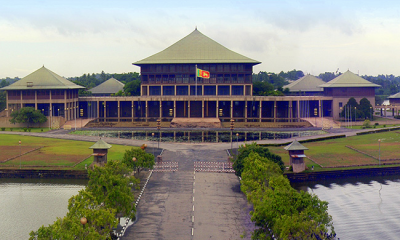
The Constitutional Council, which is chaired by the Hon. Speaker of Parliament and established under the Constitution has been empowered to assist the President in the making of certain decisions and is part of the Executive.
The Constitutional Council is duty bound to perform its functions in terms of the Constitution. Requiring the Constitutional Council to refrain from performing its functions pertaining to the appointment of the Inspector General of Police under Article 41C of the Constitution would be in violation of the Constitution.
If the Constitutional Council exercises the power conferred on it in violation of the Constitution, remedies have been provided for in the Constitution itself.
The Hon. Speaker is the head of Parliament and under Article 4C of the Constitution the Parliament exercises the judicial power of the people through Courts. The Parliament is therefore responsible only to the people.
The President will refer these matters to the Parliament for further elucidation.







Latest News
PM holds bilateral meetings in the Philippines to strengthen cooperation in Education, Skills Development, and Agricultural Research
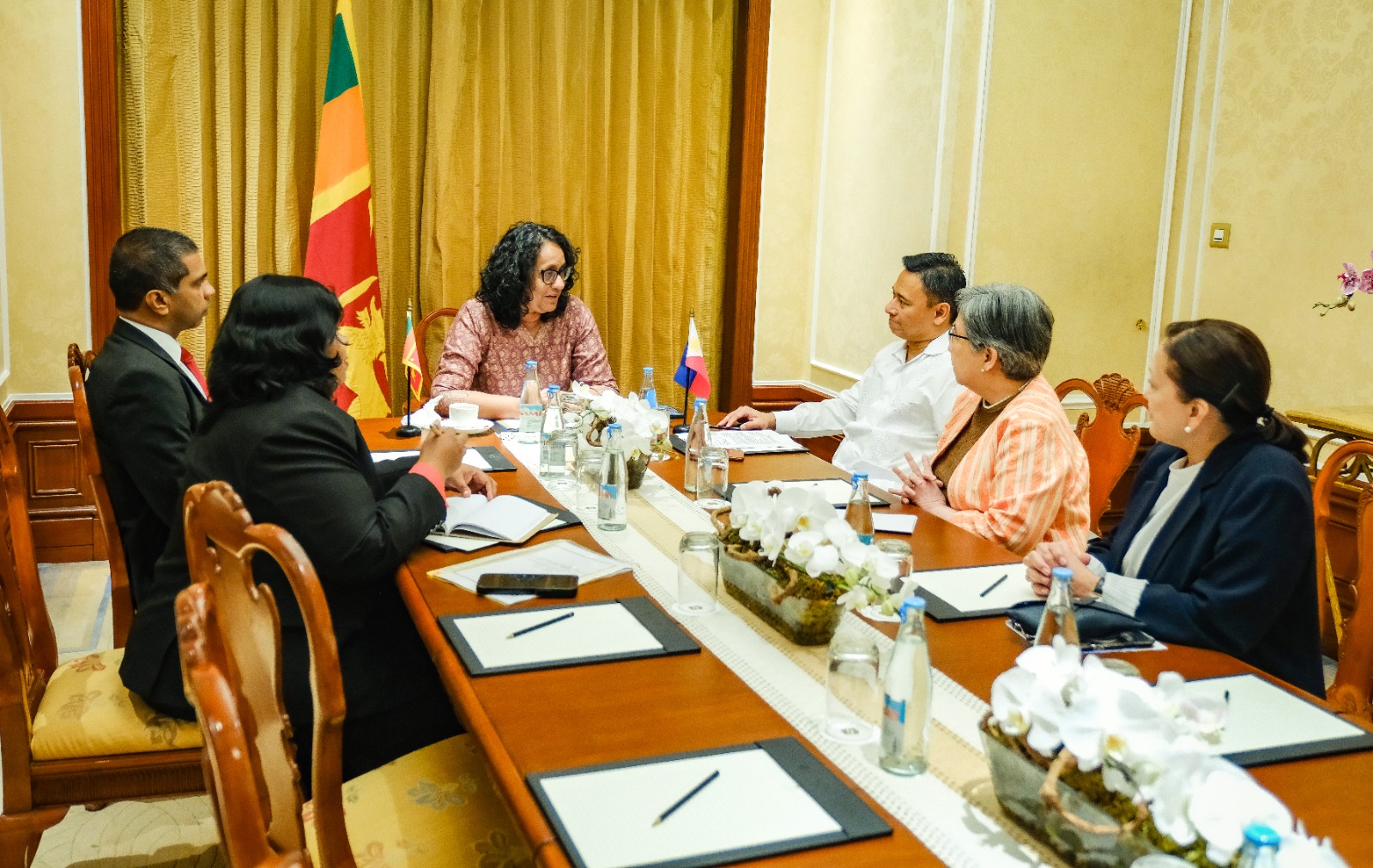
Prime Minister Dr. Harini Amarasuriya held a series of meetings with key Philippine institutions during her official visit to the Philippines from 09–11 March 2026, focusing on strengthening cooperation in education, higher education, technical skills development, and agricultural research.
On 09 March, the Prime Minister met with the Secretary of Education of the Philippines, Sonny Angara. Discussions focused on strengthening bilateral cooperation in the education sector, including sharing best practices in education policy, teacher training, curriculum reforms, and digital learning initiatives. The Prime Minister also briefed the Philippine delegation on Sri Lanka’s ongoing education reforms aimed at modernizing curricula and integrating technology into learning.
The Prime Minister also met with a delegation of the Commission on Higher Education of the Philippines (CHED), led by Chairperson Dr. Shirley C. Agrupis. Discussions centered on the development of higher education in both countries, with particular attention to research collaboration, academic partnerships between universities, student and faculty exchanges, and strengthening quality assurance frameworks.
In a separate meeting, the Prime Minister held talks with the Secretary and Director General of the Technical Education and Skills Development Authority (TESDA), Jose Francisco B. Benitez. The discussions focused on cooperation in technical and vocational education and training (TVET), including knowledge sharing, institutional partnerships, and possible alignment of qualifications frameworks to enhance skills recognition and workforce mobility.
The meetings reaffirmed the commitment of Sri Lanka and the Philippines, along with international research institutions, to strengthen collaboration in education, skills development, and agricultural research in support of sustainable development and human capital growth.
The Sri Lankan delegation included the Ambassador of Sri Lanka to the Philippines, Dr. Chanaka Talpahewa, and Senior Assistant Secretary to the Prime Minister, Ms. P.H. Piyumee Bandara.
[Prime Minister’s Media Division]
Latest News
Heat Index at Caution Level in the Western, Sabaragamuwa and North-western provinces and Monaragala district.

Warm Weather Advisory issued by the Natural Hazards Early Warning Centre of the Department of Meteorology at 3.30 p.m. on 09 March 2026, valid for 10 March 2026.
The public are warned that the Heat index, the temperature felt on the human body is likely to increase up to ‘Caution level’ at some places in Western, Sabaragamuwa and North-western provinces and in Monaragala district.
The Heat Index Forecast is calculated by using relative humidity and maximum temperature and this is the condition that is felt on your body.
This is not the forecast of maximum temperature. It is generated by the Department of Meteorology for the next day period and prepared by using global numerical weather prediction model data.

Effect of the heat index on the human body is mentioned in the above table and it is prepared on the advice of the Ministry of Health and Indigenous Medical Services.
ACTION REQUIRED
Job sites: Stay hydrated and takes breaks in the shade as often as possible.
Indoors: Check up on the elderly and the sick.
Vehicles: Never leave children unattended.
Outdoors: Limit strenuous outdoor activities, find shade and stay hydrated.
Dress: Wear lightweight and white or light-colored clothing.
Note:
In addition, please refer to advisories issued by the Disaster Preparedness & Response Division, Ministry of Health in this regard as well. For further clarifications please contact 011-7446491.


Prof. Priyanga Dunusinghe has warned that Sri Lanka could face a catastrophic situation due to a rapid and sharp drop in revenue caused by the escalating Gulf war.
Appearing on Derana ‘Big Focus’ yesterday, the Professor in Economics in the Department of Economics, and Head – Department of Information Technology, University of Colombo, Dunusinghe said that that drop in remittances from the Middle East, as well as exports, should be examined against the backdrop of runaway oil prices.
Dunusinghe said so responding to interviewer Pasan de Silva who sought expert opinion on the crisis. Referring to continuing Iranian retaliatory attacks on Gulf countries hosting US military bases, the academic pointed out that approximately one million Sri Lankans were employed in the region.
Global oil prices rose to over $100 per barrel on 08 March, for the first time since the Russia-Ukraine war erupted in February 2022. By noon prices were around USD 115 per barrel.
If a consensus couldn’t be reached soon, the consequences for Sri Lanka would be devastating, Dunusinghe said, suggesting that the government should seriously consider, what he called, a relatively small but immediate fuel hike to cushion the impact of future fuel price hikes.
Dunusinghe explained that in addition to the drop in remittances from the Middle East, Sri Lanka could lose employment opportunities in the war devastated region. Responding to the interviewer, the Prof said that if the situation further deteriorated the government would have to face the daunting challenge of evacuating Sri Lankans from the Middle East.
Referring to the devastating impact of Cyclone Ditwah, Dunusinghe pointed out that in terms of the agreement with the IMF, finalised in 2023, the debt repayment would have to be recommenced in 2028. The new Middle East war has placed the country in an extremely difficult situation, Dunusinghe said, while emphasising the responsibility on the part of the government to address the issues at hand immediately.
The rapidly changing oil markets indicated that regardless of optimism expressed by the US and Israel of swift victory, the ground realities were quite different, the academic said.
By Shamindra Ferdinando

Nepal election 2026: Counting continues with rapper Balendra Shah’s party close to super-majority

Madagascar military leader dissolves government in surprise move

ICC Board meetings in Doha called off due to West Asia conflict

Trump says some sanctions to be lifted on oil producers amid Iran war

PM holds bilateral meetings in the Philippines to strengthen cooperation in Education, Skills Development, and Agricultural Research

Heat Index at Caution Level in the Western, Sabaragamuwa and North-western provinces and Monaragala district.

‘Dates have the highest sugar content to fight Coronavirus’

Sunday Island 27 December – Headlines

#SundayIsland 17th December – Headlines

Sunday Island – 28th March

Sunday Island Headlines – 21 March

Sunday Island – 21st February – Headlines
-

 News4 days ago
University of Wolverhampton confirms Ranil was officially invited
-

 News5 days ago
Legal experts decry move to demolish STC dining hall
-

 News4 days ago
Female lawyer given 12 years RI for preparing forged deeds for Borella land
-

 News3 days ago
Peradeniya Uni issues alert over leopards in its premises
-

 Business6 days ago
Cabinet nod for the removal of Cess tax imposed on imported good
-

 News4 days ago
Library crisis hits Pera university
-

 News1 day ago
Repatriation of Iranian naval personnel Sri Lanka’s call: Washington
-
 Business6 days ago
War in Middle East sends shockwaves through Sri Lanka’s export sector