
Latest News
Perera, Lahiru flatten Namibia for 56 to make it two out of two for Sri Lanka


A collective effort by Sri Lanka’s bowlers flattened Namibia for 56 in a chase of 134 in Kimberley. Left-arm spinner Vishwa Lahiru and medium-pacer Ruvishan Perera took three each as all of Namibia’s top eight batters fell for single-digit scores.
After being put in, Sri Lanka got off to a slow start, losing Pulindu Perera for 3 in the seventh over. Fast bowler Zachen Van Vuren then caused a slide, taking the next four wickets to fall, and reducing Sri Lanka to 71 for 5 within the 20th over. But Sri Lanka’s No. 3 Supun Waduge then led the resistance, scoring an unbeaten 56 off 79, although he did not get much support at the other end. Johannes de Villiers took three lower-order wickets as Sri Lanka crumbled to 133 all out.
In return, Namibia’s chase never took off. They could barely make any progress as the Sri Lanka bowlers not only struck regularly but also kept them from scoring runs. Namibia lost eight wickets for 25 runs within the 20th over. A rebuild was attempted by Peter-Daniel Blignaut and Hanro Badenhorst, who put up an 18-run partnership, but Perera ended that in the 26th over. Lahiru took the last wicket, as Namibia’s innings came to an end in 27 overs.
Brief scores:
Sri Lanka Under 19s 133 in 37.5 overs (Supun Waduge 56*; Zanchen van Vuuren 4-23, Johannes de Villiers 3-19) beat Namibia Under 19s 56 in 27 overs (Daniel Blignaut 18*; Dinura Kalupahana 2-08, Ruvishan Perera 3-03, Vishwa Lahiru 3-19) by 77 runs
A four-wicket haul from Isai Thorne, followed by an unbeaten fifty from Jewel Andrew, powered West Indies to their first win of the tournament, against Scotland in Potchefstroom.
Batting first, Scotland began steadily, as the openers Jamie Dunk (57) and Adi Hegde (32) put up an 89-run stand. However, once Hegde fell in the 22nd over, Scotland struggled to put together meaningful partnerships, as Thorne rattled the team’s top and middle order on the way to finishing with 4 for 46. Alec Price at No.3 chipped in with 31, but only two other remaining batters managed double-digit scores, as Scotland were restricted to 205 for 9.
West Indies lost wickets at regular intervals during the chase, but handy contributions from the captain Stephan Pascal (26), Jordan Johnson (24) and Mavendra Dindyal (29) kept them on track to overhauling the target. They were precariously placed at 111 for 5, but Andrew and Nathan Edward took the team home with an unbroken partnership of 95 runs. Andrew remained unbeaten on 64 off 60 balls, stroking eight fours, and was named Player of the Match.
Brief scores:
West Indies Under 19s 206 for 5 in 35.1 overs (Jewel Andrew 64*, Stephan Pacal 26, Jordon Johnson 24, Mavendra Dindyal 29, Nathan Edward 27*; Adi Hegde 1-21 ) beat Scotland Under 19s 205 for 9 in 50 overs (Jamie Dunk 57, Adi Hegde 32, Alec Price 31; Isai Thorne 4-46), Nathn Sealy 2-38) by five wickets
Pakistan maintained their perfect start to the Under-19 World Cup, as Azan Awais’ unbeaten 63 powered the team to a five-wicket win against Nepal.
Chasing a paltry 198, Pakistan were given an ideal start courtesy their openers Shamyl Hussain (37) and Shahzaib Khan (37), who added 80 in 21.2 overs. A string of quick wickets from Aakash Chand, including two in the same over, had Pakistan in a spot of bother at 104 for 4, but Awais, coming in at No.4, put together crucial partnerships with Ahmad Hassan and Haroon Arshad to take the team over the line inside 48 overs. Awais struck six fours during his 82-ball knock.
Earlier, Nepal, opting to bat, had huffed and puffed their way to 197. Bipin Rawal was the team’s top scorer with 39, but he had little by way of support, as the team lost ground at regular intervals. Six different Pakistan bowlers were in amongst the wickets, and Arafat Minhas was the pick of the lot, ending with 3 for 23, while Umaid Shah and Hassan claimed two each.



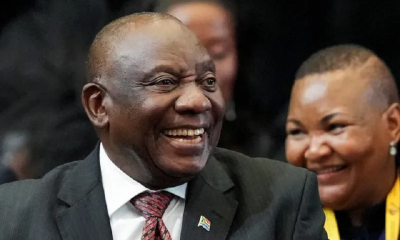









Italy’s Prime Minister Giorgia Meloni has lost a key referendum on a constitutional reform which had turned into a vote on her government.
The result gives around 54% to the “No” campaign and 46% to the “Yes” vote which Meloni had backed.
In a video posted on social media even before all the ballots were counted, Meloni said Italians had voted “with clarity” and she would respect their decision, but she regretted a “lost chance to modernise” the country.
It is the first significant defeat for Meloni and her right-wing coalition, which has overseen a rare period of political stability for Italy. Opposition parties are hailing the result as a sign that voters are looking for change, with a general election due next year.
When the two-day referendum ended on Monday afternoon, exit polls initially showed the “No” vote leading by a small margin, but that grew to a substantial lead as the count progressed.
Despite the complex question on the ballot paper, turnout was almost 60%. A high figure had been expected to favour the government, but it was not enough to swing the vote.
The reform voters rejected would have inscribed a firm separation between judges and prosecutors into the constitution. It also proposed distinct bodies to govern them and a new disciplinary court.
The government argued the change was critical to improving judicial independence.
The opposition countered that it would shatter a careful balance of powers established following the defeat of fascism, and increase political influence over the courts.
Many Italians struggled to understand the technical details – perhaps a communication failure by Team Meloni – and the vote quickly morphed into a plebiscite on her near-record three and half years in office.

[BBC]

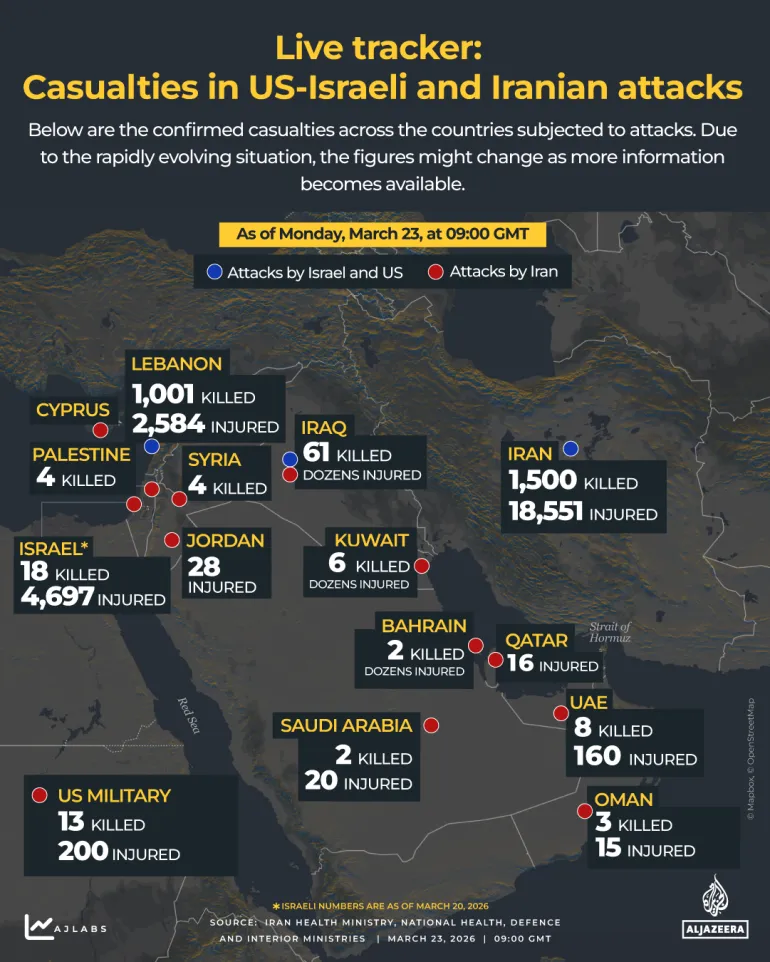
US President Donald Trump announced that discussions are ongoing with Iran to “determine whether a broader agreement can be reached”, saying that “this time, Iran means business; they want to settle. They want peace”.
But Teheran denied that talks with the US are taking place, with Iran’s parliamentary speaker saying such claims are “fake news” and being “used to manipulate financial and oil markets”.
Oil prices dropped by about 11 percent after Trump announced a delay to attacks on Iran’s power plants for five days amid his claims of talks.
Despite Trump’s comments, US Central Command says US forces “continue to aggressively strike” targets in Iran, as Iranian missiles and drones continued to target Gulf countries – including Bahrain, Saudi Arabia and Kuwait – overnight.
Israeli warplanes bombed Beirut’s southern neighborhood as the Lebanese Health Ministry said the death toll from Israel’s attacks on the country had reached 1,039 people, with 2,786 people injured, since March 23.
[Aljazeera]
Latest News
Heat Index at Caution Level in the Western, Sabaragamuwa, Southern and North-western, North-central provinces and in Mannar and Vavuniya districts
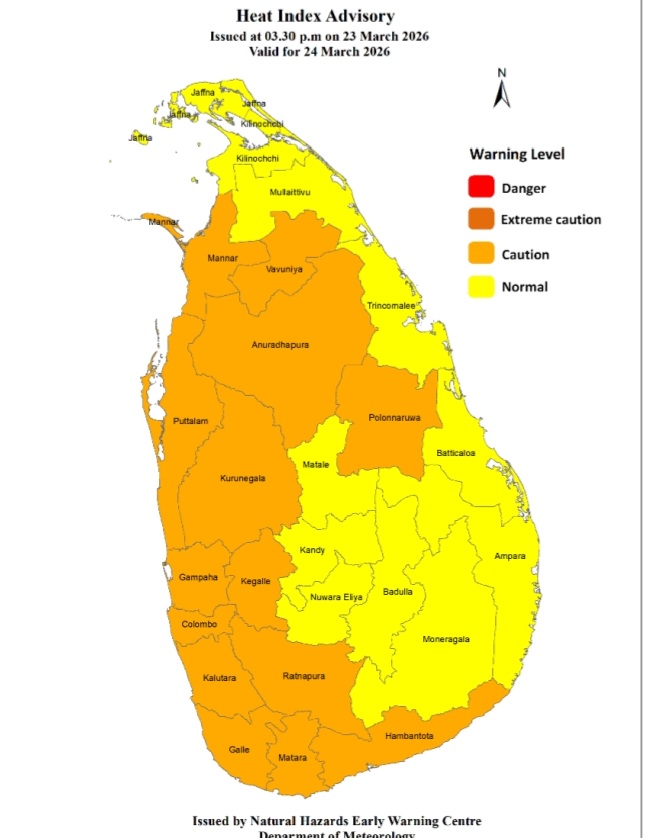
Warm Weather Advisory
Issued by the Natural Hazards Early Warning Centre
at 3.30 p.m. on 23 March 2026, valid for 24 March 2026.
The Heat index, the temperature felt on human body is likely to increase up to ‘Caution level’ at some places in the Western, Sabaragamuwa, Southern and North-western, North-central
provinces and in Mannar and Vavuniya districts.
The Heat Index Forecast is calculated by using relative humidity and maximum temperature and this is the condition that is felt on your body. This is not the forecast of maximum temperature. It is generated by the Department of Meteorology for the next day period and prepared by using global numerical weather prediction model data.

Effect of the heat index on human body is mentioned in the above table and it is prepared on the advice of the Ministry of Health and Indigenous Medical Services.
ACTION REQUIRED
Job sites: Stay hydrated and takes breaks in the shade as often as possible.
Indoors: Check up on the elderly and the sick.
Vehicles: Never leave children unattended.
Outdoors: Limit strenuous outdoor activities, find shade and stay hydrated.
Dress: Wear lightweight and white or light-colored clothing.
Note:
In addition, please refer to advisories issued by the Disaster Preparedness & Response Division, Ministry of Health in this regard as well. For further clarifications please contact 011-7446491.

Referendum defeat leaves Italy’s Meloni looking more vulnerable

Pakistan T20 cricket league to be held in empty stadiums amid oil crisis

Showers expected in the Western, Southern, Uva and Sabaragamuwa provinces and in Kandy and Nuwara-Eliya districts after 2.00 pm.

Tehran says Trump’s peace talk claims are ‘fake news’

SJB: China, India taking advantage of Lanka’s unregulated oil market

SL to redevelop Trinco tank farm expeditiously

‘Dates have the highest sugar content to fight Coronavirus’

Sunday Island 27 December – Headlines

#SundayIsland 17th December – Headlines

Sunday Island – 28th March

Sunday Island Headlines – 21 March

Sunday Island – 21st February – Headlines
-

 News6 days ago
CIABOC questions Ex-President GR on house for CJ’s maid
-

 News5 days ago
Bailey Bridge inaugurated at Chilaw
-

 News5 days ago
Pay hike demand: CEB workers climb down from 40 % to 15–20%
-

 News4 days ago
CIABOC tells court Kapila gave Rs 60 mn to MR and Rs. 20 mn to Priyankara
-

 Features1 day ago
Trincomalee oil tank farm: An engineering marvel
-

 Editorial6 days ago
Couple QR-based quota with odd-even rationing
-

 Features4 days ago
Science and diplomacy in a changing world
-

 News3 days ago
Colombo, Oslo steps up efforts to strengthen bilateral cooperation in key environmental priority areas