
News
People’s Bank remains firmly committed to the nation’s progress

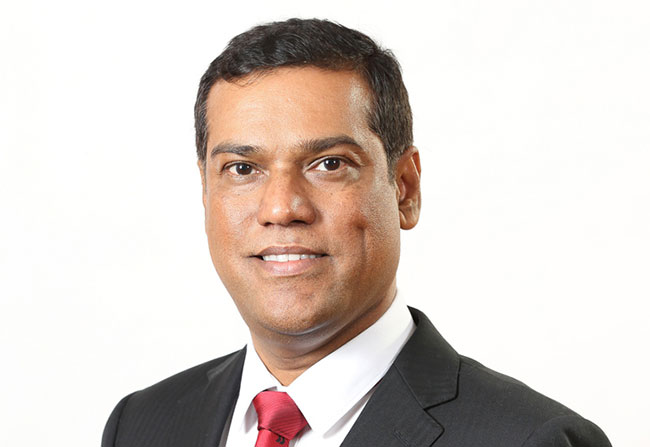
The People’s Bank is known for its commitment towards the betterment of the country. As one of the largest financial services providers in Sri Lanka, the Bank has been continuously featured in the 1000 Best Banks in the world by the world renowned ‘The Banker Magazine’ in the years of 2018, 2019, 2020 and 2021.
CEO/GM of the People’s Bank Ranjith Kodituwakku recently spoke to the media about the bank’s journey so far, and its present and future vision.
Could you share some insight about the present progress and stability of the People’s Bank?
People’s Bank was mainly initiated for the purpose of making banking facilities accessible to the general public. At present we have the country’s largest customer base of over 14 million and largest branch network of 742.
Our total assets have grown to Rs.2.6 trillion, and our deposits exceed Rs. 2.0 trillion. Our loans and receivables have exceeded Rs. 1.9 trillion. We are happy to announce that we also received the highest pre-tax profit of Rs. 30.4 billion and Rs. 23.7 billion pre-tax profit during the year 2021.
* People’s Bank has introduced a number of new innovations to the local financial sector, how are they faring?
People’s Bank became the first commercial bank to work in Sinhala and Tamil. It pioneered the act of printing cheque books in Sinhala and Tamil which were only printed in English earlier.
People’s Bank also introduced the Gold Mortgage Loan Service in 1962. Through this, we were able to free people who were caught in the clutches of money lenders.
On World Women’s Day in 1993, a branded ladies account “Vanitha Vasana” was launched, and to build future security for our student population, the “SisuUdana” account was launched coinciding World Children’s Day in 1996.As of today, most students deposit their savings at People’s Bank.
People’s Bank also was the first bank in the country to implement a complete digital transformation for the entire operating model, covering all aspects from the lowest to the highest levels of the Bank.
The bank’s Self Banking Units (SBUs) are a pioneering introduction to our digitalization programme of which there are over 265 islandwide. With ATMs, CDMs and bill payment machines (KIOSK) installed herein, you can experience convenient and efficient banking which operates 24 hours a day, seven days a week, 365 days a year, all year round.
All of our branches now have instant access to People’s Wiz which enables quick account opening. Over a million people are registered with the People’s Wave app, which allows you to bank from anywhere. People’s Bank also launched the People’s Pay Mobile App in support of the Central Bank’s efforts to promote digital transactions without the use of cash. In addition, the People’s Website offers online banking and People’s Wiz Credit provides personal loans within 24 hours. We have won numerous local and international awards for digital banking.
* People’s Bank was established to boost local agriculture, rural economy, upgrade small and medium-scale entrepreneurs by assisting every level of ordinary people with the bank. What are the contributions given by People’s Bank to those sectors?
Since the inception, People’s Bank’s main focus was on developing the rural banking system and uplifting the people. Even today, this focus remains unchanged within the bank. If you take the last year, People’s Bank granted loan facilities to SME businesses to the tune of Rs. 63.0 billion.
Also the bank introduced an agriculture-based Harvest Loan Scheme to create a self-sufficient country and granted loans of Rs.2.3 billion over a period of 15 months ending 31 December 2021 alone. The ‘Made in Sri Lanka’ loan scheme was introduced to promote local industries and ‘Saarabhoomi’ to encourage local production of fertilisers, pesticides, herbicides. ‘Vanitha Saviya’ loan scheme was launched to empower women entrepreneurs and ‘Business Power’ to uplift small and medium enterprises.
People’s Bank also launched the People’s Spark Entrepreneurship Development Programme with the aim of empowering Sri Lankan youth who are passionate about running their own business.
* What are the facilities given to customers when remitting money to Sri Lanka?
Sri Lankans working in foreign countries or any other person can send money to their loved ones and this money can be withdrawn conveniently from our 742 island wide network.
In order to recognise and encourage expatriate workers remitting money from abroad, the Bank launched a promotion called ‘Vaasi Kotiyai bonanza early this year. Under this promotion the Grand Draw winner who will be selected at the year-end will be presented with a Grand Prize of Rs.10 million. Additionally, Rs.1 Million Monthly winners will be selected every month, 22K gold sovereign weekly winners will be selected 48 times, while 10,000 daily cash prize winners will be selected 334 times until 31st December 2022.
In addition to that, we also provide loan facilities for those who seek foreign employment and to those who are already working abroad. We have also planned to introduce a special benefits package for Sri Lankan working abroad which includes insurance benefits and loans at concessionary interest rates.
* What’s your opinion about the stability of the banking system and what benefits are gained by transacting with a government bank and benefits receive by the society?
In addition to having a strong capital base, our banking system is closely monitored by the Central Bank and all local banks are run in compliance with the highest standards in the world.
State Banks specifically have the largest capital bases in the country and due to the government ownership, they enjoy extraordinary stability which in turn provides maximum security for customer deposits.
In addition, due to the large branch network and superior digital banking capabilities, customers can transact conveniently with People’s Bank.
Last but not least, the profits made by state banks are channeled back towards the development of the country which ultimately benefits customers.
* Finally, what is the contribution given by the People’s Bank through import and export trades?
People’s Bank works successfully with over 900 banks worldwide to facilitate import and export trades by issuing Letters of Credit to private and State owned enterprises. This function is invaluable to sustain normal lives of general public as it enables importation of essential items such as fuel, medicine, food and gas.
As I mentioned earlier, People’s Bank is driven by objectives that extend beyond mere profits. We work for the betterment of people and the country. As a Bank that is firmly committed to the wellbeing of the nation, we will continue to fulfill our responsibilities in this manner in the future.

Latest News
Heat Index at Caution level’ in the Northern, North-central, North-western, Western and Southern provinces and in Trincomalee district.


Warm Weather Advisory
Issued by the Natural Hazards Early Warning Centre
Issued at 3.30 p.m. on 12 April 2026, valid for 13 April 2026.
Heat index, the temperature felt on human body is likely to increase up to ‘Caution level’ at some places in the Northern, North-central, North-western, Western and Southern provinces and in Trincomalee district.
The Heat Index Forecast is calculated by using relative humidity and maximum temperature and this is the condition that is felt on your body. This is not the forecast of maximum temperature. It is generated by the Department of Meteorology for the next day period and prepared by using global numerical weather prediction model data.

Effect of the heat index on human body is mentioned in the above table and it is prepared on the advice of the Ministry of Health and Indigenous Medical Services.
ACTION REQUIRED
Job sites: Stay hydrated and takes breaks in the shade as often as possible.
Indoors: Check up on the elderly and the sick.
Vehicles: Never leave children unattended.
Outdoors: Limit strenuous outdoor activities, find shade and stay hydrated.
Dress: Wear lightweight and white or light-colored clothing.
Note:
In addition, please refer to advisories issued by the Disaster Preparedness & Response Division, Ministry of Health in this regard as well. For further clarifications please contact 011-7446491.

On the apparent northward relative motion of the sun, it is going to be directly over the latitudes of Sri Lanka from 05th to 15th of April in this year.
The nearest areas of Sri Lanka over which the sun is overhead today (13th) are Pesalai, Mankulam and Nedunkerny about 12:11 noon.
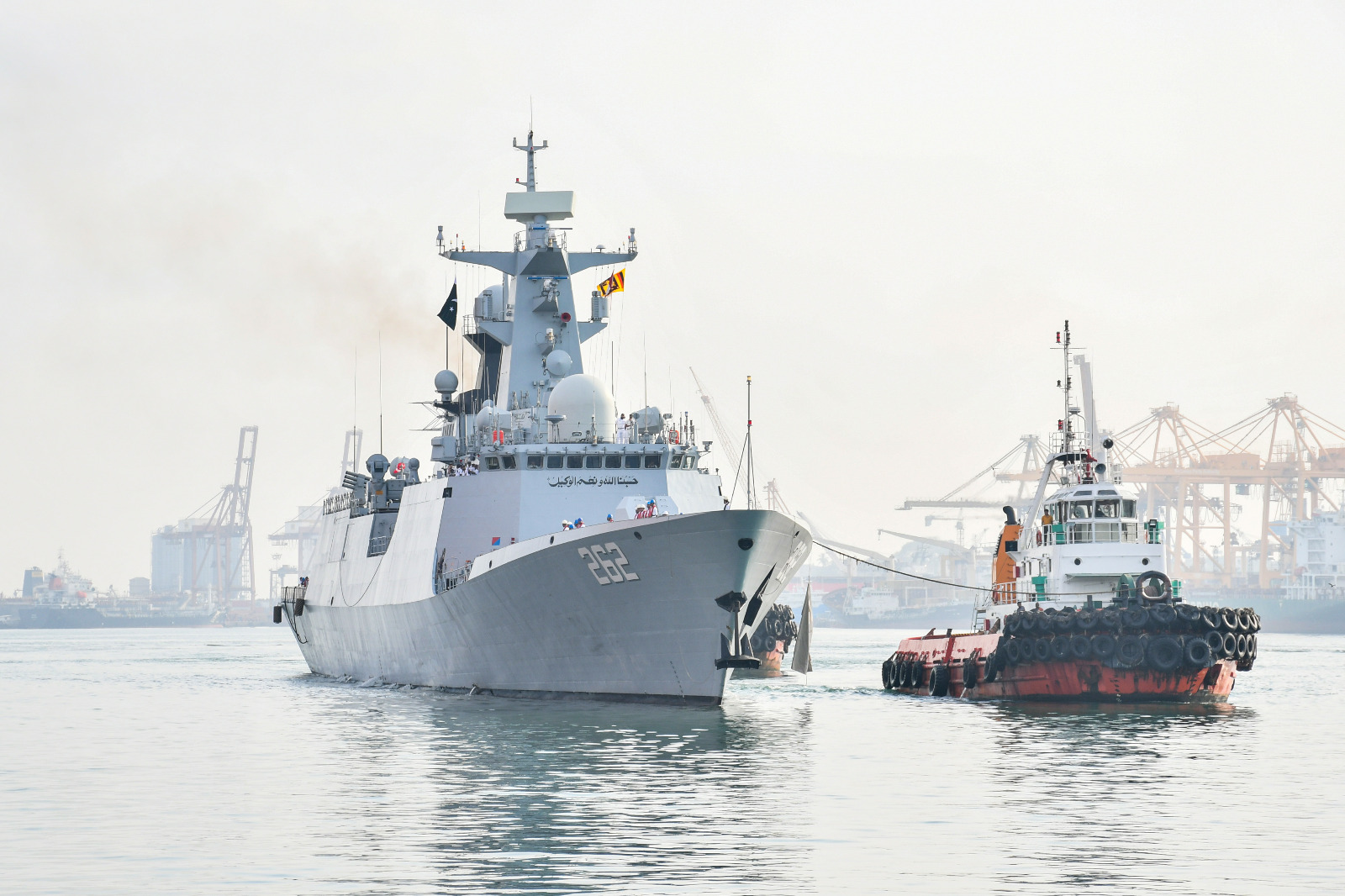
The Pakistan Navy Ship (PNS) TAIMUR and ASLAT arrived at the Port of Colombo on a goodwill visit on 12 Apr 26.
The visiting ships were welcomed by the Sri Lanka Navy in
compliance with naval traditions.
The duo of ships is commanded by Captain NIAMAT SAEED KHAN (PNS TAIMUR) and Captain NADIR MATEEN AFRIDI (PNS ASLAT).
Meanwhile, the ships are expected to conduct a Bilateral Naval Exercise LION STAR V with the Sri Lanka Navy in Colombo seas.

Salt and Patidar power RCB past Mumbai Indians

Prasidh, Buttler set up comfortable win for Gujarat Titans

Heat Index at Caution level’ in the Northern, North-central, North-western, Western and Southern provinces and in Trincomalee district.

Showers above 75 mm are likely at some places in the Western, Sabaragamuwa, Central, Southern and North-western provinces.

Sun directly overhead Pesalai, Mankulam and Nedunkerny about 12:11 noon

PNS TAIMUR & ASLAT arrive in Colombo

‘Dates have the highest sugar content to fight Coronavirus’

Sunday Island 27 December – Headlines

#SundayIsland 17th December – Headlines

Sunday Island – 28th March

Sunday Island Headlines – 21 March

Sunday Island – 21st February – Headlines
-

 News6 days ago
Lankan-origin actress Subashini found dead in India
-

 News1 day ago
CEB orders temporary shutdown of large rooftop solar systems
-

 News4 days ago
AG: Coal procurement full of irregularities
-

 Business3 days ago
Israeli attack on Lebanon triggers local stock market volatility
-

 Business4 days ago
Hayleys Mobility introduces Premium OMODA C9 PHEV
-

 Business3 days ago
HNB Assurance marks 25 years with strategic transformation to ‘HNB Life’
-

 News6 days ago
UN Regional Director launches SL’s first Country Gender Equality Profile during official visit
-

 News6 days ago
Dialog Launches ‘GanuDenu QR’, Making Cashless Transfers Free for All with eZ Cash and Dialog Finance