
Foreign News
Parents can be tried for son’s school shooting: Appeals court

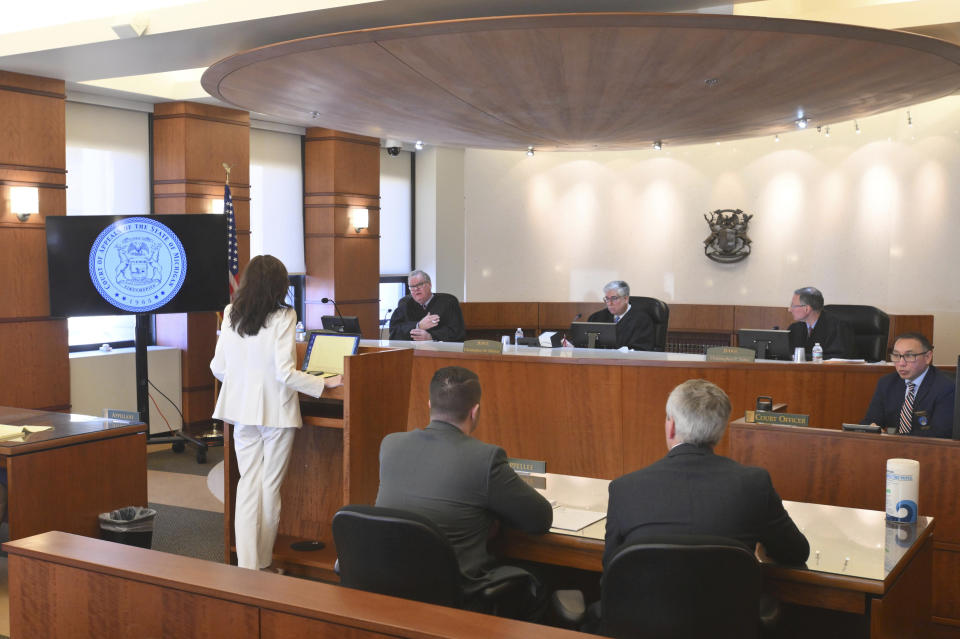
A Michigan court of appeals has ruled that the parents of a teenager responsible for a school shooting in the United States can be tried for involuntary manslaughter, paving the way for a groundbreaking case.
In a unanimous opinion, the three-judge appeals court called for a full trial against James and Jennifer Crumbley, whose son Ethan Crumbley opened fire at Oxford High School in 2021, killing four people and injuring seven.
The three judges – Christopher Murray, Michael Riordan and Christopher Yates – wrote in their decision that Ethan’s “acts were reasonably foreseeable”. They also determined that his parents’ “actions and inactions were inexorably intertwined” with the murders he committed.
The judges cited “visual evidence” that Ethan planned to commit violence with the gun that his parents had purchased for him, including drawings that depicted firearms, decapitated birds and human suffering.
Several illustrations had been drawn on a math worksheet on the day of the shooting with the words, “The thoughts won’t stop. Help me.”
“The morning of the shooting, Ethan Crumbley drew a picture of a body that appeared to have two bullet holes in the torso, apparently with blood streaming out of them,” Riordan told the court.
The judge noted that the gun depicted in the sketch resembled the firearm his parents “had very recently gifted to him”. His parents had been summoned to the school to discuss the picture hours before the shooting, but neither the school nor the parents demanded Ethan be brought home.
If not for the “defendants’ informed decision to leave Ethan Crumbley at school, these murders would not have occurred that day”, the judges concluded.
Their decision is likely to test the limits of negligence and liability in situations in which minors commit violent crimes. Ethan, now 16, pleaded guilty in October to 24 state charges, including first-degree murder and “terrorism”.
He may be summoned to testify at his parents’ trial.
On November 26, 2021, James Crumbley legally bought a 9mm SIG Sauer handgun that Jennifer Crumbley would later describe as a “Christmas gift” for their then-15-year-old son.
The following Monday, Ethan was caught researching ammunition on his phone during class at Oxford High School near Detroit, where he was a sophomore. A school official left a voicemail about the incident on Jennifer’s phone.
Jennifer, who had taken Ethan to a shooting range the weekend prior, responded by initiating a text-message conversation with her son in which she told him: “I’m not mad. You have to learn not to get caught.”
That Friday, Ethan opened fire in the high school with the handgun and an additional 50 rounds of ammunition in his backpack.
Prosecutors have maintained that James and Jennifer Crumbley shared responsibility for Ethan’s actions, writing in a court filing, “They created an environment in which their son’s violent tendencies flourished.”
The appeals court echoed that assessment, writing on Thursday, “a reasonable fact-finder could conclude” that the “defendants’ decision to purchase their mentally disturbed son a handgun” led to the shooting.
The court’s decision referenced instances in which Ethan described hallucinations to his parents in text messages, including the belief that he was being haunted by a demon. Ethan told a friend that his parents had brushed off his request to see a doctor, telling him instead to “suck it up”.
The judges also cited the parents’ “failure to properly secure the gun”.
An active shooter alert was sent to the parents on the day of the attack, prompting James Crumbley to go home and discover the firearm had been taken. He called emergency services a little more than half an hour after the attack to express concern that his son might be the shooter.
In the days after the shooting, prosecutors filed involuntary manslaughter charges against the parents, and law enforcement launched a manhunt to arrest them, ultimately discovering them in Detroit.
Lawyers for the parents have denied their clients are guilty of manslaughter. They are expected to request that the Michigan Supreme Court review the case.
“It was not foreseeable from the drawings on that math homework that he was going to later carry out the premeditated murders of those students,” defence lawyer Mariell Lehman previously told the court.
In Thursday’s decision, the appeals court acknowledged that it shared “the defendants’ concern about the potential for this decision to be applied in the future” to other parents whose children commit violent acts.
But it ultimately decided that the Crumbley case involved “uniquely troubling facts” that merited the consideration of a full jury trial.
“Whether a jury actually finds that causation has been proven after a full trial, where the record will almost surely be more expansive – including evidence produced by defendants – is an issue separate from what we decide today,” the judges wrote.
(Source: Al Jazeera and news agencies)


Iranian forces have said they struck down two fighter jets belonging to the United States military, one over the southwest part of the country and another around the Strait of Hormuz.
A spokesperson for the Iranian military’s Khatam al-Anbiya Central Headquarters said on Friday that air defences completely destroyed one F-15 jet. Later in the day, the Iranian military said it targeted an A-10 US aircraft that crashed into the Gulf.
The New York Times had cited unidentified officials as saying that the A10’s pilot was safe after the crash.
But the fate of at least one pilot from the downed F-15 crew is unknown. Several US media outlets reported that one crew member of the jet was located and rescued by US forces, but the other remains missing.
US President Donald Trump told NBC News on Friday that the downing of the jet will not affect the prospect of talks with Tehran. “No, not at all. No, it’s war. We’re in war,” he said.
State media outlets in Iran showed photos of the wreckage of the F-15 jet and what appears to be an ejection seat with an attached parachute.
After the jet was downed, Iranian Parliament Speaker Mohammad-Bagher Ghalibaf mocked Trump’s repeated claims of victory in the war.
“After defeating Iran 37 times in a row, this brilliant no-strategy war they started has now been downgraded from ‘regime change’ to ‘Hey! Can anyone find our pilots? Please?’” Ghalibaf wrote in a social media post.
There was no immediate comment on the incident from the Pentagon and US Central Command (CENTCOM), which oversees military operations in the Middle East and much of Asia.
[Aljazeera]

United States President Donald Trump has announced that Pam Bondi is out as US attorney general, in his second major cabinet-level shake-up in less than a month.
Trump confirmed the decision in a post on Truth Social on Thursday, after a slate of media reports suggested he was considering removing Bondi from the top law enforcement role. Several cited his discontent over Bondi’s handling of investigative files related to financier and convicted sex offender Jeffrey Epstein.
Deputy Attorney General Todd Blanche will temporarily replace Bondi in an interim capacity, he said.
“Pam Bondi is a Great American Patriot and a loyal friend, who faithfully served as my Attorney General over the past year,” Trump wrote.
The US president also praised Bondi for leading the Department of Justice during a period when violent crime decreased in the US, part of a wider downward trend in the wake of the COVID-19 pandemic.
Trump did not mention his reasoning for the decision, instead writing, “We love Pam.” He added that she would be “transitioning to a much-needed and important new job in the private sector”.
In a statement, Bondi said she would be transitioning the office to Blanche over the next month, adding she was moving to “an important private sector role I am thrilled about, and where I will continue fighting for President Trump and this Administration”.
“I remain eternally grateful for the trust that President Trump placed in me to Make America Safe Again,” she said.
Bondi’s dismissal comes shortly after Trump abruptly fired Department of Homeland Security Secretary Kristi Noem, who oversaw the agency amid a mass deportation campaign that led to the killing of two US citizens.
[Aljazeera]
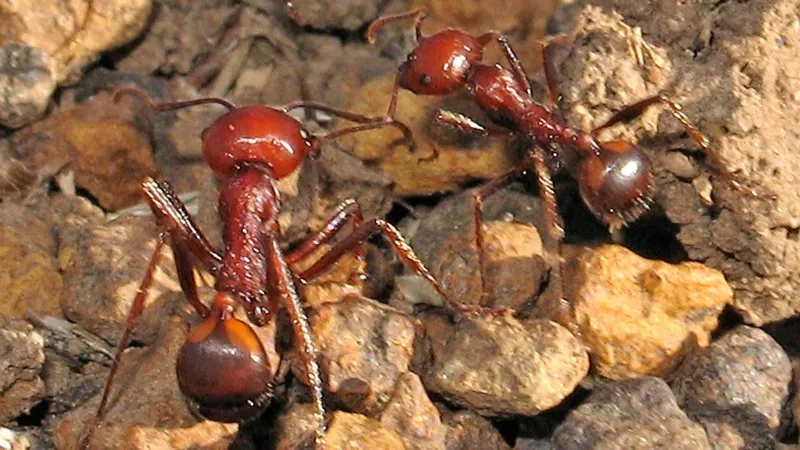
The ants are flying in Kenya at the moment
During this rainy season, swarms can be seen leaving the thousands of anthills in and around Gilgil, a quiet agricultural town in Kenya’s Rift Valley that has emerged as the centre of a booming illegal trade.
The mating ritual sees winged males leave the nest to impregnate queens, who also take flight at this time. This makes it the perfect time to chase down queen ants to sell on to smugglers who are at the heart of a growing global black market, that taps into the pet craze for keeping ants in transparent enclosures designed to observe the insects as they busily build a colony.
It is the giant African harvester ant queens, which are large and coloured red, that are most prized by international ant collectors – one can fetch up to £170 ($220) on the black market, which tends to operate online.
A single fertilised queen is able to create a whole colony and can live for decades – and can be easily posted as scanners do not tend to detect organic material.
“At first, I did not even know it was illegal,” a man, who asked not to be named, told the BBC about how he had once acted as a broker, linking foreign buyers with local collection networks.
Also known as Messor cephalotes, these ants are native to East Africa and known for their distinctive seed-gathering behaviour making them popular with ant collectors.
“A friend told me a foreigner was paying good money for queen ants – the big red ones which are easily seen around here,” the former broker said.
“You look for the mounds near open fields, usually early morning before the heat. The foreigners never came to the fields themselves – they would wait in town, in a guest house or a car, and we would bring the ants to them packed in small tubes or syringes they supplied us with.”
The scale of the illicit trade in Kenya became apparent last year when 5,000 giant harvester ant queens – mainly collected around Gilgil – were found alive at a guest house in Naivasha, a nearby lakeside town popular with tourists.
The suspects – from Belgium, Vietnam and Kenya – had packed the test tubes and syringes with moist cotton wool, which would enable each ant to survive for two months, according to the Kenya Wildlife Service (KWS).
The plan was to take them to Europe and Asia and put them up for sale.
This trade in ants has caught scientists and the authorities by surprise.
The East African nation is more accustomed to high-profile wildlife crimes involving elephant tusks and rhino horns.
UK based retailer Ants RbUs described the giant African harvester ant as “many peoples dream species” – though the queens are currently out of stock, with the site explaining that it is very hard for retailers to source them.
“Even I, as an entomologist, have been surprised at the extent of the apparent trade,” Dino Martins, a biologist based in Kenya, where there are around 600 kinds of ants, told the BBC.
However, he can understand the fascination with East Africa’s harvester, with colonies created by a “foundress queen”, who can grow up to 25mm (0.98 inches) and who produces eggs throughout her life.
“They are one of the most enigmatic species of ants – they form large colonies, engage in interesting behaviours and are easy to keep. They are not aggressive.”
During the swarming he says the queens mate with several males.
“Then that is it for the males – their job is done… most are eaten by predators or die,” the entomologist says, going on to explain how the queen then scurries away to dig a small burrow and begin laying eggs to start her empire.
Her workers and soldier ants, those that protect the nest, are all female and will eventually number in the hundreds of thousands.
“Nests can live for over 50 years, perhaps even up to 70 years. I personally know of nests near Nairobi that are at least 40 years old as I’ve been visiting them for that long,” said Martins.
This means the queens live that long too – because as soon as she dies, the colony collapses and any surviving workers will look for another nest.
Kenyans who have had to deal with ants raiding their crops or invading their houses know this well – and to get rid of a colony someone is sent in to locate the queen, often hidden deep in one of the tunnels or chambers of an ant mound.
The former broker said ants could also be harvested by gently disturbing the mound and collecting them as they tried to escape.
“It was only when I saw the arrests on the news that I realised what I had been part of – and I immediately quit,” he said.
Those arrested were convicted on charges of biopiracy and ordered to pay fines or serve 12 months in jail – they opted to pay the $7,700 fee and the foreign nationals left the country.
Two weeks ago, a Chinese national – the alleged mastermind behind last year’s ring and who is said to have escaped using a different passport, was arrested at Nairobi’s Jomo Kenyata International Airport with another 2,000 queen ants packed in test tubes and tissue rolls.
For Zhengyang Wang, who was part of a team of researchers who published a report on the ant trade in 2023 focusing on China, this is a worry and could “wreak havoc” with local ecosystems.
“Initially, we were very excited when we learnt that many people have taken up keeping ants,” Wang, assistant professor at Sichuan University, told the BBC.
“A colony of pet ants are often kept in a formicarium, which is basically a transparent plastic box so that keepers can observe colonies at work, digging tunnels, collecting food, and guarding their queen. I’d say it’s quite charming and… can be a good way of educating people about insects and their behaviour.
“But then we realised, wait, isn’t keeping invasive species incredibly dangerous?”
Monitoring online sales – of more than 58,000 colonies – in China over six months, the researchers found that more than a quarter of the traded species were not native to China – despite it being illegal to import them.
“If the trade volume of invasive ants continues to grow, it’s only a matter of time before a few escape from their formicaria and become established in the wild,” said Wang.
The study he worked on, published in the journal Biological Conservation, explained what could happen in the case of giant African harvester, one of the most traded species in China: “For example, Messor cephalotes, an East African native, is among the largest seed harvesters in the world and could potentially disrupt predominantly grain-based agriculture in south-eastern China.”
The environmental consequences are also a concern in Kenya.
“Harvester ants are both keystone species and ecosystem engineers. They harvest seeds of grasses, and other plants and in so doing also help to disperse the seeds,” said Martins, adding that the insects “create a more healthy and dynamic grassland”.
Mukonyi Watai, a senior scientist at Kenya’s Wildlife Research and Training Institute, shares these fears.
“Unsustainable harvesting – particularly the removal of queen ants – can lead to colony collapse, disrupting ecosystems and threatening biodiversity,” he told the BBC.
It is possible to collect ants legally in Kenya – in line with various international treaties – with a special permit, which would require the buyer to sign a benefit-sharing agreement with the local community involved to split any profits.
But, according to the KWS, so far none have been applied for – with the paperwork also requiring details of how many ants are being collected and their destination.
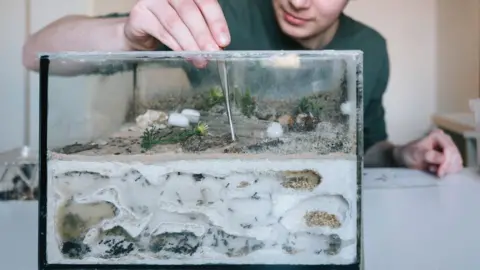 formicarium allows collectors to see the workings of an ant colony (BBC)
Some conservationists are now calling for greater trade protections for all ant species under the Convention on International Trade in Endangered Species (Cites), the global wildlife trade treaty.
“The reality is that no ant species is currently listed under Cites,” Sérgio Henriques, a researcher into the global ant trade, told the BBC.
“Without international treaties monitoring these movements, the scale of the trade remains largely invisible to policy makers and the global community,” he said.
But for the KWS the real problem is more immediate – how to monitor and clamp down on “under-reported” insect trafficking, with the agency suggesting better surveillance equipment at airports and others border points would be a good start.
Martins agrees: “It is likely only a fraction of the actual ants being traded that are being detected, so one can only guess at the scale for now.”
Journalist Charles Onyango-Obbo argues that Kenya is overlooking a significant global revenue opportunity.
“The ants are not finite items like gold or diamonds. They are biological assets that can be bred and farmed, and their production can be scaled up to thousand a day. Yet we treat them like stolen artefacts,” he recently wrote in Kenya’s Daily Nation newspaper.
In fact, Kenya’s cabinet did approve policy guidelines last year aimed at commercialising the wildlife economy, including the ant trade.
“The guidelines seek to promote sustainable use trade of wild species such as ants to generate jobs, wealth and community livelihoods across all the counties,” said Watai.
With careful monitoring in place, it could be that future farmers around Gilgil will have special formicaria on their land expanding the yields from their fields and orchards – full of vegetables and fruits – to include lucrative queen ants.
But the debate over the dangers of exporting ants to hobby collectors in different parts of the world is yet to be settled.


Sooryavanshi blitz, Jurel 81* help Rajasthan Royals take down Royal Challengers Bengaluru with ease

Sun directly overhead Pomparippu, Anuradhapura, Mihinthale, Galenbindunuwewa, Agbopura and Serunuwara about 12:11 noon today (11)

Showers expected in the Western, Sabaragamuwa, North-western , Southern and Uva provinces and in Anuradhapura, Mannar, Kandy and Nuwara-Eliya districts after 2.00 p.m.

Opposition NCM against Energy Minister defeated

Chinese Ambassador assures Lanka China will not allow a fuel crisis to develop here

Minister Jayatissa blames administrations since 2010 for not following proper procedures when procuring coal

‘Dates have the highest sugar content to fight Coronavirus’

Sunday Island 27 December – Headlines

#SundayIsland 17th December – Headlines

Sunday Island – 28th March

Sunday Island Headlines – 21 March

Sunday Island – 21st February – Headlines
-

 Features6 days ago
Ranjith Siyambalapitiya turns custodian of a rare living collection
-

 News6 days ago
Global ‘Walk for Peace’ to be held in Lanka
-

 News4 days ago
Lankan-origin actress Subashini found dead in India
-

 Business1 day ago
Israeli attack on Lebanon triggers local stock market volatility
-

 News2 days ago
AG: Coal procurement full of irregularities
-

 Features6 days ago
Beyond the Blue Skies: A Tribute to Captain Elmo Jayawardena
-

 Features6 days ago
Aspects of Ceylon/Sri Lanka Foreign Relations – 1948 to 1976
-

 Business2 days ago
Hayleys Mobility introduces Premium OMODA C9 PHEV