
Features
Order in the court

An important judicial personage was to be the Chief Guest at a prize giving of a leading school in Galle. And he prepared a six-page speech and getting his stenographer to make several copies of it, there was no photocopying at the time, he distributed them to the pressmen present saying, “You reporter fellows always distort, misreport or under-report speeches made by important people on important occasions like this. So I want to make sure that a complete report of my speech is published in your various newspapers.”
These tactless and ill-advised remarks got the goat of the local correspondent who decided to cut the Chief Guest down to size. Two or three days later the proceedings of the prize giving were reported in the country’s newspapers. The speeches of the manager of the school, the principal and even the head prefect’s vote of thanks were reported in detail and the report ended with the words; “The Chief Guest Mr. so and so also spoke.”
A.E. Buultjens was once the District Judge of Galle. One day a woman appeared before him charged with obstructing a court officer in the performance of duty. Apparently the officer had gone to evict her from a hut she had built on crown land. When her name was called, the woman walked into the dock accompanied by her two teenaged daughters. They were both blind. “Hamuduruwane,” said the women, “It is true that I obstructed the niladarithuma, but what else could I do? If we are thrown out of our house, my poor blind daughters and I will have no place to live.” Judge Buultjens fined the woman two hundred rupees for the offence. Then putting his hand into his pocket, he fished out two hundred rupee notes, and giving the money to his stenographer, asked him to pay the woman’s fine.
 Once an ancient Egyptian Pharaoh paid a visit to a Court, when it was in session. On seeing the king, the judge rose from his seat and saluted the king. It is said that the king promptly dismissed the judge from the post, for failing to preserve the independence of the Judiciary.
A certain lawyer was noted for the vigour of his language and the brusqueness of manner. One day he was arguing an appeal and in so doing provoked the judge to lose his temper.
Then addressing the lawyer the judge said “I can teach you law but I cannot teach you manners.” “Quite so My Lord” shot back the lawyer with heavy sarcasm, “Quite so!”
The judge’s face turned red while those at the Bar suppressed their sniggers with great difficulty.
One day a psychiatrist while giving evidence before a pompous self-opinionated judge said, “Thinking generates electricity.”
“Then there will be lot of electricity around the Bench,” said the judge.
“Yes,” said the cross-examining counsel, “but of a very low voltage.”
During a murder trial a small boy had finished giving evidence. He was followed by his strikingly good-looking mother. The defence counsel asked her, “Are you the mother of the boy who gave evidence just now?” She answered that it was so. Then his next question was “Who is his father?” At this the judge lost his cool and asked the counsel whether all that was relevant to this murder trial as it is a waste of time. The counsel then replied, “I will not go ahead with that question as it seems to embarrass your Lordship.”
One day a lawyer for a defendant, who had the dice very much loaded against him, was nevertheless determined to do his best. As the judge kept interrupting him, the lawyer said that the Chief Justice Sir Anton Bertram’s chamber had a framed motto hung above his table.
The motto was ‘AUDI ALTERAM PARTEM’: Let both sides be heard. Thereafter there were no more interruptions from the Bench.
There was a news item, that a youthful defendant standing trial before a Court in Indonesia, on subversion charges, has objected to be tried by a female judge saying the sight of her sexcities him!
There was this lawyer who believed in introducing a little drama into any case he appeared in.
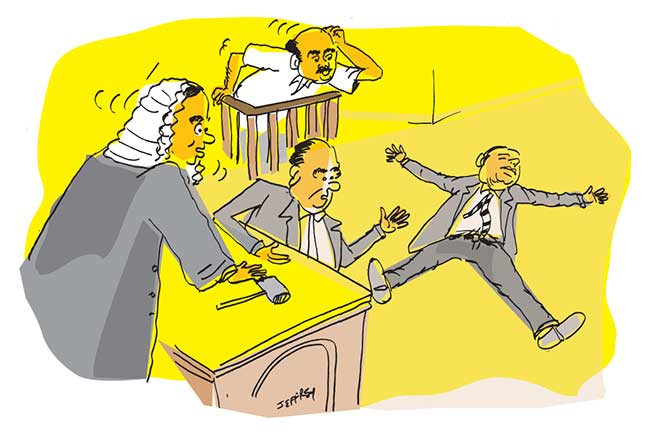
One day he appeared for a man accused of stabbing another to death. The Judicial Medical Officer had given evidence about the injuries sustained by the deceased, implying that he was standing when he was stabbed. When the lawyer for the defence, this man of drama, stood up to cross-examine the JMO, he threw himself on the floor, face upwards, and asked the JMO whether the deceased could not have been in that position when he was stabbed.
Naturally, the Judge was quite astonished at this rather undiginified exhibition, and rebuked the lawyer mildly. “Mr. Attorney” he said, with a twinkle in his eye, “thank Heavens you did not appear in the previous case. It was a rape case!”
Speaking of rape cases, in one such case, after the jury had returned having reached their verdict, the Foreman of the jury said, “We find the accused guilty, but we recommend mercy as he had committed the act on the spur of the moment.” “Oh?” said the judge coldly. “Will you please tell me on what other spur you expect the act to be done?”
Many years ago, there was this King’s Counsel, who came from a very humble stock but with a deplorable tendency to treat the simple folk with scant courtesy. Once appearing in a murder case, he bullied and browbeated an aged woman from the village where he was born and spent his childhood, but whom pretended not to recognise. “Now tell me witness,” he thundered, “how far were you from the scene of the alleged crime?” “Hamuduruwane, the distance was about the same distance from Babun Signo’s boutique in our village, yours and mine, to the shanty, where your mother used to make hoppers for sale!”
A person who was called upon to serve on the jury begged to be excused. “My Lord,” he told the judge, “My wife is about to conceive!” Suppressing a smile the judge said, “No no what you mean is that your wife is about to deliver! Anyway in either case, I agree that your presence is essential!”
This story is about a rather exuberant Judge, whose sense of justice outran his discretion. A shipping company was being sued for damages by a consignee whose bags of rice had fallen into the water in the process of being unloaded into a barge, when the ship’s tackle had given way. The company that owned the barge disclaimed responsibility on the grounds that liability did not arise until the bags were actually placed in their barge. The shipping company that owned the ship disclaimed liability saying that their responsibility was over the moment the goods left the ship’s tackle. The Judge said angrily: “Both of you are trying to avoid payment of damages to this unfortunate man. He has lost twenty-eight bags of rice. Now, tell me, who is responsible?” “Neither of us,” chorused the two defending counsels. “It was an Act of God.” “Hell of a god,” exclaimed the Judge.
“An IRC who had been convicted several times by the same Judge in the same Court, was produced once more before the Judge. “It is time we checked your career of crime,” the Judge told the old offender severely. “How many times have you been convicted of this same offence before?” “Eight times, your honour,” was the man’s unruffled reply.” “Eight times?” Exclaimed the Judge. “Then this time I shall give you the maximum sentence laid down by the law.” “Maximum?” echoed the prisoner in dismay. “Aw, c’mon, your honour, don’t regular customers get a bit of a discount?”
A witness was giving evidence and it was evident that the fellow was lying. “Isn’t most of what you are saying completely untrue?” snapped the Judge. “M’lord,” said the man, drawing himself up haughtily. “I would have the court know that I have always been wedded to the truth!” “Oh?” said the Judge sarcastically. “And since when have you been a widower?”
As a judge was about to pass sentence on an accused found guilty of burglary, the man cried passionately, “May God strike me dead, your Honour, if I did it!” The Judge waited for a few moments, gazing heavenwards, and then said dryly, “Since Providence has not seen fit to interpose in your case, it is my duty to pronounce the lighter sentence prescribed by law. Six months!”
Many years ago an Englishman was the Panadura Magistrate. He wasn’t exactly bulging with brains, and many a person wondered how he ever became a magistrate. The young Secretary to the Court was getting married and naturally he invited the magistrate to be his attesting witness. On the day of the wedding, the English Magistrate, accompanied by his Interpreter Mudliyar, went to the Bride’s house in his chauffeur-driven car. As they approached the bride’s house, where the wedding was being held, the Magistrate noticed several coloured flags strung across the road. “Good God!” exclaimed the Magistrate, his face turning pale. “Quick turn back! Get away from here as fast as you can!”
The driver did as he was ordered, and as they sped away, the Interpreter Mudliyar turned to the Magistrate in consternation and asked. “What’s wrong sir? Why are we turning back?”
“Did you see that string of coloured flags?” asked the Magistrate mopping his brow. “I served a spell in the Royal Navy before I came to Ceylon, and those flags, strung in that particular order, is a signal that there is plague on board. Mudliyar, somebody in that house is having the plague.
When a 219 Notice is served on a person, he or she has to appear in Court and declare his assets so that they could be seized to satisfy a claim ordered by Court. One day, in the Galle Magistrate’s Court, one such examination, conducted by the counsel for the claimant, went like this:
Counsel: “Your father died recently?”
Respondent: “No.”
Counsel: “Then was it your mother?”
Respondent: “No it was my mother-in-law.”
“Didn’t she gift some thing to you prior to her death?”
“Yes, her daughter.”
“Have you a Savings Bank account?”
“Yes.”
“And how much have you in deposit?”
“Eleven rupees and fourteen cents.”
“The furniture in the house you are occupying is yours?”
“No, I have no furniture”.
“What? Then where do you sleep?”
“On two Sunlight Soap boxes.”
At this stage the notice was discharged and the Court, amidst loud laughter, advised the attorney to seize the assets that had been declared to satisfy his client’s claim!
At the time the age of majority was twenty-one years, an accused was charged with posing as a major while he was actually a minor. His lawyer produced the birth certificate to prove that he was indeed a major a the time of its alleged offence. Holding up the birth certificate the Magistrate told the defence lawyer that, according to it, the accused’s age was twenty years and four months at the time of the offence. “Aha, your honour”, said the defence lawyer blandly, “you are forgetting to take into account the nine months my client spent in his mother’s womb!”
During a murder case the Prosecution led evidence to prove that the dead man was manually strangled. This was contested by the Defence and a doctor was called to give evidence in their support. “Now tell us, doctor,” said the Crown Counsel who was prosecuting, “what are your qualifications?” “I am an MBBS and I have been a Judicial Medical Officer for twelve years. Furthermore I have had six months training in Forensic Medicine under the renowned Dr. Burrows. I have also won a gold medal.”
“For what did you get the gold medal, doctor?”
“Hygiene.”
“Have you got a certificate from Dr. Burrows?”
“No, I’m afraid not.”
“Have you really been a JMO for twelve years?”
“Well actually, I was a Prison Doctor for twelve years and acted on and off for the JMO when he was on leave.”
“Do you know Dr. X. Y. Z. Fernando, an acknowledged expert in Forensic medicine?”
“Yes.”
“How do your qualifications compare with his?”
“I have far greater knowledge and a better brain!”
“In other words, doctor, the only certificates you have are certificates you give yourself?”
No answer. (Needless to say, the defence case collapsed).
(To be continued)

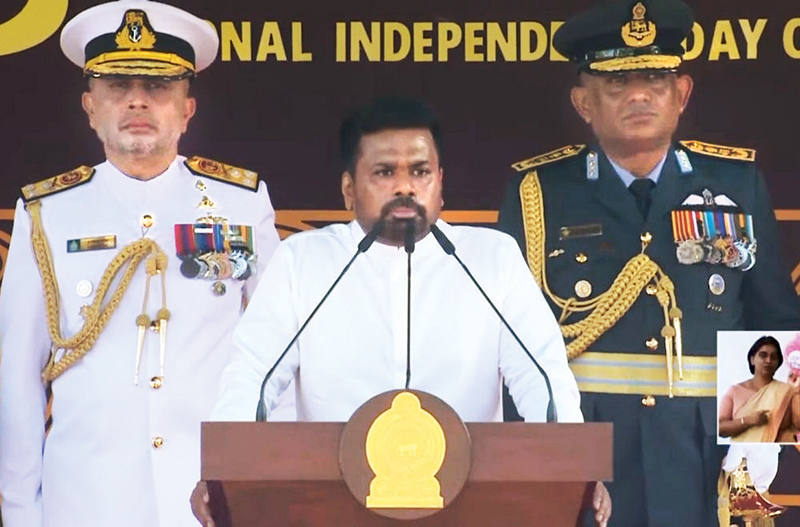
“The main theme of this year’s Independence Day is “Rebuilding Sri Lanka,” so spoke President Anura Kumara Dissanayaka as he ceremonially commemorated the island’s 78th independence anniversary. That was also President AKD’s second independence anniversary as President. Rebuilding implies that there was already something built. It is not that the NPP government is starting a new building on a vacant land, or whatever that was built earlier should all be destroyed and discarded.
Indeed, making a swift departure from NPP’s usual habit of denouncing Sri Lanka’s entire post independence history as useless, President AKD conceded that “over the 78 years since independence, we have experienced victories and defeats, successes and failures. We will not hesitate to discard what is harmful, nor will we fear embracing what is good. Therefore, I believe that the responsibility of rebuilding Sri Lanka upon the valuable foundations of the past lies with all of us.”
Within the main theme of rebuilding, the President touched on a number of sub-themes. First among them is the he development of the economy predicated on the country’s natural resources and its human resources. Crucial to economic development is the leveraging of our human resource to be internationally competitive, and to be one that prioritises “knowledge over ignorance, progress over outdated prejudices and unity over division.” Educational reform becomes key in this context and the President reiterated his and his government’s intention to “initiate the most transformative era in our education sector.”
He touched on his pet theme of fighting racism and extremism, and insisted that the government “will not allow division, racism, or extremism and that national unity will be established as the foremost strength in rebuilding Sri Lanka.” He laid emphasis on enabling equality before the law and ensuring the supremacy of the law, which are both necessary and remarkable given the skepticism that is still out there among pundits
Special mention was given to the Central Highlands that have become the site of repeated devastations caused by heavy rainfall, worse than poor drainage and inappropriate construction. Rebuilding in the wake of cyclone Ditwah takes a special meaning for physical development. Nowhere is this more critical than the hill slopes of the Central Highlands. The President touched on all the right buttons and called for environmentally sustainable construction to become “a central responsibility in the ‘Rebuilding Sri Lanka’ initiative.”. Recognizing “strong international cooperation is essential” for the rebuilding initiative, the President stated that his government’s goal is to “establish international relations that strengthen the security of our homeland, enhance the lives of our people and bring recognition to our country on a new level.”
The President also permitted himself some economic plaudits, listing his government’s achievements in 2025, its first year in office. To wit, “the lowest budget deficit since 1977, record-high government revenue after 2006, the largest current account balances in Sri Lanka’s history, the highest tax revenue collected by the Department of Inland Revenue and the sustained maintenance of bank interest rates at a long-term target, demonstrating remarkable economic stability.” He was also careful enough to note that “an economy’s success is not measured by data alone.”
Remember the old Brazilian quip that “the economy is doing well but not the people.” President AKD spoke to the importance of converting “the gains at the top levels of the economy … into improved living standards for every citizen,” and projected “the vision for a renewed Sri Lanka … where the benefits of economic growth flow to all people, creating a nation in which prosperity is shared equitably and inclusively.”
Rhetoric, Reform and Reality
For political rhetoric with more than a touch of authenticity, President AKD has no rival among the current political contenders and prospects. There were pundits and even academics who considered Mahinda Rajapaksa to be the first authentic leadership manifestation of Sinhala nationalism after independence, and that he was the first to repair the rupture between the Sri Lankan state and Sinhala nationalism that was apparently caused by JR Jayewardene and his agreement with India to end the constitutional crisis in Sri Lanka.
To be cynical, the NPP or AKD were not the first to claim that everything before them had been failures and betrayals. And it is not at all cynical to say that the 20-year Rajapaksa era was one in which the politics of Sinhala nationalism objectively served the interests of family bandyism, facilitated corruption, and enabled environmentally and economically unsustainable infrastructure development. The more positive question, however, is to ask the same pundits and academics – how they would view the political authenticity of the current President and the NPP government. Especially in terms of rejecting chauvinism and bigotry and rejuvenating national inclusiveness, eschewing corruption and enabling good governance, and ensuring environmental stewardship and not environmental slaughter.
The challenge to the NPP government is not about that it is different from and better than the Rajapaksa regime, or than any other government this century for that matter. The global, regional and local contexts are vastly different to make any meaningful comparison to the governments of the 20th century. Even the linkages to the JVP of the 1970s and 1980s are becoming tenuous if not increasingly irrelevant in the current context and circumstances. So, the NPP’s real challenge is not about demonstrating that it is something better than anything in the past, but to provide its own road map for governing, indicating milestones that are to be achieved and demonstrating the real steps of progress that the government is making towards each milestone.
There are plenty of critics and commentators who will not miss a beat in picking on the government. Yet there is no oppositional resonance to all the criticisms that are levelled against the government. The reason is not only the political inability of the opposition parties to take a position of advantage against the government on any issue where the government is seen to be vulnerable. The real reason could be that the criticisms against the government are not resonating with the people at large. The general attitude among the people is one of relief that this government is not as corrupt as any government could be and that it is not focused on helping family and friends as past governments have been doing.
While this is a good situation for any government to be in, there is also the risk of the NPP becoming too complacent for its good. The good old Mao’s Red Book quote that “complacency is the enemy of study,” could be extended to be read as the enemy of electoral success as well. In addition, political favouritism can be easily transitioned from the sphere of family and friends to the sphere of party cadres and members. The public will not notice the difference but will only lose its tolerance when stuff hits the fan and the smell becomes odious. It matters little whether the stuff and the smell emanate from family and friends, on the one hand, or party members on the other.
It is also important to keep the party bureaucracy and the government bureaucracy separate. Sri Lanka’s government bureaucracy is as old as modern Sri Lanka. No party bureaucracy can ever supplant it the way it is done in polities where one-party rule is the norm. A prudent approach in Sri Lanka would be for the party bureaucracy to keep its members in check and not let them throw their weight around in government offices. The government bureaucracy in Sri Lanka has many and severe problems but it is not totally dysfunctional as it often made out to be. Making government efficient is important but that should be achieved through internal processes and not by political party hacks.
Besides counterposing rhetoric and reality, the NPP government is also awash in a spate of reforms of its own making. The President spoke of economic reform, educational reform and sustainable development reform. There is also the elephant-in-the-room sized electricity reform. Independence day editorials have alluded to other reforms involving the constitution and the electoral processes. Even broad sociopolitical reforms are seen as needed to engender fundamental attitudinal changes among the people regarding involving both the lofty civic duties and responsibilities, as well as the day to day road habits and showing respect to women and children using public transport.
Education is fundamental to all of this, but I am not suggesting another new module or website linkages for that. Of course, the government has not created 78 reform modules as I say tongue-in-cheek in the title, but there are close to half of them, by my count, in the education reform proposals. The government has its work cut out in furthering its education reform proposals amidst all the criticisms ranged against them. In a different way, it has also to deal with trade union inertia that is stymieing reform efforts in the electricity sector. The government needs to demonstrate that it can not only answer its critics, but also keep its reform proposals positively moving ahead. After 78 years, it should not be too difficult to harness and harmonize – political rhetoric, reform proposals, and the realities of the people.
by Rajan Philips
Features
Our diplomatic missions success in bringing Ditwah relief while crocodiles gather in Colombo hotels


The Sunday newspapers are instructive: a lead story carries the excellent work of our Ambassador in Geneva raising humanitarian assistance for Sri Lanka in the aftermath of Ditwah. The release states that our Sri Lankan community has taken the lead in dispatching disaster relief items along with financial assistance to the Rebuilding Sri Lanka fund from individual donors as well as members of various community organizations.
The International Federation of Red Cross and Red Crescent Societies In Geneva had initially launched an appeal for Swiss francs CHF 5 million and the revised appeal has been tripled to CHF 14 million to provide life saving assistance and long term resilience building for nearly 600,000 of the most vulnerable individuals; the UN office for Coordination of Humanitarian Affairs has contributed US$4.5 million; the WHO has channeled US$175,000; In addition, our mission is working closely with other UN and International organizations in Geneva for technical support to improve disaster preparedness capacity in the long term in Sri Lanka such as through enhanced forecasting to mitigate risks and strengthen disaster preparedness capacities.
In stark contrast it is ironic to see in the same newspaper, a press release from a leading think tank in Colombo giving prominence to their hosting a seminar in a five star hotel to promote the extraction of Sri Lanka’s critical minerals to foreign companies under the guise of “international partners”. Those countries participating in this so called International Study Group are Australia, India, Japan and the US, all members of a regional defence pact that sees China as its main adversary. Is it wise for Sri Lanka to be drawn into such controversial regional arrangements?
This initiative is calling for exploitation of Sri Lanka’s graphite, mineral sands, apatite, quartiz, mica and rare earth elements and urging the Government to introduce investor friendly approval mechanisms to address licencing delays and establish speedy timelines. Why no mention here of the mandatory Environment Impact Assessment (EIA) or traditional public consultations even though such extraction will probably take place in areas like Mannar with its mainly vulnerable coastal areas? Is it not likely that such mining projects will renew commotion among poor mainly minority communities already badly affected by Ditwah?
It would be indeed pertinent to find out whether the think tank leading this initiative is doing so with its own funds or whether this initiative is being driven by foreign government funds spent on behalf of their multinational companies? Underlying this initiative is the misguided thinking defying all international scientific assessments and quoting President Trump that there is no global climate crisis and hence environmental safeguards need not be applied. Sri Lanka which has experienced both the tsunami and cyclone Ditwah is in the eye of the storm and has been long classified as one of the most vulnerable of islands likely to be effected in terms of natural disasters created by climate change.
Sri Lanka’s mining industry has so far been in local hands and therefore it has been done under some due process protecting both local workers involved in handling hazardous materials and with some revenue coming to the government. What is now being proposed for Sri Lanka is something in the same spirit as President Donald Trump visualized for redeveloping Gaza as a Riviera without taking into consultation the wishes of the people in that land and devoid of any consideration for local customs and traditions. Pity our beautiful land in the hands of these foreigners who only want to exploit our treasure for their own profit and leave behind a desolate landscape with desperate people.
by Dr Sarala Fernando
Features
The Architect of Minds – An Exclusive Interview with Professor Elsie Kothelawala on the Legacy of Professor J. E. Jayasuriya
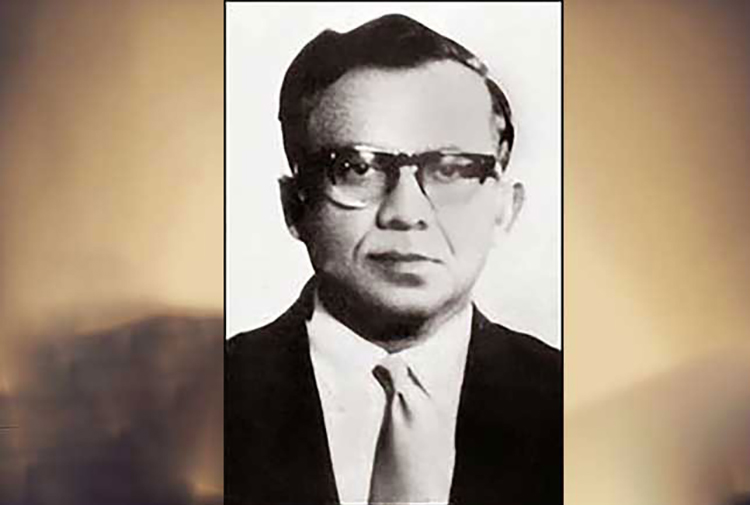
This year marks a significant milestone as we commemorate the 35th death anniversary of a titan in the field of education, Professor J. E. Jayasuriya. While his name is etched onto the covers of countless textbooks and cited in every major policy document in Sri Lanka, the man behind the name remains a mystery to many. To honour his legacy, we are joined today for a special commemorative interview. This is a slightly expanded version of the interview with Professor Elsie Kothelawala. As a former student who rose to become a close professional colleague, she offers a rare, personal glimpse into his life during his most influential years at the University of Peradeniya.
Dr. S. N. Jayasinghe – Professor Kothelawala, to begin our tribute, could you tell us about the early years of Professor J. E. Jayasuriya? Where did his journey start?
Prof. Elsie Kothelawala – He was born on February 14, 1918, in Ahangama. His primary education actually began at Nawalapitiya Anuruddha Vidyalaya. He then moved to Dharmasoka College in Ambalangoda and eventually transitioned to Wesley College in Colombo. He was a brilliant student, in 1933, he came third in the British Empire at the Cambridge Senior Examination. This earned him a scholarship to University College, Colombo, where he graduated in 1939 with a First-Class degree in Mathematics.
Q: – His professional rise was meteoric. Could you trace his work life from school leadership into high academia?
A: – It was a blend of school leadership and pioneering academia. At just 22, he was the first principal of Dharmapala Vidyalaya, Pannipitiya. He later served as Deputy Principal of Sri Sumangala College, Panadura.
A turning point came when Dr. C.W.W. Kannangara invited him to lead the new central school in the Minister’s own electorate, Matugama Central College. Later, he served as Principal of Wadduwa Central College. In 1947, he traveled to London for advanced studies at the Institute of Education, University of London. There, he earned a Post Graduate Diploma in Education and a Master of Arts in Education. Upon returning, he became a lecturer in mathematics at the Government Teachers’ Training College in Maharagama. He joined the University of Ceylon’s Faculty of Education as a lecturer in 1952 and later, in 1957, he advanced to the role of Professor of Education. Professor J. E. Jayasuriya was the first Sri Lankan to hold the position of Professor of Education and lead the Department of Education at the University of Ceylon.
The commencement of this department was a result of a proposal from the Special Committee of Education in 1943, commonly known as the Kannangara Committee.
Q: – We know he left the university in 1971. Can you tell us about his work for the United Nations and UNESCO?
A: – That was a massive chapter in his life. After retiring from Peradeniya, he went global. He moved to Bangkok to serve as the Regional Advisor on Population Education for UNESCO. He spent five years traveling across Asia, to countries like Pakistan, the Philippines, Indonesia, and Malaysia, helping them build their educational frameworks from the ground up.
Even after that, his relationship with the United Nations continued. He returned to Sri Lanka and served as a United Nations Advisor to the Ministry of Education for two years. He was essentially a global consultant, bringing the lessons he learned in Sri Lanka to the rest of the world.
Q: – How did you personally come to know him, and what was the nature of your professional relationship?
A: – I first encountered him at Peradeniya during my Diploma in Education and later my MA. He personally taught me Psychology, and I completed my postgraduate studies under his direct supervision. He was notoriously strict, but it was a strictness born out of respect for the subject. The tutorials were the highlight. Every day, he would select one student’s answer and read it to the class. It kept us on our toes! He relied heavily on references, and his guidance was always “on point.” After my MA, he encouraged me to apply for a vacancy in the department. Even as a lecturer, he supervised me, I had to show him my lecture notes before entering a hall.
Q: – He sounds quite imposing! Was there any room for humor in his classroom?
A: – He had a very sharp, dry wit. Back then, there was a fashion where ladies pinned their hair in high, elaborate piles. He once remarked, “Where there is nothing inside, they will pile it all up on the outside.” Needless to say, that hairstyle was never seen in his class again!
Q: – Looking at the 1960s and 70s, what reforms did he promote that were considered innovative for that time?
A: – As Chairman of the National Education Commission (1961), he was a visionary. He promoted the Neighborhood School Concept to end the scramble for prestige schools. He also proposed a Unified National System of education and argued for a flexible school calendar. He believed holidays should vary by region, matching agricultural harvest cycles so rural children wouldn’t have to miss school.
Q: – One of his major contributions was in “Intelligence Testing.” How did he change that field?
A: – He felt Western IQ tests were culturally biased. He developed the National Education Society Intelligence Test, the first standardized test in national languages, and adapted the Raven’s Non-Verbal Test for Sri Lankan children. He wanted to measure raw potential fairly, regardless of a child’s social or linguistic background.
Q: – How would you describe his specific contribution to the transition to national languages in schools?
A: – He didn’t just support the change, he made it possible. When English was replaced as the medium of instruction, there was a desperate lack of materials. He authored 12 simplified Mathematics textbooks in Sinhala, including the Veeja Ganithaya (Algebra) and Seegra Jyamithiya (Geometry) series. He ensured that “language” would no longer be a barrier to “logic.”
Q: – After his work with the UN and UNESCO, why did he become known as the “Father of Population Education”?
A: – While in Bangkok, he developed the conceptual framework for Population Education for the entire Asian region. He helped dozens of countries integrate population dynamics into their school curricula. He saw that education wasn’t just about reading and writing, it was about understanding the social and demographic realities of one’s country.
Q: – Madam, can you recall how Professor Jayasuriya’s legacy was honoured?
A: – Professor Jayasuriya was truly a unique personality. He was actually one of the first Asians to be elected as a Chartered Psychologist in the U.K., and his lectures on educational psychology and statistics were incredibly popular. During his time at the University of Ceylon, he held significant leadership roles, serving as the Dean of the Faculty of Arts and even as acting Vice Chancellor. His impact was so profound that the Professor J. E. Jayasuriya Memorial Lecture Theatre at the Faculty of Education in Peradeniya was named in his honor.
Beyond his institutional roles, he received immense recognition for his service, including honorary D. Lit and D. Sc degrees from the University of Colombo and the Open University, respectively. Perhaps his most global contribution was his ‘quality of life’ approach to population education developed for UNESCO in the mid-1970s. As O. J. Sikes of UNFPA noted in the International Encyclopedia on Education, it became the predominant teaching method across Asia and is still considered the fastest-growing approach to the subject worldwide.
Q: – Finally, what is the most profound message from his life that today’s educators and policymakers should carry forward?
A: – The lesson is intellectual integrity. When the government’s 1964 White Paper distorted his 1961 recommendations for political gain, he didn’t stay silent, he wrote Some Issues in Ceylon Education to set the record straight.
He believed education was a birthright, not a competitive filter. Today’s policymakers must learn that education policy should be driven by pedagogical evidence, not political expediency. As our conversation came to a close, Professor Elsie Kothelawala sat back, a reflective smile on her face. It became clear that while Professor J. E. Jayasuriya was a man of rigid logic, and uncompromising discipline, his ultimate goal was deeply human, the upliftment of every Sri Lankan child.
Thirty-five years after his passing, his presence is still felt, not just in the archives of UNESCO or the halls of Peradeniya, but in the very structure of our classrooms. He was a pioneer who taught us that education is the most powerful tool for social mobility, provided it is handled with honesty. As we commemorate this 35th memorial, perhaps the best way to honor his legacy is not just by remembering his name, but by reclaiming his courage, the courage to put the needs of the student above the convenience of the system.
Professor Jayasuriya’s life reminds us that a true educator’s work is never finished, it lives on in the teachers he trained, the policies he shaped, and the national intellect he helped ignite.
by the Secretary J.E.Jayasuriya Memorial Foundation : Dr S.N Jayasinghe

Afghanistan to bat first against New Zealand

‘I’d like to play on flat tracks’ – Shanaka links Sri Lanka’s batting woes to spin-friendly pitches at home

Washington Post chief executive steps down after mass lay-offs

Australia’s opposition coalition reunites after row over hate-speech laws

Showers may occur in the Western, Uva and Sabaragamuwa provinces and in Matale, Nuwara-Eliya, Ampara, Batticaloa, Galle, Matara and Polonnaruwa districts

King Charles to host Nigeria’s first UK state visit in 37 years

‘Dates have the highest sugar content to fight Coronavirus’

Sunday Island 27 December – Headlines

#SundayIsland 17th December – Headlines

Sunday Island – 28th March

Sunday Island Headlines – 21 March

Sunday Island – 21st February – Headlines
-
 Business1 day ago
Zone24x7 enters 2026 with strong momentum, reinforcing its role as an enterprise AI and automation partner
-

 Business5 days ago
SLIM-Kantar People’s Awards 2026 to recognise Sri Lanka’s most trusted brands and personalities
-

 Business6 days ago
All set for Global Synergy Awards 2026 at Waters Edge
-
 Business1 day ago
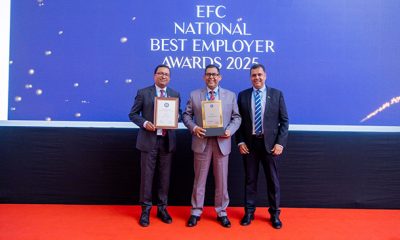
HNB recognized among Top 10 Best Employers of 2025 at the EFC National Best Employer Awards
-
 Business5 days ago
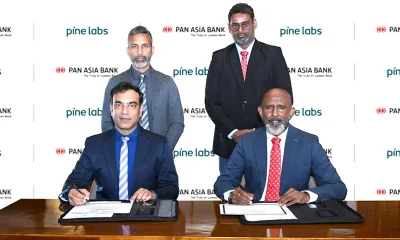
API-first card issuing and processing platform for Pan Asia Bank
-

 Editorial3 days ago
All’s not well that ends well?
-

 Business1 day ago
GREAT 2025–2030: Sri Lanka’s Green ambition meets a grid reality check
-

 Features3 days ago
Phew! The heat …