
News
NPP-controlled Kandy MC reneges on its 7% rate reduction pledge

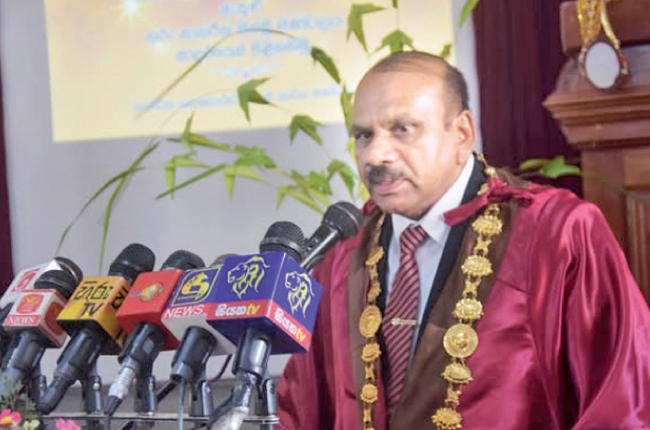
The Kandy Municipal Council (KMC) has decided to suspend its proposed 7% rate reduction until the year 2027. This decision was made during a meeting held yesterday.
Kandy Mayor Chandrasiri Wijenayake said that although the rate relief was included in the 2026 budget, its implementation had become problematic. He noted that approximately 60% of the residents had already paid rates for the year. “If we provide this relief now, we would be legally obligated to refund the excess payments to those who have already settled their dues. This would result in a staggering loss of Rs. 150 million to the Municipal Council’s revenue,” the Mayor said, adding that the decision to suspend the rate reduction after consultations with the Commissioner of Local Government and the Governor of the Central Province.
However, the move has drawn sharp criticism from the opposition. Senior Opposition Member (SJB) Vipula Ranasinghe condemned the decision, accusing the administration of placing an undue burden on the public. “The Mayor and the ruling party should have realised the difficulty in refunding rates before passing the budget. They bragged that they could run the council without the opposition’s help, but now they are trapped in their own mismanagement,” Ranasinghe remarked.
He took a swipe at the government’s previous claims: “The NPP government once claimed it had enough funds to support local authorities under its control. This about-turn proves that those were mere lies.”
By S.K. Samaranayake

Latest News
Heat Index at Caution Level in the Northern, North-central, North-western, Western, Sabaragamuwa, Eastern and Southern provinces and in Monaragala district


Warm Weather Advisory
Issued by the Natural Hazards Early Warning Centre
Issued at 3.30 p.m. on 15 April 2026, valid for 16 April 2026.
The Heat index, the temperature felt on human body is likely to increase up to ‘Caution level’ at some places in the Northern, North-central, North-western, Western, Sabaragamuwa, Eastern
and Southern provinces and in Monaragala district.
The Heat Index Forecast is calculated by using relative humidity and maximum temperature and this is the condition that is felt on your body. This is not the forecast of maximum temperature. It is generated by the Department of Meteorology for the next day period and prepared by using global numerical weather prediction model data.
Effect of the heat index on human body is mentioned in the above table and it is prepared on the advice of the Ministry of Health and Indigenous Medical Services.
ACTION REQUIRED
Job sites: Stay hydrated and takes breaks in the shade as often as possible.
Indoors: Check up on the elderly and the sick.
Vehicles: Never leave children unattended.
Outdoors: Limit strenuous outdoor activities, find shade and stay hydrated.
Dress: Wear lightweight and white or light-colored clothing.
Note:
In addition, please refer to advisories issued by the Disaster Preparedness & Response Division, Ministry of Health in this regard as well. For further clarifications please contact 011-7446491

The Indonesian Navy Sailing Ship KRI BIMA SUCI – 945 arrived at the Port of Colombo on a goodwill visit on 15 Apr 2026 and was welcomed by the Sri Lanka Navy (SLN) in compliance with time-honoured naval traditions.
The vessel’s arrival is a key highlight of the ASEAN Plus Cadet Sail (APCS) – 2026 programme , accompanying a diverse contingent of Navy cadets from 26 different nations alongside their Indonesian counterparts.
The ship is commanded by Commander SUGENG HARIYANTO. Meanwhile, Officer Under-trainees of the Sri Lanka Navy are expected to participate in various programmes aboard the
ship and naval personnel observe its operational functions during its stay in the island.
Furthermore, the ship’s crew is scheduled to take part in programmes organized by the Sri Lanka Navy to enhance camaraderie between the two navies, as well as visit several tourist attractions in the country.
News
PM initiates children into learning at the auspicious time while observing New Year traditional customs and rituals

The Sinhala and Tamil New Year cultural festival, organized by the Ministry of Buddha Sasana, Religious and Cultural Affairs, was held on Tuesday (14) in Gampaha under the patronage of Prime Minister Dr. Harini Amarasuriya, with the performance of traditional auspicious customs and rituals.
In accordance with tradition, during the Punya Kalaya (inauspicious time), the Prime Minister visited the Medagama Sri Sunandarama Viharaya in Gampaha and participated in religious observances and received blessings from Venerable Thunmodara Samitha Thero, a member of the Karaka Sangha Sabha of the Sri Lanka Ramanna Maha Nikaya and the Chief Incumbent of the Medagama Sri Sunandarama Dharmaduta Piriven Viharaya.
The traditional observances of the Sinhala and Tamil New Year cultural festival were held at the residence of Darshana Weerasinghe in Gampaha. Marking the auspicious time for commencing work, and upon the invitation of the host family, the Prime Minister planted a sapling within the premises. Concurrently, Minister of Buddha Sasana, Religious and Cultural Affairs, Dr. Hiniduma Sunil Senevi, and Minister of Foreign Affairs and Tourism, Vijitha Herath, joined the PM.
Subsequently, the Prime Minister joined children in engaging in traditional folk games.
At the auspicious time for engaging work and educational activities, the PM participated with children in reading and writing, guiding them and symbolically marking the commitment to advancing the educational development of the nation’s children.
Thereafter, the Prime Minister and other distinguished guests observed the traditional customs of exchanging greetings, transactions and gifts with the host family, and joined them to partake in the customary New Year meal.
Extending New Year greetings to all citizens, the Prime Minister expressed her gratitude to all Sri Lankans, both at home and abroad, for their contributions in overcoming and effectively managing the various challenges faced by the country.
Speaking at the occasion, Minister Dr. Hiniduma Sunil Senevi stated that the Sinhala and Tamil New Year festival symbolizes renewal and purity, and reflects the energy of the sun. He also conveyed his wishes for a peaceful and prosperous New Year for all.
The occasion was attended by the Deputy Minister of Finance and Planning and Minister of Labour, Dr. Anil Jayantha; Deputy Minister of Labour, Mahinda Jayasinghe; Member of Parliament for the Gampaha District, Ruwan Mapalagama; along with the Gampaha District Secretary, Mayor, Divisional Secretaries, and a large number of government officials.
(Prime Minister’s Media Division)

Heat Index at Caution Level in the Northern, North-central, North-western, Western, Sabaragamuwa, Eastern and Southern provinces and in Monaragala district

Pakistani army chief in Tehran amid bid to restart US talks

Sri Lanka repatriates 238 Iranian sailors stranded after US torpedo attack

Indonesian Navy Sailing Ship KRI BIMA SUCI – 945 makes port call in Colombo

PM initiates children into learning at the auspicious time while observing New Year traditional customs and rituals

Navy seize an Indian fishing boat poaching in seas north of Mannar

‘Dates have the highest sugar content to fight Coronavirus’

Sunday Island 27 December – Headlines

#SundayIsland 17th December – Headlines

Sunday Island – 28th March

Sunday Island Headlines – 21 March

Sunday Island – 21st February – Headlines
-

 News4 days ago
CEB orders temporary shutdown of large rooftop solar systems
-

 News7 days ago
AG: Coal procurement full of irregularities
-
 Features4 days ago
From Royal College Platoon to National Cadet Corps: 145 years of discipline, leadership, and modern challenges
-

 Business6 days ago
Israeli attack on Lebanon triggers local stock market volatility
-

 Business7 days ago
Hayleys Mobility introduces Premium OMODA C9 PHEV
-

 Business6 days ago
HNB Assurance marks 25 years with strategic transformation to ‘HNB Life’
-

 Latest News3 days ago
PNS TAIMUR & ASLAT arrive in Colombo
-

 Sports7 days ago
DS to face St. Anthony’s in ‘Bridges of Brotherhood’ cricket encounter