
News
Now, electricity consumers entitled to interest on LECO deposits


Rathindra Kuruwita
The Public Utilities Commission of Sri Lanka (PUCSL) responsible for protecting the rights of electricity consumers in the country, together with the electricity service providers yesterday (7) affirmed a unique right for electricity consumers.
PUCSL Chairman Janaka Ratnayake told an event held at the BMICH that the regulator PUCSL together with Electricity Utility Provider, Lanka Electricity Company Private Limited (LECO) had launched an Interest Payment scheme for Electricity Security Deposits for LECO consumers.
Over Rs. 1.2 billion would be paid back to electricity consumers annually by the distribution licensee, Chairman of the Public Utilities Commission of Sri Lanka (PUCSL) Janaka Ratnayake said yesterday at an event in Colombo to mark the commencement of payment of interest on electricity consumer deposits.
When a person obtained an electricity connection from the CEB, he or she had to place a deposit at the regional CEB engineering office. As per Sri Lanka Electricity Act, No. 20 of 2009, the CEB had to pay consumers an interest on those deposits. Section 28.3 of the act says ‘(3) Where any sum of money is provided to a distribution licensee by way of security in pursuance of this section, the licensee (CEB) shall pay interest on such sum of money at such rate as may from time to time be fixed by the licensee with the approval of the Commission (PUCSL), for the period in which it remains in the hands of the licensee.’ It is estimated that there is over Rs. 25 billion of such deposits with the CEB.
The following is the text of Ratnayake’s speech: We have taken the steps to protect the rights of electricity consumers since the inception of the Commission in accordance with the powers vested in it. We have published the Declaration of the Rights and Obligations of Electricity Consumers and many regulatory decisions to protect the rights contained therein and to protect consumers. More than 20 different regulations, rules and guidelines have been enacted to protect consumers.
Payment of interest on electricity consumer deposits declared today is a benefit provided to the consumer under Section 28 of the Sri Lanka Electricity Act. Cooperation between the various parties were required to implement such a benefit. In the recent past, steps were taken to implement this interest rate scheme. Section 28 of the Sri Lanka Electricity Act stipulates that an electricity consumer must be paid interest on the security deposit paid by his client company or licensee.
The implementation of the decision to pay interest benefits was delayed due to various issues such as determining the interest to be paid and resolving issues.
But today we have been able to solve all those problems and The Public Utilities Commission of Sri Lanka has developed a methodology for determining interest rates in an accepted and transparent manner.
The Commission recently decided that the interest rate for this year would be 8.68 per cent. Licensed companies that provide electricity services based on that interest must calculate the interest benefit and pay it to their customers. Starting today the consumers will be able to get this unique benefit scheme.
Lanka Electricity (Pvt) Ltd, a distribution licensee, will start paying interest to its customers from today. LECO alone will pay Rs. 42 million annually to its customers as a benefit through the interest payment benefit on customer deposits.
We hope that in the future other licensees will implement this interest payment programme. When other electricity distribution licensees also implement this interest benefit scheme in the future, around Rs. 1,200 million will flow into the hands of electricity consumers annually.
On the one hand, it is a huge subsidy flowing to the country’s economy through the power industry. The Commission will also implement regulatory measures to meet the aspirations of the licensees to maintain a high quality and efficient electricity service.
The Commission was established in 2002 to regulate the multi-faceted industries of the country. The regulatory powers of the electricity industry were vested in the Sri Lanka Electricity Act passed by Parliament in 2009. Since then, the Commission has initiated the economic, technological and security regulation of the power industry.
Initially, the Commission was to be empowered to regulate the electricity industry and the water services industry. Later the petroleum industry was also listed as an area regulated by the Commission. Acts authorizing the Public Utilities Commission of Sri Lanka to regulate the water services and petroleum industries have not yet come into force.
Once we gain the powers through acts to regulate those industries, we are ready to initiate regulatory activities in the water services and petroleum industries to protect consumers.
The Commission has also been appointed as the regulatory body for the lubricant market in Sri Lanka and we provide the necessary advice and assistance to the Ministry of Energy for the promotion of the lubricant market.
Also, the Commission has been entrusted with the regulation of electric vehicle charging stations. We also have plans to expand the network of electric vehicle charging stations to protect the rights of electric vehicle owners.
This year, we are also implementing a programme to enhance the quality of professionals in the electricity sector and ensure the maintenance of high-security electricity service. At present, nearly 45,000 people are working as electricians in the country. Only by standardizing these people can the quality of home electrical systems in our country be guaranteed.
We have also paved the way for these electricians to be recognized nationally and internationally. The National Electrician Licensing Scheme prepared by the Public Utilities Commission of Sri Lanka will be introduced from this year. To obtain this license, we have implemented an expeditious process of awarding at least the 3rd level of National Vocational Qualification or NVQ 3 Certificate.
Under this expeditious programme, 2500 electricians will be issued NVQ 3 qualification and professional licenses by next July. The awarding of the license and NVQ 3 certificates to the first group of professional electricians is scheduled to take place next June under the patronage of His Excellency the President Gotabhaya Rajapaksa.
Over the next few years, we look forward to implementing special programmes for the advancement of all sectors under the purview of the Public Utilities Commission of Sri Lanka. Licensing licensees who provide utility services under our regulation are also required to improve in their respective fields.
We hope they will work with us to set the tone”.


Romania, a country that has maintained diplomatic relationship with Sri Lanka for several decades in various fields, has become an increasingly popular destination among Sri Lankan skilled and semi-skilled Labour categories, especially in the fields of construction, manufacturing, hospitality, and services sectors.
At present, the recruitment of Sri Lankan workers to Romania is carried out by licensed private employment agencies under the
supervision of the Sri Lanka Foreign Employment Bureau. However, since both parties have recognized the need of establishing a more organized and sustainable recruitment method due to increasing demand, the Cabinet of Ministers has approved the proposal presented by the Minister of Foreign Affairs, Foreign Employment, and Tourism to enter into a Memorandum of Understanding between the Government of the Democratic Socialist Republic of Sri Lanka and the Government of Romania regarding cooperation in the field of the labour sector with the following objectives.
• Establishment of proper mechanism for recruitment and management of workers.
• Promotion of ethical and transparent recruitment practices.
• Protection of rights and welfare of the migrant workers.
• Facilitation of regular discussions between the formal and relevant authorities ofboth countries.
• Improvement of technical cooperation, skills recognition, and capacity building in the labour sector.
The Cabinet of Ministers has approved the proposal presented by the President, in his capacity as the Minister of Finance,
Planning, and Economic Development to repeal Management Services Circular No. 01/2019 , dated 15-03-2019, issued regarding the implementation of development projects, and to issue a new management services circular including updated provisions instead.
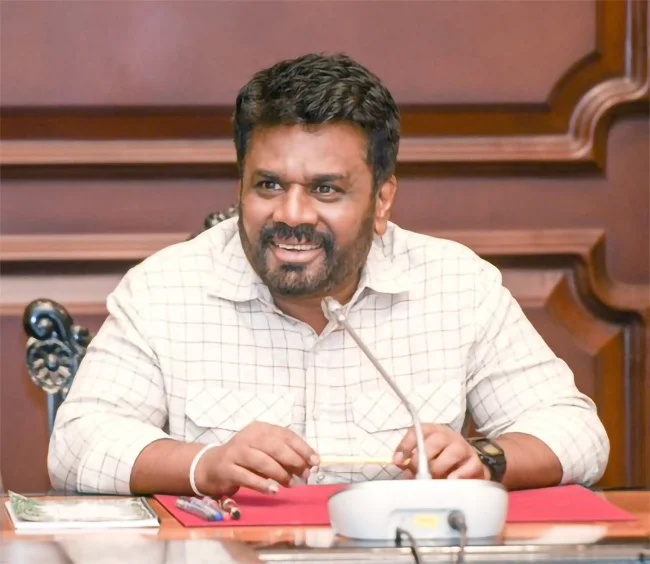
Chief Prelates of the Malwathu, Asgiriya, Amarapura and Ramanna Nikayas, in a joint letter addressed to President Anura Kumara Dissanayake, has expressed concern over the protracted delay in appointing a permanent Auditor General.
The Chief Prelates have said that the appointment of an outsider as the Head of the National Audit Office (NAO) responsible for ensuring transparency and accountability in public finances will be inappropriate.
The Chief Prelates have said that they are of the view that Dharmapala Gammanpila, a senior officer with extensive experience within the Auditor General’s Department, is the ideal candidate for the top post. They have also emphasised that his appointment will strengthen the government’s efforts to promote economic prosperity.
Chulantha Wickramaratne, who served as AG for a period of six years, retired in April 2025. Following his retirement, President Dissanayake nominated H.T.P. Chandana, an audit officer at the Ceylon Petroleum Corporation, as the AG. The CC rejected that nomination. Subsequently, President Dissanayake appointed the next senior-most official at the NAO Dharmapala Gammanpila as Acting Auditor General for a period of six months. Then, the President nominated Senior Deputy Auditor General L.S.I. Jayarathne to serve in an acting capacity, but her nomination, too, was also rejected. Many an eyebrow was raised when the President nominated O.R. Rajasinghe, the Internal Audit Director of the Sri Lanka Army for the top post. That nomination too was rejected. As a result, the vital position remains vacant since 07 December, 2025.

Cabinet nod for MOU between Sri Lanka and Romania on the cooperation in the Labour Field
New circular to replace Management Services Circular No. 01/2019

The RAPP sheet: Steve Smith, Daryl Mitchell, Umesh Yadav among over 1300 players

U19 World Cup: Pakistan overcome New Zealand by 8 wickets

U19 World Cup: Vihaan Malhotra ton headlines India’s massive win

Dry weather will prevail in most parts of the island

‘Dates have the highest sugar content to fight Coronavirus’

Sunday Island 27 December – Headlines

#SundayIsland 17th December – Headlines

Sunday Island – 28th March

Sunday Island Headlines – 21 March

Sunday Island – 21st February – Headlines
-
 Business2 days ago
ComBank, UnionPay launch SplendorPlus Card for travelers to China
-
 Business3 days ago
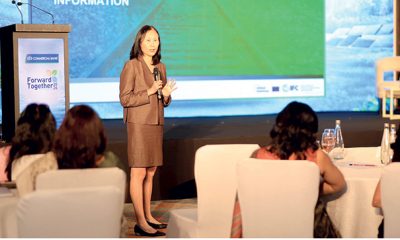
ComBank advances ForwardTogether agenda with event on sustainable business transformation
-
 Opinion6 days ago
Remembering Cedric, who helped neutralise LTTE terrorism
-
 Business6 days ago
CORALL Conservation Trust Fund – a historic first for SL
-
 Opinion3 days ago
Conference “Microfinance and Credit Regulatory Authority Bill: Neither Here, Nor There”
-

 Opinion5 days ago
A puppet show?
-
 Opinion2 days ago
Luck knocks at your door every day
-

 Features5 days ago
‘Building Blocks’ of early childhood education: Some reflections