
News
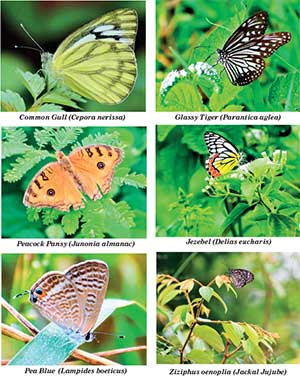
New study finds 33 species of butterflies at Maduru Oya National Park


It could be a butterfly destination as well in the long-term
by Ifham Nizam
(Pics courtesy Praneeth Silva)
An ongoing new study has discovered 33 species of butterflies at the Maduru Oya National Park, which is better known for its wildlife and aquatic birds.
The new discovery could lead to the national park being identified also as a bird location in the long-term.
The research team comprising Prof. Dharshani Mahaulpatha, Praneeth Silva, Tharanga Dassanayake, Dulan Jayasekara, Chamara Prabhath, Wathmini De Silva and Hiranthi Dilrangi Praneeth Silva, a graduate research assistant of the University of Sri Jayewardenepura, expressed optimism that with further research the number of species could increase.
 “We have already asked the Wildlife Department to take action against noise pollution as vehicles entering the park frequently is increasing”, the team said.
Though elephants and aquatic birds are popular in the park, it could also be made a popular destination for butterflies, which are fascinating flying insects among lepidopterans and essential bio indicators of ecology and evolutionary studies, the researchers said.
“There are about 19,000 species of butterflies distributed around the world. The Western Ghats and Sri Lanka are a global biodiversity hotspot characterized by a large number of endemic species. With respect to butterfly fauna which harbors 331 species, Sri Lanka has 248 species, including 26 endemics.
Of the total butterfly species in the island, 21 are categorized as critically endangered, while 38 are endangered, 40 vulnerable and 21 near threatened. Furthermore, the conservation status of 29 species of butterflies has not been evaluated due to the lack of adequate data, Praneeth Silva said.
The Maduru Oya National Park extends to the Eastern, Uva and North Central provinces. The national park provides habitats for displaced wildlife and provides refuge to many other native fauna and flora particularly elephants. It is also home to thousands of aquatic birds.
The new study discovered 33 species of butterfly fauna representing five families. The commonest butterfly species is the Common Mormon (Papilio polytes). The butterfly count is high during the wet season (October-February) and low in the dry season (March-September).
Distinct differences in butterfly individual and species counts may be governed by climatic conditions of the area. As butterflies are poikilothermic organism, their biological cycle, activity, distribution and abundance are influenced by monthly temperature and rainfall patterns of the locality.
As the park is situated in the dry zone, the climax community of the area is tropical dry mixed evergreen forests characterized by large trees. However, high butterfly diversity can be observed in shrubs and bushes in the Maduru Oya National Park other than roads, water banks and extensive grassland habitat types. Availability of diverse shrubs and bushes in the park is the main reason for occurring high numbers of butterflies.
They act as host plants for butterflies by fulfilling the main living functions of butterflies to sustain their survival in the environment: facilitate laying of eggs, ensure nourishment and shelter for caterpillars, act as nectar sources for adults.
Praneeth de Silva said a higher number of ‘road kills’ of butterflies was observed due to the impact of vehicular traffic. High speed driving, lack of awareness of foreign and local visitors and poor law restrictions of wildlife authorities are the major governing factors for this critical issue.
The research team appreciated the cooperation of the Maduru Oya National Park staff, especially former park warden M. R. Mohamed and the incumbent warden J. Rathnayake and the Department of Wildlife Conservation for granting permission for the research.
The team also thanked the “Wildlife Circle” Association (Department of Zoology, University of Sri Jayewardenepura) for helping with their field work.


The National Building Research Organisation (NBRO) has issued Landslide Early Warnings to the Districts of Kurunegala and Ratnapura effective from 16:00 hrs on 23.04.2026 To 16:00 hrs on 24.04.2026
Accordingly,
Level 1 landslide early warnings have been issued to the Divisional Secretaries Divisions and surrounding areas of Rideegama in the Kurunegala district and Kuruwita, Kalawana, Ratnapura, Nivithigala, Pelmadulla and Eheliyagoda in the Ratnapura district.
Latest News
Advisory for Severe Lightning issued for the Western, Sabaragamuwa, Central, North-western, North-central, Southern, Uva provinces, and Ampara and Batticaloa districts

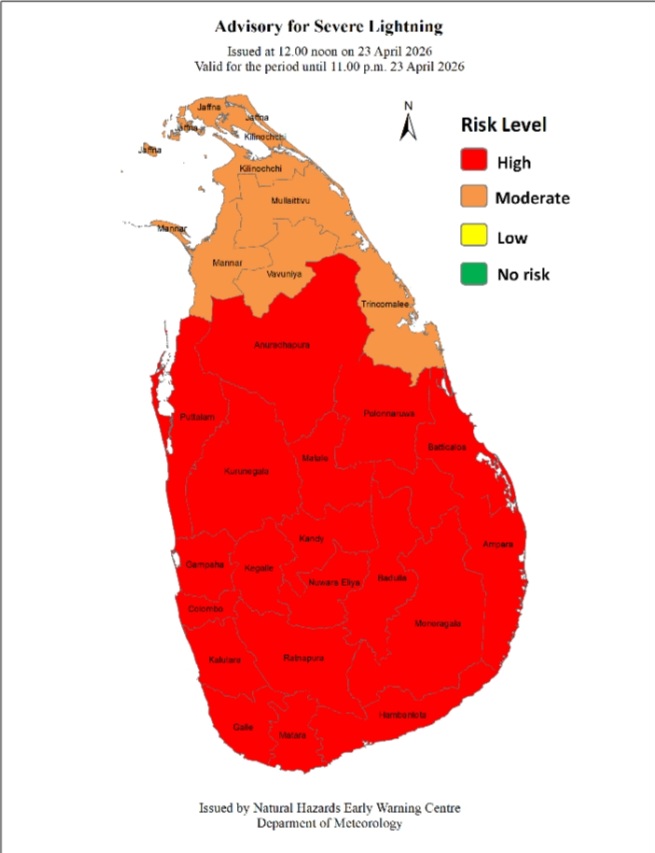
Advisory for Severe Lightning
Issued by the Natural Hazards Early Warning Centre of the Department of Meteorology
Issued at 12.00 noon 23 April 2026 valid for the period until 11.30 p.m. 23 April 2026
Thundershowers accompanied with severe lightning are likely to occur in the Western, Sabaragamuwa, Central, North-western, North-central, Southern, Uva provinces, and in Ampara and Batticaloa districts after 1.00 p.m.
There may be temporary localized strong winds during thundershowers. General public is kindly requested to take adequate precautions to minimize damages caused by lightning activity.
ACTION REQUIRED:
The Department of Meteorology advises that people should:
• Seek shelter, preferably indoors and never under trees.
• Avoid open areas such as paddy fields, tea plantations and open water bodies during thunderstorms.
• Avoid using wired telephones and connected electric appliances during thunderstorms.
• Avoid using open vehicles, such as bicycles, tractors and boats etc.
• Beware of fallen trees and power lines.
• For emergency assistance contact the local disaster management authorities.
News
Compensation payments and reconstruction activities related to the Ditwah relief measures must be expedited with special attention at the district level – PM
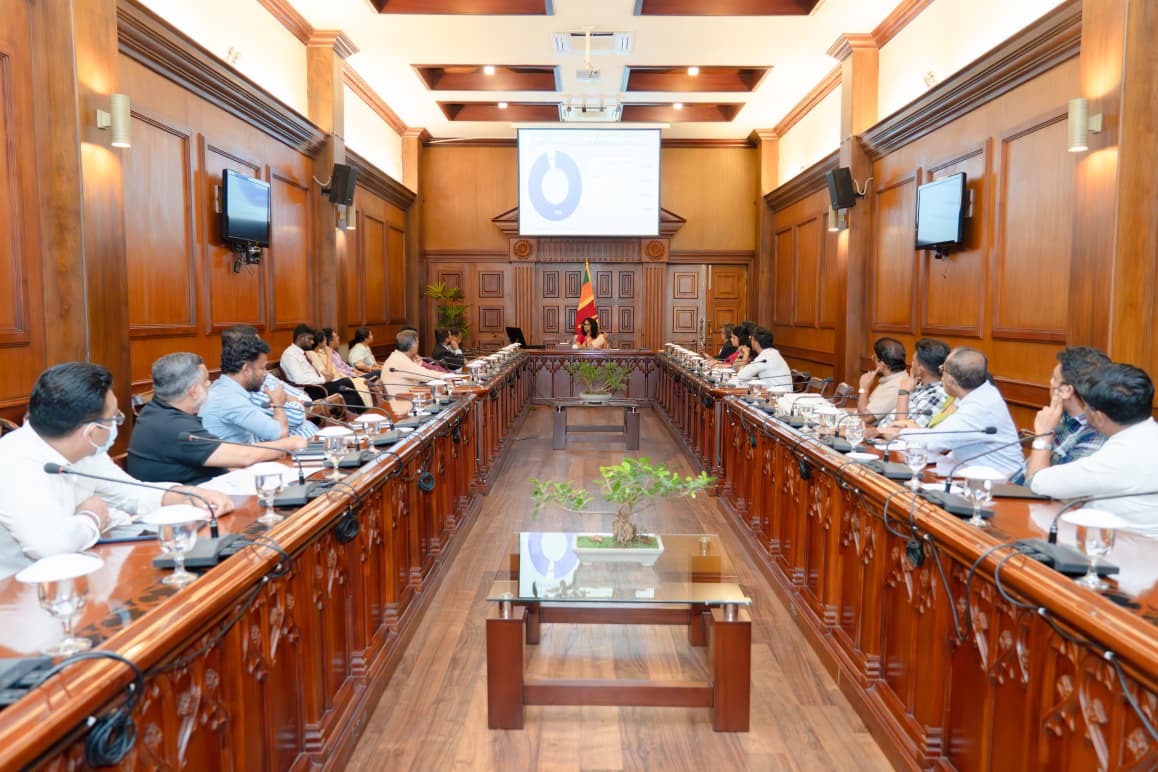
Prime Minister Dr. Harini Amarasuriya emphasized that compensation payments and reconstruction activities related to the Ditwah relief measures must be expedited with special attention at the district level. She further stated that all necessary allocations have already been made to Provincial Councils and instructed that the progress of disaster damage assessments and reconstruction efforts be closely monitored at the provincial level.
The Prime Minister made these remarks at a discussion held on Tuesday (21) at Temple Trees under her patronage, aimed at informing Chairpersons of District Coordination Committees and public representatives from disaster-affected districts, in order to accelerate the implementation of the “Rebuilding Sri Lanka” programme. The discussion focused on expediting disaster relief and compensation payments, as well as the swift restoration of infrastructure damaged by the disaster.
The Prime Minister emphasized that Rs. 500 billion has been allocated for damages caused by the Ditwah cyclone, and that all relevant development activities must be completed before the end of 2026. The Prime Minister also instructed officials to pay special attention to resolving issues at the local level that are causing delays in compensation payments.
Senior Additional Secretary to the President, G.M.R.D. Aponsu, stated that the estimated cost for reconstruction following the Ditwah cyclone is approximately USD 3.4 billion. Accordingly, funds have been allocated for compensation across several sectors including housing and social infrastructure, agriculture and livestock, fisheries, industry and livelihoods, and irrigation. He further noted that 99% of the Rs. 25,000 allowance has already been disbursed, while 95% of the Rs. 50,000 resettlement allowance has been paid. Compensation for fully and partially damaged houses is still ongoing, and 99% of temporary relief centres have been closed.
Additionally, attention was drawn to several other measures, including providing Rs. 25,000 to affected schoolchildren, paying Rs. 1 million as compensation for each deceased individual, compensation for children who lost one or both parents, support for persons with disabilities affected by the disaster, compensation for agricultural losses, and expediting resettlement of displaced families. Measures such as allocating land for new housing construction and accelerating the issuance of reports from the National Building Research Organization were also discussed.
Focus was also placed on the reconstruction of affected schools, hospitals, and daycare centres, improving the accuracy and speed of data collection at the local level, and accelerating infrastructure development.
The event was attended by Minister of Plantation and Community Infrastructure Samantha Vidyarathna, Minister of Public Administration, Provincial Councils and Local Government Dr. Chandana Abayarathna, Deputy Minister of Agriculture and Livestock Namal Karunaratne, Deputy Minister of Trade, Commerce, Food Security and Cooperatives R.M. Jayawardena, Deputy Minister of Education Dr. Madhura Senevirathna, Members of Parliament, Chairpersons of District Coordination Committees, Chief of Staff to the President and Commissioner General of Essential Services Prabath Chandrakeerthi, Additional Secretary to the President Jayantha Bandara; and officials of the Prime Minister’s Office.
[Prime Minister’s Media Division]

Landslide Early Warnings issued to the Districts of Kurunegala and Ratnapura

US boards ship carrying Iranian oil, as Iran MP says first Strait of Hormuz toll paid

Advisory for Severe Lightning issued for the Western, Sabaragamuwa, Central, North-western, North-central, Southern, Uva provinces, and Ampara and Batticaloa districts

Will another film star be able to sway the election in India’s Tamil Nadu?

‘Team audit’ done, Kirsten hopes Sri Lanka keep ‘progressing and improving’

Nuwan Thusara withdraws lawsuit against Sri Lanka Cricket

‘Dates have the highest sugar content to fight Coronavirus’

Sunday Island 27 December – Headlines

#SundayIsland 17th December – Headlines

Sunday Island – 28th March

Sunday Island Headlines – 21 March

Sunday Island – 21st February – Headlines
-

 News3 days ago
Rs 13 bn NDB fraud: Int’l forensic audit ordered
-

 Business6 days ago
Harnessing nature’s wisdom: Experts highlight “Resist–Align” path to resilience
-

 Opinion4 days ago
Shutting roof top solar panels – a crime
-

 News6 days ago
Gratiaen Trust announces longlist for the 33rd Annual Gratiaen Prize
-

 News5 days ago
From Nuwara Eliya to Dubai: Isha Holdings markets Agri products abroad
-

 News6 days ago
Heroin haul transported on 50-million-rupee contract
-

 News4 days ago
Church calls for Deputy Defence Minister’s removal, establishment of Independent Prosecutor’s Office
-

 News5 days ago
‘Agents of the devil’ seeking to block Easter probe, Cardinal warns