
Latest News
‘Neighbourhoods buried under mud’: Sri Lanka floods death toll reaches 334


At least 334 people have been confirmed dead across Sri Lanka as authorities continue to battle rising floodwaters in parts of the capital, Colombo, after a powerful cyclone left a trail of destruction.
In an update on Sunday, the Disaster Management Centre (DMC) said on Sunday nearly 400 people remain missing and warned that more heavy rains brought on by Cyclone Ditwah are expected across the island nation in the coming days.
It has been reported that among those missing were five Navy personnel who were last seen trying to cut off overflowing water at a Naval sub-station in Chalai Lagoon, northeast of the country.
The extreme weather system has destroyed nearly 15,000 homes across the country, sending almost 44,000 people to state-run temporary shelters, according to the DMC.
More than 24,000 police, army and air force personnel are still trying to reach families stranded by floods, authorities said.
Al Jazeera’s Minelle Fernandez, reporting from Sammanthurai in east central Sri Lanka, said the country is struggling to cope with the aftermath of the cyclone.
“Some neighbourhoods are completely buried under mud, and each one brings more despair,” she said. “Communication has also broken down, and there are some areas that have yet to send updates.”
In other areas, newly planted rice was submerged in water due to relentless rain, Fernandez added.
The northern part of Colombo was also facing a major flood, as the water level in the Kelani River continued to rise, DMC said.
“Although the cyclone has left us, heavy rains upstream are now flooding low-lying areas along the banks of the Kelani River,” a DMC official said.

President Anura Kumara Dissanayake declared a state emergency today [Saturday] to deal with the aftermath of the cyclone and appealed for international aid.
India was the first to respond, sending relief supplies and two helicopters with crew to carry out rescue missions. Japan said it will send a team to assess immediate needs and pledged further assistance.
While the rains have subsided across the island, several roads in the worst-affected central province remained inaccessible, the DMC said.
The extreme weather system has destroyed more than 20,000 homes and sent 122,000 people into state-run temporary shelters. Another 833,000 people required assistance after being displaced by the floods.
Troops from the army, navy, and air force have been deployed alongside civilian workers and volunteers to assist with the relief effort.
Officials reported that about a third of the country remains without electricity or running water due to collapsed power lines and inundated water purification facilities. Internet connections have also been disrupted.
The cyclone has become Sri Lanka’s deadliest natural disaster since 2017, when flooding and landslides killed more than 200 people and displaced hundreds of thousands.
The worst flooding since the turn of the century occurred in June 2003, when 254 people were killed.
[Aljazeera]


Salman Ali Agha said that he would have done things ‘differently”, after Mehidy Hasan Miraz ran him out in controversial circumstances in the second ODI in Dhaka.
Agha, who made 64 from 62 balls, had been backing up at the non-striker’s end when Mohammad Rizwan drove the ball back towards him. He was still out of his ground as Mehidy swooped round behind him in an attempt to gather, and Agha had appeared ready to pass the ball back to the bowler before Mehidy reached down to grab it first and throw down the stumps.
Agha reacted furiously to the dismissal, throwing his gloves and helmet down in disgust at the decision. However, he later came to the post-match press conference, ahead of captain Shaheen Shah Afridi and player of the match Maaz Sadaqat, to clear the air.
“I think sportsman spirit has to be there,” Agha said. “What he [Mehidy] has done is in the law. I think if he thinks it’s right, it’s right, but if you ask me my perspective, I would have done differently. I would have gone for sportsman spirit. We haven’t done this [type of thing] previously, we would never do that in the future as well.”
Agha explained that he had been trying to pick up the ball to give to Miraz, thinking it was likely to have been called dead. “Actually, the ball hit on my pad and then my bat,” he said. “So I thought he can’t get me run-out now, because the ball already hit on my pad and my bat.
“I was just trying to give him the ball back. I was not looking for the run or anything like that, but he already decided [to make the run-out].”
Agha however regretted his angry reaction. “It was just heat-of-the-moment kind of stuff,” he said. “If you ask me what would I have done, I would have done things differently. But it was everything, whatever happened after that, it was in the moment.”
He was also involved in a robust exchange with Bangladesh wicketkeeper Litton Das, though he didn’t divulge many of the details.
“I can’t remember what I was saying and I can’t remember what he was saying,” he said. “I’m sure I wasn’t saying nice things, and I’m sure he wasn’t saying nice stuff as well. But it was just heat of the moment, so we are fine.
Asked if he had patched things up with Mehidy, Agha said: “I haven’t yet, but don’t worry, I’ll find him.”
Pakistan won the match by 128 runs via the DLS method.
[Cricinfo]
Latest News
US embassy in Baghdad hit by strike as Trump says military targets ‘obliterated’ on Iran’s key oil island
The US embassy in Baghdad, Iraq, has been hit by a missile – video shows fire and smoke rising in the aftermath.
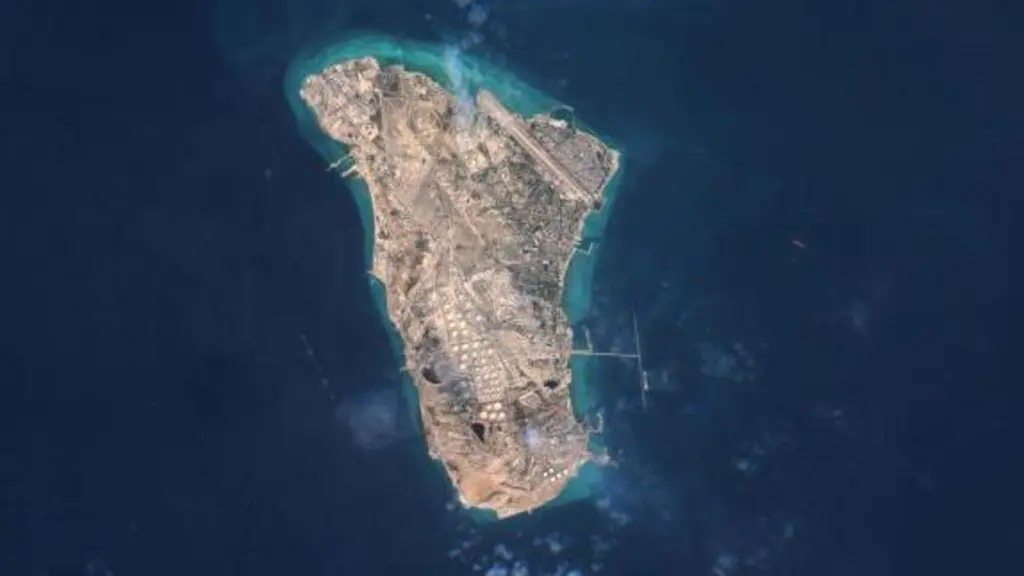
Meanwhile, President Donald Trump says “every military target” on Iran’s key oil island has been “totally obliterated”, but there was no damage to oil infrastructure.
Kharg Island is a tiny but strategic terminal in the northern Gulf, 22 miles off the coast of Iran In response, Tehran warns oil and energy infrastructure belonging to firms that co-operate with the US will be “turned into a pile of ashes” if Iran’s energy facilities are attacked
Elsewhere in the Middle East: Israel and Iran both warn of fresh attacks, and at least 12 medical staff have been killed in an Israeli strike in Lebanon
Meanwhile, more US Marines and warships are expected to be deployed to the Middle East, two officials tell BBC’s partner CBS News
[BBC]

The Bahrain and Saudi Arabia Grands Prix that were scheduled for next month are set to be cancelled as a result of the war in the Middle East.
A formal decision to call off the races has not yet been made but is expected before the end of the weekend.
Freight would need to start being shipped to the Middle East in the coming days. With no sign of the conflict between the US/Israel and Iran coming to a conclusion, holding the races would put personnel at too great a risk.
Neither event will be replaced, with the season being cut to 22 grands prix and F1 taking a commercial hit of more than £100m, given Bahrain and Saudi Arabia pay two of the highest hosting fees.
The race in Bahrain was scheduled to be on 12 April with Jeddah the following weekend.
Consideration was given to holding events at Portimao in Portugal, Imola in Italy or Istanbul Park in Turkey.
But it was accepted that the time to organise a race at any of those locations was too short, and there was little chance of securing a hosting fee.
The decision will mean there is a five-week break between the Japanese Grand Prix on 29 March and Miami on 3 May.
(BBC)
Showers will occur at several places in the Western, Sabaragamuwa, Central, North-western and Uva provinces and in Galle, Matara, Mannar and Anuradhapura districts after 2.00 pm.

Lanka discovers largest groundwater source

Lanka’s commercial legacy preserved in National Archives

Bodies of 84 Iranian sailors flown home

Kirsten brings pedigree, but Sri Lanka must fix the system

Barrels vs bombs

‘Dates have the highest sugar content to fight Coronavirus’

Sunday Island 27 December – Headlines

#SundayIsland 17th December – Headlines

Sunday Island – 28th March

Sunday Island Headlines – 21 March

Sunday Island – 21st February – Headlines
-

 News6 days ago
Repatriation of Iranian naval personnel Sri Lanka’s call: Washington
-
 Features6 days ago
Winds of Change:Geopolitics at the crossroads of South and Southeast Asia
-

 News5 days ago
Prof. Dunusinghe warns Lanka at serious risk due to ME war
-

 Sports4 days ago
Royal start favourites in historic Battle of the Blues
-

 Sports3 days ago
The 147th Royal–Thomian and 175 Years of the School by the Sea
-

 News3 days ago
Historic address by BASL President at the Supreme Court of India
-

 News4 days ago
CEBEU warns of operational disruptions amid uncertainty over CEB restructuring
-

 Business4 days ago
BOI launches ‘Invest in Sri Lanka’ forum