
Sports
More trouble as KJP injured

by Rex Clementine
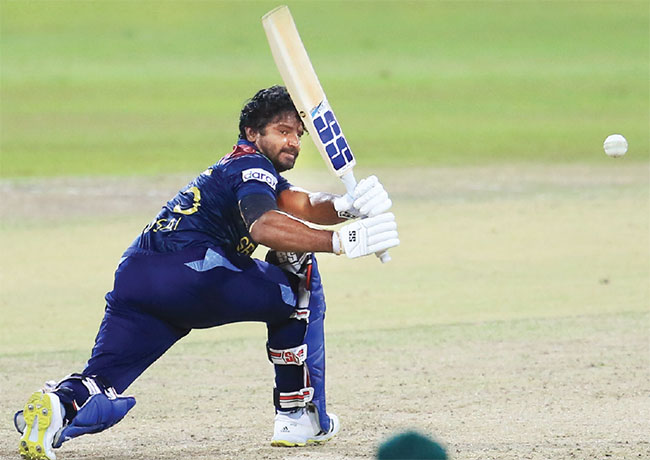
Even before the 3-0 drubbing at the hands of Proteas on Tuesday night began to sink in, Sri Lanka had to come to reality with the fact that they might have to go to next month’s T-20 World Cup without their best player.
Kusal Janith Perera top scored in the Sri Lankan innings in the third T-20 International and looked a class apart from rest of his team mates. However, he did not come to feiled and instead Dinesh Chandimal kept wickets. KJP had recovered after testing positive for COVID and many thought that he may have had breathing issues. However, after the game news emerged that KJP was down with a hamstring injury.
The Island
learns that the former captain was in severe pain on Tuesday night. Although the coaching staff has told SLC that he should be fine for the World Cup starting in UAE next month, the injury prone KJP takes more time than usual to be fully fit.
The coaching staff had informed SLC that at the worst KJP will only miss the bilateral series in Oman before the World Cup.
The opening batsman has a break of ten days before Sri Lanka resume training and the medical staff will be in a better position to assess him then.
It’s been a tough few months for one of the nicest guys in the game. KJP was appointed skipper in June when the selectors benched a whole lot of seniors as they opted to groom young blood for shorter formats of the game. Then, during a bitter pay dispute, KJP took the lead role taking the side of the players and eventually ended up burning a few bridges.
His on field leadership lacked inspiration but given the selectors’ claim that he was the only guy who was sure of his place, he should have been given the long rope. Instead, the selectors put too much on his plate, captaincy, opening batting and wicketkeeping and when things were falling apart, he was made the scapegoat. His captaincy lasted one month.
In England, KJP hurt his shoulder and missed the home series against India due to the injury. Then came COVID which forced him out of the South Africa ODIs and the opening encounter of the T-20 series.
A batting unit that is terribly short on experience and class, badly needs KJP back in action and fans will be hoping that he will be fit by the time Sri Lanka play the qualifying round of the World Cup.
All-rounder Lahiru Madushanka, however, looks to be not so lucky as his injury is more serious. Madushanka had hurt his collarbone and could be replaced for the World Cup.
Addressing the batting woes will be one of the team’s main priorities when they resume training next week. At present, the team is struggling to bat out 20 overs and their woes were magnified with the series being played on turning tracks.
South Africa’s spinners outperformed the Sri Lankan slow bowlers in the series. When the opposition has the quality of Tabraiz Shamsi, Bjorn Fortuin and Keshav Maharaj, it was a massive gamble to prepare turning tracks and in the end, it backfired.







Durban’s Super Giants kept their playoff hopes alive with a bonus-point 58-run win in their final home game, powered by a commanding century from Aiden Markram. His 108 off 58 balls lifted DSG to 189 for 7 on a surface that became increasingly difficult to bat on as the match progressed.
Durban’s Super Giants 189 for 7 (Markram 108; Viljoen 4-21) beat Paarl Royals 131 for 9 (Fortuin 35*; Narine 2-18) by 58 runs
Joburg Super Kings vs Pretoria Capitals
Pretoria Capitals 143 for 6 (Rutherford 74*, Brevis 53; Worrall 2-12) beat Joburg Super Kings 122 for 8 (Forrester 44*; Maharaj 3-15, Williams 3-25) by 21 runs

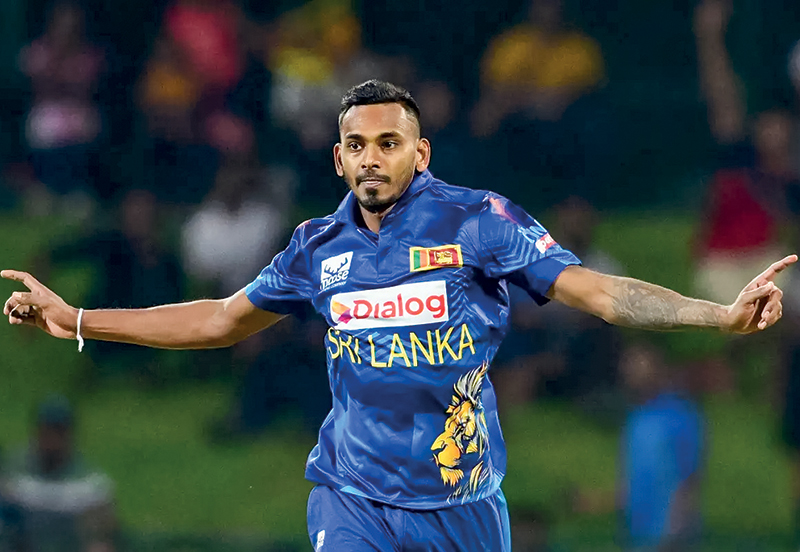
England will touch down in Colombo shortly for a six-match white-ball series, with the ODI leg staged in Colombo and the T20Is unfolding in Pallekele. But make no mistake, it is the T20 chapter that carries the weight of expectation. With the World Cup just around the corner, this series doubles as the final dress rehearsal before Sri Lanka co-host the sport’s showpiece alongside India.
Sri Lanka learned a few hard truths during the recently concluded Pakistan series, identifying areas that still need sanding down. The England tour offers a last chance to tighten the screws, apply the final coat of polish and crucially, nail down the remaining seats on the World Cup bus.
A bit of rotation is expected during the ODI leg. Speedster Dushmantha Chameera sat out the final game against Pakistan with a groin niggle and the think-tank may opt to wrap him in cotton wool, using their spearhead sparingly and unleashing him primarily in the T20Is.
While most World Cup berths are already pencilled in ink, a couple remain in erasable pencil. With the squad deadline looming before the end of the month, selectors will effectively have just the first T20I to make their calls, with the second and third matches slated for February 1 and 3. It does raise the question whether the T20Is should have been played first, or whether the England series might have been better slotted immediately after the Pakistan games, keeping momentum rolling.
Look across the Palk Strait and India appear to have their ducks in a row. They are hosting New Zealand in an eight-match white-ball series that wraps up on January 31, five T20Is and three ODIs, an almost tailor-made build-up for a global tournament. India and New Zealand are, incidentally, locking horns in five T20Is, prompting the inevitable thought: would Sri Lanka have been better served going down the same route?
Sri Lanka’s bowling cupboard is well stocked and capable of putting the brakes on even the most belligerent line-ups at the World Cup. The lingering concern remains the batting. If the chronic collapses can be curbed and partnerships stitched together, there is no reason why Sri Lanka cannot push deep into the business end of this 20-nation competition.
A heavy load rests on opener Pathum Nissanka’s shoulders, but if Kusal Mendis finds his groove and bats with freedom, Sri Lanka could yet savour this World Cup. The batting unit appears largely settled, and Dhananjaya de Silva edging out Kusal Janith Perera looks a no-brainer. Kamindu Mendis, with the all-round package he brings, is not only a long-term investment but also a calming influence in the middle order here and now. Whether the selectors read the game from the same page, however, remains to be seen.
by Rex Clementine
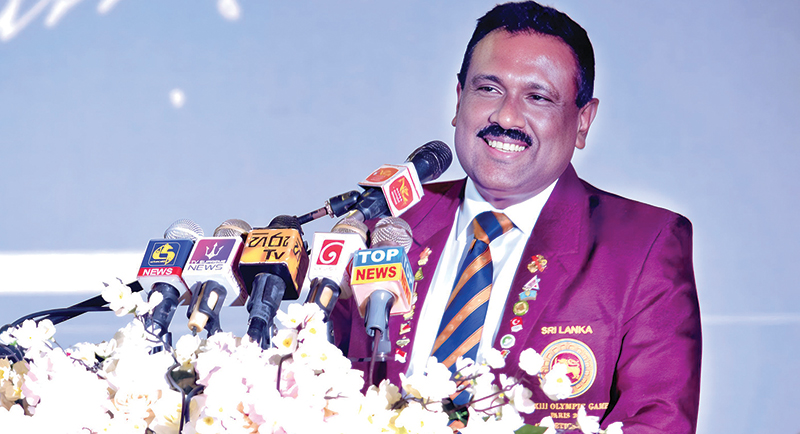
Whether it is the number of medals or the number of productive citizens it produced since its inception as s sports school, the achievements of A. Ratnayake Central Walala will remain unmatched among sports schools of the country. Behind every successful sports school stands a coach. For Ratnayake central it was Susantha Fernando—a man whose contribution to Sri Lankan athletics extends far beyond podium finishes and into the very foundations of sports education and athlete development.
For more than three decades, Fernando has been the driving force behind the track and field sucess at A. Rathnayake Central College, Walala, transforming a little kown school into one of the most dominant track and field institutions in Sri Lankan school sports history. Under his guidance, Walala achieved unprecedented sucess, winning titles at the All Island School Games, Sir John Tarbat Senior Championships and National Schools Relay Championships more than any other school in the country.
Walala’s success was not accidental. It was built on discipline, long-term planning, and a coaching philosophy that valued development over quick results. Fernando believed that talent, when nurtured patiently and systematically, could rival any advantage offered by superior facilities or urban exposure. Walala became living proof of that belief.
Renowned for his expertise in middle- and long-distance running, Susantha has been instrumental in shaping some of Sri Lanka’s finest athletes. His eye for potential and his understanding of physical and mental growth allowed young runners to mature into elite competitors on the international stage.
Among those who rose under his mentorship are Tharushi Karunaratne, Asian Games gold medalist and national 800m record holder; Dilshi Kumarasinghe, triple gold medalist at the South Asian Games and former national record holder; Manoj Pushpakumara, a multiple medalist at the Asian Junior Championships; and Indunil Herath, a national 800m record holder whose early development took place at Walala.
Collectively, athletes coached by Fernando have secured over 70 international medals, including achievements at the Asian Games, Youth Olympics, and South Asian Games. These results reflect not just individual brilliance, but a coaching system capable of producing excellence across generations.
Yet, those who know Susantha Fernando well insist his greatest strength lies beyond training schedules and race strategies. He viewed coaching as a form of education and character building. Discipline, humility, responsibility, and respect were central to his program. Winning mattered, but never at the expense of values.
This philosophy resonates strongly with long-standing discussions in Sri Lankan sports circles—often highlighted in The Island and The Sunday Island—about the need for structure, continuity, and ethics in sports development. Fernando’s career stands as a practical demonstration of those ideals.
His influence expanded when he was entrusted with duties as Assistant Director of Education (Sports and Physical Education) at the Wattegama Zonal Education Office. In this role, he has emerged as a strong advocate for reforming how physical education is treated within the school system.
Fernando proposed several progressive measures, including the introduction of mandatory termly fitness assessments for secondary students, compulsory participation in at least one sport, and the inclusion of physical fitness grades on GCE O/L and A/L result sheets. His vision was clear: physical education must be an integral part of national development, not a secondary concern.
Recognition for his work has come as Best Coach awards at Sports Awards ceremonies. More meaningful, however, was the tributes paid by former Walala athletes, his fellow officials and a distinguished gathering including former Director of Education Sunil Jayaweera at a felicitation ceremony organized by Tharanga Gunaratne, Director of Education at Wattegama Zone on the occation of his retirement from government service and at the launch of his autobiography ‘Dekumkalu Kalunika’ recently.
Both events reflected the gratitude not only for medals won, but for lives shaped.
Like many coaches working within limited systems, Fernando’s journey was marked by challenges—restricted resources, long hours, and personal sacrifice. Yet his quiet resilience ensured that standards were never compromised.
Susantha Fernando’s legacy is not confined to record books. It lives in the systems he built, the athletes he guided, and the values he instilled. As Sri Lanka continues to search for sustainable sporting success, his career offers a powerful lesson: ‘true excellence is built patiently, ethically, and with unwavering belief in people’.
In Susantha Fernando, Sri Lanka has not only produced champions—but a model of coaching worth preserving. He leaves a huge vacuum hard to fill.
Prime Minister launches Zahira College, Puttalam Website

Pretoria Capitals recover from 7/5 to beat Joburg Super Kings

Dry weather will prevail in most parts of the island

Premadasa: Grade 6 syllabus fiasco signals deeper issues

Sri Lankan Airlines launches Intl branding initiative for Colombo Nawam Maha Perahera 2026

Reports on Grade 6 module adult website link due next week

‘Dates have the highest sugar content to fight Coronavirus’

Sunday Island 27 December – Headlines

#SundayIsland 17th December – Headlines

Sunday Island – 28th March

Sunday Island Headlines – 21 March

Sunday Island – 21st February – Headlines
-

 Editorial22 hours ago
Illusory rule of law
-
 News2 days ago
UNDP’s assessment confirms widespread economic fallout from Cyclone Ditwah
-

 Business4 days ago
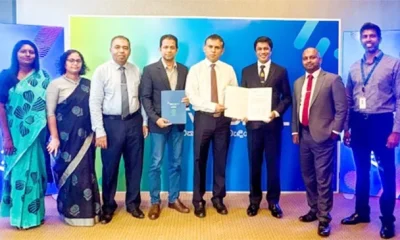
Koaloo.Fi and Stredge forge strategic partnership to offer businesses sustainable supply chain solutions
-

 Editorial2 days ago
Crime and cops
-

 Editorial3 days ago
The Chakka Clash
-
 Features22 hours ago
Daydreams on a winter’s day
-
 Business4 days ago
SLT MOBITEL and Fintelex empower farmers with the launch of Yaya Agro App
-

 Features3 days ago
Online work compatibility of education tablets