
News
More than a quarter of Lankans living in poverty – World Bank

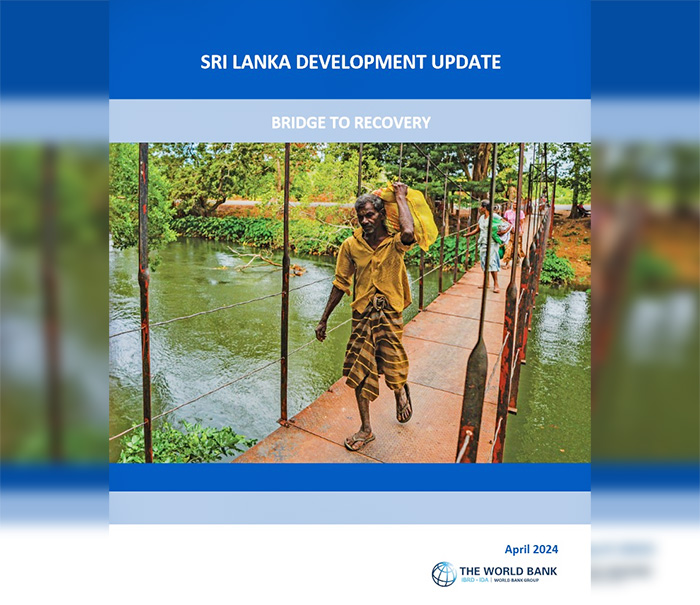
The World Bank has found that more than a quarter of Sri Lanka’s population is living in poverty,according to its latest publication.
Titled ‘World Bank Update: Bridges to Recovery’ released last week (April 2) shows that poverty has increased over the past four years—from 11 percent in 2019 to almost 26 percent in 2024 in Sri Lanka. The report briefly discusses how the unprecedented economic crisis that engulfed the country in 2022 has impacted the masses.
It however, insists that the savage austerity program dictated by the International Monetary Fund (IMF) and being implemented by the Wickremesinghe government is necessary to achieve “economic recovery.”
The World Bank report notes: “Households have been impoverished by a fall in their purchasing power due to high inflation, losses in wages, income and employment, and a drop in remittances.”
Approximately 60 percent of Sri Lankan households, it states, have decreased incomes, with many facing increased food insecurity, malnutrition and stunted growth. The persistence of this wide-scale social devastation and misery, however, is a direct result of the IMF’s brutal social attacks.
The report indicates that labour market trends in Sri Lanka have been affected by widespread closures of micro-, small- and medium-enterprises. In the third quarter of 2023, the labour force participation rate in the urban sector dropped to 45.2 percent, down from 52.3 percent in 2019. Youth unemployment, especially young adults (aged from 25–29), rose to 17.7 percent between the second and third quarters of 2023.
According to the report: “The implementation of new revenue measures increased estimated revenue as a share of GDP [Gross Domestic Product] from 8.4 percent in 2022 to 11 percent in 2023.”
As the World Bank report states: “17.5 percent of households indicated that they limited their education expenses (including on stationery and uniforms) to deal with rising costs, and most households have changed their health treatment procedures since March 2022 due to a lack of funds.”
While Sri Lanka recorded a minus 7.3 percent GDP growth rate in 2022, the World Bank said this had been reduced to minus 2.3 percent in 2023 and claimed this was “expected to turn positive” in 2024. The “improvement,” however, still means that there will be no real growth this year.
On April 2, World Bank Country Director for the Maldives, Nepal and Sri Lanka Faris Hadad-Zervos declared that the Sri Lankan economy “is on the road to recovery.” At the same time, however, he claimed that “sustained efforts to mitigate the impact of the economic crisis on the poor and vulnerable” required the government to maintain its social attacks on the working masses.
A two-pronged strategy to “maintain reforms that contribute to macroeconomic stability” and “accelerate reforms to stimulate private investment and capital inflows,” he said, must be continued. These so-called “economic reforms” mean an ever greater assault on the social position of working people.

Latest News
Our goal is to build a “Thriving Nation” where a woman can walk without fear or doubt, where her talents are duly recognized, and where she can lead a life of dignity – PM

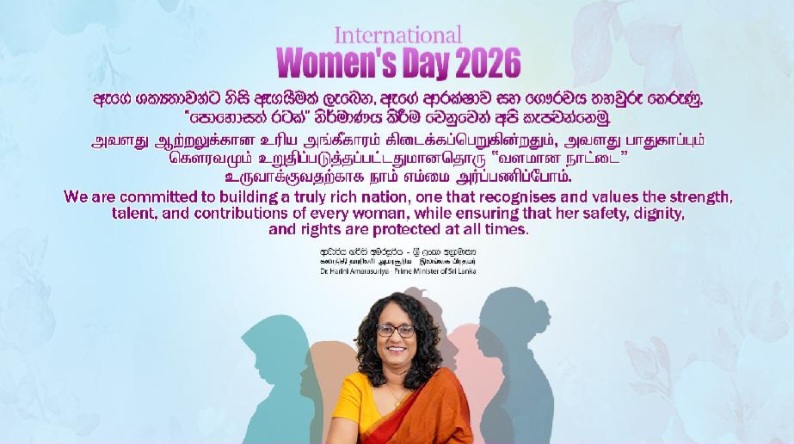
The PM’s message:
Women are the true pillar of Sri Lankan society and economy. The role they play within the family and in society has today become a decisive factor in shaping the future of our nation. Through the Government’s policy statement, “A Thriving Nation – A Beautiful Life,” we envision going beyond treating women as mere beneficiaries and recognizing them as active partners in national development, ensuring that they receive the dignity and opportunities they rightfully deserve.
Within our policy framework, special focus has been placed on women. We are committed to recognizing the economic contribution extended by women as housewives, promoting women’s entrepreneurship, and expanding access to the technical and financial support necessary for self-employment alongside strengthening the legal framework required to ensure women’s safety in public transport, workplaces, and within the family environment. Further, we are taking steps to create the environment to increase women’s representation in decision-making bodies at national and regional levels. Special attention is also being given to implementing targeted programmes aimed at improving women’s nutrition, reproductive health, and mental well-being.
Women are not a group seeking sympathy; they are vital social partners endowed with intelligence, resilience, and creativity. Our goal is to build a “Thriving Nation” where a woman can walk without fear or doubt, where her talents are duly recognized, and where she can lead a life of dignity
On this International Women’s Day, I sincerely hope that it marks the beginning of a new era in which the aspirations of all women in our country are realized as they shine before the world.
Latest News
Heat Index at Caution Level in the Sabaragamuwa, North-western and North-central provinces and in Colombo, Gampaha, Vavuniya, Mannar, Hambantota and Monaragala districts
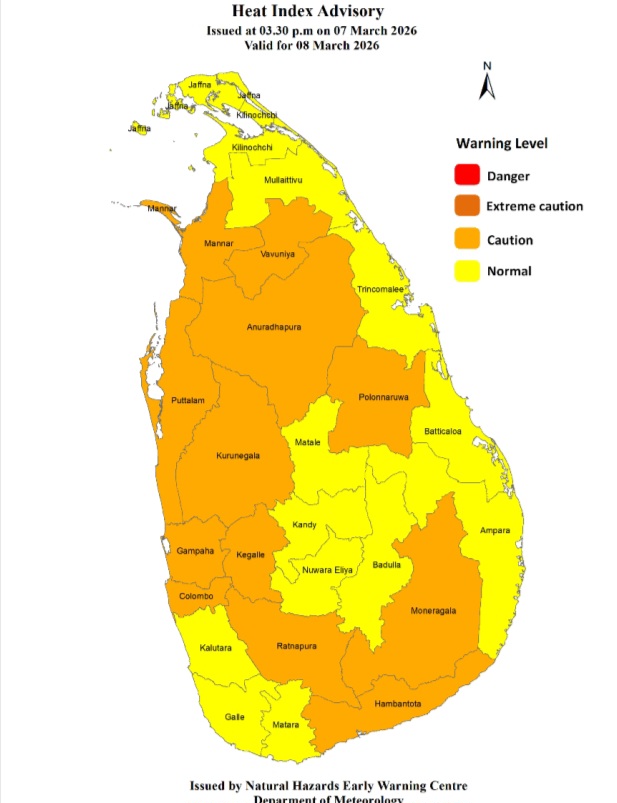
Warm Weather Advisory issued by the Natural Hazards Early Warning Centre of the Department of Meteorology at 3.30 p.m. on 07 March 2026, valid for 08 March 2026.
Heat index, the temperature felt on human body is likely to increase up to ‘Caution level’ at some places in the Sabaragamuwa, North-western and North-central provinces and in Colombo, Gampaha, Vavuniya, Mannar, Hambantota and Monaragala districts
The Heat Index Forecast is calculated by using relative humidity and maximum temperature and this is the condition that is felt on your body. This is not the forecast of maximum temperature. It is generated by the Department of Meteorology for the next day period and prepared by using global numerical weather prediction model data.

Effect of the heat index on human body is mentioned in the above table and it is prepared on the advice of the Ministry of Health and Indigenous Medical Services.
ACTION REQUIRED
Job sites: Stay hydrated and takes breaks in the shade as often as possible.
Indoors: Check up on the elderly and the sick.
Vehicles: Never leave children unattended.
Outdoors: Limit strenuous outdoor activities, find shade and stay hydrated.
Dress: Wear lightweight and white or light-colored clothing.
Note:
In addition, please refer to advisories issued by the Disaster Preparedness & Response Division, Ministry of Health in this regard as well. For further clarifications please contact 011-7446491.

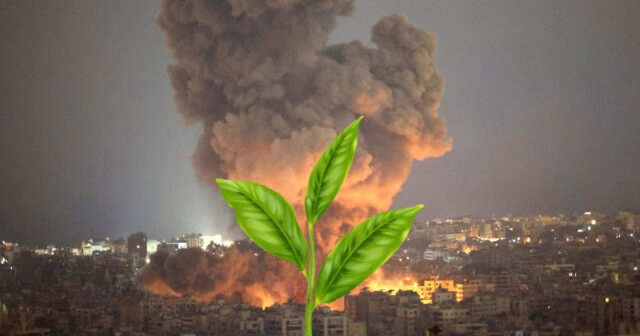
The ongoing military conflict in the Middle East has adversely impacted on the Sri Lankan tea industry as the exporters are unable to supply tea to the region. The exporters estimate the revenue loss at about $ 10-15 million per week. The exporters have orders in hand for supply of tea and it is the logistical issues and war risk preventing them fulfilling such orders, the Tea Exporters Association (TEA) said in a statement.
“In order to mitigate the impact on the industry, the tea industry has jointly requested the government to support it in addressing the cash flow issue and consider absorbing a part of the additional freight and insurance charges. It has also requested government intervention to obtain the balance payment of about $ 50 million due on tea shipments already made to Iran under the barter deal,” TEA said on Friday.
The statement said approximately 52% of Sri Lanka’s tea exports reach the affected region mainly coming from the low grown area of the country dominated by tea smallholder farmers. According to 2025 tea export statistics, about 125 million kilograms of Ceylon tea were exported to the Middle East, with an estimated value of USD 750 million. The major importing countries of Ceylon Tea in the region include Iraq, Iran, Libya, Turkey, Saudi Arabia, Syria, and the United Arab Emirates. Though Libya and Turkey can be reached via Africa, the exorbitant freight charges have prevented the buyers in those countries from importing tea at the moment.
The supply routes to Middle East countries go via Strait of Hormuz and Red sea Suez Canal. Although there is no blockade on Suez Canal, due to the war risk both channels are currently not used by the major shipping lines. The tea exports to the region have almost come to a standstill due to the following reasons:
=All major shipping lines suspended their services to the region immediately after the outbreak of the conflict.
=Several seaports in the region were temporarily closed during the initial stages.
= Although a few shipping lines resumed limited operations from March 4, freight charges have
increased significantly by approximately USD 1,800 for a 20’ container and USD 3,000 for a 40’ container.
= Existing insurance coverage obtained by exporters is no longer valid.
=There is a lack of regular and scheduled vessels operating from Colombo to Middle Eastern destinations.
The tea exporters are experiencing serious cash flow constraints, as payments for shipments already
dispatched have been delayed due to the unsettled situation in the region. This has restricted exporters’
buying capacity and that was evident at this week’s tea auction, where overall prices declined by about Rs. 50/ per kg while low grown tea prices declined by about Rs. 75/ per kg.
If the situation continues for few more weeks it will have a serious impact on the tea auction as buyers may curtail the purchase of tea if the outward movements are restricted. This could directly impact on the income of the tea smallholder farmers.
In January 2026, the country earned $ 121.8 million from tea exports compared to $ 112.7 million in January 2025 (a 5% increase). The figures for February 2026 are not yet available but should be either similar to last year or higher. The disruption to tea exports in March will certainly affect the volume and value of the exports though the exact amounts cannot be estimated at this point.
According to the available data Sri Lanka has settled about 95% of its debt to Iran by supplying tea to Iran under the Tea for Oil mechanism. Even if the military conflict comes to an end, Sri Lanka will find it difficult to continue to supply tea to Iran unless a new mechanism is introduced. Under the prevailing US sanctions on Iran, the exporters may not be able to supply tea to Iran outside the barter system. Iran purchases about 11 million kg of tea from Sri Lanka annually under the barter deal.
The situation was discussed with the Minister of Plantation & Community Infrastructure at a meeting held on March 4, 2026.

Heavy rains and flooding kills at least 23 in Nairobi

Rapper-politician Balendra Shah unseats Nepal’s ex-PM as he heads for victory

Triumph and disaster: India, New Zealand and a trophy for one

Sutherland’s sublime century and Hamilton’s night-time burst flatten India

Trump says US does not need UK aircraft carriers for Iran war

Our goal is to build a “Thriving Nation” where a woman can walk without fear or doubt, where her talents are duly recognized, and where she can lead a life of dignity – PM

‘Dates have the highest sugar content to fight Coronavirus’

Sunday Island 27 December – Headlines

#SundayIsland 17th December – Headlines

Sunday Island – 28th March

Sunday Island Headlines – 21 March

Sunday Island – 21st February – Headlines
-
 Features6 days ago
Brilliant Navy officer no more
-
 News2 days ago
University of Wolverhampton confirms Ranil was officially invited
-

 Opinion6 days ago
Sri Lanka – world’s worst facilities for cricket fans
-

 News3 days ago
Legal experts decry move to demolish STC dining hall
-

 Features6 days ago
A life in colour and song: Rajika Gamage’s new bird guide captures Sri Lanka’s avian soul
-

 News2 days ago
Female lawyer given 12 years RI for preparing forged deeds for Borella land
-

 Business4 days ago
Cabinet nod for the removal of Cess tax imposed on imported good
-

 News1 day ago
Wife raises alarm over Sallay’s detention under PTA