
Midweek Review
Missed opportunities!

By Shamindra Ferdinando
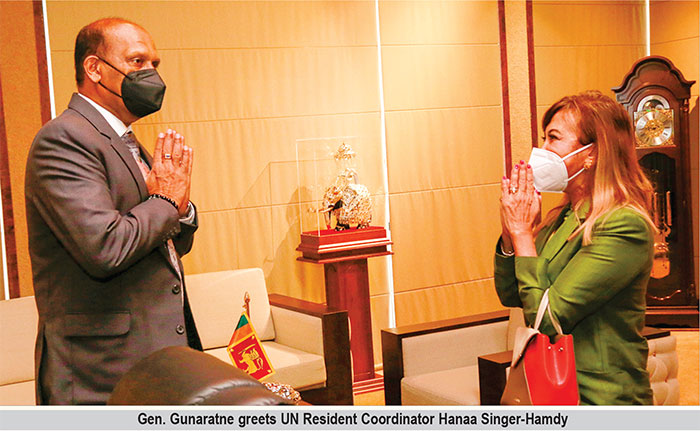
UN Resident Coordinator in Colombo Hanna Singer-Hamdy paid a courtesy call on Defence Secretary (retd.) Gen. Kamal Gunaratne on Sept. 23 at the Defence Headquarters Complex, Sri Jayewardenepura, Kotte. The Egyptian was accompanied by the head of the United Nations Office on Drugs and Crime (UNODC) Alan Cole, formerly of the British Royal Navy.
The discussion covered Sri Lanka’s high profile ongoing campaign against narcotics trade and the government’s response to the raging Covid-19 epidemic.
A brief press release issued by Lt. Col. Nalin Herath, Officiating Director, Army Media Centre, in Sinhala, Tamil and English didn’t make reference to any other issue. Therefore, the writer rationally ascertained that no other matter had been taken up at the discussion.
Against the backdrop of the 48th session of the Geneva-based United Nations Human Rights Council (UNHRC) and the 76th session of the UNGA in New York, the Sri Lanka Podujana Peramuna (SLPP) government could have used the Sept. 23 meet to brief the UN Resident Coordinator Singer as regards the accountability process.
The Defence Secretary, on behalf of the government, could have handed over a comprehensive report to the top UN official in Sri Lanka, in response to one-sided and high-handed the war crimes agenda pursued by the UNHRC against the country. Unfortunately, the government didn’t. The failure on the part of the government to do so underscored the absence of a cohesive mechanism to counter the campaign targeting Sri Lanka. Shoddy handling of the accountability process is an affront to the war-winning military that sacrificed so much to fight and defeat, militarily, ‘the world’s worst terrorist outfit’. More than 12 years after the eradication of the Liberation Tigers of Tamil Eelam (LTTE), Sri Lanka remains under the UNHRC microscope, while many other countries, that caused death and misery to millions by launching false pretext wars or through illegal regime change actions are allowed to go scot-free.
For some strange reason, most probably for lack of competence at the Foreign Ministry, the government is reluctant to properly present Sri Lanka’s case before the international community. Let us hope that with Prof. G.L. Peiris, the eminent former law academic at the helm of the Foreign Ministry, we can mount a relentless diplomatic campaign to have the country cleared from such blatant accusations. In the process, it could even go to the extent of exposing, particularly our main accusers, who despite having plenty of innocent blood in their hands are pursuing this vendetta against us due to geo-political agendas.
The wartime General Officer Commanding (GoC) the elite 53 Division, the then Maj. Gen. Gunaratne could have meticulously briefed the UN Chief here, who, too, has had the audacity to make public comments on the country’s internal affairs and get away with such behaviour.
The author of ‘Road to Nanthikadal’, Gunaratne commanded one of the two fighting Divisions, the other being the 58 Division commanded by the present Army Commander, General Shavendra Silva, involved in the final phase of the offensive. It would be pertinent to mention that a battalion (4 Vijayabahu Infantry Regiment) that had been under the overall command of the then Maj. Gen. Gunaratne killed Prabhakaran. The 53 Division had been involved in the unprecedented Anandapuram battle (late March-early April 2009) along with 58 Division and Task Force 8 that dealt a massive blow to the LTTE.
Why didn’t the government exploit the Sept. 23 meet that took place the day after President Rajapaksa addressed the 76th session of the UNGA in New York?
Sri Lanka’s continuing failure to set the record straight should be examined taking into consideration UNHRC Chief Michelle Bachelet’s latest oral update on the situation in Sri Lanka (on Sept. 13), Foreign Minister Prof. G.L. Peiris’ response by Zoom to the former twice Chilean President Bachelet on the following day, President Rajapaksa’s meet with UNSG Antonio Guterres (on Sept. 19), President Rajapaksa’s address to the UNGA (Sept. 20) and three meetings Foreign Minister Prof. G.L. Peiris had with Commonwealth Secretary General Patricia Scotland, Australian Foreign Minister Marise Payne and Indian Foreign Minister Dr. S. Jaishankar also in New York.
The Defence Secretary is the ideal person to discuss the accountability issue. With Sri Lanka firmly on the UN agenda and the issue coming up for scrutiny once again at the 49th session in March 2022, the government cannot turn a blind eye to the developments taking place.
Vanni war compared with Ruwanda et al
 Antonio Guterres’s predecessor, Ban Ki-moon once compared the Vanni offensive with that of Ruwanda and Serbia genocides in the 1990s. Gunaratne strongly disputed Ban Ki-moon’s comparison of Vanni offensive with clear cut cases of genocide in those two countries
South Korean Ki-moon played his part to facilitate the Western agenda in spite of his own mission in Colombo contradicting unsubstantiated accusations.
The government owed an explanation why absolutely no attempt was made in Geneva or New York to challenge the unsubstantiated war crimes allegations that paved the way for Western powers and other interested parties to place Sri Lanka on the Geneva agenda.
Instead of setting the record straight, President Rajapaksa assured his readiness to work with domestic stakeholders, international partners, UN, civil society and Tamil expatriate groups, whereas FM Peiris reiterated Sri Lanka’s commitment to some key provisions in the resolution co-sponsored by the then Yahapalana government in 2015 as fait accompli, while strongly rejecting external interventions.
In separate meetings with Aussie Foreign Minister Patricia, Scotland Marise Payne and Indian counterpart Dr. Jaishankar, Prof. Peiris explained ground realities and the hostile approach adopted by interested parties. Prof. Peiris also elucidated to Scotland the wrongness in replacing domestic accountability mechanisms with external bodies, particularly the ad-hoc mechanism approved at the 46th Geneva session.
Bachelet declared in her Sept. 13 speech that the UNHRC was going ahead with the investigation. Sri Lanka shouldn’t expect Scotland to take a stand favourable to Sri Lanka, under any circumstances, as the organisation Bachelet leads conveniently turned a Nelsonian eye to Indian sponsored terrorism that ravaged Sri Lanka. Did Commonwealth ever take a stand on the destabilisation of the smaller neighbour by the Commonwealth giant?
Prof. G.L. Peiris told his Australian counterpart Marise Payne how Bachelet followed a policy extremely detrimental to Sri Lanka as regards the accountability process. A Foreign Ministry press release quoted Prof. Peiris as having told Payne: “….there is a need to allow local institutions the space and opportunity to carry out their mandates and the establishment of an ad-hoc external mechanism that overrides this work is unnecessary and detrimental. It is premature and inappropriate to have a mechanism selectively targeting Sri Lanka that goes against the very principles of the UN Charter.”
Australia is aware of the Geneva project meant to undermine Sri Lanka. Regardless of close bilateral relations between Australia and Sri Lanka, the former will abide by the US position vis-a-vis Sri Lanka. The Australian policy should be examined, keeping in mind its role in the US-led alliances against China and extremely close relationship between Sri Lanka and China, the emerging world power.
The surprise Australia, the UK and the US (AUKUS) alliance struck recently, at the expense of France, on supplying a nuclear powered submarine fleet to their colonial cousin Australia should be an example of the old adage that blood is thicker than water.
The new three nation Anglo-Saxon alliance suddenly arrayed against China should also serve as a warning to New Delhi that it is already an odd partner, though one of the earliest to sign up for Quad, comprising the US, Japan, India and Australia ranged against China. If they could ditch long standing European ally France without batting an eye lid, Delhi can imagine how they will treat her if they suddenly see India too as a rival like China.
French Foreign Minister Jan-Yves Le Drian went to the extent of alleging US President Joe Biden of stabbing France in the back.
“It’s really a stab in the back. We had established a relationship of trust with Australia, this trust has been betrayed”, Foreign Minister Jean-Yves Le Drian told France Info radio. “I’m very angry today, and bitter… this is not something allies do to each other”, he said, noting that Australia would now have to explain how it would exit the contract.
A lesson for France
So Sri Lanka should not depend on foreign powers, entirely. It would be Sri Lanka’s responsibility to present its case before the global community. Major Western powers will never take a stand in support of a smaller nation at the expense of their overall strategy and lucrative business interests, the only exception being the case of Israel. There cannot be a better example than Australia going back on an agreement with France for what it considered a much better arrangement for Canberra. Obviously, not only Biden but the British and Australian leaders, too, stabbed France in the back.
In his talks with Dr. Jaishankar, Prof. Peiris declared Sri Lanka couldn’t accept external mechanisms active on the ground whereas the Indian Minister underscored the need for a fair and just resolution of residual issues in the interest of both countries.
Sri Lanka seems trapped in the eneva machinations. India, too, should be wary as its much touted relationship with the US does not mean a thing if one examined the way the US, the British and Australians sprang quite a despicable surprise.
Hope the world hasn’t forgotten how the US discarded Pakistan after having used the country in its proxy war to oust the Soviet Union from Afghanistan and to intimidate India when it was seen as being in Soviet camp. New Delhi remained noncommittal regarding the Soviet invasion of Afghanistan.
In fact, Indian destabilisation of Sri Lanka, in the 80s, is in line with its overall strategy to counter domestic threats emanating from Tamil Nadu in the backdrop of perceived threat of Sri Lanka being a base for US-Israeli operations.
However, for want of cohesive policy Sri Lanka, at least after the end of the war hadn’t made a genuine effort to set the record straight.
Prof. Peiris during his interactions with foreign dignitaries, has quite clearly explained Sri Lanka’s refusal to accept external mechanisms. President Rajapaksa, too, stressed the importance of domestic mechanisms in achieving reconciliation. Both the President and the Foreign Minister declared Sri Lanka’s readiness to work with domestic stakeholders, including the civil society, Tamil expatriate groups, international partners and the UN to accomplish genuine peace.
Pompeo on Shavendra
However, the incumbent government has so far failed to question the very basis for domestic mechanisms set up by the previous government on the strength of unsubstantiated allegations. The government owed an urgent explanation. There cannot be any excuse for not presenting a proper defense on behalf of the war-winning armed forces. Commander of the Army Gen. Shavendra Silva remains blacklisted by the US on unsubstantiated allegations. Let me reproduce the former US Secretary of State Mike Pompeo declaration on Feb 14, 2020: “I am designating Shavendra Silva making him ineligible for entry into the U.S. due to his involvement in extrajudicial killings during Sri Lanka’s Civil War. The U.S. will not waver in its pursuit of accountability for those who commit war crimes and violate human rights.”
The US made the announcement after President Gotabaya Rajapaksa named Silva the Chief of Defence Staff (CDS). Another Gajaba Regiment veteran Chagie Gallage highlighted Sri Lanka’s pathetic failure to defend the military when he retired on August 31, 2018.
There had never been a previous instance of a senior officer in his farewell speech questioning the overall failure to counter the foreign project. This happened at Saliyapura, the famed Gajaba Regimental Headquarters.
He said: “Gajaba is engraved in golden letters in the annals of the Sri Lanka Army’s history, if not in the history of Sri Lanka … and I’m certain it will never be reversed by any. So, I’m happy to be retired being a tiny particle of that proud chapter of the history, though designated as a ‘War Criminal”.
About 10 months before Gallage’s retirement, Lord Naseby made a stunning revelation in the House of Lords. On the basis of hitherto confidential dispatches from the British High Commission in Colombo, during January-May 2009, the Conservative politician contradicted the very basis of the three-member Darusman report. This report, released on March 31, 2011, had been the primary reason for the 2015 accountability resolution that faulted the Sri Lanka Army.
The World War 11 fighter pilot fought a near three-year battle with the British administration to secure the confidential dispatches and was finally able to obtain a highly redacted version to contradict the lies in the second week of Oct 2017. Although the then Foreign Minister Tilak Marapana, PC, in his address to the UNHRC made a reference to Lord Naseby’s revelations, Sri Lanka has so far not requested Geneva to examine the British dispatches.
The author of British dispatches Lt. Col. Anthony Gash has never challenged the authenticity of heavily censored dispatches disclosed by Lord Naseby.
Sri Lanka earlier squandered a similar golden opportunity to make a strong case for a revisit of the Darusman report in June 2011. The then US Defence Advisor in Colombo Lt. Col. Lawrence Smith quite convincingly defended the Sri Lanka Army at the 2011 Colombo Defence Seminar. The American contradicted unsubstantiated allegations raised by a retired Indian Major General Ashok K. Metha, formerly of the IPKF. Lt. Col. Smith must have made that declaration, based on information available to the US Embassy in Colombo as well as other dispatches from our war zone. And most importantly, the American officer made the declaration within three months after the releasing of the Darusman report. Sri Lanka is yet to use British and American dispatches in her defence.
Western powers continue to harass Sri Lanka on the basis of unsubstantiated war crimes accusations. Bachelet’s move to further investigate Sri Lanka should be challenged as the previous accusations that led to the 2015 Geneva resolution remained uninvestigated.
According to the Darusman report (paragraph 23: Confidentiality of the Panel’s records), the accusations cannot be examined till 2031. This strange stipulation has a further clause stating that the time bar could be extended for a further period. We must be the only country not allowed to see our accusers or the case against us for so long! But, successive governments never took the entire gamut of issues into consideration before making representations on behalf of the country. The incumbent SLPP is no exception. In spite of repeated vows to defend the armed forces, the SLPP had pathetically failed in its duty and responsibility.
Predicament of former SLAF Chief
As a result of sheer negligence, Sri Lanka has ended up being categorised as a perpetrator of war crimes, and those who had fought for the country are targeted. There cannot be a better example than Air Marshal Sumangala Dias who suffered due to Sri Lanka’s failure. Canada refused to accept Dias as Sri Lanka’s High Commissioner though the former Sri Lanka Air Force Commander is not under human rights scrutiny. Subsequently, the government proposed Dias as Sri Lanka’s Ambassador to Italy. However, we are yet unaware of Italy’s position. Italy as a member state of the EU, pursuing war crimes accusations against Sri Lanka, may not accept the retired SLAF Chief.
Prominent civil society activist Harsha Kumara Navaratne has quit the Human Rights Commission to take over the country’s mission in Ottawa. The former head of the NGO Seva Lanka, with his experience with the HRC, hopefully would be able to improve Sri Lanka’s image in Canada. The decision to name former minister Mahinda Samarasinghe as Sri Lanka’s Ambassador in Washington, too, is an interesting development. Samarasinghe handled human rights and related matters during Mahinda Rajapaksa’s presidency and was part of Sri Lanka’s delegation to Geneva. Perhaps the government expects missions in Washington (non- career diplomat), Ottawa (non- career diplomat) and London manned by career diplomat Saroja Sirisena to improve the ground situation. New Delhi should be part of the operation. Milinda Moragoda, who had served Ranil Wickremesinghe’s government as a Cabinet minister before switching allegiance to Mahinda Rajapaksa, recently took over the New Delhi mission. So, we now have two former ministers as heads of missions in New Delhi and Washington and prominent civil society activist in Ottawa.
Samarasinghe last served as the Ports and Shipping Minister. Having succeeded Arjuna Ranatunga (UNP), Samarasinghe, who represented the SLFP at that time, signed the 99-year-lease on the Hambantota port. Navaratne quit Seva Lanka chairmanship last month having disengaged from the NGO’s activity, beginning January this year. Navaratne’s appointment is in line with the government entering into a dialogue with the local civil society as well as President Gotabaya Rakapaksa’s declaration in New York his readiness to talk with Tamil expatriate groups. Whatever, the SLPP government does, it should set up a mechanism, without further delay, to counter those propagating lies in support of the Geneva project.
A role for ex-CNI
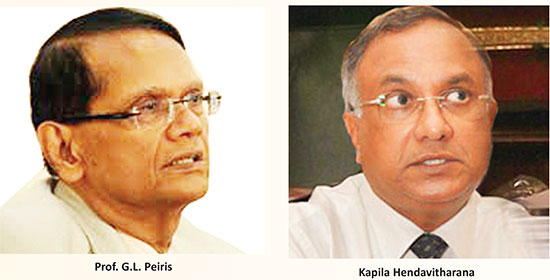
Perhaps former Chief of National Intelligence (CNI), Maj. Gen. Kapila Hendavitharana can be engaged to work out a proper strategy. Intelligence veteran Hendavitharana can be part of a special team assigned to build a strong case on behalf of the country on the basis of available information.
The information unintentionally made available by those pursuing war crimes probe can be quite useful to Sri Lanka as they are astonishing. Let there be a meticulous study of statements, accusations, documents and reports pertaining to accountability issues. Bachelet rushing to accuse the Sri Lanka Army of being responsible for so-called mass graves in Mannar, discovered in 2019, exposed the irresponsible conduct of the Geneva body, when a reputed US lab determined that those remains belonged to the colonial era.
Bachelet obviously acted on information provided by some Colombo-based diplomatic missions. There is no doubt that the British HC and the German Embassy in Colombo (both members of the self-appointed Sri Lanka Core Group in Geneva) influenced Bachel’s decision.
Due to petty political backbiting, Sri Lanka then lacked the political will to expose the Geneva project. As the simmering controversy over Mannar mass graves erupted during the yahapalana administration, the Foreign Ministry conveniently remained silent. That was nothing but treacherous behaviour and the Ministry, as one of the most important institutions, should be ashamed.
Sri Lanka didn’t have the guts to use Bachelet’s irresponsible conduct to challenge the overall process. Had there been a proper review of facts, since the change of government in Nov 2019, Gen. Gunaratne could have exploited his meeting with Hanaa Singer-Hamdy.

Did CIA chief William Burns visit Colombo in Feb 2023? Sri Lanka and the US refrained from formally confirming the visit. The Opposition sought confirmation of the then CIA Chief’s visit to Colombo in terms of the Right to Information Act but the Wickremesinghe-Rajapaksa government sidestepped the query. A former Republican congressman from Texas and Director of National Intelligence (2020–2021) John Ratcliffe succeeded Burns in late January 2025.
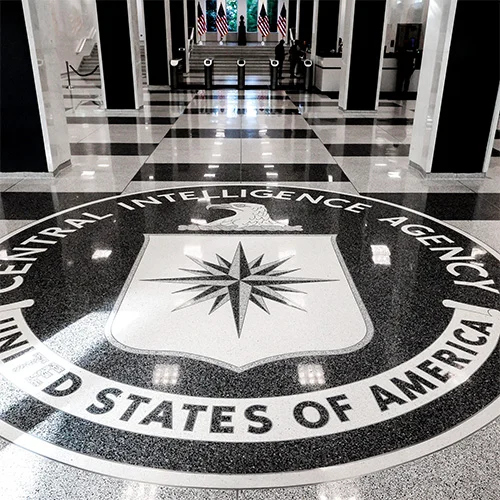
On the sheer weight of new evidence presented by Asanga Abeyagoonasekera’s ‘Winds of Change’, readers can get a clear picture of the forces that overthrew President Gotabaya Rajapaksa in 2022.
Even five years after the political upheaval, widely dubbed ‘Aragalaya,’ controversy surrounds the high-profile operation that forced wartime Defence Secretary Gotabaya Rajapaksa to literally run for his dear life.
Gotabaya Rajapaksa, formerly of the Army but a novice to party politics, comfortably won the 2019 November presidential election against the backdrop of the Easter Sunday carnage that caused uncertainty and suspicions among communities. The economic crisis, also clandestinely engineered from abroad, firstly by crippling vital worker remittances from abroad, almost from the onset of Gotabaya Rajapaksa’s presidency, overwhelmed the government and created the environment conducive for external intervention. Could it have been avoided if the government, that enjoyed a near two-thirds majority in Parliament, sought the help of the International Monetary Fund (IMF)?
The costly and well-funded book project, undertaken at the time Abeyagoonasekera was working on a governance diagnostic report for the IMF, in the wake of the change of government in Sri Lanka, meticulously examined the former Lieutenant Colonel’s ouster, taking into consideration regional as well as global developments. Abeyagoonasekera dealt efficiently and furiously with rapidly changing situations and developments before the unprecedented 03 January, 2026, US raid on Venezuela.
Lt. Col. (retd) Gotabaya Rajapaksa, for some unexplainable reason and a considerable time after the events, has chosen to blame his ouster on the United States. We cannot blame him either, by the way we have seen how other regime changes had been engineered, in our region, by Washington, since and before Gotabaya’s ouster. The accusation is extraordinary as Gotabaya Rajapaksa in his memoirs ‘The conspiracy to oust me from presidency’ refrained from naming the primary conspirator, though he clearly alluded to an international conspiracy.
April 8, 2019 meeting
Launched in March 2024, in the run-up to the presidential election that brought Anura Kumara Dissanayake (AKD) to power, almost in a dream ride, if not for the intervening outside evil actors, ‘The conspiracy to oust me from presidency’ discussed the international conspiracy, but conveniently failed to name the primary conspirator. What made the former President speak so candidly with Abeyagoonasekera, the founding Director-General of the national security think tank, the Institute of National Security Studies Sri Lanka (INSS), under the Ministry of Defence, from 2016 to 2020?
Abeyagoonasekera also served as Executive Director at the Lakshman Kadirgamar Institute (LKI), under the Ministry of Foreign Affairs (2011–2015), during Mahinda Rajapaksa’s second term as the President. The author, both precisely and furiously, dealt with issues. Readers may find very interesting quotes and they do give a feeling of the author’s general hostility towards the US, India, as well as to the US-India marriage of convenience. Those who sense so may end up thinking ‘Change of Winds’ being supportive of the Chinese strategy. Among the highly sensitive quotes that underlined the Indian approach were attributed to Indian Defence Secretary Sanjay Mitra. The author quoted Mitra as having declared: “We need the MRCC centre [Maritime Rescue Coordination Centre], and you cannot give it to another nation.” As pointed out by the author, it was not a request but an order given to Sri Lanka on 8 April, 2019, meant to prevent Sri Lanka from even considering a competing proposal from China. Against that background, the author, who had been present at that meeting at which the Sri Lanka delegation was led by then Defence Secretary Hemasiri Fernando, questioned the failure on the part of the delegations to take up the Easter Sunday attacks. Terrorists struck two weeks later. Implications were telling.
That particular quote reveals the circumstances India and the US operated here. No wonder the incumbent government does not want to discuss the secret defence MoUs it has entered into with India and the US as they would clearly reveal the sellout of our interests.
The following line says a lot about the circumstances under which Gotabaya Rajapaksa was removed: “In Singapore, a senior journalist recounted how Gotabaya Rajapaksa’s resignation was scripted, under duress, at a hotel, facilitated by a foreign motorcade.”
In the first Chapter that incisively dealt with the Belt and Road Initiative (BRI), the author was so lucky to secure an explosive quote from the ousted leader in an exclusive, hitherto unreported, interview in June 2024, a few months after the launch of Gotabaya Rajapaksa’s memoirs. The ex-President hadn’t minced his words when he alleged that the Central Intelligence Agency (CIA) orchestrated his removal. He also claimed that he had been under US surveillance throughout his presidency.
The ousted leader has confidently cleared India’s Research and Analysis Wing (RAW) of complicity in the operation. What made him call Indian National Security Advisor (NSA) Ajit Doval ‘a good man,’ in response to Abeyagoonasekera’s pointed query. Abeyagoonasekera quoted Gotabaya Rajapaksa as having said: “… he would never do such things.” The ex-President must have some reason to call Doval a good friend, regardless of intense pressure exerted on him and the Mahinda Rajapaksa government by the Indians to do away with large scale Chinese-funded projects. (Doval in late October last year declared “poor governance” was the reason behind uprisings that led to change of governments in Bangladesh, Nepal, and Sri Lanka over the period of past three-and-a-half years. The media quoted Doval as having said, during a function in New Delhi, that democracy and non-institutional methods of regime change in countries, such as Bangladesh, Sri Lanka and Nepal, created their own set of problems. That was the first time a senior Indian government official made remarks on Nepal’s government change, followed by the Gen Z uprising in early September, 2025.)
Gotabaya Rajapaksa also cleared the Chinese of seeking to oust him. It would be pertinent to mention that China reacted sternly when at the onset of the Gotabaya presidency, the President suggested the need to re-negotiate the Hambantota Port deal.
During the treacherous ‘Yahapalana’ administration (2015 to 2019) Gotabaya Rajapaksa told me how Doval had pressed him to halt not only the Colombo Port City project but to take back Hambantota Port as well. By then, the Chinese had twisted the arms of the Yahapalana leaders Mairthpala Sirisena and Ranil Wickremesinghe and secured the Hambantota Port on a 99-year lease in a one-sided USD 1.2 bn deal. The Colombo Port City project, that had been halted by the Yahapalana government, too, was resumed possibly under Chinese threat or for some money incentive.
Once Wijeyadasa Rajapakshe, PC, declared, at a hastily arranged media briefing at Sri Lanka Foundation (SLF), that Sri Lanka would be relentlessly targeted as long as the Chinese held the Hambantota Port. The writer was present at that media briefing.
Wijeyadasa Rajapakshe said so in the aftermath of the 2019 Easter Sunday carnage, while disclosing his abortive bid to convince the Yahapalana government to abrogate the Hambantota Port deal. Did the parliamentarian know something we were not aware of? The author’s assessment, regarding the Easter Sunday attacks, based on interviews with Chinese officials and scholars, is frightening and an acknowledgement of a possible Western role in Sri Lanka’s destabilisation plot.
The ousted leader, in his lengthy interview with Abeyagoonasekera, made some attention-grabbing comments on the then US Ambassador here, Julie Chung. The ex-President questioned a particular aspect of Chung’s conduct during the protest campaign but his decision not to reveal it all in his memoirs is a mystery. Perhaps, one of the most thought-provoking queries raised by Abeyagoonasekera is the rationale in Gotabaya Rajapaksa’s claim that he didn’t want to suppress the protest campaign by using force against the backdrop of his own declaration that the CIA orchestrated the project.
Author’s foray into parliamentary politics
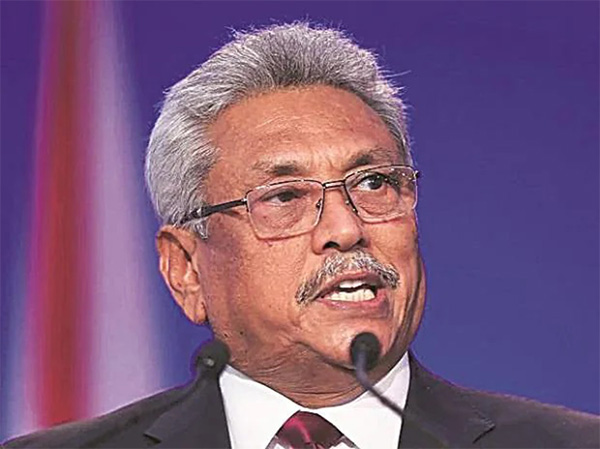
Gotabaya
For those genuinely interested in post-Chandrika Bandaranaike Kumaratunga developments, pertaining to international relations and geopolitics, may peruse ‘Winds of Change’ as the third of a trilogy. ‘Sri Lanka at Crossroads’ (2019) dealt with the Mahinda Rajapaksa period and ‘Conundrum of an Island’ (2021) discussed the treacherous Sirisena–Wickremesinghe alliance. The third in the series examined the end of the Sri Lanka Podujana Peramuna’s (SLPP) President Gotabaya Rajapaksa’s rule and the rise of Anura Kumara Dissanayake (AKD) whom the author described as a Marxist, though this writer is of the view the JVP and NPP leader AKD is not so. AKD has clearly aligned his administration with US-India while trying to sustain existing relationship with China.
Among Asanga Abeyagoonasekera’s other books were ‘Towards a Better World Order’ (2015) and ‘Teardrop Diplomacy: China’s Sri Lanka Foray’ (2023, Bloomsbury).
Had Abeyagoonasekera succeeded in his bid to launch a political career in 2015, the trilogy on Sri Lanka may not have materialised. Abeyagoonasekera contested the Gampaha district at the August 2015 parliamentary election on the UNP ticket but failed to garner sufficient preferences to secure a place in Parliament. That dealt a devastating setback to Abeyagoonasekera’s political ambitions, but the Wickremesinghe-Sirisena administration created the Institute of National Security Studies Sri Lanka (INSS), under the Ministry of Defence, for him. Abeyagoonasekera received the appointment as the founding Director-General of the national security think tank, from 2016 to 2020.
Several persons dealt with ‘Aragalaya’ (the late Prof. Nalin de Silva used to call it (Paragalaya) before Abeyagoonasekera though none of them examined the regional and global contexts so deeply, taking into consideration the relevant developments. Having read Wimal Weerawansa’s (Nine: The hidden story), Sena Thoradeniya’s (Galle Face Protest; Systems Change or Anarchy?). Mahinda Siriwardena’s (Sri Lanka’s Economic Revival – Reflection on the Journey from Crisis to Recovery) and Prof. Sunanda Maddumabandara’s (Aragalaye Balaya), the writer is of the opinion Abeyagoonasekera dealt with the period in question as an incisive insider.
Abeyagoonasekera, as a person who left the country, under duress, in 2021, painted a frightening picture of a country with a small and vulnerable economy trapped in major global rivalries. The former government servant attributed his self–imposed exile to two issues.
The first was the 2019 Easter Sunday carnage. Why did the Wickremesinghe-Sirisena government ignore the warning issued by Abeyagoonasekera, in his capacity as DG INSS, in respect of the Easter Sunday bombing campaign? There is absolutely no ambiguity at all in his claim. Abeyagoonasekera insists that he alerted the government four months before the National Thowheed Jamath (NTJ) bombers struck. The bottom line is that Abeyagoonasekera had issued the warning several weeks before India did but those at the helm of that inept administration chose to turn a blind eye.
The second was the impending economic crisis that engulfed the country in 2022. Abeyagoonasekera is deeply bitter about his arrest on 21 July, 2024, at the Bandaranaike International Airport (BIA) over an alleged IRD –related offence as reported at that time, especially because he was returning home to visit his sick mother.
Asanga’s father Ossie, a member of Parliament and controversial figure, was killed in an LTTE suicide attack at Thotalanga in late Oct. 1994. The Chairman and leader of Sri Lanka Mahajana Pakshaya had been on stage with then UNP presidential election candidate Gamini Dissanayake when the woman suicide cadre blasted herself. The assassination was meant to ensure Kumaratunga’s victory. The LTTE probably felt that it could manipulate Kumaratunga than the experienced Dissanayake who may have had reached some sort of consensus with New Delhi on how to deal with the LTTE.
Let me reproduce a question posed to Asanga Abeyagoonasekera and his response in ‘Winds of Change’ as some may believe that the author is holding something back. “Didn’t they listen?” a US intelligence officer had asked me incredulously after the bombings. Years later, during my role as a technical advisor for the International Monetary Fund (IMF) amid Sri Lanka’s collapse, the question resurfaced: “How did you foresee the collapse of a powerful regime with a majority in parliament?” My answer remained the same—patterns. Rigorously gathered data and relentless analysis reveal the arcs of history before they unfold.
Perhaps, readers may find what former cashiered Flying Officer Keerthi Ratnayake had to say about ‘Aragalaya’ and related developments (https://island.lk/ex-slaf-officer-sheds-light-on-developments-leading-to-aragalaya/)
Bombshell claim
Essentially, Abeyagoonasekera, on the basis of his exclusive and lengthy interview with former President Gotabaya Rajapaksa, confirmed what Wimal Weerawansa and Sena Thoradeniya alleged that the US spearheaded the operation.
But Prof. Maddumabandara, a confidant of first post-Aragalaya President Ranil Wickremesinghe has bared the direct Indian involvement in the regime change operation. In spite of Gotabaya Rajapaksa confidently clearing Indian NSA Doval of complicity in his ouster, Prof. Maddumabandara is on record as having said that the then Indian High Commissioner here Gopal Baglay put pressure on Speaker Mahinda Yapa Abeywardena to take over the government for an interim period. (https://island.lk/dovals-questionable-regional-stock-taking/)
Obviously, the US and India worked together on the Sri Lanka regime change operation. That is the undeniable truth. India wanted to thwart Wickremesinghe receiving the presidency by bringing in Speaker Abeywardena. That move went awry in spite of some sections of both Buddhist and Catholic clergy throwing their weight behind New Delhi.
The 2022 violent regime change operation cannot be discussed without taking into consideration the US-led project that also involved the UNP, JVP and TNA to engineer retired General Sarath Fonseka’s victory at the 2010 presidential election and their backing for turncoat Maithripala Sirisena at the 2015 presidential election.
The section, titled ‘Echoes of Crisis from Sri Lanka to Bangladesh: South Asia’s Struggle in a Polycrisis’, is riveting and underscores the complexity of the situation and fragility of governments. Executive power and undisputable majorities in Parliament seems irrelevant as external powers intervene thereby making the electoral system redundant.
Having meticulously compared the overthrowing of Gotabaya Rajapaksa and Bangladesh’s Premier Sheikh Hasina, the author condemned them for their alleged failures and brutality. Abeyagoonasekera stated: “When the military sides with the protesters, as it did in Sri Lanka and now in Bangladesh, it reveals the rulers’ vulnerabilities.” The author unmercifully chided the former President for seeking refuge in the West while alleging direct CIA role in his ouster. But that may have spared his life. Had he sought a lifeline from the Chinese so late the situation could have taken a turn for worse.
The comment that had been attributed to Gotabaya Rajapaksa seemed to belittle Ranil Wickremesinghe who accepted the challenge of becoming the Premier in May 2022 and then chosen by the ruling SLPP to complete the remainder of Gotabaya Rajapaksa’s five-year term. Ranil was definitely seen as an opportunistic vulture who backed ‘Aragalaya’ without any qualms till he saw an opening for himself out of the chaos.
On Wickremesinghe’s path
Abeyagoonasekera discussed the joint US-Indian strategy pertaining to Sri Lanka. Whatever the National People’s Power (NPP) and its President say, the current dispensation is continuing Wickremesinghe’s policy as pointed out by the author. In fact, this government appears to be ready even to go beyond Wickremesinghe’s understanding with New Delhi. The Memorandum of Understanding (MoU) on defence and the selling of the controlling interests of the Colombo Dockyard Limited (CDL) to India, mid last year, must have surprised even those who always pushed for enhanced relations at all levels.
The economic collapse that resulted in political upheaval has given New Delhi the perfect opportunity to consolidate its position here. Uncomplimentary comments on current Indian High Commissioner Santosh Jha in ‘Winds of Change’ have to be discussed, paying attention to Sri Lanka’s growing dependence and alleged clandestine activities of India’s Research and Analysis Wing (RAW). Abeyagoonasekera seemed to have no qualms in referring to RAW’s hand in 2019 Easter Sunday carnage.
Overall ‘Winds of Change’ encourages, inspires and confirms suspicions about US and Indian intelligence services and underscores the responsibility of those in power to be extra cautious. But, in the case of smaller and weaker economies, such as Sri Lanka still struggling to overcome the economic crisis, there seems to be no solution. Not only India and the US, the Chinese, too, pursue their agenda here unimpeded. Utilisation of political parties, represented in Parliament, selected individuals, and media, in the Chinese efforts, are obvious. Once parliamentarian Wijeyadasa Rajapakshe raised the Chinese interventions in Sri Lanka. He questioned the Parliament receiving about 240 personal laptops for all parliamentarians and top officials. The then UNPer told the writer his decision not to accept the laptop paid for by China. Perhaps, he is the only Sri Lankan politician to have written a strongly worded letter to Chinese leader Xi warning against high profile Chinese strategy.
Winds of Change
is available at
Vijitha Yapa and Sarasavi
By Shamindra Ferdinando
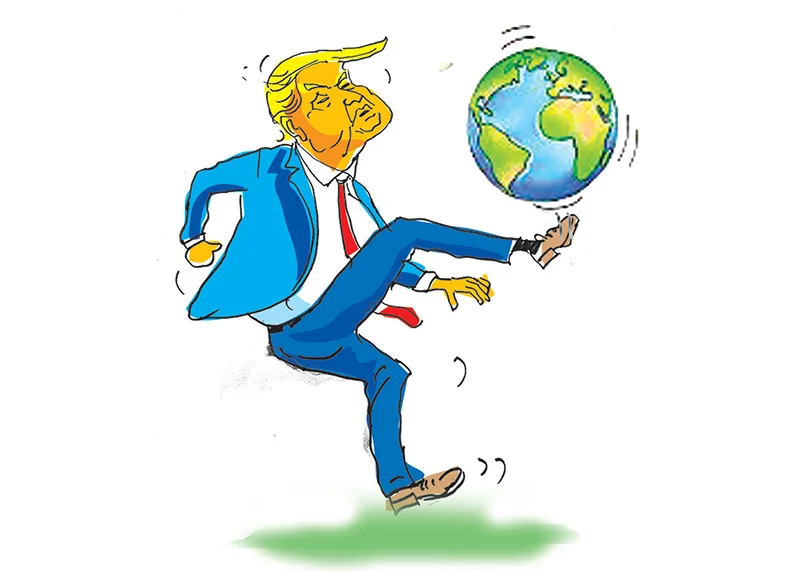
 Donald Trump’s complete lack of intelligence, empathy and common sense have become more apparent during the current term of his presidency. Ordinarily, a country’s wish to self-destruct as the United States seemingly does at present, and as the violence against US citizens and immigrants alike at the hands of federal authorities have shown in Minnesota, can be callously considered the business of that country. If the Trumpian imbecility was unfolding in Sri Lanka, anywhere else in South Asia or some other country of the purported Third World, the so-called World Order, led by the United States, would be preaching to us the values of democracy and human rights. But what happens when the actions of a powerful country, such as the United States, engulfs in the ensuing flames the rest of us? Trump and his madness then necessarily become our business, too, because combined with the military and economic power of the United States and its government’s proven lack of empathy for its own people, and the rest of the world, is quite literally a matter of global survival. Besides, one of the ‘positive’ outcomes of the Trumpian madness, as a friend observed recently, is that “he has single-handedly exposed and destroyed the fiction of ‘Western Civilisation’, including the pretenses of Europe.”
It is in this context that the speech delivered by the Canadian Prime Minister, Mark Carney, at the World Economic Forum, in Davos, on 20 January, 2026, deserves attention. It was an elegant speech, a slap in the face of Trump and his policies, the articulation of the need for global directional change, all in one. But, pertinently, it was also a speech that did not clearly accept responsibility for the current world (dis)order which Carney says needs to change. The reality of that need, however, was overly reemphasised by Trump himself during his meandering, arrogant and incohesive speech delivered a day later, spanning over one hour.
My interest is in what Carney did not specifically say in his speech: who would constitute the new world order, who would be its leaders and why should we believe it would be any different from the present one?
Speaking in French, Carney observed that he was talking about “a rupture in the world order, the end of a pleasant fiction and the beginning of a harsh reality, where geopolitics, where the large, main power, geopolitics, is submitted to no limits, no constraints.” He was, of course, responding to the vulgar script for global domination put in place by the Trumpian United States, given Trump’s declared interest in seeing Canada as part of the United States, his avarice for Greenland, not to mention his already concluded grab for Venezuelan oil. But within this scenario, bound by ‘no limits’ and ‘no constraints’ he was also talking of Russia and China albeit in a coded language.
He reiterated, “that the other countries, especially intermediate powers like Canada, are not powerless. They have the capacity to build a new order that encompasses our values, such as respect for human rights, sustainable development, solidarity, sovereignty and territorial integrity of the various states. The power of the less power starts with honesty.”
Who could disagree with Carney? His words are a refreshing whiff of fresh air in the intellectual wasteland that is the Trumpian Oval Office and the current world order it prevails over. But where has been the ‘honesty’ of the less powerful in the specific situation where he equates Canada itself within this spectrum? He tells us that “the rules-based order is fading, that the strong can do what they can, and the weak must suffer what they must.”
That is stating the obvious. We have known this for decades by experience. Long before Canada’s relative silence with regard to Trump’s and US’ facilitation of the assault on Palestine and the massacre of its people, and the US President’s economic grab in Venezuela and the kidnapping of that country’s President and his wife, Canada’s own chorus in the world order that Carney now critiques has been embellished by silence or – even worse – by chords written by the global dominance orchestra of the United States.
He says the fading of the rules-based order has occurred because of the “strong tendency for countries to go along, to get along, to accommodate, to avoid trouble, to hope that compliance will buy safety.” Canada fits this description better than most other nations I can think of. But would Canada, along with other nations among the silent majority within the ‘intermediate powers’ take the responsibility for the mess in the world precisely that silence has directly led to creating? Who will pay for the pain many nations have endured in the prevailing world order? Will Canada lead the way in the new world order in doing this?
Carney further articulates that “for decades, countries like Canada prospered under what we called the rules-based international order. We joined its institutions, we praised its principles, we benefited from its predictability. And because of that, we could pursue values-based foreign policies under its protection.”
But this is not true, is it? Countries like Canada prospered not merely because of the stability of rules of the world order, but because they opted for silence when they should not have. The rupture and the chaos in the world order Carney now critiques and is insanely led by Trump today is not merely the latter’s creation. It has been co-authored for decades by countries such as Canada, France, the United Kingdom to mention just a few who also regularly chant the twin-mantras of human rights and democracy. Trump is merely the latest and the most vocal proponent of the nastiness of that World Order.
It is not that Carney is unaware of this unpleasant reality. He accepts that “the story of the international rules-based order was partially false, that the strongest would exempt themselves when convenient, that trade rules were enforced asymmetrically. And we knew that international law applied with varying rigour depending on the identity of the accused or the victim.”
While Canada seems to be coming to terms with this reality only now, countries like Sri Lanka and others in similarly disempowered positions in this world order have experienced this for decades, because, as I have outlined earlier, Canada et al have been complicit sustainers of the now demonised and demonic world order.
It is not that I disagree with the basic description Carney has painted of the status of the world. But from personal experience and from the perspective of a citizen from a powerless country, I simply do not trust those who preach ‘the gospel of the good’ not as a matter of principle, but only when the going gets tough for them.
At this rather late stage, Carney says, Canada is “amongst the first to hear the wake-up call, leading us to fundamentally shift our strategic posture.” Unfortunately, we, the people of countries who had to dance to the tunes of the world order led by the First World, have heard it for years, with no one listening to us when our discomforts were articulated. Now, Carney wants ‘middle powers’ or ‘intermediate powers’ within which he also locates Canada, “to live the truth?” For him, the truth means “naming reality” as it exists; “acting consistently” towards all in the world; “applying the same standards to allies and rivals” and “building what we claim to believe in, rather than waiting for the old order to be restored.” This appears to be the operational mantra for the new world order he is envisioning in which he sees Canada as a legitimate leader merely due to its late wakeup call.
He goes on to give a list of things Canada has done locally and globally and concludes by saying, “we have a recognition of what’s happening and a determination to act accordingly. We understand that this rupture calls for more than adaptation. It calls for honesty about the world as it is.” He goes on to say Canada also has “the capacity to stop pretending, to name reality, to build our strength at home and to act together.” He notes this is “Canada’s path. We choose it openly and confidently, and it is a path wide open to any country willing to take it with us.” Quite simply, this a leadership pitch for a new world order with Canada at its helm.
Without being overly cynical, this sounds very familiar, not too dissimilar to what USAID and Voice of America preached to the world; not too dissimilar to what the propaganda arms of the Soviet Union and the Chinese Communist Party used to preach in our own languages when we were growing up. It is difficult to buy this argument and accept Canadian and middle country leadership for the new world order when they have been consistently part of the problem of the old one and its excuses for institutionalised double standards practiced by international organisations such as the likes of the United Nations, the World Bank, the International Monetary Fund and other hegemonic entities that have catered to the whims of that world order.
As far as Canada is concerned, it is evident that it has suddenly woken up only due to an existential threat at home projected from across its southern border and Trump’s threats against the Danish territory of Greenland. When Gaza was battered, and Venezuela was raped, there was no audible clarion call. Therefore, there is no real desire for democracy or human rights in its true form, but a convenient and strategic interest in creating a new ‘white supremacist’ world order in the same persona as before, but this time led by a new white warrior instead. The rest of us would be mere followers, nodding our heads as expected as was the case before.
As the 20th century American standup comedian Lenny Bruce once said, “never trust a preacher with more than two suits.” Mr. Carney, Canada along with the so-called middle powers and the lapsed colonialists have way more than two suits, and we have seen them all.
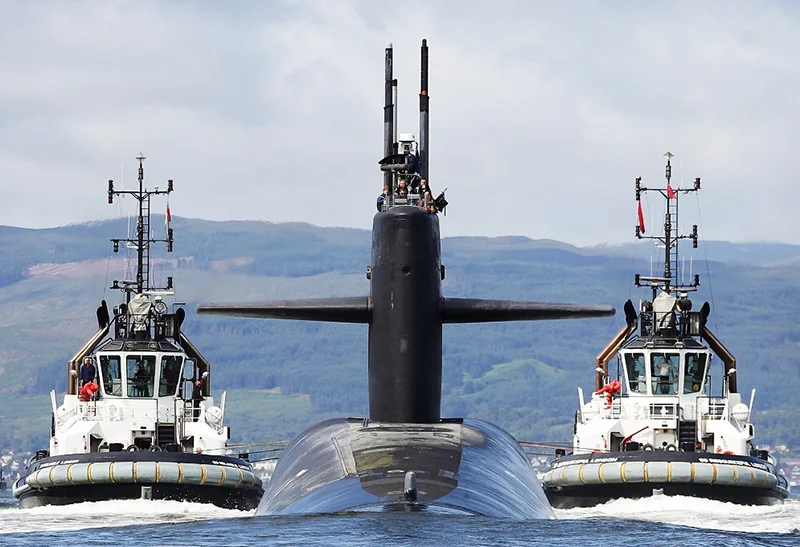
Lo and behold the dangerous doings,
Of our most rational of animals,
Said to be the pride of the natural order,
Who stands on its head Perennial Wisdom,
Preached by the likes of Plato and Confucius,
Now vexing the earth and international waters,
With nuke-armed subs and other lethal weapons,
But giving fresh life to the Balance of Terror,
And the spectre of Mutually Assured Destruction.
By Lynn Ockersz

Canada look for early splash against favourites South Africa

Italy opt to bowl; Scotland play Brad Wheal

Zimbabwe look to hit the ground running vs Oman

Portugal elects Socialist Party’s Seguro as president in landslide

World Cup debutants Italy look to make more history in Kolkata

Showers or thundershowers may occur at a few places in Galle, Matara, Kaluthara and Rathnapura districts after 2.00 p.m.

‘Dates have the highest sugar content to fight Coronavirus’

Sunday Island 27 December – Headlines

#SundayIsland 17th December – Headlines

Sunday Island – 28th March

Sunday Island Headlines – 21 March

Sunday Island – 21st February – Headlines
-
 Features1 day ago
My experience in turning around the Merchant Bank of Sri Lanka (MBSL) – Episode 3
-
 Business2 days ago
Zone24x7 enters 2026 with strong momentum, reinforcing its role as an enterprise AI and automation partner
-
 Business6 days ago
SLIM-Kantar People’s Awards 2026 to recognise Sri Lanka’s most trusted brands and personalities
-
 Business1 day ago
Remotely conducted Business Forum in Paris attracts reputed French companies
-
 Business1 day ago
Four runs, a thousand dreams: How a small-town school bowled its way into the record books
-
 Business6 days ago
API-first card issuing and processing platform for Pan Asia Bank
-
 Business2 days ago
HNB recognized among Top 10 Best Employers of 2025 at the EFC National Best Employer Awards
-

 Business2 days ago
GREAT 2025–2030: Sri Lanka’s Green ambition meets a grid reality check