
News
Minister taps SLINTEC to provide alternatives to plastic and polythene to be banned

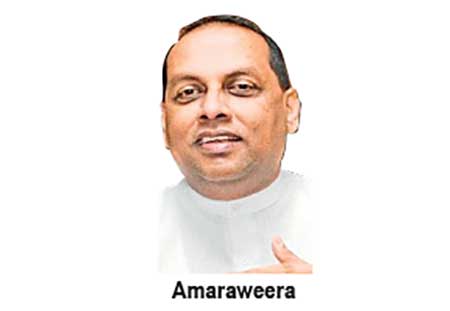
By Ifham Nizam
Environment Minister Mahinda Amaraweera has requested the Sri Lanka Institute of Nano Technology (SLINTEC) to assist in identifying alternatives to plastic and polythene to be banned.
Amaraweera, addressing a group of SLINTEC officials said most of the minerals were exported as raw materials and if they were exported as value added products or finished goods, the country could earn a higher income than at present.
The Minister also inspected the factory that converts graphite into graphite oxide and graphene. It is the largest one in Asia.
He said: “Our country has so far only exported graphite. We were able to earn a small income from it. But graphite can be converted into finished goods or value added products and a large income can be earned by exporting them.”
Officials pointed out that while a kilo of graphite raw material is exported for around USD 10, a kilo could be sold at a price hundred times higher when it was exported in the form of graphite oxide or graphene as a finished product.
Amaraweera said a large number of mineral resources went for a song to foreign markets and action must be taken to increase their value so that the country would benefit.



Minister Chrishantha Abeysena and MP Shanakiyan Rasamanickam participated in the Open Government Partnership Regional Learning Exchange Roundtable held in Bangkok.
The special international conference was organised by the Westminster Foundation for Democracy.
According to the Ministry of Science and Technology, the event brought together senior policymakers and representatives from Sri Lanka, Indonesia, Maldives and Thailand.
The Ministry said Sri Lanka had previously been inactive in the Open Government Partnership process and that the conference included extensive discussions on reactivating the country’s engagement and preparing a roadmap for the formulation of a National Action Plan.
A key objective of the meeting was to share experiences on the successes and challenges encountered by neighbouring countries in implementing open governance reforms.
Participants also discussed the need to secure political leadership support for such reforms and to ensure that they are effectively implemented for the benefit of the public rather than remaining confined to policy documents, the Ministry said in a statement.

Nearly 200 kilos of seized narcotics, linked to concluded court cases, were destroyed yesterday (13) at the incinerator at Lactowatte.
The destroyed stock comprised drugs connected to cases concluded before the Colombo High Court and the Balapitiya Magistrate’s Court.
In addition, case materials related to nearly 1,500 cases handled by the Government Analyst’s Department were also destroyed during the operation.
Earlier in the day, officers of the Police Narcotics Bureau removed a stock of drugs and narcotic pills from Court No. 05 at the Aluthkade Courts Complex under tight security.
According to the PNB, the haul included 40 kg and 539 g of heroin, 132 kg of ketamine, 55 g of cocaine and 3,482 narcotic pills.
The narcotics were transported to the incinerator under the protection of the Special Task Force, under the supervision of Deputy Inspector General of the Police Narcotics Bureau, Ashoka Dharmasena.
The narcotics, pills and related case materials were brought to the incinerator around 10 a.m. and destroyed by officers of the Government Analyst’s Department, officials of the National Dangerous Drugs Control Board and police officers under the supervision of the Balapitiya Magistrate and the Puttalam Additional Magistrate.
by Norman Palihawadane

The Ambassador of the Netherlands to Sri Lanka, Wiebe de Boer, visited Kandy on Thursday (12) afternoon to pay his respects to the Most Venerable Mahanayaka Theras of the Malwatte and Asgiriya Chapters of the Siam Nikaya.
The left photograph shows the Ambassador calling on the Most Venerable Thibbotuwawe Sri Sumangala Mahanayaka Thera of the Malwatte Chapter. The photograph on the right depicts the meeting with the Most Venerable Warakagoda Sri Gnanarathana Mahanayaka Thera of the Asgiriya Chapter.
Text and Pix by S.K. Samaranayake

APHNH aims to make Sri Lanka more competitive for healthcare investment

Bangkok Roundtable charts Sri Lanka’s OGP revival

Massive drug haul incinerated in Wanathawilluwa

Astrologers’ ire

Dutch Ambassador pays respects to Malwatte and Asgiriya Mahanayaka Theras

Bribery Commission concludes corruption probe against Shasheendra Rajapaksa and two others

‘Dates have the highest sugar content to fight Coronavirus’

Sunday Island 27 December – Headlines

#SundayIsland 17th December – Headlines

Sunday Island – 28th March

Sunday Island Headlines – 21 March

Sunday Island – 21st February – Headlines
-

 News7 days ago
Peradeniya Uni issues alert over leopards in its premises
-

 News5 days ago
Repatriation of Iranian naval personnel Sri Lanka’s call: Washington
-

 News7 days ago
Wife raises alarm over Sallay’s detention under PTA
-
 Features5 days ago
Winds of Change:Geopolitics at the crossroads of South and Southeast Asia
-

 News4 days ago
Prof. Dunusinghe warns Lanka at serious risk due to ME war
-

 Sports3 days ago
Royal start favourites in historic Battle of the Blues
-

 Latest News7 days ago
Heat Index at ‘Caution Level’ in the Sabaragamuwa province and, Colombo, Gampaha, Kurunegala, Anuradhapura, Vavuniya, Hambanthota and Monaragala districts
-

 Sports2 days ago
The 147th Royal–Thomian and 175 Years of the School by the Sea