
Foreign News
‘Merchants of death’ trial steps up fight against Channel smugglers

Peering over her glasses, the French judge glanced sternly across the cavernous underground courtroom towards a notorious figure seated in a glass cage.
“There will be no more misbehaviour. No more threats. Is that understood?” asked Arabelle Bouts, the lead judge of a Europe-wide people smuggling trial so vast that it has generated 67 tonnes of paperwork.
“Yes,” replied Mirkhan Rasoul, 26, calmly.
Mr Rasoul, already convicted on prior smuggling charges and serving a separate eight-year sentence for attempted murder, had interrupted proceedings a few days earlier by threatening two of the translators working in the courtroom. Now he was flanked by two armed policemen.
Standing near the judge, the lead prosecutor, Julie Carros, leant in towards her microphone, glanced down at her notes, and began to set out her final arguments in a sprawling case that involves a total of 33 alleged members of a Kurdish smuggling gang, accused of responsibility for the bulk of migrants crossing the Channel in small boats between 2020 and 2022.
While Mr Rasoul remained behind a glass screen, approximately 10 other accused sat in the open courtroom surrounded by another 15 armed policemen, who only removed the men’s handcuffs when the court was in session.
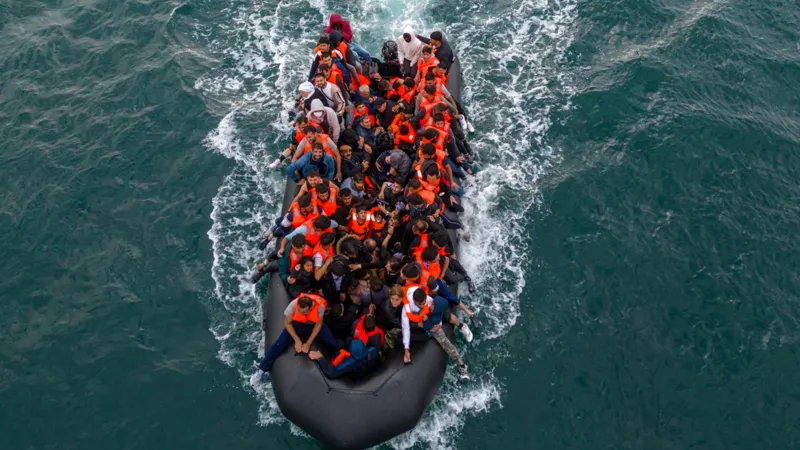
“This is a tentacle-like case… involving merchants of death,” said Ms Carros, describing how the gang had overloaded the small boats, sometimes cramming up to 15 times more people on board than the boats are designed to carry.
The result, she said, was a “phenomenal” profit margin for the gangs, who could make up to €60,000 ($65,000; £50,000) for each boat launched, with roughly half of those boats reaching UK waters, leading to an income for the gang of €3.5m ($3.8m; £2.9m) a year.
The gang itself was accused of controlling the lion’s share of all Channel crossings from the French coast – with its network delivering equipment from across Europe – until, in late 2021 and 2022, its members were arrested in France, the UK, the Netherlands, Belgium and Germany, as part of the largest international operation of its kind at the time against small-boat smugglers.
In all, 17 men and one woman are now on trial, 12 were found guilty earlier, and three more will be tried next year.
As Ms Carros set out the prosecution’s case against each of the accused, there were gasps of disappointment from at least two relatives seated in the courtroom, at the long sentences being demanded. The trial is expected to end in early November.
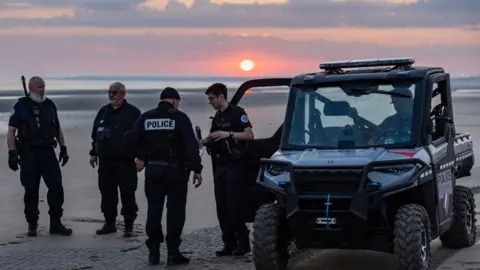
“We request a sentence of 15 years, a €200,000 fine and a permanent ban from French territory,” said Ms Carros in reference to Mirkhan Rasoul, who is accused of continuing to control the gang from a prison in central France.
“We found three mobile telephones in his cell,” she said, going on to describe an audio recording on which Mr Rasoul had boasted of the prison in Tours being “almost like a hotel… they searched the cell but never found my phones. The police are very kind”
But will this huge trial, and the prospect of tough sentences, act as a serious deterrent for a smuggling industry that has, in terms of the sheer number of successful small boat crossings, continued to thrive in the years since these arrests?
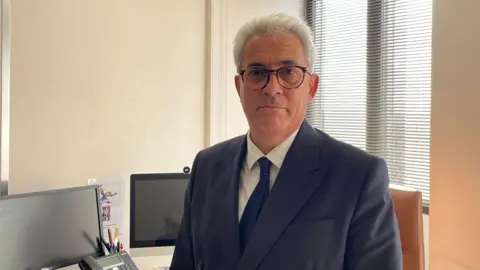
The prosecutors directly involved in this trial were not willing to talk to the BBC, but Pascal Marconville, lead prosecutor at the regional Court of Appeal for northern France, suggested that the long sentences were part of a broader strategy to raise the cost of smuggling for the gangs and their customers.
“The action taken by French police, with the support of investigative judges, is designed not only to thwart their actions, but also to make such operations so expensive that they lose their appeal,” Mr Marconville told us.
He described how the gangs had evolved in recent years from informal groups supporting their own countrymen to “networks organised much like drug gangs”.
He went on to sketch out a fragmented network with different “sectors” focusing on separate parts of the smuggling industry.
“It’s like chess, and they have [the advantage] on the board. So they’re always one step ahead of us. We have to adapt and understand how we can counter these networks. We’ve struggled with the ringleaders because when they’re arrested and imprisoned they still manage to run their networks from inside,” he said.
Despite the difficulties for law enforcement officials working across different countries and, for instance, different laws related to bail and standards of evidence, Mr Marconville praised the collaboration between French and British officials, saying the UK was “very willing to come up with solutions to improve co-operation”.
The Germans, on the other hand “who we always think of as very efficient people, don’t make things easier [for us]”, he noted.
But one of the defence lawyers involved in this case played down its broader impact on the small boat crisis.
“The sentences are becoming much harsher now. That’s clear. And I think they will continue to toughen them. Unfortunately… I am pessimistic because I don’t think it will stop… because in these [smuggling] circles people think only about money,” said Kamal Abbas.
Mr Abbas, who is defending a man accused of acting as decoy driver for smugglers’ convoys, explained how three of the accused in this trial, who were released on bail last year after two years in detention, were arrested soon afterwards in Belgium on fresh smuggling charges.
“Nothing discourages them… they see imprisonment as just another bump on the road,” he said.
After more than a decade involved in smuggling trials, Mr Abbas had another concern about their impact.
“[The real leaders] always escape. If their leader is Iraqi, he’s in Iraq. If he’s Iranian, he’ll be in Iran. But the link is often in England, I’m sure of that. The British authorities should look harder at certain areas of London if they want to stop this phenomenon,” said Mr Abbas.
[BBC]


Hushruzjon Salohidinov, 26, was working as a courier in Saint Petersburg, Russia’s second-largest city and President Vladimir Putin’s hometown.
But last year, the Tajik man and practising Muslim says he was arrested while picking up a parcel which police claimed contained money stolen from elderly women.
Salohidinov says he never interacted with the alleged criminals, but nevertheless spent nine months in the Kresty-2 pre-trial detention centre about 32km (20 miles) from the city, while a judge refused to start his trial because of the “weak evidence” against him.
But instead of releasing him after that, prison wardens threatened to place him in a cell with HIV-infected inmates who, they said, would gang-rape him – unless he “volunteered” to fight in Ukraine.
“They said, ‘Oh, you’ll put on a skirt now, you’ll be raped,’” Salohidinov, who has raven black hair and a messy full beard, told Al Jazeera at a centre for war prisoners in northeastern Ukraine, where he is now being held, having been captured in January this year by Ukrainian forces.
Using a carrot-and-stick tactic, the wardens also promised him a sign-up bonus of 2 million rubles ($26,200), a monthly salary of 200,000 rubles ($2,620) and an amnesty from all convictions.
So, in the autumn of 2025, Salohidinov signed up as he “saw no other way out”.
Officials in Kresty-2, St Petersburg’s prosecutors’ office and Russia’s Ministry of Defence did not respond to any of Al Jazeera’s requests for comment.

Hochu Jit, a Ukrainian group that helps Russian soldiers surrender, has published verified lists of thousands of Central Asian soldiers like Salohidinov.
“They are literally sent to be killed, no one considers them soldiers that need to be saved,” the group wrote in a 2025 post on Telegram. These soldiers’ life expectancy on the front line is about four months. “Losses among them are catastrophic,” the group reported.
With its low birthrate and large oil wealth, Russia has for years been a magnet for millions of labour migrants from ex-Soviet Central Asia, especially Tajikistan, Uzbekistan and Kyrgyzstan.
The campaign by the Kremlin to force Central Asians to fight in Ukraine dates back to 2023 – the year after Russia’s invasion of Ukraine – when police began rounding up anyone who didn’t look Slavic and charging them with real or imagined transgressions such as a lack of registration, expired or “fake” permits or blurred stamps on their documents. Sometimes, migrants are simply bused straight to conscription offices.
In 2025, Al Jazeera interviewed another Tajik man who said he had been detained with an expired work permit and was then tortured into “volunteering” while being subjected to countless xenophobic and Islamophobic slurs from his officers.
Migrants say they are abused, tortured and threatened with jail or having their entire families deported.
“The main way of recruiting as many migrants as possible is pressure on them with threats of deportation,” Alisher Ilkhamov, the Uzbekistan-born head of the London-based Central Asia Due Diligence think tank, told Al Jazeera.
Sometimes, migrants are simply duped.
Salohidinov said one serviceman in his squad was an Uzbek who “didn’t speak a word of Russian” and was fooled into “volunteering” while signing papers at a migration centre.
In their reports about “catching” migrants, officials frequently use derogatory terms about them, and also when they describe men who have obtained Russian passports but skipped registration at conscription offices. Since the Soviet era, such registration has been obligatory for all men and, since 2024, a newly naturalised Russian national can lose his citizenship if he fails to do it.
“We’ve caught 80,000 such Russian citizens, who don’t just want to go to the front line, they don’t even want to go to a conscription office,” chief prosecutor Alexander Bastrykin said in May 2025, referring to the migrants’ alleged patriotic sentiments.
He boasted that 20,000 Central Asians with Russian passports were herded to the front line in 2025.
The year before, he said 10,000 Central Asians had been sent to Ukraine.
Such remarks resonate with the Russian public that lives with “a high level of xenophobia in the stage of fear and helplessness,” Sergey Biziyukin, an exiled opposition activist from the western city of Ryazan, told Al Jazeera.
“For them, such phrases from Bastrykin are a form of sedative.”
What makes Central Asians easy targets is that they hail from police states, which depend on Moscow politically and economically, observers say.
“While the migrants are frightened into signing contracts, their motherland doesn’t really pay any attention,” Galiya Ibragimova, an Uzbekistan-born, Moldova-based regional expert, told Al Jazeera.
Despite hefty signup bonuses and relentless propaganda, the number of Russians who want to fight in Ukraine fell by at least one-fifth this year, and Moscow will strive to recruit more Central Asians, she said.

After signing the contract and leaving his debit card with his sign-up bonus with his parents, Salohidinov was sent to the western city of Voronezh for three weeks of training that did little to prepare him for the war.
“We just kept running back and forth with guns,” he said.
Their drill sergeants, he says, told the conscripts that the standard-issue flak jackets, helmets, boots and flashlights were of subpar quality and urged them to pitch in a million rubles ($13,100) each for “better” gear.
The incident corroborates reports on dozens of similar cases in Russian military units.
Salohidinov was ordered to work in a kitchen – and was verbally abused and beaten for the slightest transgression.
Of 28 men in his unit, 21 were Muslims – but their ethnic Russian officers ignored their pleas not to have pork in meals, repeating a decades-old practice of ignoring religion-related dietary restrictions dating back to the Soviet army.
The commanders demonised Ukrainians, telling them “that if we surrender, we’d be tortured, have our fingers broken, maimed, get [construction] foam up our a**, have our teeth yanked out one by one, have our arms broken”, Salohidinov says.
In early January this year, the conscripts were bused to the Russia-occupied Ukrainian region of Luhansk.
Salohidinov says he was tired, frightened and disoriented – Ukrainian drones were “always” above them and a grenade explosion nearby damaged his left eardrum.

On the fourth day of his service, Salohidinov was ordered to run beyond Ukrainian positions as part of Russia’s new tactic to send two or three servicemen to infiltrate the porous front line.
The mission was suicidal because the terrain was open, dotted with landmines and the bodies of dead Russian soldiers, while Ukrainians were firing machineguns and flew drones above them.
“I ran and ran and saw we were being shot at,” he said. “Me and my commander decided to surrender voluntarily instead of dying for nothing.”
They detached their assault rifles’ magazines, raised their hands and yelled they were surrendering.
What followed was “a calm feeling, beautiful”, he said. “They fed us, let us have a smoke, gave us food and water and even cake.”
Now, Salohidinov hopes to return to Tajikistan and panics at the thought of being made part of a prisoner swap – these have taken place several times each year – and returning to Russia because he would be sent back to the front line.
Tajikistan and other Central Asian nations have never endorsed Russia’s war in Ukraine, but nor have they openly criticised it.
In August 2025, Tajikistan’s Prosecutor General Habibullo Vohidzoda declared that no Tajik national would be charged for fighting in Ukraine.
So, what Salohidinov needs right now is an extradition request.
“I’m even glad that I got captured, because I’m not fighting anyone now, not risking anything,” he said. “I’ll even say thanks to Ukraine for taking me prisoner.”
The Tajik embassy in Kyiv did not respond to Al Jazeera’s request for comment.
[Aljazeera]

Iranian forces have said they struck down two fighter jets belonging to the United States military, one over the southwest part of the country and another around the Strait of Hormuz.
A spokesperson for the Iranian military’s Khatam al-Anbiya Central Headquarters said on Friday that air defences completely destroyed one F-15 jet. Later in the day, the Iranian military said it targeted an A-10 US aircraft that crashed into the Gulf.
The New York Times had cited unidentified officials as saying that the A10’s pilot was safe after the crash.
But the fate of at least one pilot from the downed F-15 crew is unknown. Several US media outlets reported that one crew member of the jet was located and rescued by US forces, but the other remains missing.
US President Donald Trump told NBC News on Friday that the downing of the jet will not affect the prospect of talks with Tehran. “No, not at all. No, it’s war. We’re in war,” he said.
State media outlets in Iran showed photos of the wreckage of the F-15 jet and what appears to be an ejection seat with an attached parachute.
After the jet was downed, Iranian Parliament Speaker Mohammad-Bagher Ghalibaf mocked Trump’s repeated claims of victory in the war.
“After defeating Iran 37 times in a row, this brilliant no-strategy war they started has now been downgraded from ‘regime change’ to ‘Hey! Can anyone find our pilots? Please?’” Ghalibaf wrote in a social media post.
There was no immediate comment on the incident from the Pentagon and US Central Command (CENTCOM), which oversees military operations in the Middle East and much of Asia.
[Aljazeera]

United States President Donald Trump has announced that Pam Bondi is out as US attorney general, in his second major cabinet-level shake-up in less than a month.
Trump confirmed the decision in a post on Truth Social on Thursday, after a slate of media reports suggested he was considering removing Bondi from the top law enforcement role. Several cited his discontent over Bondi’s handling of investigative files related to financier and convicted sex offender Jeffrey Epstein.
Deputy Attorney General Todd Blanche will temporarily replace Bondi in an interim capacity, he said.
“Pam Bondi is a Great American Patriot and a loyal friend, who faithfully served as my Attorney General over the past year,” Trump wrote.
The US president also praised Bondi for leading the Department of Justice during a period when violent crime decreased in the US, part of a wider downward trend in the wake of the COVID-19 pandemic.
Trump did not mention his reasoning for the decision, instead writing, “We love Pam.” He added that she would be “transitioning to a much-needed and important new job in the private sector”.
In a statement, Bondi said she would be transitioning the office to Blanche over the next month, adding she was moving to “an important private sector role I am thrilled about, and where I will continue fighting for President Trump and this Administration”.
“I remain eternally grateful for the trust that President Trump placed in me to Make America Safe Again,” she said.
Bondi’s dismissal comes shortly after Trump abruptly fired Department of Homeland Security Secretary Kristi Noem, who oversaw the agency amid a mass deportation campaign that led to the killing of two US citizens.
[Aljazeera]

Singapore Zoo’s first Sri Lankan leopard cubs make their public debut

Sri Lanka Navy seize multi day fishing craft suspected of smuggling narcotics

‘Sent to be killed’: How Russia forces migrants to fight in Ukraine

Babar Azam 71* helps Peshawar Zalmi extend lead at top

Trump threatens to fire Fed chair Jerome Powell if he doesn’t leave in May

Royal Challengers Bengaluru top the table after bowlers help thump Lucknow Super Giants

‘Dates have the highest sugar content to fight Coronavirus’

Sunday Island 27 December – Headlines

#SundayIsland 17th December – Headlines

Sunday Island – 28th March

Sunday Island Headlines – 21 March

Sunday Island – 21st February – Headlines
-

 News5 days ago
CEB orders temporary shutdown of large rooftop solar systems
-

 Features5 days ago
From Royal College Platoon to National Cadet Corps: 145 years of discipline, leadership, and modern challenges
-

 Business7 days ago
Israeli attack on Lebanon triggers local stock market volatility
-

 Business7 days ago
HNB Assurance marks 25 years with strategic transformation to ‘HNB Life’
-
 Latest News4 days ago
PNS TAIMUR & ASLAT arrive in Colombo
-

 News6 days ago
Anura Solomons passes away
-

 Features5 days ago
CIA’s hidden weapon in Iran
-

 Latest News3 days ago
Prasidh, Buttler set up comfortable win for Gujarat Titans