
Latest News
Mathews becomes first batter to be timed out in international cricket


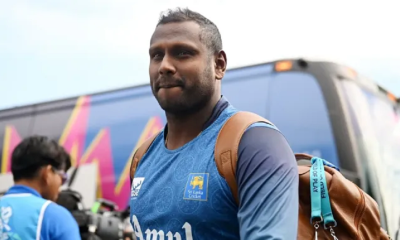
In what was a first in international cricket, Angelo Mathews was dismissed ‘timed out’ during the first innings of the World Cup game in Delhi between Bangladesh and Sri Lanka at the Arun Jaitley Stadium on Monday (November 6).
In the 25th over of the first innings, Mathews was readying to take strike after the dismissal of Sadeera Samarawickrama when his helmet strap broke. He gestured to the dugout for a new helmet but didn’t consult with Shakib Al Hasan, the opposition captain, who went on to successfully appeal for “timed out” to onfield umpires.
According to the ICC Playing Conditions for the World Cup, the incoming batter has to “be ready to receive the ball” within two minutes of a dismissal or a batter retiring. This rule has been in place in ODI cricket since June 2023. For Tests, the corresponding time limit is three minutes, and for T20Is it is 90 seconds.
Samarawickrama was dismissed at 15:49 local time according to official scorers at the venue whereas Mathews was timed out at 15:54 local time. He walked in at 15:50 local time according to the official scorers, but wasn’t ready at the crease within the stipulated time.
Mathews tried to plead his case with Marais Erasmus and Richard Illingworth, the onfield umpires, but to no avail.
As the Bangladesh players celebrated, Mathews walked off in anger. He was seen displaying the helmet to head coach Chris Silverwood before throwing it in anger and stomping off towards the dressing room.
This is the seventh overall time in men’s cricket that a ‘timed out’ dismissal has occurred, and the first time in 50-over cricket. The previous six instances were all in first-class cricket.











Japan’s ruling party, led by Prime Minister Sanae Takaichi, is projected to have won Sunday’s snap election by a landslide.
An exit poll by public broadcaster NHK suggests the coalition led by Takaichi’s Liberal Democrat Party (LDP) is set to win two-thirds of seats in Japan’s House of Representatives. The LDP alone is forecast to have a majority of seats.
The country’s first female prime minister had sought a clear public mandate by calling the election just four months after becoming party leader.
Her apparent success is in marked contrast to her two predecessors, under whom the party lost its parliamentary majority due to corruption scandals and rising costs.
Takaichi previously pledged to step down if her party failed to secure a majority, and some called the snap election a big gamble.
The LDP lost its majority in both houses of parliament in 2024, and its decades-old coalition with the Komeito party collapsed.
But Takaichi’s personal popularity appears to have helped the party, with approval ratings for her government mostly hovering above 70%.
The LDP and its current coalition partner, the Japan Innovation Party, could secure as many as 366 of the 465 seats in the House of Representatives, according to NHK projections as votes continue to be counted.
US Treasury Secretary Scott Bessent has already hailed a “big victory” for Takaichi, saying “when Japan is strong, the US is strong in Asia”.
Indian Prime Minster Narendra Modi also congratulated Takaichi for the “landmark” result, saying he was confident India and Japan’s friendship could be taken to “greater heights”.
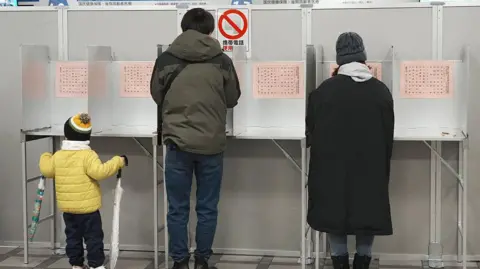
People across Japan braved snow to vote in the country’s first mid-winter poll in 36 years.
Japan’s transport ministry said 37 train lines and 58 ferry routes were closed and 54 flights cancelled as of Sunday morning. There was rare snowfall in Tokyo as people headed out to vote.
“People want their lives to be better and more comfortable because we are so accustomed to not having inflation [costs rising]… so people are very worried. I think we need a long-term solution rather than short-term fixes,” Ritsuko Ninomiya, a voter in Tokyo, told the BBC.
Takaichi’s enthusiasm, populist spending promises and nationalist rhetoric appear to have energised voters.
Her social media presence has also cultivated new followers, particularly among young voters. She regularly shares clips of her daily life and political activities, and a video of her playing the drums with South Korean President Lee Jae Myung is one of many clips to have gone viral.

Takaichi and the LDP faced a more unified opposition than before. LDP’s former coalition partner Komeito has joined forces with the Constitutional Democratic Party of Japan to form the largest opposition bloc in the lower house.
Takaichi has pushed to toughen the immigration system, review rules around foreign ownership of Japanese land, and tackle any non-payments of tax and health insurance by foreign nationals.
But in a country where only 3% of the population are foreign nationals, critics have accused her of creating anxiety and division.
Relations with China – Japan’s largest trading partner – have been strained as well, after Takaichi suggested last November that Japan could intervene militarily if China invaded Taiwan.
With a two-thirds majority, Takaichi would be a strong position to considering her long-held aim of changing Japan’s pacifist constitution.
Takaichi has courted Donald Trump, who has publicly endorsed her – an unusual move by a US president – and they both seem to agree that Japan should spend more on defence.
That relationship too was on voters’ minds as they headed to the polls on Sunday.
“I am concerned with what President Trump is doing as well as the national defence issues. I am not sure where the money is coming from to cover that. So balancing budget spending between defence and people’s life is a major concern for me,” Yuko Sakai says.
(BBC)

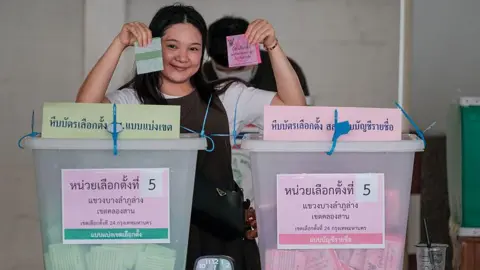
Prime Minister Anutin Charnavirakul has claimed victory in Thailand’s general election, with preliminary vote counts putting his ruling conservatives well ahead of their rivals.
Anutin said his success belonged to “all Thais, no matter whether you voted for us or not”, after his party’s expected result defied opinion polls that had placed the reformist People’s Party ahead.
With 90% of the votes counted, Anutin’s Bhumjaithai party projected to win 194 seats in Bangkok’s 500-seat parliament, with the People’s Party in second place on 116.
People’s Party leader Natthaphong Ruengpanyawut appeared to concede the election, saying he was ready to serve in opposition if Anutin could form a government.
The election was called after several coalition governments collapsed, giving the country three prime ministers in as many years.
While no party is projected to gain an overall majority, paving the way for coalition talks, Anutin is now almost certain to stay in office.
Elections in Thailand are often unpredictable, and so it proved this time.
This shock result is a huge disappointment for the People’s Party, which had expected to improve on its winning performance of three years ago.
But a widely expected “orange wave” of support for its young, idealistic candidates did not materialise.
The party, which won the election in 2023 but was blocked from taking power, found itself pushed into second place by Anutin’s pragmatic conservatives.
The reformists will remain in opposition for now. The feared crisis that could have occurred had they won, and once again been barred from office, has been averted.
Opinion polls have frequently been wrong in Thailand, but there will be a lot of post-election analysis of how Anutin turned his once small, provincial Bhumjaithai – “Thai Pride”- party into a such formidable electoral machine.
Playing on patriotic sentiment after the two short border wars with Cambodia last year, Anutin’s party became the standard-bearer for conservatives, promising to defend the status of traditional Thai institutions like the monarchy and military.
He campaigned on hard-line nationalist sentiments and populist giveaways – but his victory was also down to his ability to win local power-brokers to his side, in an electoral system where 80% of seats were decided on a first-past-the-post basis.
The People’s Party did well in the proportional votes, where it appears to have got more votes than any other party. But it was unable to overcome its lack of networks at a local level.
The third main contender was the Shinawatra family and its Pheu Thai – “For Thais” – party, which is projected to win 86 seats.
In the past it dominated elections, with well-marketed populist policies. It had promised to create nine new millionaires – in Thai baht – every day through a national prize draw. Both Bhumjaithai and Pheu Thai have offered subsidies and cash handouts to voters.
Pheu Thai was expected to lose significant support in this election after its last coalition administration was accused of mishandling the conflict with Cambodia, and its patriarch, former PM Thaksin Shinawatra, was sent to jail.
Thailand’s once dynamic economy has ground to a halt as political instability and the lack of structural changes worry foreign investors. Voters, meanwhile, had voiced concerns about rising costs.
“I want the economy to improve and I don’t want big factories to relocate to our neighbouring countries,” civil servant Phananya Bunthong told the BBC, a reference to Thailand falling behind Vietnam.
The People’s Party promised big changes, from curbing the power of the biggest businesses and military, to streamlining the extensive bureaucracy and modernising the education system.
But in Thailand, even a straight election victory may not have been enough, as powerful, unelected forces have repeatedly intervened to block parties challenging the status quo.
Two previous incarnations of the People’s Party were dissolved by the court, and their leaders banned from politics. When the young reformers won last time, the military-appointed senate barred them from forming a government and the constitutional court dissolved the party.
They are not the only ones to have been subjected to intervention by the constitutional court, and other unelected conservative institutions. Five Pheu Thai prime ministers have been dismissed by the court since 2008, and two earlier incarnations of the party have been dissolved.
But if the People’s Party had exceeded the 151 seats it won in 2023, it may have proven difficult to bar it from forming a government. This is despite the great unease about its radical agenda in conservative and royalist circles.
The projected result means the People’s Party’s opponents will not be in this position, for now.
Besides the election, Thais have voted in a referendum on whether to reform the 2017 constitution, which was drafted under military rule in 2017.
Critics of the charter believe it gives too much power to unelected forces like the senate, “handcuffing” the country’s democracy.
With over 90% of votes counted, preliminary tallies suggested around 65% had voted in favour.
“I want change. I don’t want things to be the same,” 28-year-old Kittitat Daengkongkho told the BBC.
That, in effect, was the choice Thai voters were presented with in this election: sweeping change, or more of the same.
(BBC)
Sri Lanka 163 for 6 in 20 overs (Pathum Nissanka 24, Kamil Mishara
Catches win matches. Ireland dropped seven, of varying difficulty, and that proved to be a major factor in their 20-run loss to Sri Lanka at the R Premadasa Stadium.
Sent in, Sri Lanka started briskly but the Ireland spinners George Dockrell and Gareth Delany, handcuffed them in the middle overs. After 16 overs, they were on 104 for 4. That they could add another 59 to finish on a competitive 163 for 6 was down to Ireland’s sloppy fielding.
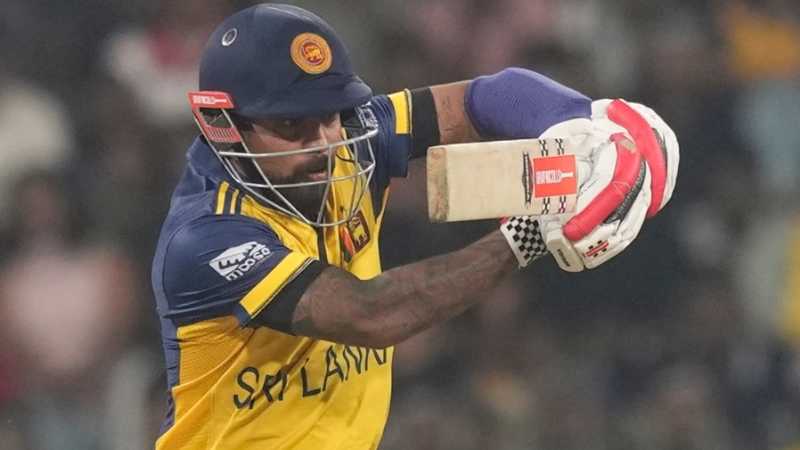
Kamindu Mendis was dropped on 14; he went on to smash 44 off 19 balls. Kusal Mendis was first put down on 34; he finished on 56 not out off 43. The pair added 67 off 30 balls for the fifth wicket to inject the much-needed momentum.
Ireland made a solid start to their chase, reaching 52 for 1 in seven overs. But Wanidu Hasaranga, who had hurt his hamstring after sending down just two balls, derailed them. Bowling with hardly any follow-through, he picked up 3 for 25 from his four overs. Maheesh Theekshana also took three, hastening the end as Ireland were bowled out for 143 in 19.5 overs.
Earlier, Kamil Mishara barely looked assured during his brief stay. In the third over, he hit one uppishly back towards Barry McCarthy but the bowler had little time to react. In the same over, he was dropped by Ross Adair at short midwicket. But Mishara failed to make it count. In the following over, he was caught at mid-off off a slower delivery from Mark Adair. Kusal started briskly, hitting three fours in his first eight balls to take Sri Lanka to 50 for 1 by the end of the powerplay.
After the powerplay, Ireland deployed spin from both ends. That put the brakes on the scoring rate. Pathum Nissanka went for the cut against Dockrell and was caught at extra cover. Pavan Rathnayake tried to upper-cut the spinner, only for the ball to hit the middle stump. That left Sri Lanka on 68 for 3 in the 11th over.
Such was the stranglehold of the Ireland spinners that Sri Lanka couldn’t hit a boundary for 56 balls after the powerplay. All told, Ireland bowled 13 overs of spin, the most by them in a T20I.
Kamindu ended the boundary drought in the 16th over when he reverse-swept Delany for four over backward point. After that, Ireland made one fielding mistake after another to cede the advantage. In the 17th over, bowled by Matthew Humphreys, Kusal was reprieved twice and Kamindu once. The Kamindu chance at long-off went for six. To rub it in, he hit the next two balls for four, making it a 21-run over.
There was another drop in the following over, with Ross Adair putting down Kusal off Mark Adair at deep square leg. The wheels completely came off in the 19th. McCarthy started with a beamer down the leg side, which Kamindu put away for four. When the free hit arrived after two wides, Kamindu pulled it for a six. McCarthy did send back Kamindu and Dasun Shanaka off successive balls but ended up conceding 19 from the over. Lasting 11 balls, it was the joint longest over in the T20 World Cup history. Kusal, who largely played second fiddle to Kamindu, brought up his half-century in the final over.

Japan’s PM Takaichi on course for landslide victory in snap election

Thai PM claims election victory with conservatives well ahead of rivals

Kamindu Mendis, Kusal Mendis, spinners script Sri Lanka’s win

England survive Nepal scare to clinch last-ball thriller

Ireland opt for an extra batter as they ask Sri Lanka to bat

England bat; Nepal hand debut to Sher Malla

‘Dates have the highest sugar content to fight Coronavirus’

Sunday Island 27 December – Headlines

#SundayIsland 17th December – Headlines

Sunday Island – 28th March

Sunday Island Headlines – 21 March

Sunday Island – 21st February – Headlines
-

 Business2 days ago
Zone24x7 enters 2026 with strong momentum, reinforcing its role as an enterprise AI and automation partner
-

 Business6 days ago
SLIM-Kantar People’s Awards 2026 to recognise Sri Lanka’s most trusted brands and personalities
-

 Business7 days ago
All set for Global Synergy Awards 2026 at Waters Edge
-

 Business6 days ago
API-first card issuing and processing platform for Pan Asia Bank
-

 Business2 days ago
HNB recognized among Top 10 Best Employers of 2025 at the EFC National Best Employer Awards
-

 Business2 days ago
GREAT 2025–2030: Sri Lanka’s Green ambition meets a grid reality check
-

 Editorial4 days ago
All’s not well that ends well?
-

 Features4 days ago
Phew! The heat …