
Latest News
Mandhana, Shafali and Ghosh help India edge run-fest to go 4-0 up


After three one-sided, low-scoring encounters, the fourth T20I between India and Sri Lanka exploded into a run-fest in Thiruvananthapuram, with both sides posting their highest totals in women’s T20Is. India’s big score of 221 for 2 proved too much for Sri Lanka, who fell short by 30 runs, handing the hosts a 4-0 series lead with one match remaining. India missed two catching opportunities and a stumping chance, while Sri Lanka gave away three, but the batting dominance was decisive.
Smriti Mandhana and Shafali Verma set the tone with blistering half-centuries to power India’s innings, while Chamari Athapaththu kept Sri Lanka in the chase with a fighting 52. Despite a few late cameo efforts, the visitors couldn’t overcome India’s dominant batting display.
Shafali and Mandhana delivered a masterclass in aggressive opening batting, putting together 162 runs off just 92 balls – the highest opening partnership for India in women’s T20Is. Shafali continued her purple patch with a third successive T20I half-century, while Mandhana, who had managed only 40 runs in the first three matches, roared back to form. The innings also saw Mandhana climb to the top of the charts for most runs (1,703) in women’s internationals in a calendar year, underlining her dominance.
India’s openers were relentless from the outset, racing to 61 without loss in the powerplay with 12 boundaries. Shafali’s innings was built on control and placement – her first six came only after her fifty, a loft over long-off in the 11th over – and she finished with 12 fours and a six.
Mandhana, meanwhile, struck 11 fours and three sixes, though her innings briefly dipped in tempo. After racing to 24 off 14 balls, she moved to 28 off 24 during a short lull before accelerating sharply to reach her half-century off 35 deliveries. From there, she cut loose, using the feet to loft the spinners and driving straight with authority.
The contest decisively tilted in overs 11 to 13, when India tore into the attack. The 11th over went for 15 runs, followed by a 20-run 12th and an 18-run 13th, each featuring two fours and a six. Any hopes Sri Lanka had of restricting the damage vanished as India surged from 85 for no loss to 120 in just two overs.
India brought up 150 in only 14.2 overs, making light of the Sri Lanka captain’s assessment at the toss that 140 would be a competitive total.
Sri Lanka had to wait 92 balls for their first breakthrough and struck again in the following over, the 17th, but any momentum was swiftly snuffed out by Richa Ghosh. With Harleen Deol replacing Jemimah Rodrigues, who was recovering from a mild fever, India promoted Ghosh to No. 3 for the death overs – a move that paid rich dividends. Having faced just one delivery in the series before this match, Ghosh made an impact, blasting 40 off 16 balls and adding an unbroken 53-run stand with Harmanpreet Kaur.
Ghosh announced herself by heaving her second ball over Nimasha Meepage’s head for four. After a relatively quiet 17th over, she found her range against the same bowler, striking two more boundaries. The onslaught peaked against Kavisha Dilhari, one of Sri Lanka’s more experienced bowlers, as Ghosh went into overdrive. She smoked three sixes and a four to plunder 23 runs from the 19th over, punishing anything in her hitting arc and underlining India’s ruthless finish.
Sri Lanka began their chase aggressively, with Hasini Perera taking charge. She tore into Renuka Singh’s first over, hitting three boundaries, while Arundhati Reddy, making a comeback in place of the rested Kranti Gaud, conceded 17 off the second over. By the end of four, Sri Lanka had raced to 52 for 0, with the opening stand between Perera and Athapaththu putting on 59 runs off 34 balls.
Athapaththu struck the chase’s first six, charging down the track and clearing long-off off Deepti Sharma in the third over. Both left-handers punished anything too full or short, though Perera fell in the sixth over, holing out to Harmanpreet at mid-off off Reddy’s offcutter.
Athapaththu kept the momentum going, adding 57 runs off 46 balls with Imesha Dulani for the second wicket. Athapaththu moved from 20 off 15 balls to fifty in the next 19 deliveries, hitting three sixes and as many fours. However, her innings ended when she mistimed a charge over the off side, gifting a catch to Mandhana at long-off off Vaishnavi Sharma. At that stage, Sri Lanka needed 106 runs from 42 balls. Despite a few late cameos, the chase fell short.
On a night dominated by big scores, Vaishnavi emerged as the standout bowler, picking up two crucial wickets for just 24 runs. Introduced into the attack after the powerplay, she began by floating the ball outside off stump to entice the batters before gradually attacking the stumps and testing the left-handers with clever variations.
After dismissing Athapaththu in the 13th over, she also removed Harshitha Samarawickrama for a 13-ball 20 in the 17th, when the batter looked threatening. Her disciplined lines and sharp changes of pace helped India keep Sri Lanka’s scoring in check.
Brief scores:
India Women 221 for 2 in 20 overs (Smriti Mandhana 80, Shafali Verma 79, Richa Ghosh 40*, Harmanpreet Kaur16*; Malsha Shehani 1-32, Nimasha Meepage 1-40) beat Sri Lanka Women 191 for 6 in 20 overs (Chamari Athapaththu 52, Hasini Perera 33, Imesha Dulani 29, Harshitha Samarawickrama 20, Kavisha Dilhari 13, Nilakshika de Silva 23*; Arundhati Reddy 2-42, Vaishnavi Sharma 2-24, Shree Charani 1-46) by 30 runs
(Cricinfo)

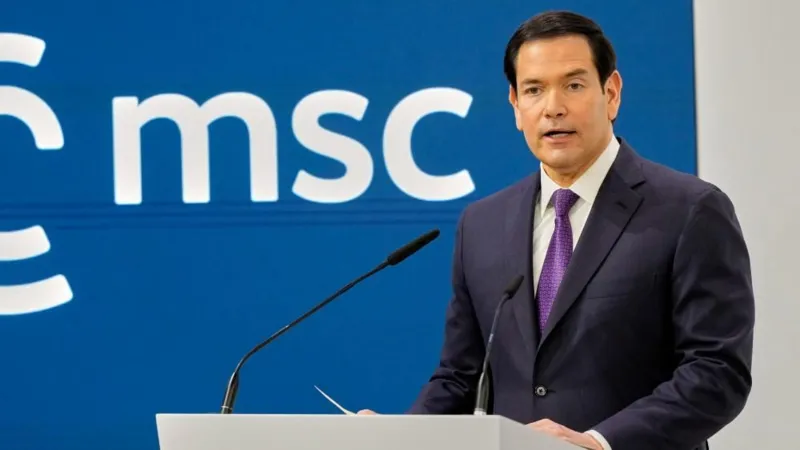
Marco Rubio has assured European leaders the US does not plan to abandon the transatlantic alliance, saying its destiny “will always be intertwined” with the continent’s.
The US secretary of state told the Munich Security Conference: “We do not seek to separate, but to revitalise an old friendship and renew the greatest civilisation in human history.”
He criticised European immigration, trade and climate policies, but the overall tenor of the closely-watched speech was markedly different to Vice President JD Vance’s at the same event last year, during which he scolded continental leaders.
European Commission President Ursula von der Leyen said she was “very much reassured” by Rubio’s remarks.
Rubio, the Trump administration’s most senior diplomat, said it was “neither our goal nor our wish” to end the transatlantic partnership, adding: “For us Americans, our home may be in the Western Hemisphere, but we will always be a child of Europe.
“And I am here today to leave it clear that America is charting the path for a new century of prosperity, and that once again we want to do it together with you, our cherished allies and our oldest friends.”
However, he repeated several criticisms repeatedly levelled at Europe by the Trump administration, including describing immigration policies as a threat to civilisation, and saying a “climate cult” had taken over economic policy.
On trade, he said Europe and the US had “made mistakes together” by adopting a “dogmatic vision of free and unfettered trade”.
He repeated familiar calls from the US for Europe to invest more in defence, saying: “We want allies who can defend themselves so that no adversary will ever be tempted to test our collective strength.”
In response, von der Leyen said: “Rubio is a good friend, a strong ally. And this was, for me, very reassuring to listen to him.”
She continued: “We want a strong Europe. And this is, I think, the message of today.”
Elsewhere in his half-hour address, Rubio said the system of international co-operation “must be rebuilt” and singled out the UN for particular criticism, saying it had “played virtually no role” in resolving the Gaza and Ukraine conflicts.
He also said the organisation was “powerless to constrain the nuclear programme” of Tehran.
In recent weeks, US President Donald Trump has threatened strikes on Iran if a deal to curb its nuclear programme can be reached, as negotiations between the two intensify.
A second round of talks will be hosted by Oman in Geneva next week, the Swiss foreign ministry said on Saturday.
Outside the conference, an estimated 200,000 protesters held a rally against the Iranian government, local police report.
The demonstrators denounced the country’s leadership, following the government crackdown on January’s protests in which thousands of people were killed.

Rubio also said the US did not know whether the “Russians are serious about ending the war” in Ukraine, before adding: “But we’re going to continue to test it.”
Ukraine’s President Volodymyr Zelensky told the conference later on Saturday that no one in Ukraine believed his Russian counterpart Vladimir Putin would leave the country alone, describing the Russian leader as a “slave to war”.
Zelensky has come under pressure from the White House to hold presidential elections, which have been suspended while the country is under martial law.
Asked about a Financial Times report that his administration was planning for elections as soon as May, Zelensky said it was “something new to me” and repeated that “nobody supports elections during the war”.
He said that Ukraine would need “two months of ceasefire” and “security infrastructure” to safely conduct elections.
[BBC]
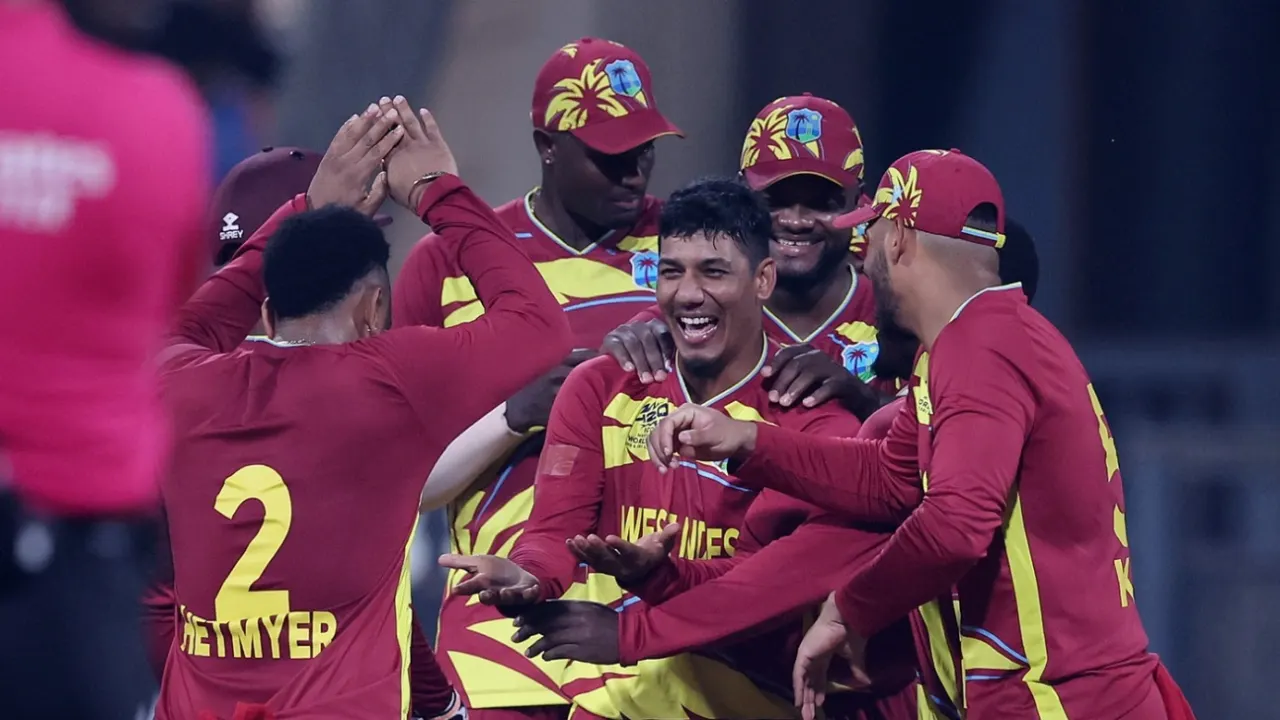
From being one hit away from beating England to being hammered by T20 World Cup debutants Italy four days later, Nepal have seen the whole spectrum of emotions in Mumbai. Among the Associate teams at this World Cup, Nepal could easily have the biggest travelling contingent of fans, who must be wondering what would have been had Nepal sealed the thriller last Sunday that would have kept them far from their current bottom spot in Group C.
Fans’ expectations and social media distractions are things Nepal head coach Stuart Law has warned his team about, now that they have slipped to a must-win situation. Nepal need to pick themselves up after being trampled by the Mosca brothers to face their table-toppers and the in-form West Indies. This is the same West Indies side Nepal had taken down 2-1 a few months ago in Sharjah, in the first bilateral series between the two teams. But this is, in reality, not the same West Indies side because that one in September was without most of the first-choice players that have turned West Indies’ form around in this tournament after recent series losses against South Africa and Afghanistan at the start of the year.
It might take a mountain to climb for this defeated Nepal side to bring down West Indies, but there is hope. Nepal could learn from their two wins in September – and from Zimbabwe against Australia on Friday – that batting first might be the way to go to put pressure on stronger teams. Ever since West Indies have landed in India, they haven’t been put under the pressure of chasing so far.
Nepal also have the advantage of being stationed only in Mumbai so far, which would have given them a fair idea of the red-soil conditions at Wankhede. Since it’s a day game, Nepal may not mind being put in to bat if the toss doesn’t go their way.
West Indies hardly have any headaches. Their batters are belting sixes, their pace bowlers have picked wickets, their spinners strangled England and they took excellent catches too. They would want to continue their winning streak and seal the Super Eights spot soon.
After being beaten by Michael Leask’s arm ball in their opening match, Shai Hope would have been miffed for falling to a not-so-great ball against England. He bagged a duck and will be eager to lift his strike rate of 76 from the two games – the only West Indies batter who has struck at under 100 – as the tournament picks up pace and teams firm up their plans as per conditions and opposition. Hope will, however, draw confidence from the fact that he has been West Indies’ leading scorer since the last T20 World Cup and their top boundary-hitter too, for both fours and sixes.
Nepal will be looking for a cracking start to overcome their Italian heartbreak, and they don’t need to look any further than opening batter Kushal Bhurtel. He had taken down Jofra Archer and Luke Wood with a boundary barrage against the new ball that saw him smash 29 off 17. He is, however, due a big score and with his jersey number 14 as a dedication to Ricky Ponting, the muscular batter would want to emulate his idol in a crunch match.
West Indies packed a punch against England and won’t feel the need to tinker with their XI on the same ground.
West Indies (probable): Brandon King, Shai Hope (capt), Shimron Hetmyer, Roston Chase, Sherfane Rutherford, Rovman Powell, Jason Holder, Romario Shepherd, Akeal Hosein, Gudakesh Motie, Shamar Joseph
Nepal captain Rohit Paudel was down with fever on Friday night but should be good to go on Sunday after taking some medicines, Stuart Law said.
Nepal (probable): Kushal Bhurtel, Aasif Sheikh (wk), Rohit Paudel (capt), Dipendra Singh Airee, Aarif Sheikh, Lokesh Bam, Gulshan Jha, Karan KC, Nandan Yadav, Sandeep Lamichhane, Lalit Rajbanshi
[Cricinfo]
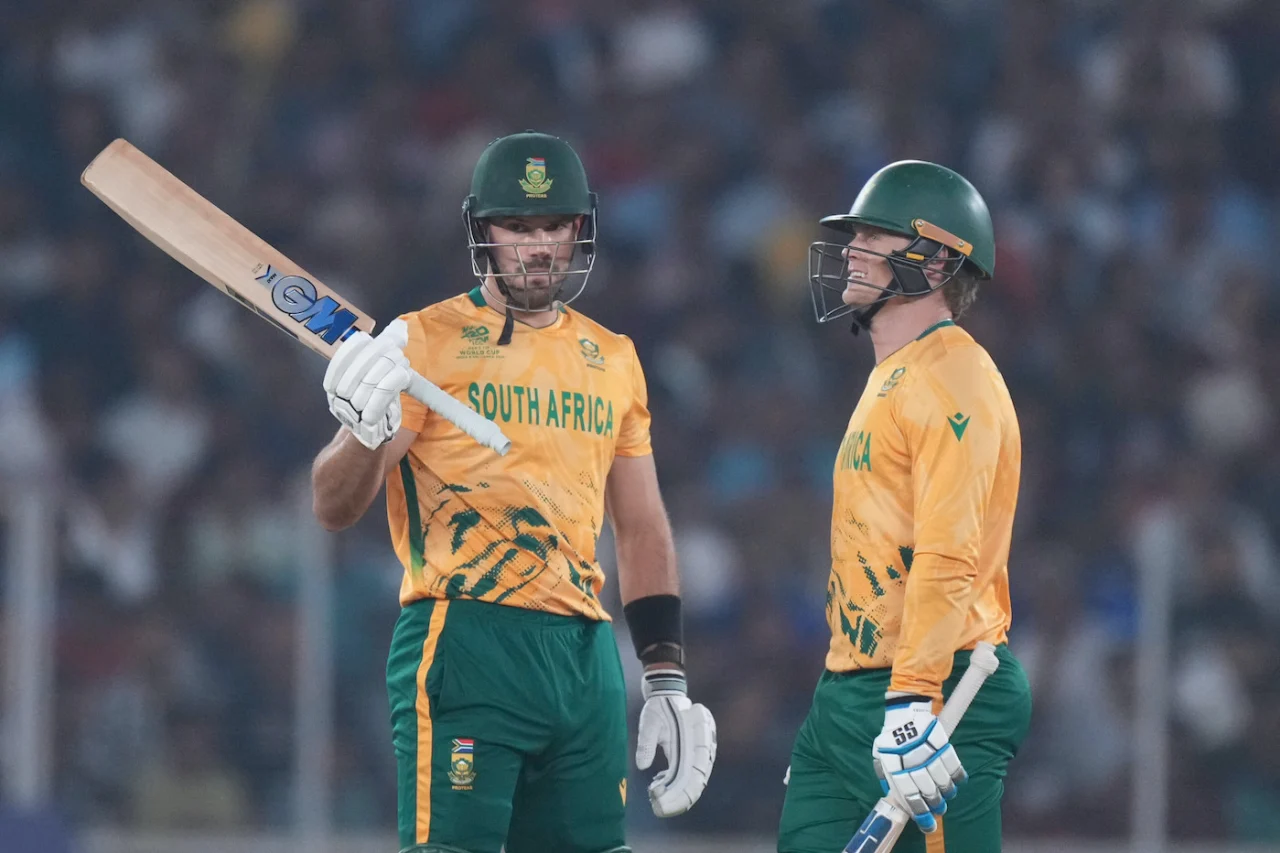
Marco Jansen’s first four-wicket haul in T20Is broke the back of two New Zealand assaults to give South Africa an easy win and a likely top spot in Group D. Not that the finish matters as the teams’ games in Super Eights are pre-decided as long as they make it out of the first group.
This was the first successful chase in a night game of this World Cup, but this was also arguably the first night match between evenly matched sides. Having survived Afghanistan in this group of death, both sides played with freedom. New Zealand kept coming at South Africa, reaching 33 for 0 in 3.1 overs, 57 for 1 in 5.1 and then 138 for 4 in 13.5.
However, Jansen pegged New Zealand back every time, the final strike resulting in a practical shutdown: only 37 came off the last 37 balls as New Zealand ran out of batting. In response, Aiden Markram’s personal best of 86 off 44 ended the game with 17 balls to spare, making it 5-0 for them against New Zealand in T20 World Cups.
Lungi Ngidi and Kagiso Rabada kept the dangerous duo of Tim Seifert and Finn Allen quiet for two overs, but the eventual onslaught arrived on a pitch where the ball came onto bat beautifully. Allen started off with three fours and a six in the third over, bowled by Ngidi. The powerplay hitting involved no innovation or cuteness, just timing and power.
Jansen’s first ball of the night was dismissed disdainfully for a six over mid-on by Siefert. Jansen immediately went to Plan B. Mid-on went back, leaving no boundary riders on the off side. Siefert looked to exploit that field but Jansen bowled an accurate short ball to take an edge through to the keeper.
Allen didn’t slow down, but then Jansen came back for the last over of the powerplay to take out Rachin Ravindra and Allen. While Ravindra got a thick edge to short third, Allen got too close to a slower offcutter and couldn’t find the elevation to clear mid-off.
Mark Chapman still kept coming, but when Keshav Maharaj bowled Glenn Phillips to make it 64 for 4 in seventh over, New Zealand finally had to go into recovery mode.
To be absolutely accurate, only Mitchell was in recovery mode. Chapman looked in fine touch, and pulled Maharaj for a six two balls after Phillips’ fall. Ngidi managed to bowl the 10th over without a boundary, but in the 11th and 12th the duo took 29. Corbin Bosch was hit for a four by each batter, and Markram a six each. At 131 for 4 in 13, New Zealand were back on track for 200, which looked like the bare minimum to stay competitive.
Jansen had got one wicket with a slower ball already, but on his return he unveiled a knuckle ball, which completely bewitched Chapman, who was 48 off 25 at that point. When Ngidi had Mitchell caught at long-on – for a change, with an on-pace delivery that hit the inner half of the bat – New Zealand had lost six wickets with more than four overs left. Only James Neesham could do some damage in the end but 175 looked paltry with dew already apparent.
It almost looked like a footnote that he brought up the fastest half-century for South Africa in T20 World Cups in 19 balls and took South Africa to their joint-highest powerplay score in t20 World Cups, 83. Quinton de Kock and Ryan Rickelton didn’t do badly either, scoring 20 off 14 and 21 off 11, but it wasn’t possible to take your eye off Markram’s driving.
Brief scores:
New Zealand 175/7 in 20 overs (Tim Siefert 13, Finn Allen 31, Rachin Ravindra 13, Mark Chapman 48, Daryl Mitchell 32, James Neesham 23*;Lungi Ngindi 1-34, Marco Jansen 4-40, Keshav Maharaj 1-24, Corbin Bosch 1-34) lost to South Africa 178/3 in 17.1 overs (Aiden Markram 86*, Quinton de Kock 20, Ryan Rickelton 21, Dewald Brevis 21, David Miller 24*; Lockie Ferguson 1-33, James Neesham 1-15, Rachin Ravindra 1-09) by seven wickets
[Cricinfo]

Rubio says US and Europe ‘belong together’ despite tensions

Nepal fight to stay alive against in-form West Indies

Jansen, Markram hand South Africa statement win

Russia killed opposition leader Alexei Navalny using dart frog toxin, UK says

Tom Banton 63* sets up nervy win for England

Landslide Early Warnings issued to the districts of Kandy and Nuwara Eliya extended

‘Dates have the highest sugar content to fight Coronavirus’

Sunday Island 27 December – Headlines

#SundayIsland 17th December – Headlines

Sunday Island – 28th March

Sunday Island Headlines – 21 March

Sunday Island – 21st February – Headlines
-

 Features7 days ago
My experience in turning around the Merchant Bank of Sri Lanka (MBSL) – Episode 3
-

 Business7 days ago
Remotely conducted Business Forum in Paris attracts reputed French companies
-
 Business7 days ago
Four runs, a thousand dreams: How a small-town school bowled its way into the record books
-

 Business7 days ago
ComBank and Hayleys Mobility redefine sustainable mobility with flexible leasing solutions
-

 Business4 days ago
Autodoc 360 relocates to reinforce commitment to premium auto care
-
 Midweek Review4 days ago
A question of national pride
-
 Opinion3 days ago
Will computers ever be intelligent?
-
 Midweek Review4 days ago
Theatre and Anthropocentrism in the age of Climate Emergency