
Latest News
Mandhana and Rawal’s tons fire India to record win

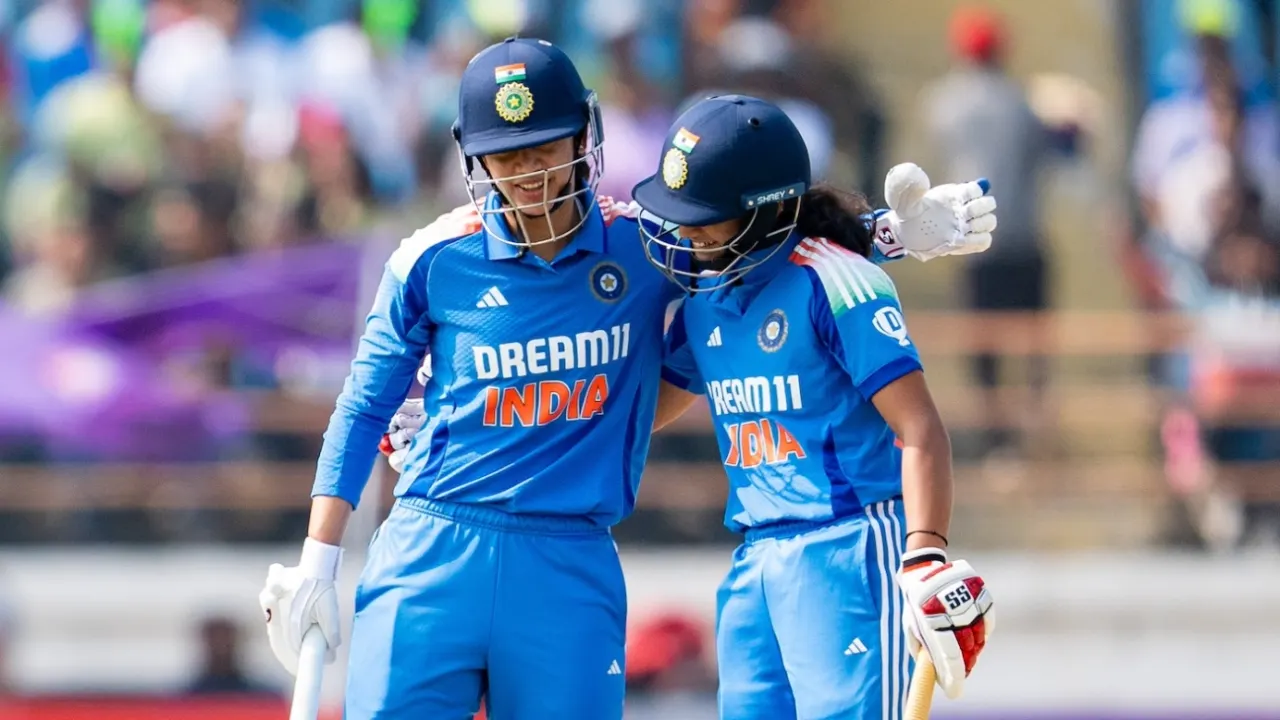
India Women 435 for 5in 50 overs (Pratika Rawal 154, Smriti Mandhana 135, Richa Ghosh 59, Tejal Hasbnis 29; Orla Prendergast 2-71) beat Ireland Women 131 in 31.4 overs (Sarah Forbes 41, Orla Prendergast 36; DeeptiSharma 3-27, Tanuja Kanwar 2-31)by 304 runs
On a record-shattering day in Rajkot, India registered their biggest win in ODI cricket. They beat Ireland by 304 runs in the third and final match of the series, thus completing the whitewash. Their previous biggest win was also against Ireland, in 2017, when they had beaten them by 249 runs in Potchefstroom.
Batting first, India piled up 435 for 5, their highest ODI total, going past the 370 for 5 they made in the previous game. Overall, this was the fourth-highest total in women’s ODIs.
Stand-in captain Smriti Mandhana led the way by smashing the fastest ODI hundred by an India batter. She reached the mark in 70 balls, breaking Harmanpreet Kaur’s record by 17 balls. In her 135 off 80 balls, Mandhana hit 12 fours and seven sixes. Her opening partner, Pratika Rawal, reached her maiden ODI hundred in 100 balls and went on to compile 154 off 129. Only two India batters have a higher individual score in the format: Deepti Sharma (188) and Harmanpreet (171*).
Mandhana and Rawal added 233 for the first wicket, the third-highest opening stand for India in ODIs. The floodgates had opened as early as the third over when Rawal hit Orla Prendergast for three fours. By the end of the sixth over, she had moved to 29 off 25 with the help of six fours.
Mandhana did not have much strike till then. She even got a life in the seventh over when wicketkeeper Christina Coulter Reilly, standing up to Arlene Kelly, failed to grab an outside edge. Mandhana was on 12 off 13 at that point but took over the aggressor’s role after that, hitting Kelly for two fours in that over. In the seamer’s next over, Mandhana hit her for two sixes and a four.
Mandhana and Rawal brought up India’s hundred in the 13th over. This was their fourth century stand in just six innings they have opened together.
Soon after that, Mandhana reached her fifty, off just 39 balls. Rawal followed suit; hers coming off 52 balls. It was her fourth 50-plus score in six ODIs.
Mandhana was now batting on a different plane. It felt more like a free-wheeling centre-wicket practice than a contest as she tried to dispatch as many balls to the boundary as possible. Ireland’s wayward bowling and poor ground fielding helped her further. Such was her dominance that she left Rawal well behind. When she brought up her hundred, off 70 balls, Rawal was only on 72 off 69.
Mandhana was dismissed when she failed to clear short fine leg against Prendergast. But there was no respite for Ireland as Richa Gosh, promoted to No. 3, took over the baton and scored 59 off 42. She and Rawal added 104 in 12 overs.
Rawal opened up after her hundred and raked in 54 off the next 29 balls she faced. Today’s innings took her ODI run tally to 444 – no batter has scored more in her first six innings.
By then, there was more interest in if India could reach 400. They got there with four overs to spare, and then got some more.
With Renuka Singh rested, Titas Sadhu and Sayali Satghare opened the bowling for India. Both picked up a wicket each with the new ball but also conceded 15 extras in the first seven overs. India’s fielding was also as poor as their counterparts, with Mandhana dropping a skier from Sarah Forbes off Deepti at extra cover.
Forbes and Prendergast made India pay for their mistakes and took the side to 85 for 2 after 14 overs. Tanuja Kanwar broke the 64-run stand by dismissing Prendergast. The batter tried to steer her towards deep third but failed to connect and was bowled. It was Kanwar’s first wicket in ODIs. Three overs later, Forbes was run out going for a quick single.
Ireland capitulated after that. From 100 for 3, they were all out for 131. Deepti was the most successful bowler for India, with figures of 3 for 27. Kanwar chipped in with 2 for 31 and two batters were run out.
Brief scores:

Latest News
Sooryavanshi blitz, Jurel 81* help Rajasthan Royals take down Royal Challengers Bengaluru with ease

Vaibhav Sooriyavanshi equalled his own record for the fastest half-century, off 15 balls, in a six-fest on a flat Guwahati deck as Rajasthan Royals walloped Royal Challengers Bengaluru for their fourth straight win.
RCB hit seven sixes through their 20 overs in an innings where they went all out, seemingly mindful of the challenge Sooryavanshi would pose. And pose he did, hitting seven sixes off his own blade, in a scarcely believable exhibition of brutal hitting.
Reputation counted for little. If it was Jasprit Bumrah the other night, it was Josh Hazlewood’s turn to come under Sooryavanshi’s wheel on Friday. By the time he was dismissed for a 26-ball 78, toe-ending a flat-batted hit to long-on off Krunal Pandya, RR’s asking rate in a 202 chase was just over six with 11.5 overs remaining.
Sooryavanshi’s uninhibited hitting was matched by Dhruv Jurel’s scintillating stroke play, the pair effectively snuffed out RCB’s hopes in the powerplay itself as they plundered 97 – the highest of the season. Although RR lost a couple of wickets in a rush thereafter, the result was never really in doubt.
RCB’s defence was given an early lift when the returning Hazlewood struck in the second over to remove Yashasvi Jaiswal. After conceding a couple of sixes off the short ball, Hazlewood responded smartly by going cross-seam and into the pitch to induce the edge. But the delight at having struck early dissipated quickly as Sooryavanshi seized control by rattling off three boundaries and a six in succession in his next over.
Each of the four boundaries pierced a different arc. The short ball was carved behind point, the hard length into the pitch was muscled over mid-on, the fuller one driven crisply between cover and mid-off, and when tested with the bumper, Sooryavanshi fetched it from outside off and nailed the pull over deep square for six.
And remarkably, it wasn’t just Hazlewood under the pump. Bhuvneshwar Kumar – who had nearly dismissed him first ball with a late-curving inswinging yorker, only for the teenager to dig it out and shovel it straight back for four – was also taken apart. In the fifth over, Sooryavanshi swatted him for back-to-back sixes to bring up his half-century.
Keeping pace with Sooryavanshi stroke for stroke can’t be easy, but Jurel managed it seamlessly, without ever looking like he was trying to. He capped off the powerplay by hitting rookie Abhinandan Singh for a sequence of 4, 6, 4, 0, 6, 4 to end an extraordinary passage.
Jurel’s fast hands were the defining feature of that over – whether it was picking length early to pull or using his wrists to whip the ball into the top tier over deep square. He would later take charge of the innings, tightening his approach after a flurry of wickets, and finishing unbeaten on 76 off 36 balls.
Jurel’s 68-run fifth-wicket stand with Ravindra Jadeja then guided RR home comfortably, steadying things after Krunal briefly stirred RCB’s hopes with back-to-back strikes of Sooryavanshi and Shimron Hetmyer in the ninth over.
RR went through a quiet passage of four overs without a boundary, but the early onslaught from Sooryavanshi and Jurel meant they could afford to play out a few quiet overs fully knowing RCB were a spinner short, as they activated Venkatesh Iyer as an impact player for batting firepower in place of Suyash Sharma.
The match had a blockbuster opening act, with Jofra Archer’s vicious, rip-roaring bouncer sending back Phil Salt for a golden duck. But Virat Kohli fought fire with fire, hitting him for three boundaries in his next over, before Archer struck back to remove the in-form Devdutt Padikkal.
This didn’t affect Kohli, though, as he shredded a much-talked-about matchup with Sandeep Sharma (who had dismissed him seven times in 18 innings) by thumping him over the infield for two fours. But trouble soon came RCB’s way as Ravi Bishnoi struck two quick blows to leave them 73 for 4.
In his first two outings, Rajat Patidar went crash-bang-wallop from the get-go. But a top-order wobble forced him to dig deep. He played himself in, getting to 20 off 22 balls at one stage. And then, three overs later, he brought up a half-century off 35 balls. One of the reasons for this surge was his surety in stroke-making.
The two sixes he hit off Nandre Burger in the 15th had that stamp of authority. A gentle extension of his arms to loft one cleanly over long-off laid down the marker, but the hop back to whip a short ball aimed at his ribs over deep square leg was the blockbuster.
With none of Romario Shepherd or Tim David coming off with the bat, RCB brought in Venkatesh Iyer as their Impact Player, leaving Suyash on the bench. And Venkatesh gave an excellent account of himself on RCB debut, finishing the innings off with a cameo 29 that pushed them past 200.
As it turned out, it was nowhere near enough.
Brief scores:
Rajasthan Royals 202 for 4 (Yashasvi Jiswal 13, Dhruv Jurel 81*, Vaibhav Sooryavanshi 78, Ravindra Jadeja 24*; Josh Hazelwood 2-44, Krunal Pandya 2-30) beat Royal Challengers Bengaluru 201 for 8 in 20 overs (Virat Kohli32, Devudutt Padikkal 14, Rajat Patidar 63, Tim David 13, Romario Shepherd 22, Venkatesh Iyer 29*; Jofra Archer 2-33, Sandeep Sharma 1-47, Ravi Bishnoi 2-32, Ravindra Jadeja 1-14, Brijesh Sharma 2-37) by six wickets
[Cricinfo]
Latest News
Sun directly overhead Pomparippu, Anuradhapura, Mihinthale, Galenbindunuwewa, Agbopura and Serunuwara about 12:11 noon today (11)

On the apparent northward relative motion of the sun, it is going to be directly over the latitudes of Sri Lanka from 05th to 15th of April in this year.
The nearest areas of Sri Lanka over which the sun is overhead today (11th) are Pomparippu, Anuradhapura, Mihinthale, Galenbindunuwewa, Agbopura and Serunuwara about 12:11 noon.
| Date | Match |
|---|---|
| May 3 | 1st ODI |
| May 6 | 2nd ODI |
| May 9 | 3rd ODI |
| May 12 | 1st T20I |
| May 14 | 2nd T20I |
| May 15 | 3rd T20I |
[Cricbuzz]

Sooryavanshi blitz, Jurel 81* help Rajasthan Royals take down Royal Challengers Bengaluru with ease

Sun directly overhead Pomparippu, Anuradhapura, Mihinthale, Galenbindunuwewa, Agbopura and Serunuwara about 12:11 noon today (11)

Showers expected in the Western, Sabaragamuwa, North-western , Southern and Uva provinces and in Anuradhapura, Mannar, Kandy and Nuwara-Eliya districts after 2.00 p.m.

Opposition NCM against Energy Minister defeated

Chinese Ambassador assures Lanka China will not allow a fuel crisis to develop here

Minister Jayatissa blames administrations since 2010 for not following proper procedures when procuring coal

‘Dates have the highest sugar content to fight Coronavirus’

Sunday Island 27 December – Headlines

#SundayIsland 17th December – Headlines

Sunday Island – 28th March

Sunday Island Headlines – 21 March

Sunday Island – 21st February – Headlines
-

 Features7 days ago
Ranjith Siyambalapitiya turns custodian of a rare living collection
-

 News7 days ago
Global ‘Walk for Peace’ to be held in Lanka
-

 News5 days ago
Lankan-origin actress Subashini found dead in India
-

 News3 days ago
AG: Coal procurement full of irregularities
-

 Business2 days ago
Israeli attack on Lebanon triggers local stock market volatility
-

 Features7 days ago
Beyond the Blue Skies: A Tribute to Captain Elmo Jayawardena
-

 Features7 days ago
Aspects of Ceylon/Sri Lanka Foreign Relations – 1948 to 1976
-

 Business3 days ago
Hayleys Mobility introduces Premium OMODA C9 PHEV