
Latest News
Mandalay was the ‘city of gold’ – now it reeks of death

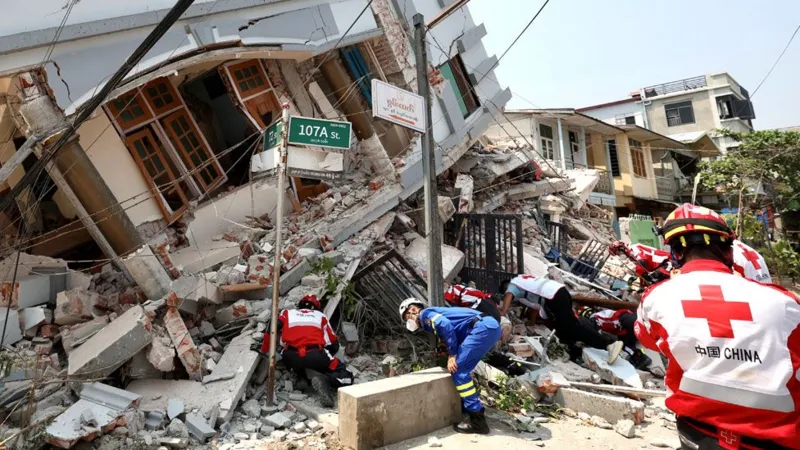
Mandalay used to be known as the city of gold, dotted by glittering pagodas and Buddhist burial mounds, but the air in Myanmar’s former royal capital now reeks of dead bodies.
So many corpses have piled up since a 7.7 magnitude earthquake struck last Friday close to Mandalay, that they have had to be “cremated in stacks”, one resident says.
The death toll from the quake and a series of aftershocks has climbed past 2,700, with 4,521 injured and hundreds still missing, Myanmar’s military chief said. Those figures are expected to rise.
Residents in the country’s second most populous city say they have spent sleepless nights wandering the streets in despair as food and water supplies dwindle.
The Mandalay resident who spoke of bodies being “cremated in stacks” lost her aunt in the quake.
“But her body was only pulled out of the rubble two days later, on 30 March,” said the 23-year-old student who wanted only to be known as J.
Poor infrastructure and a patchwork of civil conflicts are severely hampering the relief effort in Myanmar, where the military has a history of suppressing the scale of national disasters. The death toll is expected to keep rising as rescuers gain access to more collapsed buildings and cut-off districts.
J, who lives in Mandalay’s Mahaaungmyay district, has felt “dizzy from being deprived of sleep”, she said.
Many residents have been living out of tents – or nothing – along the streets, fearing that what’s left of their homes will not hold up against the aftershocks.
“I have seen many people, myself included, crouching over and crying out loud on the streets,” J said.
But survivors are still being found in the city. The fire service said it had rescued 403 people in Mandalay in the past four days, and recovered 259 bodies. The true number of casualties is thought to be much higher than the official version.
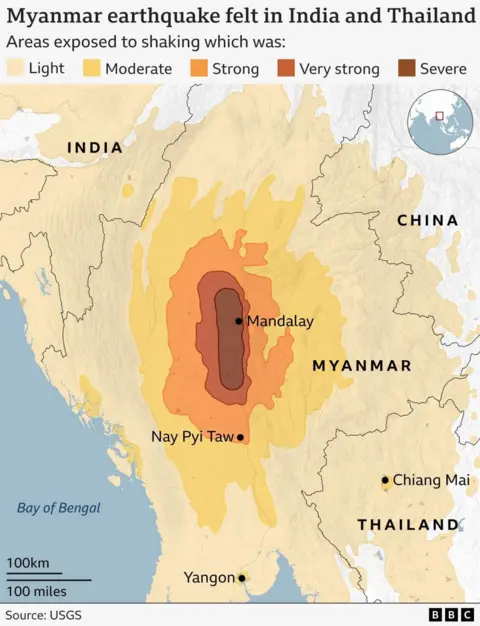
In a televised speech on Tuesday, military chief Min Aung Hlaing said the death toll may exceed 3,000, but the US Geological Survey said on Friday “a death toll over 10,000 is a strong possibility” based on the location and size of the quake.
Young children have been especially traumatised in the disaster.
A local pastor told the BBC his eight-year-old son had burst into tears all of a sudden several times in the last few days, after witnessing parts of his neighbourhood buried under rubble in an instant. “He was in the bedroom upstairs when the earthquake struck, and my wife was attending to his younger sister, so some debris had fallen onto him,” says Ruate, who only gave his first name. “Yesterday we saw bodies being brought out of collapsed buildings in our neighbourhood,” said Ruate, who lives in the Pyigyitagon area.
“It’s very sobering. Myanmar has been hit by so many disasters, some natural, some human made. Everyone’s just gotten so tired. We are feeling hopeless and helpless.”
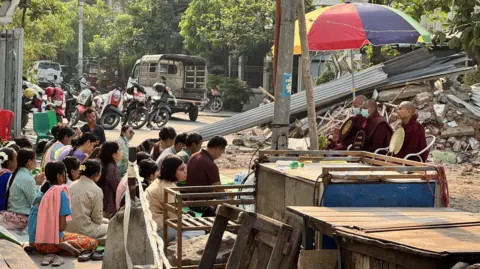
A monk who lives near the Sky Villa condominium, one of the worst-hit buildings reduced from 12 to six storeys by the earthquake, told the BBC that while some people had been pulled out alive, “only dead bodies have been recovered” in the past 24 hours. “I hope this will be over soon. There are many bodies still inside, I think more than a hundred,” he said.
Crematoriums close to Mandalay have been overwhelmed, while authorities have been running out of body bags, among other supplies, including food and drinking water.
Around the city, the remains of crushed pagodas and golden spires line the streets. While Mandalay used to be a major centre for the production of gold leaf and a popular tourist destination, poverty in the city has soared in recent years, as with elsewhere in Myanmar (formerly called Burma).
 BBC Burmese
Last week’s earthquake also affected Thailand and China, but itsnimpact has been especially devastating in Myanmar, which has been ravaged by a bloody civil war, a crippled economy and widespread disillusionment since the military took power in a coup in 2021.
On Tuesday, Myanmar held a minute of silence to remember victims, part of a week of national mourning. The junta called for flags to fly at half mast, media broadcasts to be halted and asked people to pay their respects.
Even before the quake, more than 3.5 million people had been displaced within the country.
Thousands more, nany of them young people, have fled abroad to avoid forced conscription – this means there are fewer people to help with relief work, and the subsequent rebuilding of the country.
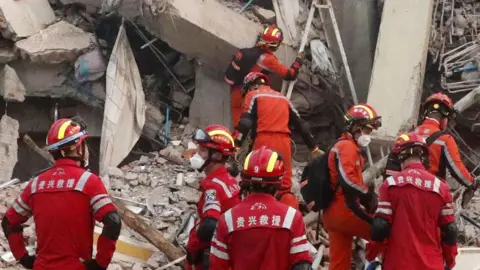
Russia and China, which have helped prop up Myanmar’s military regime, are among countries that have sent aid and specialist support.
But relief has been slow, J said.
“The rescue teams have been working non-stop for four days and I think they are a little tired. They need some rest as well.
“But because the damage has been so extensive, we have limited resources here, it is simply hard for the relief workers to manage such massive destruction efficiently,” she said.

While the junta had said that all assistance is welcome, some humanitarian workers have reported challenges accessing quake-stricken areas.
Local media in Sagaing, the earthquake’s epicentre, have reported restrictions imposed by military authorities that require organisations to submit lists of volunteers and items that they want to bring into the area.
Several rights groups, including Human Rights Watch and Amnesty International, have urged the junta to allow aid workers immediate access to these areas.
“Myanmar’s military junta still invokes fear, even in the wake of a horrific natural disaster that killed and injured thousands,” said Bryony Lau, Human Rights Watch’s deputy Asia director.
“The junta needs to break from its appalling past practice and ensure that humanitarian aid quickly reaches those whose lives are at risk in earthquake-affected areas,” she said.
The junta has also drawn criticism for continuing to open fire on villages even as the country reels from the disaster.
[BBC]

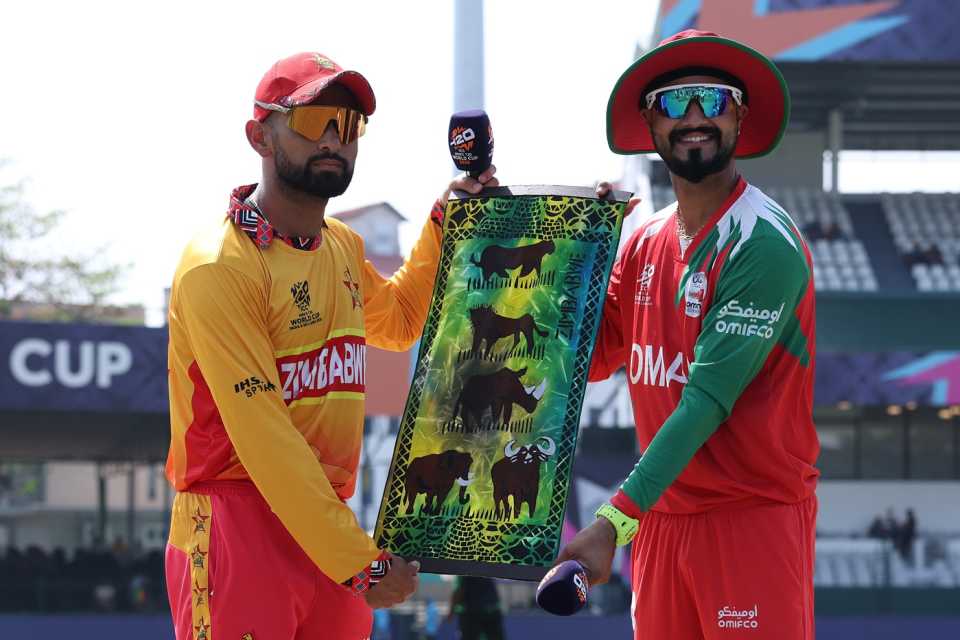
Zimbabwe captain Sikandar Raza decided to field first against Oman in the men’s T20 World Cup match at the SSC in Colombo. Both teams were pleased to arrive in Sri Lanka early to get themselves attuned to the conditions.
Zimbabwe have Blessing Muzarabani back in the squad after he missed the tri-series in Pakistan in November.
Oman, meanwhile, include 44-year-old Aaamir Kaleem the oldest player in the tournament – after he came into the side in place of Hasnain Shah, who was injured after the squad was named.
Zimbabwe return to the tournament after missing out on the previous edition in West Indies and the United States of America. They had made it to the Super 12s of the 2022 T20 World Cup but failed to progress through the qualifiers for the 2024 tournament. They completed qualification alongside Namibia; Brian Bennett was the tournament’s top run-scorer, while Brad Evans and Richard Ngarava were among the leading wicket-takers.
Zimbabwe are bolstered by the return of Graeme Cremer, whose November 2025 comeback marked the longest gap between T20I appearances.
Oman are one of three qualifiers from the Asia-Pacific region, alongside Nepal and the UAE. They have previously appeared in the 2016, 2021, and 2024 editions of the T20 World Cup.
Oman: Jatinder Singh (capt), Aamir Kaleem, Hammad Mirza, Wasim Ali, Karan Sonavale, Jiten Ramanandi, Vinayak Shukla (wk), Sufyan Mehmood, Nadeem Khan, Shah Faisal, Shakeel Ahmad
Zimbabwe: Brian Bennett, Tadiwanashe Marumani, Dion Myers, Brendan Taylor (wk), Sikandar Raza (capt), Ryan Burl, Tashinga Musekiwa, Brad Evans, Wellington Masakadza, Richard Ngarava, Blessing Muzarabani
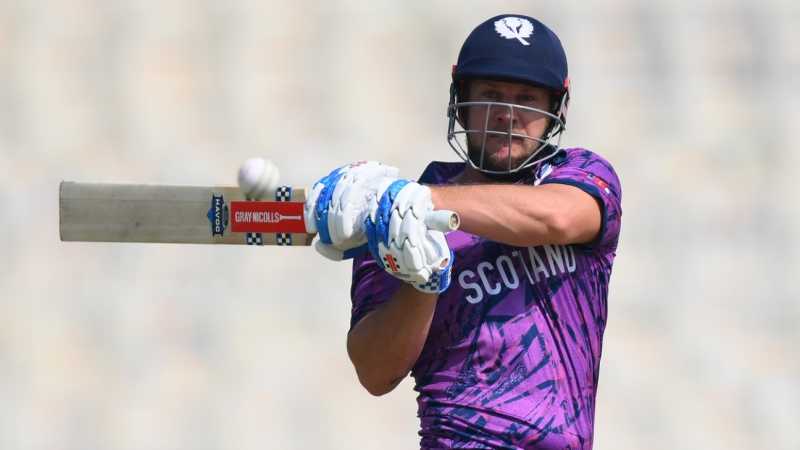
Scotland may have suffered a blip the last time they faced Italy in a T20I but ensured they picked up the first points of their 2026 T20 World Cup campaign after a dominant performance at Eden Gardens. George Munsey’s 54-ball 84, supported by cameos from Brandon McMullen and Michael Leask, followed by Leask’s four-wicket haul helped Scotland spoil Italy’s debut in the tournament. The 73-run win gave Scotland two points after their defeat to West Indies in Kolkata two days ago.
Brief scores:
Scotland 207 for 4 in 20 overs (George Munsey 84, Michael Jones 37, Brandon McMullen 41, Richie Berrington 15, Michael Leask 22*; Ali Hasan 1-21, Grant Stewart 1-44, Thomas Draca 1-37, JJ Smuts 1-38) beat Italy 134 in 16.4 overs (Anthony Mosca 13, JJ Smutts 22, Harry Manenti 52; Michael Leask 4-17, Brad Currie 1-12, Brad Wheal 1-29, Mark Watt 2-24, Oliver Davidson 1-33 ) by 73 runs
(Cricinfo)

In an inauspicious start to Italy’s maiden T20 World Cup campaign, their captain Wayne Madsen dislocated his shoulder in the fourth over of Scotland’s innings at #den Gardens. He was later ruled out of any further participation in the match.
Madsen was fielding at midwicket when he tried to stop a pull from George Munsey. He unsuccessfully dived to his left and rolled over on the practice pitches and immediately asked for medical attention. He soon left the ground using a towel as a sling for his left arm.
Madsen, by far Italy’s most experienced cricketer at age 42, is playing his maiden T20 World Cup and was taken for X-rays right away at the venue. A typical shoulder dislocation can take anywhere between seven to 21 days for full recovery while more serious cases can take three to four months.
In Madsen’s absence, Italy were captained by Harry Manenti for the remainder of Scotland’s innings. Scotland went on to score 207 for 4 after they were sent in to bat.
While serious injury replacements are being trialled by cricket boards in India and Australia in domestic cricket, there are no injury replacements in the playing XI allowed in international cricket. At the moment, replacements are allowed only if players suffer concussion.
Madsen was appointed Italy captain for the 2026 T20 World Cup after Joe Burns was not selected for the tournament. This World Cup is his second across sports; he also represented South Africa in the men’s hockey in the 2006 World Cup.
After the game against Scotland in Kolkata on February 9, Italy play Nepal in Mumbai on February 12, and then travel back to Kolkata to play England on February 16 and West Indies on February 19.
( Cricinfo)

Muzarabani returns as Zimbabwe opt to bowl against Oman

Munsey and Leask spoil Italy’s T20 World Cup debut2

Italy captain Wayne Madsen injures shoulder in T20 World Cup opener

Canada look for early splash against favourites South Africa

Italy opt to bowl; Scotland play Brad Wheal

Zimbabwe look to hit the ground running vs Oman

‘Dates have the highest sugar content to fight Coronavirus’

Sunday Island 27 December – Headlines

#SundayIsland 17th December – Headlines

Sunday Island – 28th March

Sunday Island Headlines – 21 March

Sunday Island – 21st February – Headlines
-

 Features1 day ago
My experience in turning around the Merchant Bank of Sri Lanka (MBSL) – Episode 3
-

 Business2 days ago
Zone24x7 enters 2026 with strong momentum, reinforcing its role as an enterprise AI and automation partner
-

 Business6 days ago
SLIM-Kantar People’s Awards 2026 to recognise Sri Lanka’s most trusted brands and personalities
-

 Business1 day ago
Remotely conducted Business Forum in Paris attracts reputed French companies
-
 Business1 day ago
Four runs, a thousand dreams: How a small-town school bowled its way into the record books
-

 Business6 days ago
API-first card issuing and processing platform for Pan Asia Bank
-

 Business2 days ago
HNB recognized among Top 10 Best Employers of 2025 at the EFC National Best Employer Awards
-

 Business1 day ago
ComBank and Hayleys Mobility redefine sustainable mobility with flexible leasing solutions