
Sports
Linde, Brevis and debutant Hermann star as SA beat Zimbabwe in tri-series opener


It’s just not getting any easier for Zimbabwe. After suffering two heavy defeats to South Africa in the Tests, they opened their T20I triangular series, which also includes New Zealand, with a loss. It was Zimbabwe’s sixth succesive T20I defeat to South Africa, against whom they are yet to register a win after two other games between the sides produced no results.
South Africa, playing in their first T20I this year – and first under Shukri Conrad since he was named all-format coach – will be pleased with their early outing. Chasing 142, they wobbled at 38 for 3, but debutant Rubin Hermann top-scored with 45, and shared in a 72-run fourth-wicket stand with Dewald Brevis, who contributed 41 off just 17 balls. Corbin Bosch finished things off with an unbeaten 23 off 15 deliveries.
The Hermann-Brevis partnership will make headlines, but South Africa will be equally satisfied with their bowlers – in particular with the return of Lungi Ngidi. After missing their last seven T20I matches, Ngidi came back with impressive accuracy, and finished with 1 for 15 from four overs. Overall, George Linde (3 for 10) was the standout with the lowest economy (3.33) and most wickets.
South Africa’s victorious chase, completed inside 16 overs, overshadowed Sikkander Raza’s 15th T20I fifty, and his first against South Africa. Raza also went past Craig Ervine as Zimbabwe’s most capped T20I captain, with 39 matches. His knock lifted Zimbabwe from 39 for 2 to a total over 140, though they needed far more to be competitive.
It may hardly sound like much, but Zimbabwe’s 34 runs in the first six overs was their joint-highest in a T20I against South Africa, and better, in wicket terms, than the 34 for 2 they had got in 2018. With only Wessly Madhevere dismissed – and he has only got past 20 once in his last 11 innings – Zimbabwe would have felt they hadd built a solid base, especially with the way Brian Bennett was playing.
His first boundary came when he flayed Ngidi through a vacant slip area, his second when he upper cut Burger to deep third, and his third and fourth off glorious drives over and through the covers off Bosch. What Bennett lacked was a partner as industrious as Zimbabwe’s scoring rate of under six an over needed a massive boost.
At 53 for 2 at the halfway stage, Zimbabwe were going nowhere, but Raza and Ryan Burl gave their innings some urgency. The pair ran well between the wickets, with Burl providing the early aggression. He took advantage of the only bad ball Ngidi bowled, down leg, to help its way for four, and then made Nqakaba Peter pay for poor length. The short ball was swung over fine leg, and the full one hit over long-on for the innings’ first six.
Raza began the final onslaught when he picked up a slower ball from Andile Simelane, and hit it back over his head for six. He was dropped on 33 by Brevis at deep cover, and then slammed Simelane for six more in an over that cost 19. The partnership between Raza and Burl was worth 66 from 38 balls when Burl holed out to long-off to give Nandre Burger, on comeback after ten months, his first wicket. Zimbabwe scored 88 runs in the last ten overs to stage a decent fightback.
It is always going to be difficult for Linde to get past Keshav Maharaj in the South Africa side. But if they ever consider twin left-arm spin, Linde has done his bit to be the other half. Against Zimbabwe on Monday, Linde was brought on immediately after the powerplay, and bowled a tight first over. He then had Bennet out in his second over, and was tasked with the last over. where he took two wickets in two balls.
Tashinga Musekiwa tried to force Linde over mid-off but was caught, before Tony Muyonga was caught off a low full toss. Linde almost had a hat-trick, before finishing with figures three wickets. However, there will be questions over why he did not bowl his full quota of overs.
Richard Ngarava hurt his back during Zimbabwe’s Test in England, and missed the Tests against South Africa. But he showed why he is so crucial to Zimbabwe’s side with an explosive opening spell. Ngarava’s first legitimate ball stuck in the turf, and Lhuan-dre Pretorius toe-ended it back to him for a simple return catch.
In his next over, a similar delivery took Reeza Hendricks’ inside edge as he drove loosely, and went on to rock middle stump. South Africa were 17 for 2 in the third over, and Ngarava had given Zimbabwe a solid chance. With Hendricks’ wicket, Ngarava went past Raza as Zimbabwe’s leading wicket taker in T20Is, with 82 to his name. Ngarava returned to bowl the 15th over, and added to the tally by getting rid of Hermann with a delivery that kept low and skidded on to take out off stump.
Hermann announced himself by scoring his first international runs with a six when he stepped inside the line to send Ngarava over fine leg. He very nearly didn’t add to his score when he popped Blessing Muzarabani to cover point, but the ball fell safe. Then Hermann took control of the chase when he thumped back-to-back-to-back fours off Wellington Masakadza to bring the required run rate down to under seven an over.
Hermann played the sweep, and showed his power-hitting and ability to use his feet in the three fours he struck. Not to be outdone, Brevis, who only had five runs in his previous two
T20Is, then went one better. Two overs after Hermann’s blitz, Brevis sent Burl down the ground three times for a hat-trick of sixes. Burl was guilty of going too short, and Brevis was happy to make room and swing away. He took 24 runs off Burl’s opening over, which cost 25, and effectively ended the contest.
South Africa were 103 for 3 after 11 overs, and needed 39 runs from the next nine overs to win. Eventually, they got those runs in less than five overs.
Brief scores:
South Africa 142 for 5 in 15.5 overs (Reeza Hendricks 11, Rassie van der Dussen 16, Robin Hermann 45, Dewald Brevis 41, Corbin Bosch 23*; Richard Ngarava 3-35, Trevor Gwandu 2-15) beat Zimbabwe 141 for 6 in 20 overs (Sikkandar Raza 54*, Brian Bennett 30, Ryan Burl 29; Lungi Ngidi 1-15, Nandre Burger 1-22, George Linde 3-10, Nqabayomzi Peter 1-22) by five wickets
[Cricinfo]

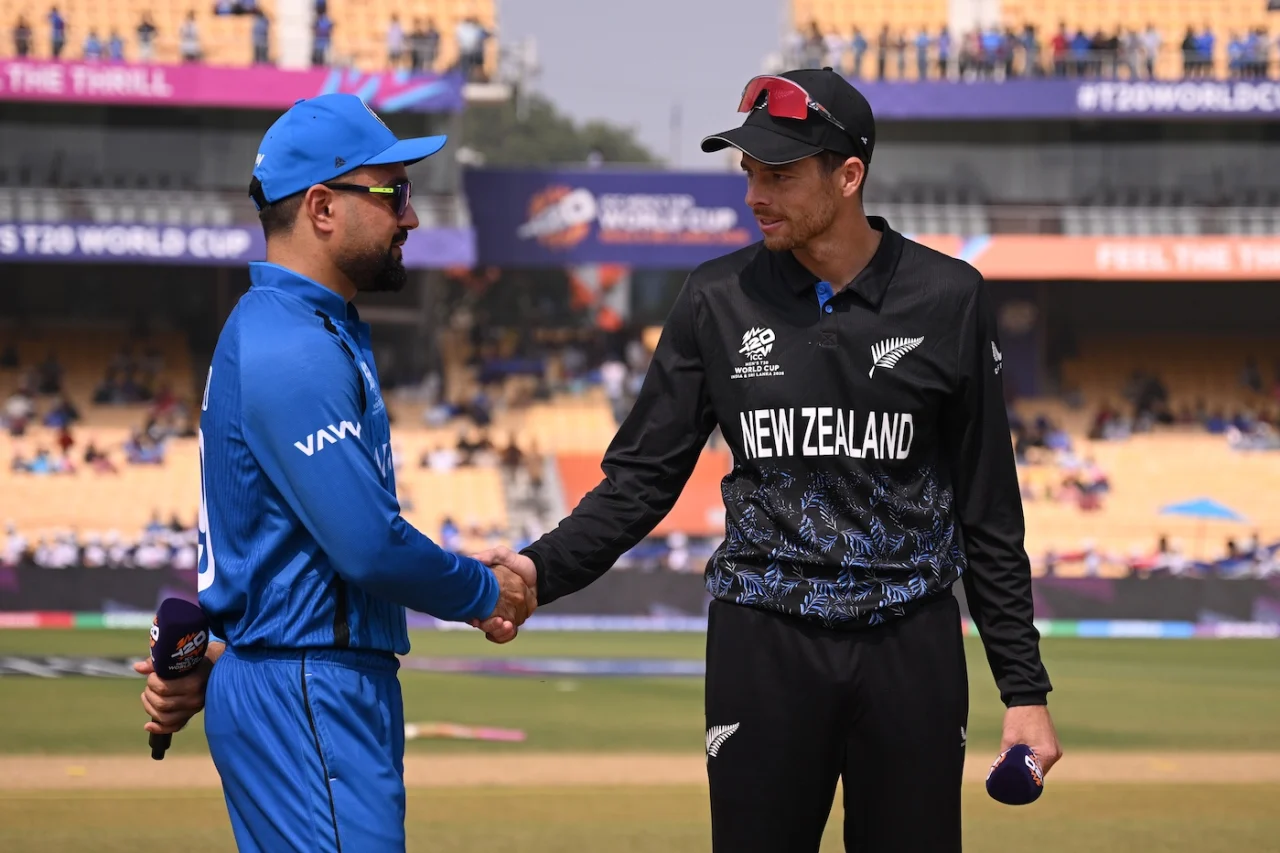
Afghanistan won the toss and elected to bat first in the 2026 T20 World Cup Group D encounter against New Zealand..
New Zealand XI Finn Allen, Tim Seifert (wk), Rachin Ravindra, Glenn Phillips, Mark Chapman, Daryl Mitchell, Mitchell Santner (capt), James Neesham, Matt Henry, Lockie Ferguson, Jacob Duffy
Afghanistan XI Rahmanullah Gurbaz (wk), Ibrahim Zadran, Sediqullah Atal, Darwish Rasooli, Azmatullah Omarzai, Gulbadin Naib, Mohammad Nabi, Rashid Khan (capt), Fazalhaq Farooqi, Ziaur Rahman, Mujeeb Ur Rahman
Latest News
‘I’d like to play on flat tracks’ – Shanaka links Sri Lanka’s batting woes to spin-friendly pitches at home
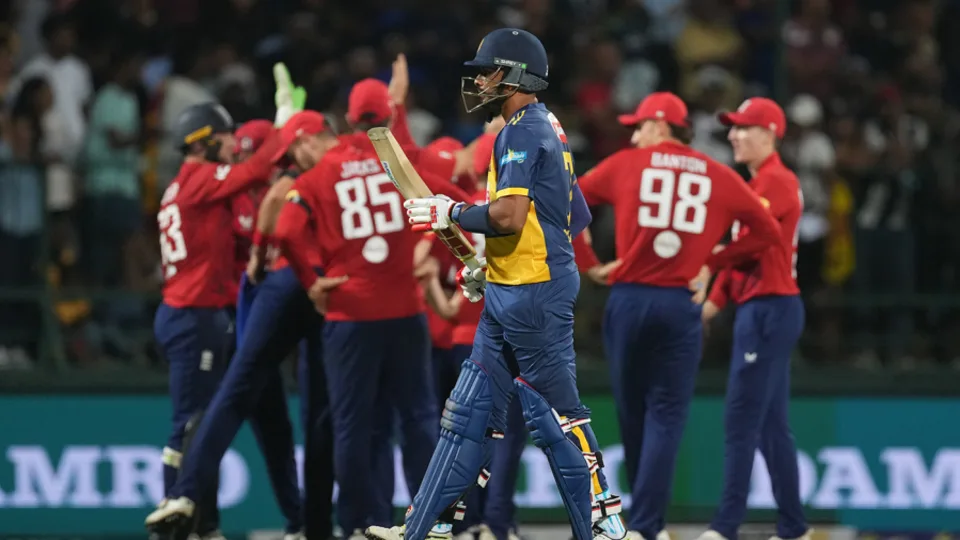
Dasun Shanaka’s got 99 problems, and the pitch is also one. If cricket writers misappropriating Jay Z lyrics from 22 years ago is getting kind of old, so is the complaint, sadly. For years now, Sri Lanka’s captains have been campaigning to get more batting-friendly tracks on the island. For years now, surfaces have been given to substantial spin, depressing totals while envenoming spinners through the middle overs, especially.
At the World Cup, though, a struggling Sri Lankan captain hopes his batters can perform on what he thinks will be better tracks. Sri Lanka arrive at this tournament fresh from a 3-0 bruising at home at the hands of England. Shanaka’s own returns in that recent series were modest. His scores were 20 off 16, 1 and 4.
“I think in this World Cup the ICC has told the groundstaff that they have to leave a certain amount of grass on the pitch,” Shanaka said. “Because of that, I think the number of dismissals will fall. Eventually, I’d like to get a good track on which to show how I can bat, because it’s harder to showcase my striking ability on turning wickets. Lots of people see me negatively because of this.”
In fact, there is no actual official requirement from the ICC regarding length of grass – it is only that there is greater pressure to produce surfaces conducive to good cricket (read: batting tracks) in global events.
In any case, Sri Lanka’s problems at home go back far further than the series against England, however. Since the start of 2024, Sri Lanka have lost 13 and won only nine T20Is at home. Previous captains – Charith Asalanka and Wanindu Hasaranga among them – had asked for flatter decks. But then Sri Lanka were having success on big turners in the ODI format.
“Recently, we’ve had a lot of issues with the pitches,” Shanaka said. “I know the middle order hasn’t performed well. If you want to know why that happened, you should look at the kind of pitches we played on. You’ll be able to figure out why the strike rates are low and we’re losing wickets.
“I was only recently reappointed as the captain. I didn’t know what the plan was before that. In my opinion I’d like to play on flat tracks. Yes, we have some good spinners in our side, but at the same time other teams also have quality spinners. I think giving 50-50 wickets will help in future. I’d like to bat on flat tracks.”
Although Shanaka expects Sri Lankan surfaces to be better for batting, there may still be a gap between Indian tracks and Sri Lankan ones in this World Cup. Since the start of 2020, the T20I strike rate in India is 143 (the highest in the world), compared with 123 in Sri Lanka.
“If you look at India you will see how good the pitches they play on are,” Shanaka said. “Some people have a problem with India scoring so many runs and ask why Sri Lanka can’t do the same. It totally depends on conditions. You’ll be able to assess what the numbers in the World Cup are and what the previous numbers were. I think this will be a good tournament for our batters.”
[Cricinfo]


Not many are giving Sri Lanka a fighting chance in this World Cup after being handed a 3-0 whitewash by England on the eve of the tournament. Yet, with a core that has been together for five years and the comfort of home conditions under their spikes, they will quietly fancy sneaking into the second round at the very least. The campaign gets underway on Sunday when they lock horns with Ireland at the RPS.
After the opener, the former champions shift base to Kandy where Oman await on February 12, followed by the heavyweight bout against Australia. They then return to Colombo to face Zimbabwe in the final group fixture. Apart from the Aussies, the other three sides sit below Sri Lanka in the rankings, reason enough for the hosts to believe they can punch above their recent weight.
Ideally, the team would have liked to go in with a settled deck. The chopping and changing of selectors and captain has hardly gone down well with the public, although Charith Asalanka’s excesses left the authorities with something of a Hobson’s choice. Whether they should have held their nerve until the World Cup was done and dusted instead of twisting the knife remains a question that refuses to go away.
Dasun Shanaka, the man recalled to replace Asalanka, has been around this block before and rarely set the field alight as leader. What he brings to the table is well known, as are his frailties with the bat, particularly against wrist spin. Should he fail to strike form, the selectors may be forced into a 2014-style déjà vu, leaving the captain cooling his heels outside the playing XI. The trouble is, there is no obvious skipper in waiting to take the reins if that storm breaks.
The panel has also copped flak for plucking Dhananjaya de Silva out of thin air. It is widely believed his recall came at the behest of a fast-bowling guru who has now begun offering batting sermons as well. That is precisely why a selection committee needs a spine of its own, rather than dancing to every passing tune.
Sri Lanka had been making steady, if unspectacular, strides in white ball cricket without exactly setting the stage ablaze. Their blueprint was clear, big runs from Pathum Nissanka at the top, Matheesha Pathirana creating mayhem with his slingy darts and a spin attack marshalled by Wanindu Hasaranga. With that backbone, a few rubs of the green might have made them serious dark horses. Instead, they pressed the panic button with the World Cup on the doorstep and now appear a touch disjointed and disoriented.
What tilts the scales in their favour is a gentle runway – fixtures against Ireland and Oman before they enter the sharp end against Australia. For now, the fans seem to have voted with their feet, but one statement win over the Aussies could have them flocking back in droves. After all, it’s a funny old game.
by Rex Clementine

Afghanistan to bat first against New Zealand

‘I’d like to play on flat tracks’ – Shanaka links Sri Lanka’s batting woes to spin-friendly pitches at home

Washington Post chief executive steps down after mass lay-offs

Australia’s opposition coalition reunites after row over hate-speech laws

Showers may occur in the Western, Uva and Sabaragamuwa provinces and in Matale, Nuwara-Eliya, Ampara, Batticaloa, Galle, Matara and Polonnaruwa districts

King Charles to host Nigeria’s first UK state visit in 37 years

‘Dates have the highest sugar content to fight Coronavirus’

Sunday Island 27 December – Headlines

#SundayIsland 17th December – Headlines

Sunday Island – 28th March

Sunday Island Headlines – 21 March

Sunday Island – 21st February – Headlines
-

 Business1 day ago
Zone24x7 enters 2026 with strong momentum, reinforcing its role as an enterprise AI and automation partner
-

 Business5 days ago
SLIM-Kantar People’s Awards 2026 to recognise Sri Lanka’s most trusted brands and personalities
-

 Business6 days ago
All set for Global Synergy Awards 2026 at Waters Edge
-

 Business1 day ago
HNB recognized among Top 10 Best Employers of 2025 at the EFC National Best Employer Awards
-

 Business5 days ago
API-first card issuing and processing platform for Pan Asia Bank
-

 Business1 day ago
GREAT 2025–2030: Sri Lanka’s Green ambition meets a grid reality check
-

 Editorial3 days ago
All’s not well that ends well?
-

 Features3 days ago
Phew! The heat …